B. Drama / D. Visual Arts · Drama and Visual ArtsVisual Arts: Traditions Maintained, Adapted or Appropriated
D3.1 D2.3 D1.4About 50 minutes
Learning goals- I can identify and explain ways artistic traditions have been maintained, adapted or appropriated in different times and places.
- I can tell the difference between cultural appreciation and cultural appropriation, and borrow ideas respectfully.
- I can read and interpret signs, symbols and style in works of art.
- I can build a design or 3D construction from motifs, using real and illusory textures, to solve a design challenge.
Words to know
artistic tradition
A way of making art that a community has passed down over time, including its materials, techniques, symbols and meanings.
maintained
Kept close to how it has long been done.
adapted
Changed or combined with new ideas, materials or tools, while keeping a connection to the original.
cultural appropriation
Taking images, symbols, styles or objects from another culture, often a marginalized one, without permission, understanding or credit, often for profit.
cultural appreciation
Learning about and honouring another culture's art, with understanding, credit and respect.
motif
A shape or design that is repeated to build a pattern or composition.
real texture
Texture you can actually feel.
illusory texture
Texture that is drawn or painted to look real but is flat. Also called implied texture.
Remember from earlier grades
In Grade 6 you studied how art reflects beliefs and traditions, including Métis floral beadwork, the Woodland style of Norval Morrisseau and Inuit prints from Kinngait. In Grade 7 you read signs, symbols, icons and logos, explored style (Pop Art and Kenojuak Ashevak's The Enchanted Owl), and looked at how art shapes identity.
In Grade 8 you'll ask what happens to traditions over time and when they travel: are they maintained, adapted, or appropriated? And how can you learn from other cultures respectfully?
Who gets to use a design?
Imagine you design a pattern for your family that tells a story only your family knows. Then a company prints it on T-shirts without asking, gets the meaning wrong, and keeps all the money.
How would that feel? That question is at the heart of today's lesson.
Maintained, adapted, appropriated
Maintained: artists keep a tradition close to how it has long been done, passing on its techniques and meanings.
- Ukrainian Canadian families and artists make pysanky: eggs decorated with designs drawn in beeswax and dipped in dye, one colour at a time. The tradition came to Canada with Ukrainian immigrants and continues today.
- Métis artists today continue floral beadwork on clothing, bags and moccasins. The Métis have long been called the "Flower Beadwork People" for this tradition.
Adapted: artists change a tradition, combine it with new ideas or bring it to new materials, while keeping a connection to its roots. Many artists adapt their own traditions.
- Michael Nicoll Yahgulanaas, a Haida artist, created Haida manga, which combines Haida formline (the flowing lines, ovoids and U-shapes of Northwest Coast art) with the panels of Japanese manga comics.
- In the late 1950s, Inuit artists in Kinngait (then called Cape Dorset), Nunavut, began making prints, adapting printmaking methods to tell their own stories in their own styles. The studio still produces an annual print collection today.
- Christi Belcourt, a Métis artist, is known for paintings that adapt the look of Métis floral beadwork, using thousands of carefully placed dots of paint.
Appropriated: someone outside a culture takes its images, symbols or sacred objects without permission, understanding or credit, often to make money. Examples include fake "Indigenous-style" art made by people who are not Indigenous, and sacred items, such as eagle-feather headdresses that are earned and carry deep meaning in some First Nations, being worn as party costumes. Appropriation can spread stereotypes, take income from the culture's own artists and disrespect what is sacred.
Since 1958, Canada has used the Igloo Tag trademark to identify authentic art made by Inuit artists, helping buyers avoid imitations.
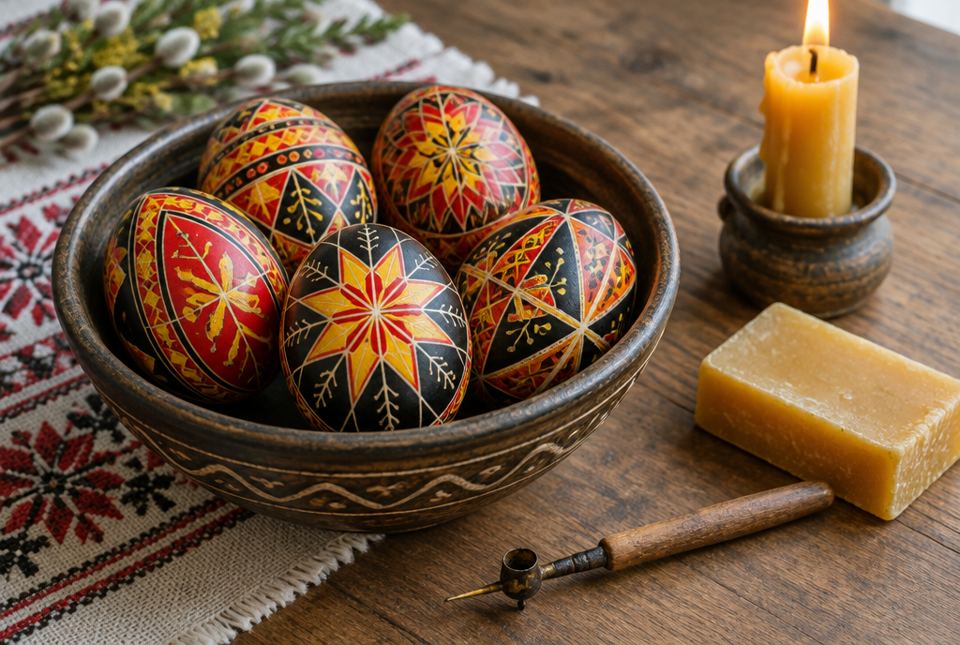 Pysanky are made by drawing with melted beeswax and dyeing the egg one colour at a time, a tradition maintained by Ukrainian Canadian families. AI-generated imageThree ways artistic traditions travel through time. Traditions can be maintained, adapted by artists (including artists from inside the culture), or appropriated by outsiders without permission, credit or understanding.
Appreciation versus appropriation
You can learn from and be inspired by other cultures. The difference is how:
- Learn what the art means, ideally from people of that culture.
- Credit your sources and influences.
- Respect what is sacred or restricted; some designs belong to specific families or Nations and are not for others to use.
- Support artists from the culture, for example by buying from them directly.
- Make it your own: draw on your own experiences and family traditions.
Reading signs, symbols and style
To read a traditional art work, ask: What motifs repeat? What colours and materials are used? Is the style flat or realistic, bold or delicate? What might the symbols mean to the people who made it? Meaning depends on culture and context, so look for information from the community itself, such as a museum label written with community members, an artist's statement, or a cultural centre's website.
Motifs, textures and 3D constructions
Many traditions build designs from motifs: simple shapes repeated, reflected and rotated. Floral beadwork, quilt blocks, pysanky, tile patterns and textile designs all do this.
In Grade 8 you can build complex three-dimensional constructions from motifs: a relief made of layered cardboard, a sculpture of folded paper units, or a box covered in repeated designs. Combine real textures (corrugated cardboard, fabric, string, bark) with illusory textures (drawn or painted to look like wood grain, fur or stone). Look for textures in your environment: bricks, tree bark, ice on a window, a knitted toque.
Worked exampleExample: Is it appreciation or appropriation?
Let's sort four situations using the respectful-borrowing check.
- A. A store sells T-shirts printed with designs that copy Haida formline, made by a company with no Haida artists and no permission. Appropriation: no permission, no credit, profits go to outsiders.
- B. A student learns about Métis floral beadwork from a Métis guest speaker, then designs a floral pattern based on plants in their own backyard, crediting what inspired them. Appreciation: learned from the culture's own voice, credited, made it their own.
- C. Someone wears an eagle-feather headdress as a Halloween costume. Appropriation: a sacred, earned item used as a costume.
- D. A family buys a print directly from an Inuit artist's co-operative, with an Igloo Tag. Appreciation: supports the artist and community directly.
The key questions are permission, understanding, credit, respect for the sacred and who benefits.
Worked exampleExample: A motif-based 3D construction about my own traditions
Leah designs a 3D construction about her family's traditions. Design challenge: make it stand on its own and include both real and illusory texture.
- Motif from her own family: the pattern of her grandmother's knitted mittens, a repeating snowflake-and-diamond design.
- Build: she folds eight cardboard units into triangular prisms and joins them into a ring that stands up.
- Real texture: she glues yarn and corrugated cardboard strips on some faces.
- Illusory texture: on other faces she draws the knitting stitches with fine lines so they look like wool.
- Motif transformations: the snowflake is reflected and rotated around the ring.
- Solve a problem: the ring tipped over, so she added a heavier base made of layered cardboard.
Drawing on your own traditions, transforming motifs, and mixing real and illusory textures produces original work that solves a real design challenge.
Learning about cultures respectfully
- Use present tense for living cultures: Métis beadwork, Inuit printmaking and Haida art are created today.
- Name specific Nations and artists rather than saying "Native art" in general.
- Some designs and objects are sacred or belong to specific families. When in doubt, don't copy; learn instead.
- Look for information from the community itself.
Just for funWhy did the drawing of a log never give anyone splinters?
Its wood grain was only an illusory texture.
Hands-on activityMotif and texture studio
You need: paper, a pencil, coloured pencils or markers, scissors, glue, thin cardboard (cereal boxes), and textured materials (yarn, string, corrugated cardboard, fabric scraps, leaves).
- Read a tradition: with a grown-up, look at a museum or cultural centre website about one living tradition (for example, Métis beadwork, Ukrainian pysanky, Inuit prints). Note three motifs or style features and what they mean, according to the community.
- Sort it: write one example each of a tradition being maintained, adapted and appropriated.
- Your motif: find a motif from your own life or family (a quilt, a dish, a sweater, a plant in your yard). Draw it.
- Transform it: reflect it, rotate it and repeat it, like the diagram.
- Build in 3D: fold cardboard units and join them into a construction that stands up. Cover some faces with real textures and draw illusory textures on others.
- Explain: write an artist's statement: where your motif comes from, how you transformed it, and one design problem you solved.
Safety: a grown-up should help with scissors and any craft knife.
Your turn
1What is the difference between a tradition being maintained and being adapted?
Maintained: kept close to how it has long been done. Adapted: changed or combined with new ideas, materials or tools while keeping a connection to its roots.
2What is cultural appropriation?
Taking images, symbols, styles or objects from another culture without permission, understanding or credit, often for profit.
3Give one example of an adapted tradition.
Any one: Haida manga by Michael Nicoll Yahgulanaas (Haida formline + Japanese manga); Kinngait prints (Inuit artists adapting printmaking); Christi Belcourt's paintings adapting Métis beadwork.
4What is the Igloo Tag for?
It's a trademark, used since 1958, that identifies authentic art made by Inuit artists.
5Name three ways to show cultural appreciation.
Any three: learn the meaning from the culture's own voices; credit sources; respect sacred or restricted designs; support the culture's artists; make it your own.
A shape or design that is repeated (often reflected or rotated) to build a pattern.
7What is the difference between real and illusory texture?
Real: you can feel it. Illusory: drawn or painted to look textured, but flat.
More practice: warm-up
1Ukrainian pysanky are decorated with ___ and dye.
2Which Haida artist created Haida manga?
Michael Nicoll Yahgulanaas.
3True or false: you should never learn from or be inspired by other cultures.
False. You can, with understanding, credit and respect.
4Is a drawing of wood grain on flat paper real or illusory texture?
5Which community is known for floral beadwork and has been called the "Flower Beadwork People"?
More practice: on your own
1A company sells "dreamcatcher" key chains made overseas with no connection to any First Nation. Is this appreciation or appropriation? Explain.
Appropriation: the item is mass-produced without permission or connection to the Nations whose tradition it comes from, profits go to outsiders, and its meaning is reduced to a souvenir.
2Explain how Haida manga shows a tradition being adapted, not abandoned.
It keeps Haida formline (ovoids, U-shapes, flowing lines) and Haida stories, but puts them into a new form: comic-book panels from Japanese manga. The roots are kept while the art reaches new audiences.
3Read the style: an art work uses flowing black formlines, ovoids and U-shapes. What tradition is it likely connected to, and what should you do before interpreting its symbols?
Likely Northwest Coast art, such as Haida art. Before interpreting, look for information from the artist or community (artist's statement, museum label, cultural centre), because the meaning of crest figures depends on culture and context.
4Describe how you'd use real and illusory texture together in a winter landscape.
Example: glue real cotton or crumpled tissue for snowbanks (real texture), and draw bark lines on the trees and frost patterns on a window (illusory texture). The mix makes the work more interesting to see and touch.
5Why might a tradition being maintained be important to a community?
It passes on knowledge, skills, stories and identity between generations, and keeps the community's connection to its history and values strong.
Challenge
1A friend says, "Art belongs to everyone, so it's fine to copy any design." Respond respectfully with a counter-argument.
Example: "Lots of art can inspire everyone, but some designs belong to specific families or Nations, and some are sacred. Copying without permission can spread stereotypes, take money from the artists who carry the tradition, and disrespect its meaning. We can be inspired by learning, giving credit and making our own work."
2Compare how two traditions have been adapted for new audiences, and what each kept.
Example: Kinngait printmaking kept Inuit stories, land and imagery but adapted printmaking methods to share them widely as editions. Haida manga kept formline and Haida stories but adapted the comic panel format. Both reach new audiences while keeping their roots.
3Design a 3D construction that solves this challenge: it must stand on its own, include a motif from your own life transformed three ways, and use two real and two illusory textures. Describe your plan and one problem you expect.
Example: a four-sided tower of folded cardboard; a maple key motif from my backyard, reflected, rotated and repeated around it; real textures: sandpaper and burlap; illusory: drawn brick and bark. Expected problem: the tower may tip, so I'll make a wide, weighted base. Look for all requirements and a realistic problem-solving step.
Quiz
1. Haida manga is an example of a tradition being ___.
2. Which is cultural appropriation?
3. The Igloo Tag identifies ___.
5. Texture drawn to look rough on flat paper is ___.
6. Which is a sign of appreciation?
Big idea: Grade 8 students identify and explain ways artistic traditions in a variety of times and places have been maintained, adapted or appropriated (D3.1), read and interpret signs, symbols and style (D2.3), and solve design challenges with tools and materials (D1.4), including complex three-dimensional constructions and motifs and real and illusory textures.
About this topic: appropriation can feel abstract. Concrete questions help: "Who made this? Who profits? Did they have permission? What does it mean to the people it comes from?" First Nations, Métis and Inuit art traditions are living today; please model present-tense language.
How to help:
- Share a tradition from your own family (a recipe card design, a quilt, a holiday decoration) as a source of motifs.
- Look at a museum or cultural centre website together.
- Help with scissors and any craft knife.
Common difficulties:
- Thinking any borrowing is wrong. Explain appreciation: learn, credit, respect, support.
- Interpreting symbols from guesswork. Look for the community's own explanation.
- 3D constructions that collapse. Wider bases and folded (not flat) cardboard units help.