B. Drama / D. Visual Arts · Drama and Visual ArtsDrama: Complex Issues, Multiple Perspectives and Possible Outcomes
B1.1 B2.1About 50 minutes
Learning goals- I can explore a complex issue in role from multiple perspectives, including ones I disagree with.
- I can use conventions such as a town hall meeting and flash-forward to test possible outcomes of a choice.
- I can find issues, themes and relationships in a wide variety of sources from diverse communities.
- I can build a personal interpretation of a drama that connects its issues to social concerns at the local and global level.
Words to know
complex issue
An issue with no easy answer: many people are affected, they want different things, and every choice has costs as well as benefits.
stakeholder
Anyone who is affected by an issue or has a say in it.
possible outcome
What might happen as a result of a choice. Drama lets you test outcomes safely before anyone decides.
trade-off
Giving up one good thing to get another.
town hall meeting
A drama convention where the whole group is in role at a public meeting, each speaking for a different stakeholder.
flash-forward
A scene that jumps ahead in time to show what might happen later.
social concern
A problem that affects many people in a community or around the world, such as flooding, housing or online safety.
personal interpretation
What you think a drama means, supported by evidence from the drama and connected to your own and others' ideas and experiences.
Remember from Grade 7
In Grade 7, the drama "Shared" explored a current issue (a video posted without permission) from multiple perspectives. You used conscience alley, and you learned to build a personal interpretation with a claim, evidence and connections to your own and others' experiences.
In Grade 8 the issues get more complex, and you will look at possible outcomes: not just who thinks what, but what might happen next if people choose one way or another. Your interpretations will also connect a drama to social concerns in your community and around the world.
Which would you choose?
Imagine your town has $10 million to spend and two urgent problems. Every choice helps some people and leaves others waiting. There is no option that makes everyone happy.
That's what a complex issue feels like. Real communities face choices like this every year. Drama lets you sit in every chair at the table, try out a decision, jump ten years into the future, and see what happens, all before anyone has to live with the result.
Our Grade 8 drama: "High Water"
This made-up (fictional) story runs through the drama lessons in this unit.
Willow Bend is a small Ontario town on the Little Fox River. The oldest neighbourhood, the Flats, sits low beside the river. Every spring, melting snow and heavy rain raise the water. This April, the Flats flooded for the third time in five years. Basements filled, a road washed out, and families stayed in the community centre for four nights.
Now the town council must choose a plan before next spring.
- Nadia Haddad, a Grade 8 student whose family lives in the Flats. Her grandmother, Teta, lives next door.
- Teta (Mrs. Haddad), who has lived in the Flats for 50 years and does not want to leave.
- Owen Martel, Nadia's classmate. His mother runs Martel's Marina, a business on the river.
- Councillor Ruth Ambrose, who must vote on the plan and answer to every voter in town.
- Dr. Lily Feng, a scientist who studies rivers and flooding (a hydrologist) for the local conservation authority.
- Gord Lindqvist, a farmer downstream whose fields could flood more if the water is pushed his way.
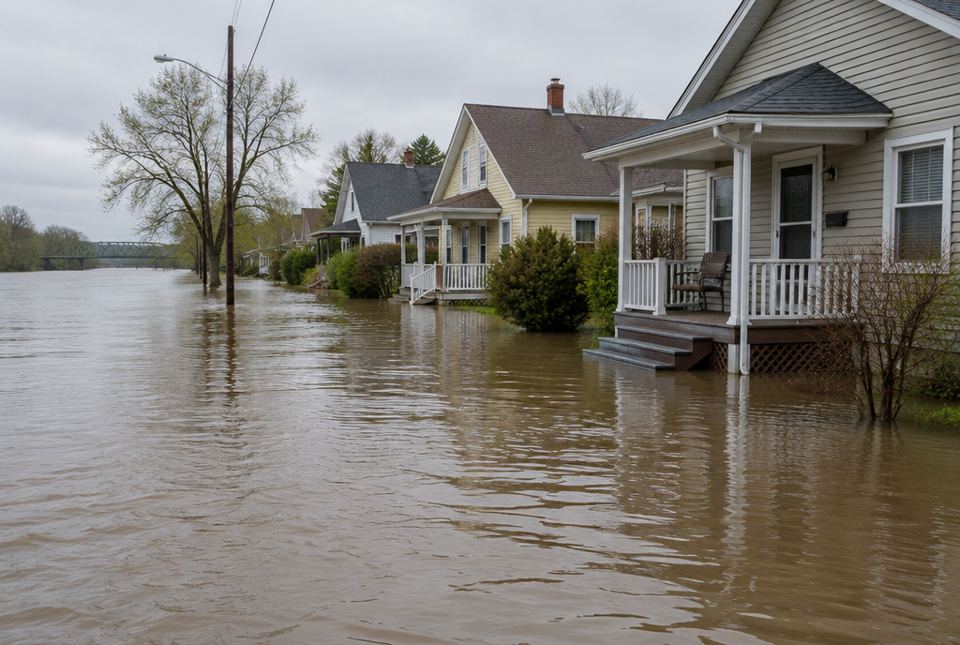 A flood like the one in the Flats affects many people in different ways. Drama lets you explore each perspective and possible outcome. AI-generated image
What makes an issue complex?
A complex issue usually has:
- Many stakeholders, each with real reasons.
- Trade-offs: every choice gives something and costs something.
- Uncertainty: nobody knows exactly what will happen.
- Values in conflict: for example, home and memory versus safety, or saving money now versus preventing damage later.
The council has three main choices: (A) build a higher berm (a long bank of earth) along the river; (B) buy the houses in the Flats from willing owners and turn the land into a wetland park that can flood safely; (C) keep things as they are but help families flood-proof their homes.
New conventions for exploring outcomes
- Town hall meeting: everyone is in role as a stakeholder at a public meeting. A chair (often the teacher or a student in role as the mayor) runs the meeting. Each person speaks for their character's interests and listens and responds to others.
- Flash-forward: a short scene set in the future: "Willow Bend, ten years later." Make one flash-forward for each choice, and you can compare outcomes.
- Outcome tree: out of role, map a choice and its possible results, like the diagram above. Then pick the most surprising branch to act out.
Remember hot seating, conscience alley and writing in role from earlier grades. They work well here too.
Sources from diverse communities
Grade 8 dramas can draw on many sources: a local news story about flooding, an interview with an older neighbour, a photo of a flooded street, a song about a river, or a news story about how another country lives with floods. In the Netherlands, for example, a national program called Room for the River has given rivers more space to spread out safely in some places. Each source adds a new perspective and a new possible outcome.
Interpretations that connect to social concerns
In Grade 7, you connected a drama to your own and others' experiences. In Grade 8, also connect it to social concerns at two levels:
- Local: What does this drama say about a problem in my community? (Who pays for flood protection? Who gets heard at council?)
- Global: What does it say about a problem that people face around the world? (Heavy rain and flooding, protecting homes, deciding fairly.)
A strong interpretation: claim, evidence from the drama, a personal or others' connection, and a local or global connection.
Worked exampleExample: A town hall meeting in role
The class runs a town hall meeting about the flood plan. Let's hear four stakeholders and notice how each speaks from real interests.
- Councillor Ambrose (chair): "We have one plan to choose and limited money. I want to hear from every side tonight."
- Teta: "My husband planted the maple tree in my yard the year we arrived. You want me to leave my whole life behind?" (value: home and memory)
- Gord Lindqvist: "If you build that berm higher, where does the water go? Onto my fields. My crops are my family's income." (value: fairness to people downstream)
- Dr. Feng: "Our studies show bigger spring floods are becoming more common here. A wetland can hold a lot of water, like a sponge." (value: evidence and long-term safety)
- Owen (for his mom's marina): "A park on the river could bring visitors. A big wall could block the view of the water." (value: jobs and the economy)
- Out of role, notice: four speakers raised four different values. Nobody was simply wrong.
A town hall meeting lets you hear many perspectives at once and shows why a complex issue has no easy answer.
Worked exampleExample: Testing outcomes with flash-forwards
The group makes three 30-second flash-forwards, one for each choice, set in Willow Bend ten years later.
- Choice A (berm): Nadia, now 23, walks through a dry Flats. But Gord says his fields flooded twice. Outcome: safer for some, worse for others.
- Choice B (wetland park): Teta, now living in an apartment on the hill, sits on a bench in the new park where her house was. Kids watch herons. Outcome: safe and beautiful, but a loss of home.
- Choice C (flood-proofing): Neighbours carry wet carpets to the curb after another flood. Someone says, "At least we're still here." Outcome: community stays, damage continues.
- Interpretation: "I think 'High Water' is about how safety and belonging can pull in opposite directions (claim). In the park flash-forward, Teta is safe but keeps touching the bench as if it were her front step (evidence). My grandparents sold their farm, and my grandfather still talks about it (personal connection). Towns all over the world are facing more flooding and having to make the same kind of choice (global connection)."
Flash-forwards let you compare possible outcomes. A Grade 8 interpretation connects the drama to personal, local and global concerns.
Exploring a hard issue safely
- Stay with made-up characters, even if your own town floods.
- If a topic brings up something hard (a family move, a disaster), you can step out of role at any time and talk to a trusted adult.
- Give every stakeholder real reasons. Playing someone you disagree with fairly is a skill, not a betrayal of your own views.
- Disagree with ideas, not people.
Just for funWhy did the river refuse to join the town hall debate?
It already had too many banks to answer to.
Hands-on activityKitchen-table town hall
You need: paper, pencils, a table, and one or more family members if possible.
- Read the "High Water" story again. List three issues, three themes and two relationships in it.
- Make a name card for four stakeholders (Teta, Gord, Dr. Feng, Owen or Councillor Ambrose). On the back of each, write what the character wants, what they fear and one value.
- Hold a 5-minute town hall meeting at the kitchen table. If you are alone, switch chairs as you switch characters and speak each part aloud.
- Draw an outcome tree with the three choices and at least one outcome for each.
- Act out two flash-forwards (30 seconds each), set ten years later.
- Out of role, write a personal interpretation: claim, evidence, a personal connection and a local or global connection.
Bonus: find a short, age-appropriate news story about a decision your community is facing. Make an outcome tree for it.
Your turn
1Name three things that make an issue complex.
Any three: many stakeholders with real reasons; trade-offs (every choice costs something); uncertainty about what will happen; values in conflict.
2What is a flash-forward, and why is it useful for exploring an issue?
A scene that jumps ahead in time to show what might happen. It lets you test possible outcomes of a choice and compare them before deciding.
3Name three stakeholders in "High Water" and one value each holds.
Example: Teta, home and memory; Gord, fairness to people downstream (and his income); Dr. Feng, evidence and long-term safety; Owen's mom, jobs and the economy; Councillor Ambrose, fairness to all voters and spending wisely.
4How does a town hall meeting work as a drama convention?
Everyone is in role as a stakeholder at a public meeting. A chair in role runs it. Each person speaks for their character's interests and responds to others.
5What is a trade-off? Give one from "High Water."
Giving up one good thing to get another. Example: the wetland park keeps people safe, but families lose their homes in the Flats.
6What is the difference between a local and a global social concern?
Local: a problem in your own community (who pays for Willow Bend's flood protection). Global: a problem people face around the world (more heavy rain and flooding).
7List four parts of a strong Grade 8 personal interpretation.
Claim, evidence from the drama, a personal or others' connection, and a local or global connection.
More practice: warm-up
1True or false: a complex issue has one right answer that everyone will agree with.
False. Every choice has costs and benefits, and stakeholders disagree.
2Which convention jumps ahead in time: flashback or flash-forward?
Anyone who is affected by an issue or has a say in it.
4Who studies rivers and flooding in "High Water"?
Dr. Lily Feng, a hydrologist.
5Name one source you could use to build a drama about flooding.
Any one: a news story, an interview with a neighbour, a photo of a flooded street, a song about a river, a report from a conservation authority.
More practice: on your own
1Teta refuses to leave the Flats. Play fair: give two reasons she might feel this way.
Examples: her house holds 50 years of memories (her late husband planted the maple tree); her neighbours and community are there; she may worry about starting over at her age; she may feel the town is not listening to people like her. Look for two real, respectful reasons.
2Write a short line for Gord at the town hall that shows a perspective nobody else has raised.
Example: "Everyone's talking about the Flats. But a berm upstream just sends the water to my farm. Is my family's land worth less than yours?" It raises the perspective of people downstream who are affected by others' choices.
3Plan a flash-forward for Choice C (flood-proofing) that shows a positive outcome as well as a cost.
Example: ten years later, neighbours in the Flats have pumps, raised furnaces and a flood-ready plan. After a flood, they clean up in one day together and share a meal (positive: community stays strong). But a family that couldn't afford the changes has moved away (cost). Look for both a benefit and a cost.
4Connect "High Water" to a global social concern, with a reason.
Example: "It connects to more frequent heavy rain and flooding around the world. Many towns, like Willow Bend, have to decide whether to build walls or give rivers more room." Look for a concern beyond one town and a clear link.
5Why is it valuable to play a character whose view you disagree with?
It helps you understand why they think that way, builds empathy, makes the drama more truthful, and helps you find better solutions that consider everyone.
Challenge
1Invent a fourth choice for the council that combines parts of A, B and C. Describe one possible outcome.
Example: Buy out only the lowest ten houses, turn that strip into a wetland, and help the remaining families flood-proof. Possible outcome: fewer people have to move, the wetland soaks up some floodwater, and flooding in the rest of the Flats becomes less severe; but the families who move still feel the loss. Look for a combined plan and a realistic outcome with a trade-off.
2Two classmates interpret "High Water." One says it's about climate and the environment. The other says it's about who gets heard in a community. Can both be strong? What would each need?
Yes, if each has evidence and connections. The climate interpretation could use Dr. Feng's warning that big floods are becoming more common, plus a global connection. The who gets heard interpretation could use Gord's question about whether his land matters less, or Teta feeling ignored, plus a local connection, like a real council meeting.
3Explain why testing outcomes in drama can help real communities make better decisions.
Acting out outcomes lets people feel the consequences for each stakeholder, notice costs they hadn't considered, and build empathy before anyone is affected for real. Community groups sometimes use drama this way to help people talk through hard decisions.
Quiz
1. Which is a complex issue?
2. A flash-forward shows ___.
3. In a town hall meeting convention, the group ___.
5. Which interpretation makes a global connection?
6. Why give Gord real reasons in role?
Big idea: In Grade 8, drama exploration focuses on examining multiple perspectives and possible outcomes related to complex issues, themes and relationships from a wide variety of sources and diverse communities (B1.1). Students construct personal interpretations that connect drama issues and themes to social concerns at both the local and global level (B2.1).
About the topic: "High Water" is about spring flooding. If your family has experienced a flood, fire or forced move, check in with your child first; they can choose a different issue from local news.
How to help:
- Take a role at the kitchen-table town hall. Play your character fairly, even if you disagree with them.
- Ask outcome questions: "What might happen ten years from now if they choose that?"
- Ask connection questions: "Does this happen in our town? Somewhere else in the world?"
Common difficulties:
- Treating the issue as easy. Ask, "Who loses if they choose that?"
- Villains instead of stakeholders. Ask, "What does this person want? What are they afraid of?"
- Interpretations that stay personal. Ask, "What does this say about our community? About the world?"
Keep the character list: "High Water" continues in the next drama lessons.