B. Number · Number Sense: Numbers to 100 000, Fractions, Decimals and PercentsEquivalent Fractions from Halves to Twelfths
B1.3 A1About 40 minutes
Learning goals- I can show equivalent fractions with fraction strips, groups of objects and drawings.
- I can find an equivalent fraction by multiplying the numerator and denominator by the same number.
- I can find an equivalent fraction with bigger pieces by dividing the numerator and denominator by the same number.
- I can explain why adding the same number to the top and bottom does not work.
Words to know
equivalent fractions
Fractions that name the same amount, like 1/2 and 3/6.
numerator
The top number. It tells how many parts we are talking about.
denominator
The bottom number. It tells how many equal parts make one whole.
twelfths
The parts you get when you cut a whole into 12 equal parts. Each part is 1/12.
Remember from Grade 4
In Grade 4 you worked with fractions from halves to tenths. The denominator (bottom) tells how many equal parts make the whole. The numerator (top) tells how many parts we have. You also saw that some fractions cover the same amount, like 1/2 = 5/10. This year you'll find these equivalent fractions for any fractions from halves to twelfths, and learn a rule for making them.
Let's start with eggs
An egg carton holds 12 eggs. Dad uses 6 eggs to make pancakes. He used 6/12 of the carton.
But 6 is exactly half of 12. So Dad also used 1/2 of the carton!
6/12 and 1/2 are equivalent fractions. They are different names for the same amount.
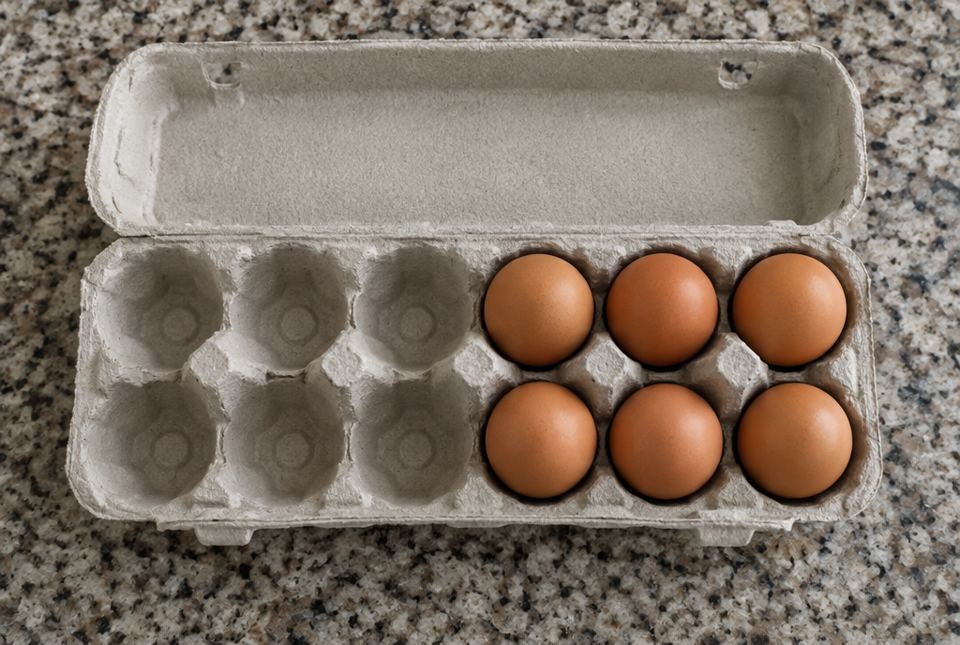 6 of the 12 cups are empty. That is 6/12 of the carton, which is the same as 1/2. AI-generated imageFive strips of the same length. Each shaded part is the same length: 1/2 = 2/4 = 3/6 = 4/8 = 6/12.
The rule: cut every piece the same way
Look at the 1/2 strip. If you cut each half into 2 pieces, you get fourths. The 1 shaded half becomes 2 shaded fourths.
- There are 2 times as many pieces in the whole: 2 × 2 = 4.
- There are 2 times as many shaded pieces: 1 × 2 = 2.
So 1/2 = 2/4. To find an equivalent fraction, multiply the numerator and the denominator by the same number.
It works backwards too. If you group pieces together, you divide the numerator and denominator by the same number: 6/12 → (6 ÷ 6)/(12 ÷ 6) = 1/2.
Worked exampleExample 1: Make more pieces
Find the fraction equal to 2/3 that has a denominator of 12.
- Ask: 3 times what is 12? 3 × 4 = 12.
- Each third gets cut into 4 pieces, so multiply the numerator by 4 too: 2 × 4 = 8.
Worked exampleExample 2: Make bigger pieces
- Ask: 12 divided by what is 6? 12 ÷ 2 = 6.
- Group the pieces in 2s, so divide the numerator by 2 too: 10 ÷ 2 = 5.
🥚🥚🥚🥚🥚🥚🥚🥚🥚🥚🥚🥚
12 eggs in 4 equal rows of 3.Worked exampleExample 3: Fractions of a group
Look at the 12 eggs in 4 equal rows. What fraction of the eggs is one row? Give two names.
- One row has 3 eggs out of 12: that's 3/12.
- There are 4 equal rows, so one row is also 1/4 of the eggs.
- Check with the rule: 3 ÷ 3 = 1 and 12 ÷ 3 = 4.
Worked exampleExample 4: A trap to avoid
Leo says 1/2 = 2/3 because he added 1 to the top and 1 to the bottom. Is he right?
- Check with strips: 1/2 is half a strip. 2/3 is more than half a strip.
- Or use twelfths: 1/2 = 6/12 and 2/3 = 8/12. These are different.
No. Adding the same number does not make equivalent fractions. You must multiply (or divide) the top and bottom by the same number.
| Fraction | Some equivalent fractions (denominators to 12) |
|---|
| 1/2 | 2/4, 3/6, 4/8, 5/10, 6/12 |
| 1/3 | 2/6, 3/9, 4/12 |
| 2/3 | 4/6, 6/9, 8/12 |
| 1/4 | 2/8, 3/12 |
| 3/4 | 6/8, 9/12 |
| 1/5 | 2/10 |
| 1/6 | 2/12 |
Keep trying
Folding paper into thirds is tricky! If your first try is uneven, unfold it and try again. Getting it right after a few tries is what good problem solvers do.
Egg riddleWhen is half a dozen eggs the same as half a carton?
Always! 6/12 = 1/2. (Just don't try to make pancakes with 6/12 of an egg.)
Hands-on activityEgg carton fractions
You need: an empty, clean egg carton with 12 cups, and 12 small objects like dry beans, buttons or cereal (keep small objects away from little brothers and sisters).
- Put one object in each of 6 cups. What fraction of the carton is filled? Say two names (6/12 and 1/2).
- Empty it. Now fill 1/3 of the carton. How many cups is that? (4 cups, so 1/3 = 4/12.)
- Fill 1/4 (3 cups), 2/3 (8 cups), 3/4 (9 cups) and 5/6 (10 cups). For each one, write the fraction in twelfths.
- Your grown-up fills some cups. You name the fraction in twelfths and, if you can, in bigger pieces.
Math talk: Why can't you fill exactly 1/5 of an egg carton? (12 can't be shared into 5 equal groups.)
Your turn
4/8. 2 × 4 = 8, so 1 × 4 = 4.
3/9. 3 × 3 = 9, so 1 × 3 = 3.
9/12. 4 × 3 = 12, so 3 × 3 = 9.
2/3. 4 ÷ 2 = 2, so 6 ÷ 2 = 3.
1/2. 5 ÷ 5 = 1 and 10 ÷ 5 = 2.
6Write two fractions equivalent to 1/4.
For example 2/8 and 3/12.
7There are 12 muffins. 8 have blueberries. What fraction have blueberries? Write it in twelfths and in thirds.
8/12 = 2/3. Divide top and bottom by 4.
More practice: warm-up
12/12. Both are one whole.
More practice: on your own
10/12. Multiply top and bottom by 2.
2/3. Divide top and bottom by 3.
4/10. Multiply top and bottom by 2.
3/4. Divide top and bottom by 3.
5Is 2/3 equivalent to 3/4? Explain.
No. In twelfths, 2/3 = 8/12 and 3/4 = 9/12. They are not the same amount.
Challenge
1List all the fractions equal to 1/2 that have a denominator from 2 to 12.
1/2, 2/4, 3/6, 4/8, 5/10, 6/12. Only even denominators work, because the numerator must be exactly half of the denominator.
2Which one is not equivalent to 2/3: 4/6, 6/9, 8/12 or 6/10?
6/10. 4/6, 6/9 and 8/12 all come from multiplying 2/3 by 2, 3 or 4. But 6/10 = 3/5, which is less than 2/3.
3A pan of lasagna is cut into 12 equal pieces. You eat 2 pieces, your sister eats 1 piece and your dad eats 3 pieces. What fraction of the pan was eaten? Give two names.
6/12 = 1/2. 2 + 1 + 3 = 6 pieces out of 12. (2/4 and 3/6 are also correct names.)
Quiz
1. Which fraction is equal to 1/2?
4. How can you make an equivalent fraction?
5. Which is not equal to 1/3?
6. You use 4 eggs from a carton of 12. What fraction did you use?
Big idea: B1.3 asks Grade 5 students to represent equivalent fractions from halves to twelfths, including improper fractions and mixed numbers (next lesson), using tools like fraction strips, sets of objects and number lines.
Common difficulties:
- Adding instead of multiplying (1/2 = 2/3). Show both with strips of the same length; seeing is believing.
- Changing only one number (2/3 = 2/12). Explain that cutting each piece into 4 makes 4 times as many shaded pieces too.
- Different-sized wholes. Strips must be the same length to compare.
How to help: An egg carton is a perfect twelfths tool. Muffin tins (often 12 cups) work too. Ask "What fraction is filled? Is there another name for it?" Praise persistence when folding paper into thirds; it takes a few tries.