B. Number · Number Sense: Numbers to 100 000, Fractions, Decimals and PercentsReading, Writing and Using Numbers to 100 000
B1.1 A1About 35 minutes
Learning goals- I can read and write numbers up to 100 000 in numerals and in words.
- I can count by 1000s and by 10 000s up to 100 000.
- I can explain how big numbers are used in everyday life.
- I can explain my thinking out loud.
Words to know
ten thousands place
The place to the left of the thousands place. In 45 320, the 4 is in the ten thousands place and is worth 40 000.
hundred thousand
100 000. It is the same as 10 ten thousands, or 100 thousands.
numeral
A number written with digits, like 45 320.
number words
A number written in words, like forty-five thousand three hundred twenty.
period
A group of three places. Big numbers have a space between groups of three digits, like 45 320.
Remember from Grade 4
In Grade 4 you read and wrote numbers up to 10 000. You learned the thousands, hundreds, tens and ones places, and you saw that numbers can count, measure, name or label something, or tell the year. This year, numbers get ten times bigger: all the way to 100 000!
Let's start with a story
This winter, a ski hill near a small town counted its visitors. The sign at the gate says:
45 320 visitors this season!
How do you read that number? It has five digits. That means we need a new place: the ten thousands place.
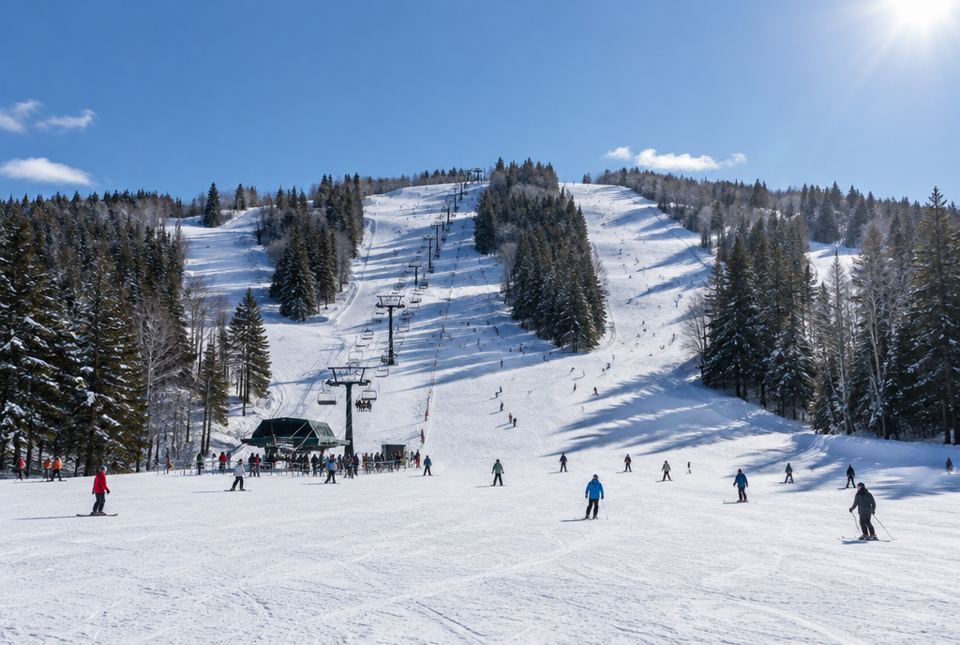 A busy ski hill can have tens of thousands of visitors in one season, enough to need a five-digit number. AI-generated image
| Ten thousands | Thousands | Hundreds | Tens | Ones |
|---|
| 4 | 5 | 3 | 2 | 0 |
| 40 000 | 5000 | 300 | 20 | 0 |
How to read a big number
Big numbers are written with a space between groups of three digits. The space helps your eyes.
- Read the part before the space, then say "thousand".
- Read the part after the space like a normal 3-digit number.
45 320 → "forty-five thousand three hundred twenty".
We don't say "and" when we read whole numbers.
Counting to 100 000
Count by 10 000s: 10 000, 20 000, 30 000, 40 000, 50 000, 60 000, 70 000, 80 000, 90 000, 100 000.
10 groups of ten thousand make one hundred thousand. It is written 100 000. It has six digits!
Worked exampleExample 1: Read a big number
- Read the part before the space: 72. Say "seventy-two thousand".
- Read the part after the space: 058. There are 0 hundreds, so we skip the hundreds. Say "fifty-eight".
seventy-two thousand fifty-eight
Worked exampleExample 2: Write a numeral from words
Write thirty thousand four hundred six as a numeral.
- "Thirty thousand" goes before the space: 30.
- "Four hundred six" goes after the space. There are no tens, so we write a 0 as a placeholder: 406.
- Put them together with a space: 30 406. Check: 5 digits, just right for a number in the ten thousands.
Worked exampleExample 3: Count across 100 000
Count by 1000s: 96 000, 97 000, ___, ___, ___
- Each jump adds 1 to the thousands: 98 000, 99 000.
- One more thousand after 99 000 makes 100 thousands, which is 100 000.
Big numbers in everyday life
- To count: "The arena has 6500 seats."
- To measure: "Our car has been driven 84 316 km."
- To name or label: "Take bus number 52." A label is not an amount.
- To tell the year: "It is 2026."
There are 86 400 seconds in one day. That's a big number hiding in every day of your life!
Think like a mathematician
Read numbers out loud with your grown-up, and explain how you know. Saying "There's a 0 in the hundreds place, so I skip the hundreds" helps your brain remember. Mistakes are fine: fixing them is how you learn.
Just for funFunny but true: there are 86 400 seconds in one day. If you counted one number every second without stopping, it would take you more than a whole day to reach 100 000. Better bring snacks!
Hands-on activityBig number hunt
You need: paper, a pencil, and a grown-up to help you look.
- Hunt for big numbers around your home. Ideas: the kilometres on a car's display (only with a grown-up, while the car is parked), a step counter, flyers with prices of cars or houses, the number of pages in a long book, a calendar.
- Write down 5 numbers you find. Try to find at least two with 5 digits.
- Read each number out loud to your grown-up.
- Next to each number, write how it is used: count, measure, label or year.
- Circle the greatest number you found and write it in words.
Math talk: Ask your grown-up how many seconds are in one day (24 × 60 × 60). Check: 86 400, or eighty-six thousand four hundred.
Your turn
fifty-six thousand two hundred fourteen
2Write eighty-one thousand seven hundred as a numeral.
3Write forty thousand nine as a numeral.
40 009. There are no thousands, hundreds or tens, so they are zeros.
4What comes next? 70 000, 80 000, 90 000, ___
5Count by 1000s: 37 000, 38 000, ___, ___
6What number is 1 more than 59 999?
7"The car display shows 63 250 km." Is this number used to count, measure, label, or tell the year?
To measure. It tells how far the car has travelled.
More practice: warm-up
2Write fifteen thousand as a numeral.
3How many digits does 100 000 have?
4What comes next? 45 000, 46 000, 47 000, ___
5Write nine thousand as a numeral.
More practice: on your own
sixty thousand fifty-three. There are 6 ten thousands, 0 thousands, 0 hundreds, 5 tens and 3 ones, so we only say the thousands part and "fifty-three".
2Sam wrote seven thousand two hundred as 70 200. Is he right?
No. Seven thousand two hundred is 7200. The number 70 200 is seventy thousand two hundred.
3Count back by 10 000s: 95 000, 85 000, ___, ___
75 000, 65 000. Each jump takes away 1 ten thousand.
4What is 1000 more than 99 000?
100 000. 99 thousands + 1 thousand = 100 thousands.
5There are 86 400 seconds in a day. Write this number in words.
eighty-six thousand four hundred
Challenge
1Use the digits 3, 0, 8, 1, 6 once each. Make the greatest 5-digit number you can, and write it in words.
86 310: eighty-six thousand three hundred ten. Put the biggest digits in the biggest places: 8, then 6, then 3, then 1, then 0.
2Use the same digits (3, 0, 8, 1, 6) to make the smallest 5-digit number.
10 368. You can't start with 0 (then it wouldn't be a 5-digit number), so start with the smallest other digit, 1. Then put 0, 3, 6, 8.
3My number has 5 digits. The ten thousands digit is 4. The ones digit is 7. All the other digits are 0. What is my number? How do you read it?
40 007, read as forty thousand seven.
Quiz
1. Which numeral is thirty-four thousand sixty?
3. What number comes right after 99 999?
4. How many ten thousands make 100 000?
5. "My house number is 24." How is this number used?
6. Count by 10 000s: 30 000, 40 000, ___
Big idea: B1.1 asks Grade 5 students to read, represent, compose and decompose whole numbers up to 100 000, and to describe how numbers are used in everyday life. This first lesson focuses on reading, writing and counting.
Common difficulties:
- Zeros as placeholders. "Forty thousand nine" is often written 409 or 4009. Have your child say how many digits a "thousand" number in the ten thousands needs (5), then fill the empty places with zeros.
- Saying "and". In Canada we read 45 320 as "forty-five thousand three hundred twenty" with no "and". The word "and" is saved for the decimal point (3.5 is "three and five tenths").
- The space. Canadian math books use a space, not a comma, to group digits (45 320). Four-digit numbers are usually written without the space (9000).
How to help: Read big numbers you see together: kilometres on the car, prices of cars or homes in flyers, attendance at a game. Ask "Is that number counting, measuring or a label?" Strand A (social-emotional learning and math processes) is woven in: praise your child for explaining their thinking out loud.