A. Heritage and Identity · Early Societies to 1500 CETrade, Cooperation and Conflict: The Mali Empire and Beyond
A3.9 A3.10 A3.1 A3.2 A3.7About 45 minutes
Learning goals- I can describe the Mali Empire and how trade across the Sahara made it rich.
- I can give reasons why early societies cooperated or came into conflict.
- I can describe ways early societies dealt with conflict and built cooperation.
- I can sort events into cooperation, conflict, or both, and explain why.
Words to know
empire
A large area with many peoples, ruled by one ruler or government.
mansa
The title of the ruler of the Mali Empire, meaning king or emperor.
caravan
A group of traders travelling together, often with camels, for safety.
cooperation
Working together toward a shared goal.
conflict
A serious disagreement or fight between people or groups.
alliance
An agreement between groups to support each other.
treaty
A formal agreement between nations, with promises on both sides.
griot
A West African storyteller, musician and historian who keeps the history of a people.
The Mali Empire
Find West Africa on a globe. About 800 years ago, a great empire grew there along the Niger River: the Mali Empire.
Its founder was Sundiata Keita. We know his story mostly from griots, storytellers and musicians who have passed down the Epic of Sundiata by heart for hundreds of years. That is oral history, just like the histories kept by First Nations and Inuit Elders.
The ruler of Mali was called the mansa, meaning king or emperor. The mansa ruled with help from governors and advisers, and many local leaders kept power in their own areas as long as they were loyal and paid tribute.
Gold and salt: trade across the Sahara
West Africa had a lot of gold. But people there needed salt: in a hot climate, people need salt to stay healthy, and salt helps keep food from spoiling. Salt was dug from mines in the Sahara Desert, to the north.
So traders formed caravans of camels, which can travel for days with little water, to cross the huge Sahara:
- Salt came south from the desert.
- Gold went north to North Africa, and from there to Europe and the Middle East.
- Cloth, copper, books, horses and ideas travelled too, including the religion of Islam.
The Mali Empire controlled the trade cities and grew very rich.
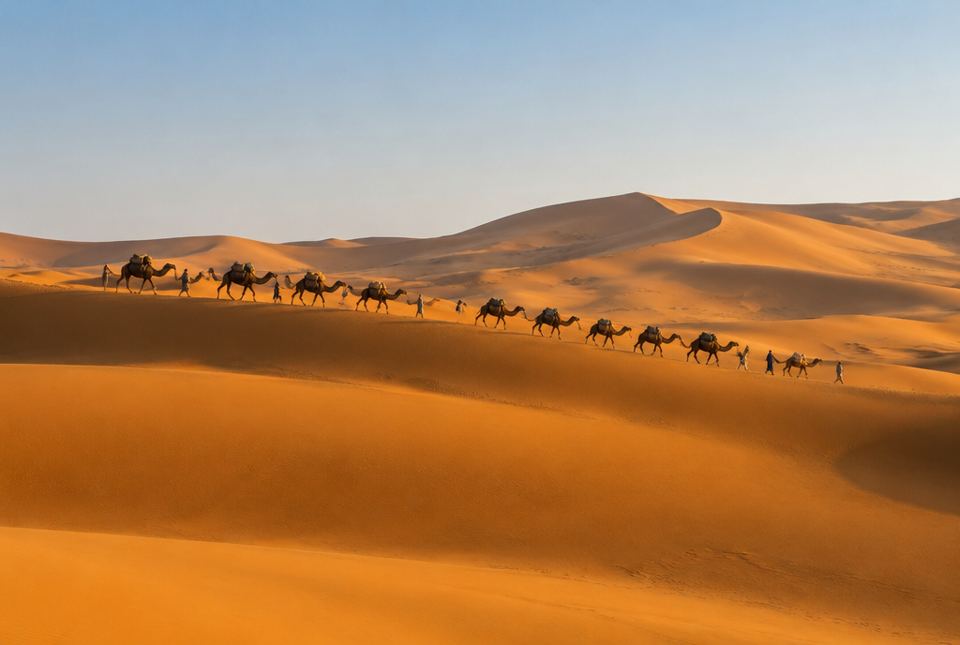 A camel caravan crossing the Sahara. Camels can travel for days with little water, so traders used them to carry salt and gold across the desert. AI-generated imageThe gold and salt trade, drawn as simple bands from north to south (not a real map). Camel caravans carried salt south and gold north across the Sahara.
Mansa Musa and Timbuktu
The most famous ruler of Mali is Mansa Musa, who ruled about 700 years ago. In 1324, he made a religious journey (a pilgrimage) to the holy city of Mecca, with thousands of people and camels carrying gold. Writers at the time said he gave away so much gold in Cairo, Egypt, that gold became less valuable there for years.
Mansa Musa built mosques and supported scholars. The city of Timbuktu became a famous centre of trade and learning, with many books (manuscripts) about math, astronomy, medicine and law. Families in Timbuktu have looked after old manuscripts for centuries.
The great mosques of Mali were built of mud brick, which suits the hot, dry climate. Some mud-brick mosques in Mali are still re-plastered by the whole community every year.
🐪🐪🐪🧂🪙
A camel caravan carried salt south and gold north across the Sahara.Why did societies cooperate or come into conflict?
Across this whole unit, you have seen early societies meet each other. Sometimes they cooperated; sometimes they had conflict; often both!
Reasons:
- Trade: to get things they didn't have (salt for gold, silk for horses).
- Territory and resources: good land, water, hunting grounds or trade cities.
- Exploration: travelling to new places.
- Religion: sharing beliefs, or fighting over them.
- Protecting their homeland and people.
| Example | Cooperation, conflict or both? | Why |
|---|
| Gold and salt trade across the Sahara | Cooperation | Both sides got what they needed. |
| The Silk Road | Both | Trade and sharing ideas; but bandits and empires fought over the routes. |
| Maya city-states | Both | They traded and made alliances, and also fought wars. |
| The Crusades (about 900 years ago) | Conflict | Armies from Christian Europe and Muslim rulers fought for control of Jerusalem and nearby lands, a place holy to several religions. |
| The Norse (Vikings) in Newfoundland, about 1000 years ago | Both | Norse sagas (stories) tell of trading with the people living there, and also of fighting. The Norse soon left. Their site at L'Anse aux Meadows can be visited today. |
| The Great Law of Peace | Conflict became cooperation | Five warring nations agreed to live in peace as a confederacy. |
Ways to deal with conflict and build cooperation
Early societies found many ways to make peace and work together:
- Councils and agreements: the Haudenosaunee Great Law of Peace; treaties recorded with wampum.
- Laws that limit power: the Magna Carta.
- Rules for fair work: guilds.
- Trade and gift-giving: exchanging goods and gifts builds friendship.
- Marriages between families of different groups or kingdoms, to create alliances.
- Songs, humour and games: Inuit song duels; some First Nations held lacrosse games that also helped settle disputes.
- Sharing food and feasts.
Worked exampleLet's sort an event
Mali traders brought gold north, and North African traders brought salt south. Cooperation, conflict or both? Explain.
- Ask: did the groups work together or fight?
- They traded: each side gave something the other needed.
- Both groups benefited: Mali got salt; North African traders got gold.
- There is no fighting in this example, so it is cooperation.
Cooperation, because both groups traded and got something they needed.
Just for funRiddle: I'm white, I come from the desert, and people once crossed the Sahara with camels to trade gold for me. What am I?
Salt! Remember that next time you sprinkle some on your popcorn.
Hands-on activityTrade game
You need: 2 or more people, and two kinds of small items, for example 10 dry pasta pieces ("salt") and 10 buttons or coins ("gold").
- Give one person all the "salt" and the other all the "gold".
- Each person needs at least 3 of each to "win". Trade by talking and making fair deals.
- Play again, but this time one person tries to keep everything. What happens?
- Talk about it: what helped you cooperate? What caused conflict? How did you solve it?
Keep small items away from young children.
Your turn
1Where was the Mali Empire?
In West Africa, along the Niger River.
2What two goods were traded across the Sahara?
Gold (going north) and salt (going south).
3Why did people in West Africa need salt?
To stay healthy in the hot climate and to keep food from spoiling.
A famous ruler (mansa) of Mali, known for his great wealth and his journey to Mecca in 1324.
5What was Timbuktu famous for?
Trade and learning: scholars, mosques and many manuscripts.
6Name three reasons early societies came into conflict.
Any three: territory, resources, trade, religion, exploration, protecting their homeland.
7Name three ways early societies made peace or built cooperation.
Any three: treaties, the Great Law of Peace, the Magna Carta, guilds, trade and gift-giving, marriage alliances, song duels, lacrosse, sharing food.
More practice: warm-up
A group of traders travelling together, often with camels.
2What animal carried goods across the Sahara?
A West African storyteller, musician and historian.
4Who founded the Mali Empire?
5What were Mali's great mosques built from?
More practice: on your own
1How do we know about Sundiata Keita?
Mostly from griots, who passed down the Epic of Sundiata by oral history for hundreds of years.
2Why are camels good for desert travel?
They can go for days with little water and carry heavy loads.
3Cooperation, conflict or both: the Silk Road? Explain.
Both. People traded and shared ideas, but bandits attacked caravans and empires fought over the trade cities.
4How is a song duel a way to deal with conflict?
It lets people settle a quarrel with songs and laughter in front of the community, instead of fighting.
5Why was mud brick a good building material in Mali?
It suits the hot, dry climate, keeps buildings cooler, and is made from local earth. It can be repaired every year.
Challenge
1Compare the trade across the Sahara with the Silk Road. Give two similarities.
Both used camels to cross deserts; both carried valuable goods (gold, salt, silk) and ideas (like religions) between faraway societies; both made trade cities rich.
2Why might trade help prevent wars?
If two groups depend on each other for goods, fighting would hurt both. Trading builds relationships and trust.
3The Norse at L'Anse aux Meadows met the people already living in Newfoundland about 1000 years ago. Why is it important to remember that this land was already home to Indigenous peoples?
Because the Norse did not find an empty land: Indigenous peoples had lived there for a very long time, with their own ways of life. Saying the Norse "discovered" it leaves out the people who were already there.
Quiz
1. What did Mali trade for salt?
3. Timbuktu was famous for...
4. Which is an example of building cooperation?
5. Which is a reason societies came into conflict?
6. The Great Law of Peace is an example of...
Big idea: This lesson pulls together A3.9 (why societies cooperated or came into conflict) and A3.10 (ways of dealing with conflict and building cooperation) from across the unit, and adds the Mali Empire as an African society (locating it on a map, A3.1; governance, A3.7). Timbuktu's mosques (named in a curriculum sample question) and manuscripts are examples of evidence (A3.2).
How to help at home:
- Find West Africa, the Sahara and the Niger River on a map, then trace a caravan route.
- Ask "cooperation, conflict, or both?" about news stories, sports or playground events, and ask for a reason.
- Compare griots with First Nations and Inuit Elders as keepers of oral history.
Common difficulties:
- Africa as one country: Africa is a continent with many countries and societies; Mali was one empire in West Africa.
- "Discovery" language: when talking about the Norse or later Europeans, remind your child that Indigenous peoples already lived here.
- Seeing only conflict: encourage your child to notice the many ways early societies cooperated.
Keep small items from the trade game away from young children.