A. Heritage and Identity · Early Societies to 1500 CEAncient Egypt: Gift of the Nile
A3.4 A3.5 A3.6 A3.7 A3.8 A3.2 A1.2About 45 minutes
Learning goals- I can explain how the yearly flooding of the Nile River made farming possible in ancient Egypt.
- I can describe how ancient Egypt was governed by a pharaoh.
- I can describe the social classes of ancient Egypt and compare the daily lives of different groups.
- I can name some ancient Egyptian developments, like hieroglyphs, papyrus and a 365-day calendar.
Words to know
pharaoh
The ruler of ancient Egypt. Egyptians believed the pharaoh was a god on Earth.
flood
When a river rises and water spreads over the land around it.
silt
Fine, rich mud that a river carries and leaves behind on the land.
irrigation
Bringing water to crops using canals, ditches or tools.
social class
A group of people in a society with the same kind of work, wealth and power.
hieroglyphs
The picture-writing of ancient Egypt.
papyrus
A tall reed that grew by the Nile; also the paper-like material Egyptians made from it.
scribe
A person trained to read and write, who kept records.
A society in the desert
Look back at the thematic map in the maps lesson. Egypt is mostly desert, with very little rain. But one great river runs through it: the Nile.
About 5000 years ago, a powerful society grew along the Nile. It lasted for about 3000 years! An ancient Greek writer called Egypt "the gift of the Nile". Let's find out why.
The yearly flood
Every year, in late summer, the Nile flooded. Rain fell far to the south in the mountains, and the river rose and spread over the land beside it.
When the water went down, it left behind a layer of black, rich mud called silt. Egyptians called their land Kemet, "the black land", because of this dark, fertile soil.
Egyptians organized their year around the river, in three seasons:
- Flood season: the land was underwater. Many farmers worked on building projects for the pharaoh.
- Growing season: farmers planted wheat, barley, vegetables and flax in the wet silt.
- Harvest season: crops were gathered before the next flood.
Farmers dug canals and used a tool called a shaduf (a bucket on a long pole) to lift water to their fields. This is irrigation.
But the flood could also cause problems. A flood that was too high washed away villages. A flood that was too low meant poor harvests and hunger. Egyptians measured the river's height carefully to predict the harvest.
Who ruled Egypt?
The ruler was the pharaoh. Egyptians believed the pharaoh was a god on Earth, who kept order and made sure the Nile flooded each year.
- The pharaoh made laws, collected taxes (often paid in grain), led the army, and directed building projects.
- The job usually passed from parent to child. This is inherited power.
- Most pharaohs were men, but a few were women. Hatshepsut was a woman who ruled as pharaoh and was known for trade and building.
- Officials and scribes helped run the country.
Social classes: different lives
- Pharaoh: lived in palaces and had the most power.
- Nobles and priests: owned land, ran temples and helped govern.
- Scribes and soldiers: scribes trained for years to read and write hieroglyphs and kept records of taxes, harvests and laws.
- Artisans and merchants: skilled workers (painters, jewellers, carpenters, potters) and traders.
- Farmers: most Egyptians. They grew food, paid taxes in grain, and lived in mud-brick houses.
- Enslaved people: often prisoners captured in wars. They had no freedom.
Archaeologists have found villages where the pyramid builders lived. Many of these builders were paid workers who got food and medical care, not enslaved people.
Women in ancient Egypt could own property, run businesses and go to court, which was not allowed in many other early societies.
Developments that lasted
- Hieroglyphs: picture-writing with hundreds of signs.
- Papyrus: a paper-like material made from reeds, used for writing scrolls.
- A calendar of 365 days, based on the seasons of the Nile. Our calendar today also has 365 days (366 in a leap year).
- Pyramids: huge stone tombs. The Great Pyramid at Giza was built about 4500 years ago.
- Medicine: doctors wrote down treatments for injuries and illnesses on papyrus.
What wall paintings tell us
Egyptian tombs are full of paintings of daily life: farmers ploughing, people fishing in reed boats, families feasting, children playing. These paintings are a great source for history detectives, but remember: they were painted for wealthy people's tombs, so they show the world the way the rich wanted to remember it.
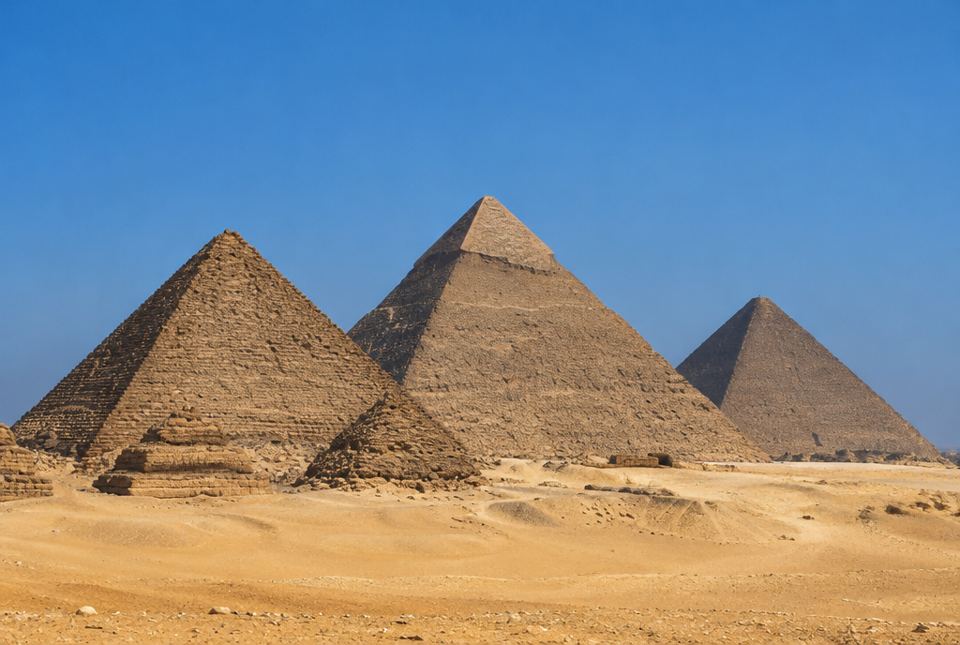 The pyramids at Giza as they look today. They are huge stone tombs built more than 4000 years ago, and they are still standing. AI-generated image
Just for funFunny but true: papyrus was precious, so Egyptian students often practised writing on broken pieces of pottery. It was the ancient version of scrap paper. Imagine handing in homework on a cracked plate!
Worked exampleLet's compare two lives
Compare a day in the life of a scribe's son and a farmer's son in ancient Egypt.
- Scribe's son: goes to a school for scribes for many years. Practises hieroglyphs on pieces of pottery or stone. Will get an important job keeping records.
- Farmer's son: does not go to school. Works in the fields from a young age: scaring birds from crops, carrying water, helping at harvest. Will most likely become a farmer too.
- Why different? The family's social class decided whether a child went to school and what job they would do.
- Same: both lived by the rhythm of the Nile, and both played games such as ball games and board games like senet.
The scribe's son went to school and would get a powerful job; the farmer's son worked in the fields with his family. Social class shaped their lives.
Hands-on activityWrite in hieroglyphs (sort of!)
You need: paper, a pencil, and a brown paper bag or a piece of cardboard (to stand in for papyrus).
- Make a simple picture alphabet: draw a small picture for each sound in your name (for example, a snake for "s", a hand for "h", a mouth for "m"). You are inventing your own; real hieroglyphs had hundreds of signs.
- Write your name in your picture signs on the "papyrus".
- Ask someone at home to read it using your key.
- Talk about it: why did Egypt need trained scribes? (It took years to learn all the signs, so most people could not read.)
Your turn
1Why was Egypt called "the gift of the Nile"?
Because the Nile's water and rich silt made farming possible in a desert. Without the river, there would be no Egypt.
2What did the Nile leave behind after its yearly flood?
3What was the ruler of ancient Egypt called?
4Name the three seasons of the Egyptian year.
Flood season, growing season, harvest season.
5Which social class had the most people?
The picture-writing of ancient Egypt.
7Name two developments from ancient Egypt.
Any two: hieroglyphs, papyrus, the 365-day calendar, pyramids, medicine, irrigation canals and the shaduf.
More practice: warm-up
1On which continent is Egypt?
A bucket on a long pole used to lift water from the river to the fields.
3What did Egyptians call their land, and what did it mean?
4Name a woman who ruled as pharaoh.
5What was papyrus made from?
A tall reed that grew by the Nile.
More practice: on your own
1Why could a flood that was too low be a problem?
Not enough land got water and silt, so harvests were poor and people could go hungry.
2Why did the pharaoh collect taxes in grain?
Grain was food and was valuable. It could feed workers and soldiers and be stored for bad years.
3Why were scribes important?
Few people could read and write. Scribes kept records of taxes, harvests and laws, which the government needed.
4Why should we be careful when using tomb paintings as evidence?
They were painted for wealthy people, so they show life the way the rich wanted to remember it. They might not show the hard parts of poor people's lives.
5Name one way the life of a farmer was different from the life of a noble.
Farmers did hard work in the fields, lived in mud-brick houses and paid taxes; nobles owned land, had more wealth and power, and helped govern.
Challenge
1Explain the cause and effect chain: rain in the southern mountains → ? → ? → food for Egypt.
Rain in the mountains → the Nile rises and floods → the flood leaves rich silt on the fields → farmers plant crops in the wet silt → food for Egypt.
2How was power passed on in ancient Egypt, and how is that different from how Canadians choose their government?
In Egypt, power was usually inherited from parent to child. In Canada, adult citizens vote in elections to choose who governs.
3Compare the status of women in ancient Egypt with the role of Haudenosaunee clan mothers. One similarity, one difference.
Similarity: women in both societies had important rights (Egyptian women could own property and run businesses; clan mothers had political power). Difference: Haudenosaunee clan mothers chose and removed leaders, while in Egypt most powerful positions were held by men, with only a few women pharaohs.
Quiz
1. What did the Nile flood leave on the fields?
3. Which group had the most people?
5. Ancient Egypt's calendar had about how many days?
6. Why did most Egyptians live near the Nile?
Big idea: Ancient Egypt is a classic example of a society shaped by a natural process (the annual Nile flood; A3.4) and of a hierarchical society with inherited power and slavery (A3.7, A3.8). Comparing the lives of children of different classes covers A1.2.
How to help at home:
- Draw the cause-and-effect chain of the flood together.
- Look at pictures of tomb paintings online or in a library book and ask, "What is happening? Who painted this, and for whom?"
- Compare the social pyramid with the Haudenosaunee clan system: who had power in each?
Common difficulties:
- "Slaves built the pyramids": archaeological evidence shows many builders were paid workers. Slavery did exist in Egypt, but this is a common myth.
- Thinking floods are always bad: for Egypt, a normal flood was essential; only floods that were too high or too low caused trouble. (The modern Aswan High Dam, built in the 1960s, now controls the flood.)
- Social classes: explain that most people could not change class; this is different from today's ideal that anyone can become anything.