A. Heritage and Identity · Early Societies to 1500 CERiver Valley Inventors: Mesopotamia and Ancient China
A3.1 A3.4 A3.6 A3.7 A3.9About 45 minutes
Learning goals- I can locate Mesopotamia and ancient China and explain how their rivers shaped them.
- I can describe how kings and emperors governed these societies.
- I can name important inventions from Mesopotamia and ancient China and say how we still use them.
- I can explain how the Silk Road brought societies together through trade.
Words to know
Mesopotamia
A Greek word meaning "land between the rivers": the land between the Tigris and Euphrates rivers.
city-state
A city and the farmland around it, with its own ruler and government.
cuneiform
The wedge-shaped writing of Mesopotamia, pressed into wet clay.
code of laws
A written list of laws for everyone to follow.
emperor
The ruler of an empire, a large area with many peoples.
dynasty
A family that rules a country for a long time, passing power from parent to child.
invention
A new tool or way of doing something that someone creates.
Silk Road
A network of trade routes, over land and sea, that connected China with Central Asia, the Middle East, Africa and Europe.
Two river valleys in Asia
Find Asia on a globe. Two of the world's earliest societies grew there, both beside great rivers:
- Mesopotamia, between the Tigris and Euphrates rivers, mostly in what is now Iraq. Some of the world's first cities, like Ur and Uruk, were built there about 5000 years ago.
- Ancient China, along the Yellow River (Huang He) and later the Yangtze River.
Mesopotamia: taming the rivers
Mesopotamia gets little rain, so farmers needed the rivers. But the Tigris and Euphrates flooded at unpredictable times, sometimes violently.
So Mesopotamians:
- dug canals to carry water to their fields (irrigation),
- built banks of earth to hold back floods,
- worked together in large groups to keep the canals clean. This needed organization and leaders.
They grew barley and wheat, dates and vegetables, and raised sheep and goats.
Government
Mesopotamia was made of city-states. Each was ruled by a king, who said the gods chose him. Each city had a huge stepped temple called a ziggurat.
About 3750 years ago, King Hammurabi of Babylon had his code of laws carved on a tall stone pillar so people could see the rules. It had about 280 laws. The punishment often depended on your social class: harming a noble was punished more harshly than harming a poor person or an enslaved person.
Ancient China: the Yellow River
The Yellow River gets its name from the yellow soil it carries. When it floods, it leaves that rich soil on the land, which is good for farming. But its floods could be terrible, so it was also called "China's Sorrow". People built dikes (walls of earth) and canals to control it.
In the north, farmers grew millet and wheat. In the warm, wet south, along the Yangtze, they grew rice in flooded fields.
Government
China was ruled by emperors from powerful families called dynasties.
- Chinese people believed the emperor ruled with the Mandate of Heaven: permission from heaven to rule. If an emperor ruled badly, and there were floods, famines or rebellions, people might say he had lost the Mandate, and a new dynasty could take over.
- For many centuries, many government officials were chosen by passing difficult exams about laws, history and writing, not only by being born into a rich family.
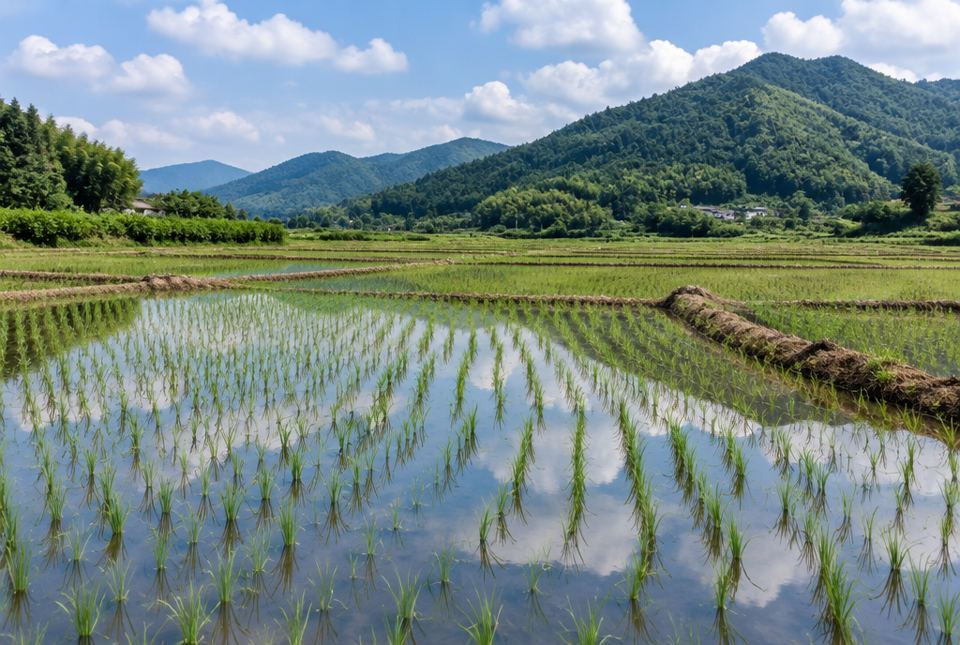 Rice grows in flooded fields like these. Farmers in the warm, wet south of ancient China grew rice this way, along the Yangtze River. AI-generated image
| Invention | Where | How we still use it |
|---|
| Cuneiform, one of the earliest writing systems (about 5000 years ago) | Mesopotamia | Writing lets us keep records, laws and stories. |
| The wheel (one of the first places to use it) | Mesopotamia | Cars, bikes, wagons, wheelchairs, gears. |
| Counting in groups of 60 | Mesopotamia | 60 seconds in a minute, 60 minutes in an hour. |
| Silk (from silkworm cocoons) | China | Clothing and fabric. |
| Paper (about 2000 years ago) | China | Books, notebooks, money, packaging. |
| Printing with carved wooden blocks | China | Printing books and pictures. |
| Magnetic compass for finding direction (used by sailors about 900 years ago) | China | Hiking and navigation; phones have a digital compass. |
🛞⏰📜🧭
A wheel, a clock (60 minutes in an hour), a scroll (writing and paper) and a compass.The Silk Road: cooperation through trade
About 2000 years ago, traders began travelling along a long network of routes between China and Central Asia, the Middle East, and on to Europe and Africa. Much later, people named it the Silk Road, after China's famous silk.
- Goods travelled: silk, paper and tea from China; horses, glass, gold, spices and wool from other places.
- Ideas travelled too: religions, music, foods, and inventions like paper-making.
- Traders often used camels to cross deserts, and rested at cities along the way.
Trade gave societies a reason to cooperate and stay peaceful. But there was conflict too: bandits attacked caravans, and empires fought for control of the rich trade cities.
Chinese dynasties also built long walls over many centuries to protect their northern lands from attacks. Today we call them the Great Wall.
Worked exampleLet's trace an invention's journey
How did paper, invented in China, end up in a Canadian classroom?
- China: paper was invented about 2000 years ago, made from plant fibres pressed into thin sheets.
- Silk Road: over hundreds of years, the knowledge of paper-making spread west along trade routes to the Middle East.
- From there, paper-making spread to Europe.
- Much later, Europeans brought paper to North America. Today, paper is made in Canada from trees in our forests.
Paper travelled from China, along trade routes to the Middle East and Europe, and then to North America. Trade spreads inventions and ideas.
Just for funIn Mesopotamia, writing a note meant pressing wedge shapes into wet clay. Imagine making a birthday card that had to dry in the sun before you could give it to your friend!
Hands-on activityMake a clay tablet
You need: play dough or modelling clay (or a flattened ball of salt dough), and a craft stick or the end of a chopstick.
- Flatten the clay into a small tablet, about the size of your palm.
- Use the end of the stick to press wedge shapes (little triangles) into the clay. Invent a code: for example, 1 wedge = 1 sheep, a sideways wedge = 10 sheep.
- Write a "trade record": I traded 12 sheep for a bag of barley.
- Let it dry. Real clay tablets were baked or dried in the sun, and some have lasted thousands of years.
Talk about it: why is writing on clay better than writing in sand? Why is paper easier to carry?
Your turn
1What does Mesopotamia mean?
"Land between the rivers."
A city and the farmland around it, with its own ruler and government.
3Who was Hammurabi, and what is he known for?
A king of Babylon known for his code of laws, carved on a stone pillar.
4Why was the Yellow River called "China's Sorrow"?
Its floods could be terrible and destroy villages and crops.
5What is the Mandate of Heaven?
The belief that heaven gave the emperor permission to rule, and that a bad ruler could lose it.
6Name two inventions from ancient China.
Any two: silk, paper, woodblock printing, magnetic compass (also gunpowder).
7Name two things Mesopotamia gave us that we still use.
Any two: writing (cuneiform), the wheel, counting in 60s (minutes and seconds), irrigation canals.
A network of trade routes connecting China with Central Asia, the Middle East, Europe and Africa.
More practice: warm-up
1On which continent were Mesopotamia and ancient China?
2What shape were the marks in cuneiform writing?
Wedges (little triangles).
A huge stepped temple in a Mesopotamian city.
4What grain grew in the warm, wet south of China?
5What animal often carried goods across deserts on the Silk Road?
More practice: on your own
1Why did Mesopotamian farmers need to work together?
Building and cleaning canals and flood banks was too big a job for one family. It needed many people and leaders to organize them.
2Why was it important that Hammurabi's laws were carved where people could see them?
So everyone could know the rules, and the laws could not easily be changed or forgotten.
3How was choosing officials by exams different from inherited power?
With exams, people got jobs by showing what they knew, not only by being born into a powerful family.
4Besides goods, what else travelled along the Silk Road?
Ideas: religions, music, foods, and inventions like paper-making (and sadly, sometimes diseases).
5How did the Silk Road lead to both cooperation and conflict?
Cooperation: societies traded and shared ideas peacefully. Conflict: bandits attacked caravans, and empires fought to control trade cities.
Challenge
1Hammurabi's code gave different punishments to different social classes. Is that fair? How is it different from laws in Canada today?
It was not equal: rich people were treated better. In Canada today, the law is supposed to treat everyone equally, whatever their wealth or background.
2Compare the Nile with the Tigris and Euphrates. Why did Mesopotamians need more flood protection than Egyptians?
The Nile flooded at about the same time every year and usually gently, so Egyptians could plan. The Tigris and Euphrates flooded at unpredictable times and sometimes violently, so Mesopotamians built flood banks and canals to control the water.
3Which invention from this lesson do you think changed the world the most? Give two reasons.
Answers will vary. Example: writing, because (1) it lets people keep laws and records, and (2) it lets knowledge pass to people far away and in the future. Look for a clear choice and two sensible reasons.
Quiz
1. Mesopotamia was between which two rivers?
2. Cuneiform was written on...
3. Which was invented in China?
4. Why do we have 60 minutes in an hour?
5. The Silk Road was mainly a...
6. In ancient China, an emperor who ruled badly might lose...
Big idea: These two river-valley societies show how controlling water led to organized government (A3.4, A3.7) and to inventions still used today (A3.6). The Silk Road introduces cooperation and conflict between societies (A3.9).
How to help at home:
- Hunt for "ancient inventions" around the house: wheels, clocks, paper, a compass app.
- Talk about rules at home: are they written down where everyone can see? Are they the same for everyone?
- Find the Tigris, Euphrates, Yellow and Yangtze rivers on a map.
Common difficulties:
- "The Silk Road was one road": it was many routes, including sea routes, and the name was given much later.
- Confusing emperors and pharaohs: both had inherited power and claimed support from heaven or gods; the titles belong to different societies.
- "Who invented the wheel?": we don't know a single inventor. Mesopotamia was one of the first places to use wheels; it is safest to say "one of the first".