A. Heritage and Identity · Early Societies to 1500 CEInuit and Their Thule Ancestors in the Arctic
A3.3 A3.4 A3.6 A3.7 A3.10 A1.3About 45 minutes
Learning goals- I can explain who the Thule were and how they are connected to Inuit today.
- I can describe how the Arctic environment shaped Thule and Inuit food, homes, clothing and travel.
- I can describe Inuit technologies like the toggling harpoon, snow goggles and the inuksuk.
- I can explain how Inuit camps made decisions and settled disagreements, and how children learned.
Words to know
Thule
The ancestors of Inuit. They moved east from Alaska across the Arctic about 800 years ago.
Inuit
The Indigenous people of the Arctic. One person is an Inuk.
Inuit Nunangat
The Inuit homeland in Canada: Nunavut, Nunavik (northern Quebec), Nunatsiavut (northern Labrador) and the Inuvialuit Region (Northwest Territories).
umiaq
A large open boat made of a wooden or bone frame covered with skins, used for whale hunting and moving families.
toggling harpoon
A harpoon whose tip turns sideways inside the animal, so it holds tight.
qarmaq
A winter house made with stones, sod (earth and grass) and whale bones.
inuksuk
A figure or marker of stacked stones built by Inuit. The plural is inuksuit.
cache
A safe place where food is stored to use later.
Remember from Grade 3
In Grade 3 you learned how Inuit families lived around 1800: hunting seal at breathing holes, using the qulliq lamp, travelling by qamutiik (dog sled) and qajaq (kayak), and sewing warm clothing from caribou and seal skin. Now let's travel back hundreds of years earlier, to meet the ancestors of Inuit: the Thule.
Who were the Thule?
The Thule (say: TOO-lee) people lived in Alaska. About 800 years ago (in the 1200s CE), they began moving east across the Arctic, all the way to Greenland. They were excellent hunters of the bowhead whale, a huge whale.
The Thule are the ancestors of Inuit. Inuit today are their descendants. Inuit oral history also tells of an earlier people who lived in the Arctic before them, called the Tuniit.
Today, Inuit live across Inuit Nunangat, the Inuit homeland in Canada: Nunavut, Nunavik (northern Quebec), Nunatsiavut (northern Labrador) and the Inuvialuit Region (Northwest Territories), as well as in Alaska and Greenland, and in cities across Canada.
The Arctic environment
- Very cold, with long winters.
- In midwinter, the sun barely rises or does not rise at all for weeks. In summer, it can shine all day and night.
- No trees on the tundra, so wood was rare. Driftwood washed up on some beaches.
- Sea ice covers the ocean for much of the year.
- Rich in animals: whales, seals, walrus, caribou, fish, birds.
The Thule and Inuit used deep knowledge of the land, sea, ice and animals to live well in this environment. Nothing from an animal was wasted: meat for food, skins for clothing and boats, bones and antlers for tools, fat (blubber) for lamp oil.
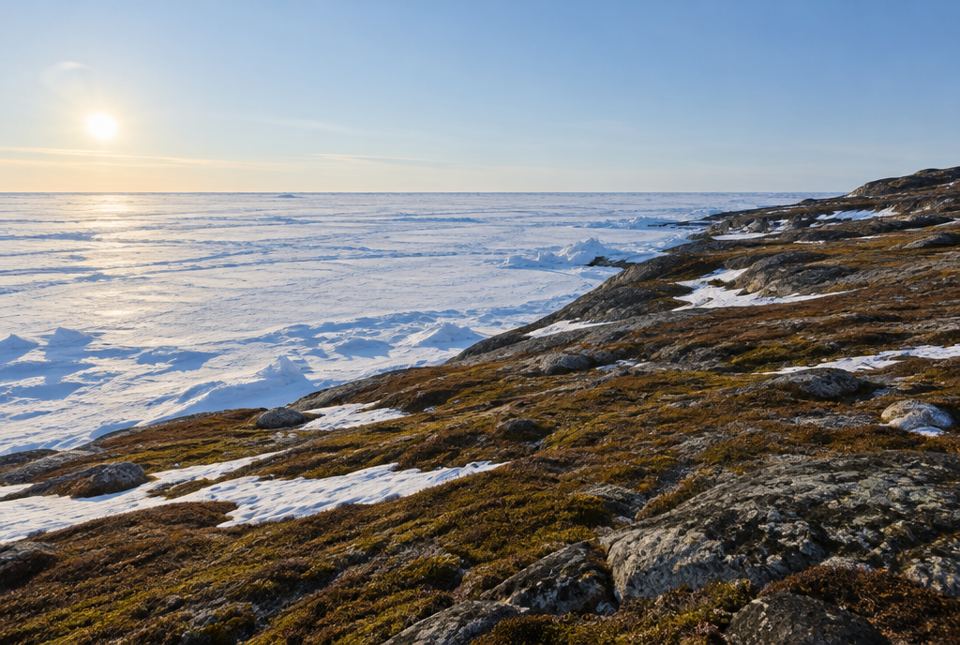 Look closely: there are no trees at all, and the ocean is frozen into sea ice. The Thule and Inuit used the animals of the land and sea for almost everything they needed. AI-generated image
| Need | How the Thule and Inuit met it |
|---|
| Food | Hunted bowhead whales from the umiaq, and seals, walrus, caribou, fish and birds. Meat was stored under piles of rocks (caches) to keep it from animals. Some meat, like igunaq (usually walrus), was stored to ferment, which preserved it. |
| Winter homes | Qarmaq: houses dug partly into the ground, built with stones, sod and whale bones for the roof. Snow houses (igluvijaq) were used while travelling and at some winter camps. |
| Summer homes | Tents made of skins. |
| Clothing | Parkas, pants and boots (kamiik) of caribou and seal skin, sewn with tight, waterproof stitches. |
| Travel | Dog sleds on snow and ice; the one-person qajaq and the large umiaq on water. |
Amazing technologies
The Thule and Inuit invented tools that worked perfectly in the Arctic:
- Toggling harpoon: the tip turns sideways after it goes in, so it holds tight. A float made from a sealskin full of air was tied to the line, so a whale or seal could not dive away.
- Snow goggles: made of bone, antler or wood, with thin slits to look through. They protect the eyes from snow blindness caused by bright sunlight reflecting off snow.
- Snow knife: for cutting blocks of hard snow to build a snow house.
- Qulliq: a stone lamp burning seal or whale oil for light, heat and cooking.
- Dog sleds: the Thule brought dog teams with them across the Arctic.
- Inuksuk: a figure or marker of stacked stones (more about it below).
Finding the way
Inuksuit (more than one inuksuk) can mark a travel route, a good fishing or hunting place, or a food cache. Some helped guide caribou during hunts. The word inuksuk means something like "acting in the place of a person".
Inuit also navigate (find their way) using:
- the stars at night,
- the wind: in winter, hard snowdrifts shaped by the wind line up in the same direction, so a traveller can read them like a compass,
- landmarks like hills and shorelines, remembered in detail.
Making decisions and solving problems
The Thule and Inuit did not have kings or rulers. People lived in small camps of related families.
- Respected Elders and skilled, wise hunters gave guidance. Such a person is sometimes called an isumataq ("one who thinks").
- Decisions were made by talking together and listening to Elders.
- Sharing was a rule of life: when a hunter caught a seal or whale, the meat was shared so that everyone had food.
To settle a disagreement without fighting, some Inuit held a song duel. The two people took turns singing funny or teasing songs about each other, often with a drum, in front of the whole community. The audience's laughter helped decide who won, and then the quarrel was over. Humour, games and sharing food also helped people get along.
Growing up in a Thule or Inuit camp
Children learned by watching, listening and helping. Young people learned to hunt, fish, sew, prepare skins and read the weather from parents, grandparents and Elders. They learned the stories and values of their people too.
Children played games that built skill and strength, such as string games and Arctic sports like the one-foot high kick. These games are still played today, including at the Arctic Winter Games.
Just for funIn parts of the Arctic, the summer sun does not set for weeks. Imagine trying to convince your family it's bedtime when it's still bright and sunny at midnight!
Worked exampleLet's connect the environment to a technology
Why did Inuit invent snow goggles? Use cause and effect.
- Look at the environment: the Arctic is covered with snow and ice for much of the year, and in spring the sun shines for many hours.
- Cause: sunlight reflects (bounces) off the white snow into people's eyes.
- Effect: too much bright light can cause snow blindness, a painful eye injury.
- Solution: goggles with thin slits let in only a little light, so hunters can see safely.
Bright sunlight reflecting off snow can cause snow blindness, so Inuit made goggles with thin slits to protect their eyes.
Hands-on activityBuild a mini inuksuk
You need: 6 to 10 small, flat stones or wooden blocks (or Lego bricks), and a flat surface.
- Build a small inuksuk: two "legs", a "body", a long stone for "arms", and a "head".
- It must stand on its own! Balance is tricky. Real inuksuit are built so carefully that some have stood for hundreds of years.
- Decide what your inuksuk is telling a traveller: "Good fishing here"? "Food cache"? "Go this way"? Write it on a card beside it.
Note: when outdoors, build only with stones you can easily lift, put them back where you found them, and never knock down a real inuksuk; they are important to Inuit communities.
Your turn
The ancestors of Inuit. They moved east from Alaska across the Arctic about 800 years ago.
2What huge animal were the Thule expert at hunting?
3What was a qarmaq made of?
Stones, sod and whale bones.
4How does a toggling harpoon work?
The tip turns sideways inside the animal so it holds tight.
5What do snow goggles protect against?
Snow blindness, from bright sunlight reflecting off snow.
6Name two things an inuksuk might mark.
Any two: a travel route, a hunting or fishing place, a food cache; some helped guide caribou.
A way to settle a disagreement: two people take turns singing funny or teasing songs, with the community listening, instead of fighting.
8Name two regions of Inuit Nunangat.
Any two: Nunavut, Nunavik, Nunatsiavut, Inuvialuit Region.
More practice: warm-up
1What is one Inuk? More than one?
One person is an Inuk; more than one are Inuit.
A large open boat covered with skins, for whale hunting and moving families.
3Why was wood rare in the Arctic?
No trees grow on the tundra.
4What did the Thule bring with them across the Arctic to pull sleds?
5How did Inuit children learn?
By watching, listening and helping adults and Elders.
More practice: on your own
1Why did Thule build winter homes with whale bones instead of wooden beams?
There were no trees for wood, but whale bones were big and strong and came from the animals they hunted.
2How did sharing food help everyone survive?
Hunting could be hard. If one hunter caught an animal, everyone ate. Next time another hunter might share. No family went hungry.
3Name two ways Inuit find their way across the land without a map.
Any two: the stars, wind-shaped snowdrifts, landmarks, inuksuit.
4Why was the sealskin float on a harpoon line useful?
It was full of air, so it floated and stopped the animal from diving away, and helped hunters follow it.
5Who guided decisions in a Thule or Inuit camp?
Respected Elders and wise, skilled hunters (an isumataq), with people talking together.
Challenge
1Compare how disagreements were settled in an Inuit camp with how they are settled in Canada today.
Inuit camps used song duels, humour and talking with Elders, in front of the community. Today Canada uses courts, judges and laws, and also mediators and talking it out. Both try to settle problems without violence.
2The Thule and Inuit had no kings. Why might small camps not need a king?
Camps were small groups of families who knew each other well. They could talk together and listen to Elders. A king is more useful for very large societies with many strangers.
3Describe how Inuit used one animal completely. Choose the seal.
Meat and blubber for food; blubber also for lamp oil in the qulliq; skin for clothing, boots, tents and boat covers; and sealskin floats for harpoon lines. Nothing was wasted.
Quiz
1. The Thule were the ancestors of...
2. Snow goggles protect against...
3. What was a qarmaq roof often held up with?
4. A song duel was a way to...
5. Which of these is an Inuit region in Canada?
Big idea: The Thule (ancestors of Inuit) are the Inuit society required by this strand, from a different region and era than the First Nations societies studied. The lesson connects the Arctic environment to food, shelter and technology (A3.4, A3.6), governance without rulers (A3.7), conflict resolution through song duels and humour (A3.10), and how young people learned (A1.3).
How to help at home:
- Talk about Inuit in the present tense: Inuit communities thrive today across Inuit Nunangat and in southern cities. The inuksuk appears on Nunavut's flag.
- Watch a video of Arctic sports (e.g., one-foot high kick) together and try a safe version (reach for a hanging sock).
- Compare how your family settles disagreements with a song duel. Could humour help?
Common difficulties:
- "Inuit only live in igloos": Thule and Inuit used many kinds of homes: qarmaq, tents and snow houses. Today Inuit live in modern houses.
- Calling Inuit a First Nation: Inuit are a distinct Indigenous people, not a First Nation.
- Dates: scientists give slightly different dates for the Thule migration. Most now date it to the 1200s CE, about 800 years ago (older books say about 1000 years ago). "About 800 years ago" is fine.
Safety: when building an inuksuk outdoors, use small stones only, and do not disturb real inuksuit.