A. Heritage and Identity · Early Societies to 1500 CEThe Maya: Cities of the Rainforest
A3.2 A3.3 A3.5 A3.6 A3.8 A1.3About 45 minutes
Learning goals- I can describe how the Maya farmed and built cities in a rainforest environment.
- I can describe the social organization of the Maya and how their city-states were ruled.
- I can read Maya numbers and describe Maya developments in writing, math and astronomy.
- I can use art, like the Bonampak murals, as evidence about Maya life.
Words to know
Maya
An Indigenous people of southern Mexico and Central America. Millions of Maya people live there today.
rainforest
A thick forest with lots of rain and warm weather all year.
milpa
A Maya farm field where maize (corn), beans and squash grow together.
maize
Corn. The most important Maya food.
terrace
A flat step cut into a hillside so crops can grow on it.
astronomy
The study of the sun, moon, stars and planets.
mural
A large painting on a wall.
codex
A Maya book made of bark paper, folded like a fan (plural: codices).
Into the rainforest
Travel south from Canada, past the United States, into southern Mexico and Central America: Guatemala, Belize, Honduras and El Salvador. This is where the Maya built great cities, especially between about 250 CE and 900 CE, although Maya villages and towns were there long before that.
Much of the land is rainforest: hot, wet, with tall trees and many animals. Other parts are highlands (mountains) and the flat, dry Yucatán Peninsula, where water collects in natural sinkholes called cenotes.
The Maya did not disappear! Millions of Maya people live there today, and many speak Maya languages.
Farming in the rainforest
Rainforest soil is often thin: heavy rain washes the nutrients away. The Maya were clever farmers:
- In a milpa, they grew maize, beans and squash together, like the Three Sisters of the Haudenosaunee! After a few years, they let the field rest so the soil could recover.
- On hillsides, they built terraces (flat steps) so the soil would not wash away.
- In swampy places, they dug canals and built raised fields.
- They collected rainwater in reservoirs for the dry season.
Maize was so important that a Maya creation story (from the K'iche' Maya book, the Popol Vuh) tells that the first people were made from maize.
The Maya also grew cacao and made a chocolate drink from its beans, and used rubber from trees to make balls.
City-states and kings
There was no single Maya empire. Instead there were many city-states, such as Tikal, Palenque, Copán and Calakmul. Each had its own king, called a "holy lord".
- Power was usually inherited, from father to son. A few women ruled as queens.
- Kings led ceremonies, wars and building projects.
- City-states traded with each other (jade, salt, cacao, feathers, obsidian for tools), made alliances, and also fought wars against each other.
In the middle of each city were tall stone pyramid temples and a ball court, where teams hit a heavy rubber ball using their hips, not their hands. The ball game was a sport and also part of religious ceremonies.
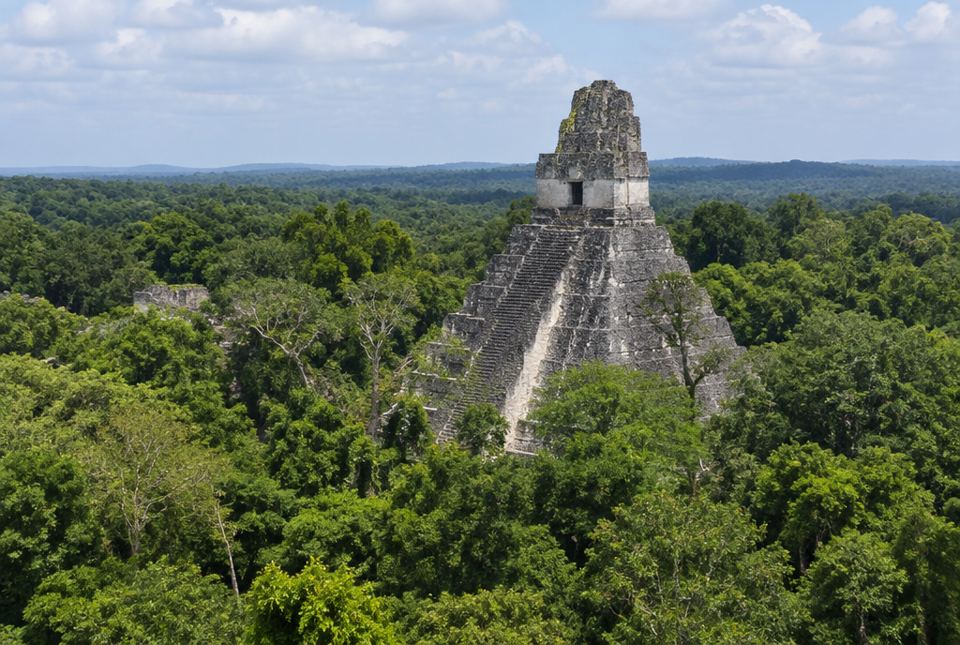 A Maya pyramid temple as it looks today. Temples like this stood in the middle of Maya city-states, surrounded by rainforest. AI-generated image
| Group | Their life |
|---|
| King and royal family | Ruled the city-state; lived in stone palaces. |
| Nobles and priests | Helped rule, led ceremonies, studied the stars and kept the calendar. |
| Scribes and artists | Wrote and painted books, carved stone monuments, made pottery and murals. |
| Merchants | Traded goods between cities, on foot and by canoe. |
| Farmers | The largest group. Grew maize, beans and squash; built temples during some seasons; paid tribute (goods) to rulers. |
| Enslaved people | Often prisoners captured in war. They did hard work for others. |
Writing, numbers and the sky
- Writing: the Maya had a full writing system of glyphs (signs), carved in stone and painted in codices (folding books made of bark paper).
- Numbers: they wrote numbers using a dot for 1, a bar for 5, and a shell for zero. The Maya were one of the few early societies to use a symbol for zero.
- Astronomy: priests carefully watched the sun, moon and planets, especially Venus, and recorded their movements.
- Calendars: the Maya used several calendars at once, including a 365-day calendar (like Egypt!) and a 260-day calendar for ceremonies.
Worked exampleLet's read a Maya number
A Maya number has 3 bars and 4 dots. What number is it?
- Each bar is worth 5. Three bars: 5 + 5 + 5 = 15.
- Each dot is worth 1. Four dots: 4.
- Add them: 15 + 4 = 19.
It is 19. (In the Maya system, one place can show up to 19.)
Worked exampleLet's read a mural as evidence
At Bonampak, in Mexico, there are Maya murals painted around 790 CE. They show musicians playing drums, trumpets and rattles; nobles in fancy clothes with feather headdresses; a battle; and prisoners in front of the king. What can we learn?
- Music: the Maya played drums, trumpets and rattles at ceremonies.
- Clothing: nobles wore feathers and jewellery, showing they were wealthy and important.
- Conflict: there were wars between city-states, and prisoners were taken.
- Careful: the murals were made for a king. They show the king's view. They don't show much of farmers' everyday lives.
The murals show Maya music, rich clothing, warfare and royal power, from the king's point of view.
Just for funMaya ball players hit a heavy rubber ball with their hips, not their hands. Try keeping a balloon in the air using only your hips. It's much harder (and sillier) than it looks!
Hands-on activityMaya numbers with things from home
You need: dry beans or buttons (for dots), craft sticks or pencils (for bars), and a small shell, button or bottle cap (for zero).
- Show these numbers the Maya way: 3, 7, 10, 12, 18.
- Ask someone at home to make a Maya number for you to read.
- Show zero using your "shell".
- Talk about it: why is it useful to have a symbol for zero?
Safety: keep small beans and buttons away from little brothers and sisters, who could choke on them.
Your turn
Southern Mexico and Central America (Guatemala, Belize, Honduras, El Salvador).
2What was the most important Maya food?
A Maya field where maize, beans and squash grow together.
4Why did the Maya build terraces on hillsides?
To make flat places to farm and stop the soil from washing away in heavy rain.
5Who ruled a Maya city-state?
A king (a "holy lord"); power was usually inherited.
6What number is 2 bars and 2 dots?
7What symbol did the Maya use for zero?
8Are there Maya people today?
Yes. Millions of Maya people live in Mexico and Central America today, and many speak Maya languages.
More practice: warm-up
1What is a dot worth in Maya numbers?
3What drink did the Maya make from cacao beans?
4In the Maya ball game, players hit the ball with their...
A natural sinkhole where water collects.
More practice: on your own
1Write 17 in Maya numbers.
3 bars and 2 dots. 5 + 5 + 5 + 1 + 1 = 17.
2Why was rainforest soil hard to farm, and what did the Maya do about it?
Heavy rain washes the nutrients away, so soil is thin. The Maya let fields rest, built terraces and raised fields, and grew plants together in the milpa.
3Which group was the largest in Maya society? What did they do?
Farmers. They grew maize, beans and squash, paid tribute to rulers, and helped build temples.
4How is the Maya milpa like the Haudenosaunee Three Sisters?
Both grow maize (corn), beans and squash together, so the plants help each other.
5Name two reasons Maya city-states came into contact with each other.
Any two: trade (jade, salt, cacao, obsidian), alliances, wars, ceremonies and ball games.
Challenge
1In the Maya system, a number in the upper place counts groups of 20. A dot in the upper place with a shell below it means 20. What would a dot in the upper place with one bar below it mean?
25. The upper dot is 1 group of 20 = 20, and the bar below is 5. 20 + 5 = 25.
2Many Maya cities in the southern lowlands were left empty around 800 to 900 CE. Scientists think droughts, wars and overused land were part of the cause. How does this show the importance of the environment?
When rain failed and the soil was worn out, there was not enough food for big cities. People moved elsewhere. A society depends on its environment to meet its needs.
3Compare Maya children's lives in a farming family and a noble family.
Farm children worked in the milpa, carried water, helped cook and weave, and learned from their families. Noble children might learn writing, the calendar and ceremonies, preparing to be leaders, scribes or priests. Social class decided what they learned.
Quiz
1. What did the Maya use as a symbol for zero?
2. What number is 1 bar and 3 dots?
4. How were Maya lands governed?
5. The Bonampak murals mostly show life from the point of view of...
6. Which is true about Maya people today?
Big idea: The Maya show farming adapted to a difficult rainforest environment (A3.5), a hierarchy of city-states with inherited kingship (A3.8), important developments in writing, mathematics and astronomy (A3.6), and evidence from art (A3.2, the Bonampak murals are an example named in the curriculum).
How to help at home:
- Practise Maya numbers with beans and sticks; this connects nicely to Grade 4 math.
- Compare the milpa to the Three Sisters from the Haudenosaunee lesson.
- Point out that Maya people are a living Indigenous people with millions of speakers of Maya languages.
Common difficulties:
- "The Maya disappeared": many cities were abandoned, but the people did not vanish.
- Maya vs. Aztec vs. Inca: these are different societies in different places and times. The Aztec were later, in central Mexico; the Inca in the Andes of South America.
- Maya place value: only the challenge question uses the upper place (groups of 20); it is enrichment.
Safety: small beans or buttons are a choking hazard for young children.