A. Literacy Connections and Applications / C. Comprehension: Understanding and Responding to Texts · Understanding and Responding to TextsLocal and Global Inferences in Complex Texts
C3.2About 45 minutes
Learning goals- I can make local inferences about words, sentences and details, using explicit and implicit evidence.
- I can combine local inferences into global inferences about a whole text's meaning, theme or purpose.
- I can explain and support my interpretation of a complex text and weigh it against other interpretations.
Words to know
inference
A conclusion you reach by combining clues in a text with what you already know.
local inference
An inference about a small part of a text, such as what a word, sentence or detail suggests.
global inference
An inference about a whole text, such as its theme, a character's change or the author's purpose.
explicit evidence
Information the text states directly.
implicit evidence
Information the text suggests without stating it.
interpretation
Your explanation of what a text means, supported by evidence.
theme
A big idea or message about life that a text explores.
Remember from Grade 7
In Grade 6 you made local and global inferences, and in Grade 7 you sorted evidence into explicit and implicit and built interpretations.
In Grade 8 you'll do this with complex texts: stories that skip time, leave big gaps and never explain themselves. You'll build chains of local inferences into a global one, and you'll test your interpretation against other possible readings.
Hook: Four words
Here are four words from the story you're about to read: This year, Leo drove.
What can you infer from just these four words? Keep your answer in mind.
The Last Ferry (a story written for this website)
Every September, on the Sunday after Labour Day, Grandpa Teodor drove Leo to the dock for the last ferry of the season. They always brought two hot chocolates, and they always stood at the rail until the island was a grey line.
This year, Leo drove.
Grandpa sat in the passenger seat with his hands folded on the blanket across his knees. At the dock, Leo bought two hot chocolates out of habit, then stood holding them both, not sure where to put one.
"Rail?" he asked.
Grandpa looked at the steep steps up to the deck for a long moment. "You go," he said. "Tell me what it looks like."
So Leo went. He stood where they had always stood and watched the island shrink. Then he took out his phone, and for the whole crossing he talked: about the gulls, the colour of the water, a kid in a bright jacket waving at nobody. Below, in the lounge, someone listened with his eyes closed.
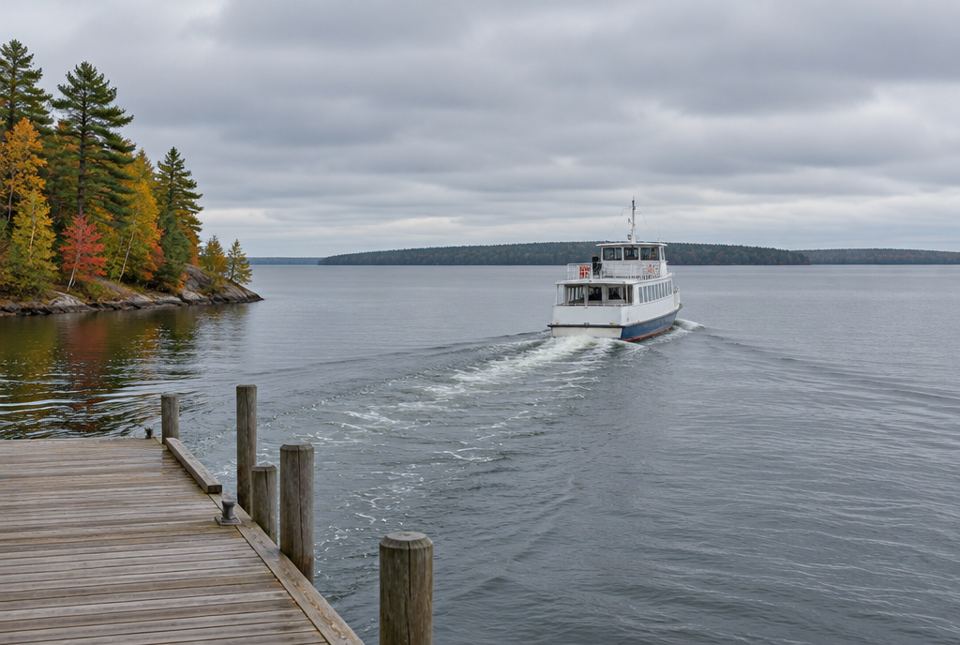 A ferry pulling away from the dock on a cloudy autumn day, like the last ferry of the season in the story. The setting itself hints at endings, which supports a global inference about change. AI-generated image
Worked exampleLet's make local inferences
Make a local inference about each moment. Name the clue, say whether it's explicit or implicit, and add what you know.
- This year, Leo drove.
- Grandpa looked at the steep steps up to the deck for a long moment.
- Leo bought two hot chocolates out of habit, then stood holding them both, not sure where to put one.
- 1. Clue (explicit): This year, Leo drove. Contrast with Grandpa Teodor drove Leo in past years. What I know: in Ontario you must be at least 16 to get a driver's licence. Inference: time has passed, Leo is now old enough to drive, and Grandpa no longer drives.
- 2. Clue (implicit): he looks at the steps for a long moment and then says You go. What I know: older people or people who are unwell may find steep stairs hard or unsafe. Inference: Grandpa can't manage the stairs now, and he knows it.
- 3. Clue (implicit): out of habit, not sure where to put one. What I know: habits continue even when circumstances change. Inference: the tradition is changing, and Leo feels awkward and sad that it isn't the same; maybe Grandpa can't stand at the rail with his hot chocolate anymore.
Each local inference comes from a specific clue plus knowledge. Notice that the story never says Grandpa is older and frailer now. We infer it from several small details: the driving, the blanket, the steps.
Worked exampleLet's build a global inference
What is The Last Ferry really about? Combine local inferences into a global inference about its theme.
- Chain the local inferences: time has passed → Grandpa can no longer drive or climb stairs → the tradition can't happen the old way → Leo feels the change (two hot chocolates).
- Look at the turning point: Tell me what it looks like. Grandpa finds a new way to share the tradition.
- Look at the ending: Leo describes everything on the phone; Grandpa listened with his eyes closed, which suggests he's picturing it. The story calls him someone, which makes us infer who it is and slows us down at the most important moment.
- Notice the role reversal: once Grandpa drove Leo and showed him the lake; now Leo drives Grandpa and shows him the lake through words.
- State the global inference (theme): When people we love grow older, the ways we share our lives have to change, but love can find new forms, and the younger generation can begin to care for the older one.
Global inference: the story is about love adapting to change and roles reversing between generations. It's supported by a chain of evidence: driving, the blanket, the stairs, the extra hot chocolate, Tell me what it looks like, and the phone call.
Each clue plus what you know gives a local inference. Put all five together and you get a global inference about the theme of The Last Ferry.Weighing interpretations
Complex texts often allow more than one reasonable interpretation. Test each one:
- Is it supported by several pieces of evidence?
- Does any evidence go against it?
- Does it go beyond what the text supports?
- Interpretation A: The story is about love adapting as people age. Supported by many details; nothing goes against it. Strong.
- Interpretation B: The story is about Leo growing up and taking on responsibility. Supported (he drives, he leads the tradition, he finds a way to include Grandpa). Also strong, and it fits with A.
- Interpretation C: Grandpa is dying and this is their last trip together. The title The Last Ferry and the blanket might suggest this, but the text never says it; last ferry explicitly means the last ferry of the season. This reading goes beyond the evidence. Use careful words: It's possible that...
- Interpretation D: Grandpa doesn't want to spend time with Leo. Contradicted by Tell me what it looks like and by him listening the whole crossing. Weak.
Inferences in informational texts
You infer in non-fiction too. Read this sign posted at the Larkspur Bay ferry dock (invented):
NOTICE: Starting next season, the ferry will carry passengers only. Vehicles must use the mainland lot ($15/day). Elevator to the upper deck: out of service until further notice.
Local inference: islanders who used to bring cars will now pay to park and carry their things. Local inference: people who can't climb stairs can't reach the upper deck, like Grandpa. Global inference: the changes may make the ferry harder to use for some people, especially older riders, people with disabilities and families with lots to carry. The sign never says this: you infer it.
Inference formula, Grade 8 edition
Clue (explicit or implicit) + what I know = local inference. Several local inferences + turning point + ending = global inference. Then test it: What supports it? What goes against it? Am I going beyond the evidence? Use careful words for implicit evidence: suggests, probably, seems, may.
Just for funInference challenge: your friend replies to your long, excited message with just "k." (with a period).
Local inference: something is off. Global inference: you may want to ask, kindly, what's up.
Hands-on activityInference detectives at home
You need: a short story, a picture book for older readers, a song with lyrics, or a TV scene; paper; a pencil.
- Choose one page or scene. List five details that suggest something without saying it.
- For each, write a local inference using the formula.
- Connect them into one global inference about the whole story's theme.
- Silent scene challenge: with a family member, act out a 30-second scene without words (for example, someone receiving a letter they've been waiting for). The audience writes local and global inferences. Compare what the actor meant with what the audience inferred.
- Write two interpretations of your story. Test both with the three questions from the lesson.
Your turn
1What can you infer from This year, Leo drove?
Time has passed: Leo is now old enough to drive (at least 16 in Ontario), and Grandpa no longer drives, probably because of age or health.
2What does the blanket across his knees suggest about Grandpa?
He may feel cold easily or be frail, details often associated with older age or illness. It suggests he's less strong than in the past.
3Is Grandpa can't climb the steps explicit or implicit? Explain.
Implicit. The text never says it; we infer it from him looking at the steps for a long moment and saying You go.
4Why does the story say someone listened instead of Grandpa listened?
It makes the reader infer who is listening, slowing us down at the emotional ending. It also shows the scene from a distance, as if we're discovering Grandpa in the lounge. (Accept reasonable answers about emphasis or effect.)
5What role reversal happens in the story?
Grandpa used to drive Leo and share the view with him; now Leo drives Grandpa and shares the view with words over the phone.
6State a global inference about the story's theme.
Sample: As people we love grow older, traditions must change, but love can find new ways to continue.
7From the ferry notice, infer one group of people who will be affected and how.
Any one: people who can't climb stairs (older people, people who use wheelchairs) can't reach the upper deck; islanders with cars must pay $15 a day to park on the mainland; families with lots to carry must carry everything without a vehicle.
More practice: warm-up
1What is a local inference?
An inference about a small part of a text, such as one word, sentence or detail.
2What is a global inference?
An inference about the whole text, such as its theme or purpose.
Stated directly in the text.
5In the story, what did Leo and Grandpa always bring?
More practice: on your own
1Why is Grandpa is dying a weaker interpretation than Grandpa is older and less able?
The text never states or clearly suggests he is dying. The last ferry means the last ferry of the season. The evidence (driving, stairs, blanket) supports frailty, but dying goes beyond the evidence. You could only say it's possible.
2Find two pieces of evidence that Grandpa still wants to share the tradition.
- He says Tell me what it looks like. 2) He listened for the whole crossing, with his eyes closed (picturing it).
3How do the two hot chocolates work as a symbol?
They stand for the tradition and the two people who share it. When Leo doesn't know where to put one, it shows that the tradition can't happen the old way, and Leo feels the change.
4What can you infer about Leo's character from how he handles the crossing?
He's caring and creative: instead of giving up on the tradition, he finds a new way to include Grandpa, describing small details (gulls, water, the kid waving) for the whole crossing.
5Explain how a global inference depends on local ones.
A global inference is built by combining many local ones. Each detail (driving, blanket, steps, hot chocolate, phone call) adds a piece; together they reveal the whole meaning. Without local evidence, a global inference is just a guess.
Challenge
1Write a paragraph (4 to 6 sentences) explaining and supporting Interpretation B: The story is about Leo growing up and taking on responsibility.
Model: The Last Ferry shows Leo growing up and taking on a new role in his family. In the past, Grandpa drove Leo, but now "this year, Leo drove," which shows Leo has become the one responsible for getting them there. At the dock, Leo is the one who decides what to do and asks Grandpa, "Rail?" When Grandpa can't climb the steps, Leo doesn't give up on the tradition; he invents a new way to share it by describing everything over the phone. This shows maturity and care, because he puts Grandpa's experience first. The story suggests that growing up means learning to care for the people who once cared for you. (Look for: a clear claim, at least three pieces of evidence, explanation of each, and a concluding link.)
2Add one sentence to the story that would make Interpretation C (Grandpa is dying) better supported. Then explain why the author might have left such a sentence out.
Sample sentence: The doctor had said this might be his last trip to the island. Why the author may have left it out: the story is more open and powerful when readers infer; it keeps the focus on love and change rather than a single sad event, and lets readers bring their own experiences of aging grandparents.
3The title The Last Ferry could be read in two ways. Explain both, and say which the evidence supports more.
Literal: the last ferry of the season, which the first sentence states explicitly. Figurative: it might hint at a final trip or the end of a stage of life. The evidence explicitly supports the literal meaning; the figurative meaning is possible (because of the changes in Grandpa) but not confirmed. Strong readers note the double meaning without claiming more than the text supports.
Quiz
1. Mia slammed her locker and didn't answer when Sam said hi. Which is a reasonable local inference?
2. A global inference is about...
3. In The Last Ferry, which evidence is explicit?
4. Which interpretation of The Last Ferry goes beyond the evidence?
5. Which question helps test an interpretation?
6. Elevator to the upper deck: out of service. Who is most affected?
7. What is the best word to use when an inference rests on implicit evidence?
What this lesson teaches: Grade 8 students make local and global inferences using explicit and implicit evidence, and explain and support their interpretations of complex texts (C3.2).
How to help at home:
- During a movie, pause on a silent moment and ask: "What's this character feeling? How do you know?"
- Ask for the theme: "So what is this whole story really about?" Then: "What details prove it?"
- Play devil's advocate: offer a weak interpretation and let your teen refute it with evidence.
Common difficulties:
- Over-reading: stating guesses (like Grandpa is dying) as facts. Encourage careful language.
- Stopping at local inferences. Ask: "Put it together: what's the big idea?"
- Ignoring contradicting evidence. Make "What goes against it?" a routine question.
About the texts: The Last Ferry and the ferry notice were written for this site. In Ontario, the minimum age to begin getting a driver's licence (G1) is 16.