A. Literacy Connections and Applications / C. Comprehension: Understanding and Responding to Texts · Understanding and Responding to TextsText Patterns and Features: Problem and Solution, Glossaries and Infographics
C1.3 A2.5 A3.1About 45 minutes
Learning goals- I can identify the problem-solution pattern in a letter to the editor and compare it with other text patterns.
- I can explain how a glossary and an infographic help readers, and evaluate how important each feature is for understanding a text.
- I can explain how a text's pattern and features connect to its form, purpose and audience.
Words to know
text pattern
The way ideas in a text are organized, such as problem-solution, cause-effect, compare-contrast, chronological order or description.
problem-solution
A text pattern that describes a problem, explains why it matters or what causes it, and then proposes one or more solutions.
letter to the editor
A short letter written by a reader to a newspaper or magazine, giving an opinion on an issue, often in response to something the publication printed.
glossary
An alphabetical list of important or specialized words in a text, with their meanings, usually at the end.
infographic
A visual text that combines numbers, icons, short text and design to explain information quickly.
signal words
Words that show how ideas are connected, such as the problem is, as a result, however, one solution.
evaluate
To judge how well something works, using reasons and criteria.
Remember from Grade 7
In Grade 7 you traced cause-and-effect chains, saw why a bibliography lets readers check sources, and learned how accessible fonts help everyone read.
In Grade 8 you'll compare text patterns, especially problem-solution, and you'll evaluate features like glossaries and infographics: not just what do they do? but how much do they actually help, and for whom?
Hook: Got a problem?
Think of something in your community that bugs you: no bus on weekends, a dark path, a park with nothing for teens. If you wanted the whole town to fix it, what would you need to explain first? Probably: What's the problem? Why does it matter? What should we do? Why will that work? That's the problem-solution pattern.
Letter to the editor: Larkspur Bay Needs a Weekend Bus
To the editor, The Larkspur Bay Beacon (all invented for this lesson):
Your article last week celebrated our new community centre. I agree it's great. The problem is that many of us can't get there. The town bus doesn't run on weekends, and the centre is three kilometres from most of the houses on the east side.
This matters because the people who most need the centre are the ones without rides: teens, seniors who don't drive, and families who share one car. Last month, my friend missed every Saturday swim lesson because her parents work weekend shifts.
One solution is a small weekend shuttle that loops between the east side and the centre every hour from 9 a.m. to 5 p.m. Some people will say it costs too much. However, the town already owns a van that sits in a parking lot on weekends. Volunteers with the right licence could drive it.
I urge council to try the shuttle for one summer and count the riders. If no one uses it, we'll know. But I'm betting the centre will finally be full.
Grace Lin, Grade 8, Larkspur Bay
Why problem-solution suits a letter to the editor
A letter to the editor is short and persuasive, written by an ordinary reader to a whole community. The problem-solution pattern fits because readers need to agree there's a problem before they'll accept a solution. Notice the signal words in bold in Grace's letter: The problem is... because... One solution is... Some people will say... However... They work like signposts for the reader.
Letters to the editor often respond to something the newspaper printed (Your article last week...), are signed with the writer's name and community, and end with a clear request.
| Pattern | Main question it answers | Signal words | Often found in |
|---|
| Problem-solution | What's wrong and how can we fix it? | the problem is, one solution, to solve this, however | Letters to the editor, proposals, science and geography reports |
| Cause-effect | Why did this happen, and what did it lead to? | because, as a result, therefore, led to | History and science texts, news |
| Compare-contrast | How are these alike and different? | similarly, both, unlike, whereas, on the other hand | Reviews, essays, buyer's guides |
| Chronological | In what order did things happen? | first, then, in 1867, later, finally | Biographies, timelines, instructions, history |
| Description | What is it like? | for example, such as, features include | Encyclopedia entries, travel writing |
Worked exampleLet's compare two patterns on the same topic
Read this second short text, then compare its pattern with Grace's letter.
Since the weekend bus route was cut in 2019, attendance at Larkspur Bay's Saturday programs has dropped. As a result, the swim club cancelled two classes, and the library ended its weekend teen club. Fewer young people now use the waterfront on weekends.
- Look for signal words: Since..., As a result..., now. These signal cause-effect.
- Trace the chain: route cut (cause) → attendance dropped (effect, which becomes a cause) → classes and club cancelled → fewer teens at the waterfront.
- Notice what's missing: there's no solution proposed. This text explains what happened; it doesn't try to fix it.
- Compare purpose: cause-effect fits an informational purpose (explain). Problem-solution fits a persuasive purpose (get something done). A writer might use both: Grace's letter includes a small cause-effect example (missed every swim lesson because her parents work weekend shifts) inside a problem-solution structure.
The second text uses cause-effect to explain the consequences of cutting the bus. Grace's letter uses problem-solution to persuade the town to act. Same topic, different patterns, because the purposes are different.
Text features: the glossary
Read this paragraph from an invented school science booklet, The Larkspur Bay Compost Challenge:
Compost needs a balance of greens and browns. Greens, such as fruit and vegetable scraps, are rich in nitrogen. Browns, such as dry leaves and shredded cardboard, are rich in carbon. Decomposers, including bacteria, fungi and worms, break the materials down. Turning the pile adds oxygen, which aerobic bacteria need.
Glossary (at the back of the booklet)
- aerobic: needing oxygen to live
- browns: dry, carbon-rich compost materials such as leaves, straw and cardboard
- decomposer: a living thing that breaks down dead plants and animals into simpler materials
- greens: moist, nitrogen-rich compost materials such as food scraps and fresh grass clippings
- nitrogen: a chemical element that living things need to build proteins
The words in bold in the paragraph are a signal: this word is in the glossary.
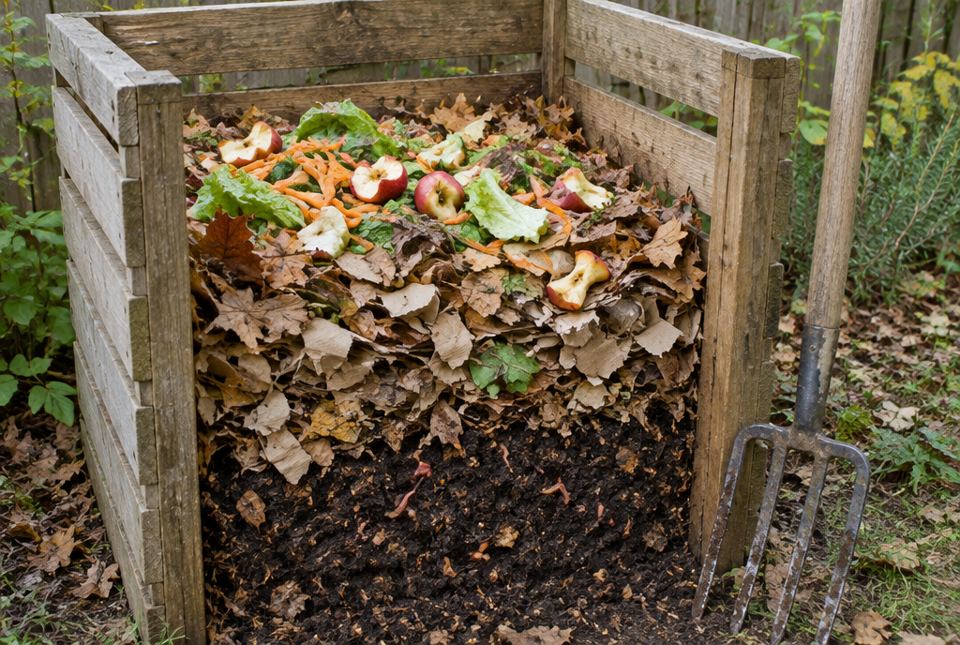 A real compost bin: the apple cores and lettuce are greens, the dry leaves are browns, and the dark compost at the bottom is the work of decomposers. A photo like this is another text feature that can help readers with the glossary words. AI-generated image
Worked exampleLet's evaluate how important the glossary is
How important is the glossary for understanding the compost paragraph? Does it matter who is reading?
- Which words would block understanding without help? aerobic, nitrogen, decomposers. Context gives some help (including bacteria, fungi and worms hints at decomposers), but aerobic has no context clue except oxygen.
- Special meanings: greens and browns are everyday words used in a special way. A reader might think browns means anything brown, like chocolate. The glossary prevents that misunderstanding.
- Audience: for a Grade 8 student who studied cells and systems in science, nitrogen may be familiar. For a younger student, a newcomer learning English, or a parent who's new to composting, the glossary is essential.
- Limits: a glossary only helps if readers know it's there. The bold words help. Alphabetical order makes terms quick to find.
The glossary is very important for this text, because it explains technical terms and special meanings of everyday words (greens, browns) that could cause real misunderstanding. It matters most for readers new to the topic or to English, and less for experts. Its usefulness depends on bold signals and alphabetical order.
Text features: the infographic
The Grade 8 class audited one week of lunch waste at their school (numbers invented for this lesson) and made an infographic. Here is its content, described in words:
- Title (large): WHERE DOES OUR LUNCH GO?
- Big number: 38 kg of lunch waste in one week
- Icons with numbers: 🍎 food scraps 18 kg · 📦 packaging 12 kg · 🥤 drink containers 8 kg
- A bar showing: Half of the food scraps were whole fruit, never bitten.
- Bottom line: Our goal: cut it in half by June. Compost bins arrive March 2!
🍎🍎🍎🍎🍎🍎🍎🍎🍎🍎🍎🍎🍎🍎🍎🍎🍎🍎📦📦📦📦📦📦📦📦📦📦📦📦🥤🥤🥤🥤🥤🥤🥤🥤
One icon for each kilogram in the class's invented audit: 18 food scraps, 12 packaging, 8 drink containers. 18 + 12 + 8 = 38 kg.Worked exampleLet's evaluate the infographic
Evaluate the lunch-waste infographic. What makes it effective? What could make it better?
- Check the math: 18 + 12 + 8 = 38 kg. The parts add up to the total, so the numbers are consistent.
- Strengths: the big number grabs attention; icons let a reader see the three categories in seconds; the surprising fact (whole fruit, never bitten) makes the problem memorable; the bottom line gives a goal and a date. Notice that it, too, follows a problem-solution pattern!
- Questions to ask: Who collected the data, and how? An infographic should say its source (here, a one-week class audit). Is one week typical? A week with a pizza lunch might be different.
- Accessibility: icons and colours alone won't work for someone using a screen reader, so the infographic needs text labels and alt text.
The infographic is effective for a quick, school-wide audience: clear categories, a striking total and a goal. It would be more trustworthy with a source line (Data: Grade 8 audit, one week in February) and more accessible with text labels and alt text. Infographics are powerful because they're fast, which is also why readers must check where the numbers come from.
Features are tools: judge them by the job
When you evaluate a text feature, ask: What job does it do? How well does it do it? For which readers? What would be lost without it? A glossary might be essential in a science booklet and unnecessary in a picture book. An infographic might be perfect for a hallway poster and too simple for a research report.
Just for funI wrote a letter to the editor complaining about all the puns in the newspaper.
The problem is, no pun in ten did.
Hands-on activityProblem-solution hunt and feature check
You need: a local newspaper or news website (a grown-up can help you find the letters or opinion section), a non-fiction book or textbook with a glossary, paper and a pencil.
- Find one letter to the editor. Draw the four boxes from the diagram (Problem → Why it matters → Solution → Objection + answer) and fill them in. If a box is missing, write missing and say whether the letter is weaker for it.
- Circle the signal words.
- In the non-fiction book, find the glossary. Choose three glossary words and find them in the main text. Would you have understood them without the glossary? Rate the glossary's importance from 1 (not needed) to 5 (essential) and give a reason.
- Do a one-day waste audit at home (with a grown-up, and wearing gloves if you sort anything): count items in the recycling, compost and garbage. Sketch an infographic with a title, a big number, icons and a goal. Add a source line.
Your turn
1What problem does Grace's letter describe?
The town bus doesn't run on weekends, so many people (especially on the east side, three kilometres away) can't get to the new community centre.
2What solution does Grace propose?
A weekend shuttle looping between the east side and the centre every hour from 9 a.m. to 5 p.m., using the town's unused van and volunteer drivers, tried for one summer.
3What objection does Grace expect, and how does she answer it?
Objection: it costs too much. Answer: the town already owns a van that sits unused on weekends, and volunteers with the right licence could drive it.
4List three signal words or phrases from the letter and the pattern each signals.
Any three: The problem is (problem); because (cause-effect inside the letter); One solution is (solution); Some people will say (objection); However (answer to objection / contrast).
5Why does Grace mention the newspaper's article in her first sentence?
Letters to the editor often respond to something the paper printed. It connects her letter to a topic readers already know and shows she agrees the centre is great, which makes her sound fair before she names the problem.
6Name two words from the compost glossary that are everyday words with a special meaning.
7What is one thing the lunch-waste infographic should add to be more trustworthy?
A source line explaining who collected the data and how (for example, Data: Grade 8 class audit, one week in February).
More practice: warm-up
1Which pattern answers What's wrong and how can we fix it?
2Where is a glossary usually found in a book?
At the end (back) of the book.
3In what order are glossary words listed?
4Which pattern uses signal words like first, then and finally?
Chronological (time order).
5What three things does an infographic combine?
Numbers (data), images or icons, and short text, arranged with design.
More practice: on your own
1Why does the problem-solution pattern suit a persuasive letter?
Readers must first agree there's a real problem before they'll accept a solution. Laying out the problem, why it matters, the solution and answers to objections leads readers step by step to agree.
2A history textbook chapter explains why the Rideau Canal was built and what happened afterward. Which pattern is it most likely to use? Why?
Cause-effect (with chronological order). It explains why something happened (causes) and what it led to (effects), usually in time order.
3Why might a glossary be more important for a newcomer learning English than for a native speaker?
A newcomer may not know technical words, and may misread everyday words used in special ways (greens, browns). The glossary gives exact meanings without needing to guess from context.
4An infographic says 9 out of 10 students LOVE the new lunch menu! What questions should you ask before trusting it?
Who made it (the cafeteria company?), how many students were asked, how they were chosen, what question was asked, and when. Without a source and method, the claim could be biased or misleading.
5Compare a glossary and an infographic: when is each feature most useful?
A glossary is most useful when a text has specialized vocabulary and readers need exact meanings while reading carefully. An infographic is most useful when readers need to grasp numbers or relationships quickly, such as on a poster or at the start of a report.
Challenge
1Grace's letter contains a cause-effect sentence inside a problem-solution structure. Find it and explain why mixing the patterns makes the letter stronger.
Last month, my friend missed every Saturday swim lesson because her parents work weekend shifts. The cause-effect sentence gives a real, specific example of why the problem matters. It turns a general claim into a human story, which makes readers care more about the solution. Writers often nest one pattern inside another to support the main pattern.
2Write a counter-letter of 4 to 5 sentences from a resident who disagrees with the shuttle, using the problem-solution pattern.
Sample: To the editor: I support getting people to the community centre, but the shuttle plan has a problem: volunteers may not show up every weekend, and riders would be left waiting. Without reliable drivers, people will stop trusting the service. A better solution is to give east-side families discount taxi vouchers for weekend trips. Some will say vouchers cost more per ride. However, we'd only pay for rides people actually take. I urge council to compare both options before deciding. (Look for: a problem, why it matters, a solution, an objection with an answer, a call to action.)
3The lunch-waste infographic shows only one week. Explain how this could mislead readers and suggest two changes to fix it.
One week might not be typical: a field-trip day, a special lunch or a holiday could make waste unusually high or low, so readers might believe the problem is bigger or smaller than it is. Fixes: 1) Collect data for several weeks and show the average; 2) add a source and method line stating the dates, so readers can judge for themselves. (Also acceptable: show the weekly numbers as a line or bar graph so readers see the variation.)
Quiz
1. The problem is that the skating path isn't lit. One solution is solar lights. These sentences use which pattern?
2. A letter to the editor is usually written by...
3. Which word is the best example of an everyday word with a special meaning that a glossary should explain?
4. Which question best helps you evaluate an infographic?
5. Unlike the old arena, the new one has an elevator. Both have two rinks. Which pattern is this?
6. Why do writers answer an objection in a problem-solution letter?
7. An infographic's three categories add up to more than its total. This tells you...
What this lesson teaches: Grade 8 students compare text patterns, such as problem-solution in a letter to the editor, and text features, such as glossaries and infographics, and evaluate how important they are for understanding (C1.3). They show how form, purpose and audience connect (A2.5) and how these skills help in other subjects (A3.1).
How to help at home:
- Read a letter to the editor together and ask: "What's the problem? What's the solution? Did they answer the other side?"
- When you see an infographic (news, a cereal box, a poster), ask: "Where do these numbers come from? Do they add up?"
- Point out glossary-style words in your own work or hobbies, words that mean something special in that field.
Common difficulties:
- Mixing up problem-solution and cause-effect. Ask: "Does the text propose a fix? If not, it's probably cause-effect."
- Describing features instead of evaluating them. Push for a judgment: "How much does it help, and for whom?"
- Trusting numbers automatically. Practise checking totals and looking for a source.
About the texts: The letter, newspaper, booklet and lunch-waste numbers are invented for this lesson. The compost science is accurate: greens are nitrogen-rich, browns are carbon-rich, decomposers include bacteria, fungi and worms, and turning a pile adds oxygen for aerobic bacteria. Safety: if your teen sorts household waste for the activity, use gloves and keep away from sharp items, broken glass and cleaning products.