A. Literacy Connections and Applications / C. Comprehension: Understanding and Responding to Texts · Understanding and Responding to TextsComparing Genres and Cultural Text Forms, and Choosing Texts for a Purpose
C1.2 C2.2 A3.1 A3.2About 50 minutes
Learning goals- I can analyze and compare genres such as historical fiction, memoir, magical realism and speeches, and explain with evidence how their characteristics create meaning.
- I can describe two cultural text forms, the landay and the renga, and explain how their structure shapes meaning.
- I can name my purpose for reading, listening or viewing, choose texts by diverse creators that fit it, and justify my choices.
- I can explain how knowing genres helps me in other subjects, in high school and in everyday life.
Words to know
genre
A category of texts that share characteristics, such as memoir, historical fiction or speech.
historical fiction
A made-up story set in a real time and place in the past. Real events and details mix with invented characters and conversations.
memoir
A true account of part of the writer's own life, told in the first person, that looks back and reflects on what the events meant.
magical realism
Fiction set in the ordinary, real world in which one magical thing happens and is treated as normal, without explanation.
speech
A text written to be spoken aloud to an audience, often using direct address, repetition and a call to action.
landay
A two-line folk poem from the Pashto-speaking people of Afghanistan and Pakistan: 9 syllables, then 13 syllables, traditionally ending on an m or n sound.
renga
A Japanese form of linked poetry written by several poets taking turns, alternating three-line and two-line stanzas.
cultural text form
A form of text that grew out of a particular culture's ways of making and sharing texts.
Remember from Grade 7
In Grade 7 you analyzed dystopian fiction, mysteries, interviews and opinion columns, and two cultural text forms, the pantoum (from the Malay pantun) and the sijo (from Korea). You chose texts by diverse creators for a purpose.
In Grade 8 you will analyze and compare: you'll put two genres side by side, explain what each one can do that the other can't, and back every claim with evidence from the text. This is exactly the kind of thinking you will do in Grade 9 English.
Hook: Six texts, one lighthouse
All six texts below are about the old lighthouse at Larkspur Bay, a made-up town on the shore of Lake Huron. They were written for this website. As you read, ask:
- What genre or form is this?
- Which clues prove it?
- What can this genre do for a reader that the others can't?
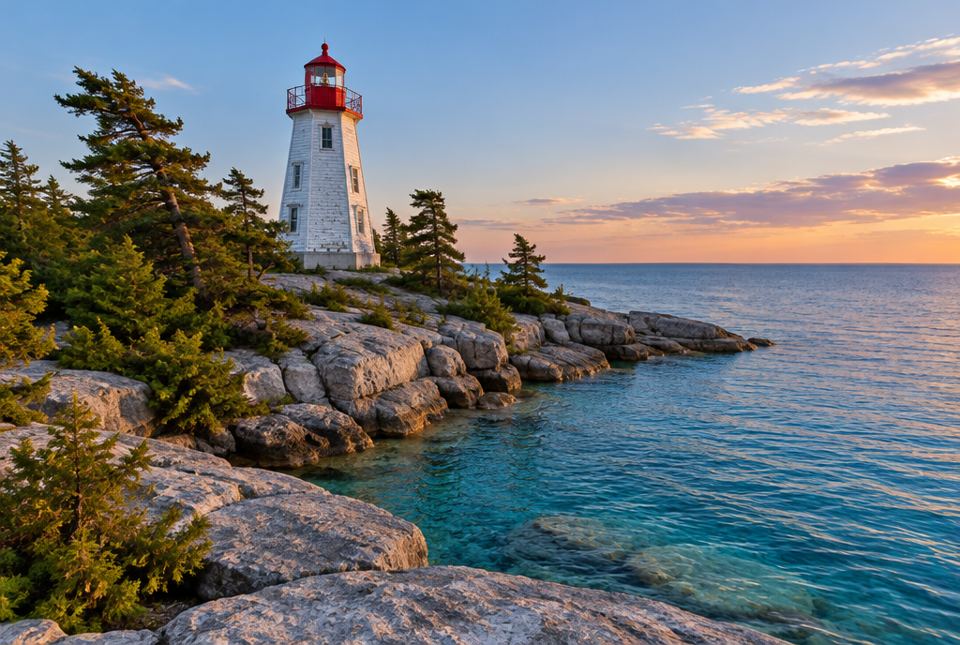 A lighthouse on a Great Lakes shore, like the made-up one at Larkspur Bay. As you read the six texts, think about how each genre would describe a scene like this differently. AI-generated image
Text A: The Keeper's Daughter
November 9, 1913. By noon the wind off Lake Huron was screaming so hard that Elsie could not hear her own voice. Her father had not slept in two nights. "The lamp must not go dark," he said, "not tonight." Then he coughed until he had to sit down on the stairs.
So Elsie climbed. Eighty-one steps, a can of kerosene knocking against her knees. At the top, she trimmed the wick the way he had shown her and wound the clockwork that turned the great lens. Out on the black water, somewhere, a ship's horn sounded once.
(Elsie is invented. The Great Lakes storm of November 1913 was real: it wrecked or sank many ships, and many sailors lost their lives.)
**Text B: from Salt and Kerosene, a memoir**
by Ruth Ann Mercer (a writer invented for this lesson)
I was seven the summer my grandfather let me polish the brass in the lighthouse. I remember the smell most of all: lake wind, metal polish and kerosene. He never said much. He would hand me a rag, point, and nod when I got it right.
I didn't understand then why he checked the lamp three times before bed. I understand it now. Sixty years later, I still check the stove three times before I go to sleep. Some lessons don't come in words.
Text C: What the Light Finds
Everyone in Larkspur Bay knows the lighthouse beam finds lost things. It has done so for as long as anyone remembers. Each night, when the light sweeps the town, it stops for one second on something that is missing: a mitten under a hedge, a dog asleep in a canoe, a wedding ring in a gutter.
Nobody finds this strange. Mrs. Okafor just puts on her boots and goes to get her reading glasses.
So when the beam stopped on Jonah's front window three nights in a row, his mother stood in the kitchen for a long time. Jonah hadn't lost anything. Or so he said.
Text D: Speech at the Lighthouse Festival
Given by Priya, a Grade 8 student, on Canada Day (invented for this lesson)
Good evening, everyone. Look up. That light has been shining over this bay for one hundred and fifty years. It shone through storms. It shone through wars. It shone through the years when no one remembered to thank it.
Now, the lighthouse needs us. Its paint is peeling. Its windows are cracked. Its stairs are closed. If we do nothing, it will be gone before my little sister is my age.
So tonight, I'm asking you three things. Sign the petition. Join the volunteer crew. And bring your kids up those eighty-one steps when they open again, so they can see what we see. Thank you.
Text E: Two landays
The lake took my brother's boat in fog. Now each lit window on the dark shore whispers his name.
You say the city has more to do, but the city has never once let you watch a loon.
Text F: Summer's Last Weekend, a renga written by three Grade 8 students (Amara, Jun and Teo)
Gulls over the pier, the lighthouse paint is peeling, summer's last weekend. (Amara)
My cousin packs her suitcase and leaves one sandal behind. (Jun)
One sandal, one shoe, the scarecrow at the corn maze wears them both by fall. (Teo)
First snow fills the empty field. The scarecrow keeps on waiting. (Amara)
Comparing two genres about the past
Texts A and B are both about lighthouses in the past, and both show a child helping a grandparent or parent. But they are different genres, and they do different things for a reader.
- Text A is historical fiction. The setting is real (Lake Huron, a real storm in November 1913) and the details fit the time (kerosene, a wick, clockwork that turned the lens). But Elsie is invented, and so is her conversation with her father. Historical fiction lets readers live inside a moment of history and feel it, even when no one recorded what ordinary people said.
- Text B is a memoir. It is true, it is told in the first person (I was seven), and the writer looks back from the present (I understand it now. Sixty years later...). A memoir's power is reflection: the writer tells us what the events meant to her life.
| Characteristic | Historical fiction (Text A) | Memoir (Text B) |
|---|
| True or invented? | Invented characters in a real time and place | True events from the writer's own life |
| Narrator | Often third person (Elsie climbed) | First person (I remember) |
| Time | Stays inside the past moment | Moves between past and present |
| Main power | Makes history feel immediate and exciting | Shows how an experience shaped a real person |
| Question to ask | Which details are historical, and which are invented? | What does the writer understand now that she didn't then? |
Worked exampleLet's compare magical realism with fantasy
In Grade 6 you learned that fantasy builds an invented world with magic. Text C has magic too. Why is it magical realism and not fantasy? What does the genre do for the story's meaning?
- Setting: Text C takes place in an ordinary town with mittens, hedges, gutters and boots. Fantasy usually creates a new world (or a hidden one) with its own rules, creatures and maps.
- One magical element: the beam that finds lost things. Everything else is realistic.
- No explanation, no amazement: Nobody finds this strange. Mrs. Okafor just puts on her boots. In fantasy, magic is often explained, studied or battled. In magical realism it is treated as everyday.
- What the magic means: when the beam stops on Jonah's window, it suggests Jonah himself is lost in some way, even though he hadn't lost anything. Or so he said. The magic becomes a way to show a feeling that is hard to say out loud.
Text C is magical realism: a realistic setting, one magical element treated as normal, and magic used to reveal a real emotional truth (Jonah may be struggling, and his mother notices). Fantasy is more about exploring an invented world; magical realism is about seeing our real world more deeply.
Worked exampleLet's analyze the features of a speech
Text D is a speech. Find three characteristics of the genre and explain how each helps Priya reach her purpose.
- Purpose: to persuade the audience to help save the lighthouse.
- Direct address: Good evening, everyone. Look up. She speaks to the crowd and gets them to do something right away, which grabs attention.
- Repetition: It shone through storms. It shone through wars. It shone through the years... Listeners can't reread a speech, so repetition helps them remember and builds rhythm and emotion.
- Rule of three and a clear call to action: Sign the petition. Join the volunteer crew. And bring your kids... Three short, numbered requests are easy to hear, remember and act on.
- Personal stakes: before my little sister is my age makes the problem feel close and urgent.
Direct address, repetition, the rule of three and a call to action are all features of the speech genre. They work because a speech is heard, not read: listeners need rhythm, repetition and clear requests to follow and remember.
Two cultural text forms
The landay is a folk poetry form of the Pashto-speaking people of Afghanistan and Pakistan. Landays are traditionally oral: they are spoken or sung, passed from person to person, and usually anonymous (no one owns them). Many have been made and shared by women. A landay is a couplet (two lines): 9 syllables, then 13 syllables, traditionally ending on an m or n sound in Pashto. Landays can be about love, grief, homeland, war or everyday life, and many are sharp and witty. In English, poets imitate the 9-and-13 shape.
The renga is a form of Japanese poetry that was very popular for centuries. A renga is written by several poets taking turns. Stanzas of three lines (5-7-5 syllables) alternate with stanzas of two lines (7-7 syllables). Each new stanza must link to the one just before it, but also shift in a new direction. The haiku you studied in earlier grades grew out of the opening stanza of a renga.
Worked exampleLet's count a landay and explain its shape
Check that the first landay in Text E fits the form, then explain how its short line, long line shape helps create meaning.
- Line 1: The / lake / took / my / bro / ther's / boat / in / fog = 9 syllables.
- Line 2: Now / each / lit / win / dow / on / the / dark / shore / whis / pers / his / name = 13 syllables. It ends on name, with an m sound, like a traditional landay.
- Shape and meaning: line 1 is short and blunt, like the shock of a loss. Line 2 is longer, stretching out like grief that goes on and on, until every window in town seems to remember the brother.
- Compare with the second landay: it has the same shape but a witty tone. The short line states an argument (the city has more to do); the long line answers back with a sharp twist about the loon.
Both landays fit the 9 + 13 pattern. The form's short-then-long shape works like setup and punch: a quick statement, then a longer line that deepens it into grief (landay 1) or turns it into a clever comeback (landay 2).
The first landay in Text E with one box per syllable: 9 in line 1 and 13 in line 2, ending on name. The longer second line has room to deepen what the short first line sets up.Worked exampleLet's trace how the renga links and shifts
Explain how each stanza of Text F links to the one before it and how it shifts. What meaning comes from many poets writing together?
- Stanza 1 to 2: summer's last weekend links to the cousin packing. Shift: from a place (the pier) to a person.
- Stanza 2 to 3: the forgotten sandal links to one sandal, one shoe. Shift: to a funny image, a scarecrow wearing them.
- Stanza 3 to 4: the scarecrow links again. Shift: the season jumps to winter, and the mood becomes lonely (keeps on waiting).
- Meaning from collaboration: no single poet planned the ending. The poem drifts like a conversation, and it ends up being about time passing and people leaving, an idea that grew out of three voices together.
Each stanza picks up one image from the stanza before (packing, sandal, scarecrow) and turns it somewhere new (person, humour, winter). Because several poets write in turns, a renga's meaning builds like a conversation, often reaching ideas no one poet would have planned.
Choosing texts for a purpose
Before you choose a text, name your purpose. Then choose texts whose genre and creators fit it, and be ready to justify your choice.
- I want to know what really happened: non-fiction (news, history books, documentaries, interviews) and primary sources.
- I want to know how it felt to live through it: memoir, historical fiction, poetry, oral stories.
- I want to be moved to act: speeches, opinion pieces, documentaries.
- I want to see my own world in a new way: magical realism, poetry, short stories.
Diverse creators matter because people from different backgrounds, communities, languages, abilities and generations notice different things. When a story is told by someone from the community it is about, you hear an insider's perspective. Ask: Whose voices are in my pile of texts, and whose are missing?
Worked exampleLet's choose texts and justify the choice
Kai's purpose: I want to understand what it was like for families who lived through the 1913 storm on the Great Lakes, for a Grade 8 History project. Which of these should Kai choose, and why?
- Text A, The Keeper's Daughter (historical fiction)
- Newspaper articles printed in Great Lakes towns in November 1913, from a library archive
- A museum website about the storm, with photos and a list of ships lost
- Text C, What the Light Finds
- Letters or memories from sailors' families, collected by a local historical society
- Text C is set in the present and its magic isn't about the storm, so it doesn't fit this purpose.
- Sources 2 and 5 are primary sources: they come from people who lived through it. They show what families actually saw and felt. They are the heart of a history project.
- Source 3 gives reliable facts and context (dates, ships, images) to check details against.
- Text A can help Kai imagine the night, but it's fiction. Kai could use it as a starting point for questions (Did keepers really work through storms like that?) and check the details in the primary sources.
Kai should rely on 2, 3 and 5 (primary sources plus a reliable museum source) and might use Text A only to spark questions and imagination, clearly labelled as fiction. Text C doesn't fit. Kai could also look for perspectives from different communities around the lakes, such as First Nations communities on the shore and the families of sailors from many backgrounds, to make the project fuller.
Genre knowledge everywhere
In History, knowing a memoir is one person's reflection reminds you to compare it with other sources. In Science, a lab report has fixed sections, so you know where to find the results. In high school, you'll be asked to compare how two genres treat the same theme: this lesson is that skill. In everyday life, recognizing a speech's repetition and call to action helps you notice when someone is trying to move you, so you can decide for yourself.
Just for funImagine a group chat where every message has to be exactly 5-7-5 or 7-7 syllables and link to the message before it. Japanese poets did this for fun, and a classic renga could run to 100 stanzas. Your group chat has nothing on them.
Hands-on activityGenre remix and form workshop
You need: paper, a pencil, and 3 or 4 texts from home or the library (a novel, a magazine, a recipe book, a song lyric sheet, a news site a grown-up opens).
- Genre ID: for each text you found, name its genre and give two pieces of evidence.
- Remix: choose a true event from your family (a big snowstorm, a move, a first day). Write it twice, in two genres: as a 5-sentence memoir (first person, looking back) and as the opening of a magical realism story (realistic setting, one magical element nobody questions). Underline the features of each.
- Write a landay: 9 syllables, then 13. Tap the syllables on the table as you count. Try to make line 2 deepen or twist line 1.
- Family renga: you write a 5-7-5 stanza, a family member writes a 7-7 stanza that links to one image in yours, then you write the next 5-7-5. Read it aloud. Talk about where the poem ended up, and why.
- Purpose pick: with a grown-up, choose a purpose (for example, understand what it's like to start school in a new country). Find two texts by creators from different backgrounds that fit, and write two sentences justifying each choice.
Your turn
1Give two pieces of evidence that Text A is historical fiction.
Any two: a real historical setting (Lake Huron, the real storm of November 1913); period details (kerosene, trimming a wick, clockwork turning the lens); invented characters and dialogue (Elsie and her father); the note saying Elsie is invented but the storm was real.
2Give two pieces of evidence that Text B is a memoir.
Any two: it's true and about the writer's own life; first person (I was seven); it looks back from the present (I understand it now. Sixty years later...); it reflects on what the experience meant (Some lessons don't come in words).
3What is the one magical element in Text C, and how do the townspeople react to it?
The lighthouse beam finds lost things. The townspeople treat it as normal: Nobody finds this strange, and Mrs. Okafor simply puts on her boots to fetch her glasses.
4Find an example of repetition in Text D and explain its effect.
It shone through storms. It shone through wars. It shone through the years when no one remembered to thank it. The repeated It shone through builds rhythm and makes the lighthouse seem faithful and enduring, so listeners feel it deserves help. It's also easy to remember when heard.
5Count the syllables in the second landay of Text E. Does it fit the form?
Line 1: You / say / the / ci / ty / has / more / to / do = 9. Line 2: but / the / ci / ty / has / ne / ver / once / let / you / watch / a / loon = 13. Yes, it fits the 9 + 13 pattern (and it ends on an n sound, loon).
6In Text F, which word or image links stanza 2 to stanza 3?
The sandal: Jun's cousin leaves one sandal behind, and Teo's stanza begins One sandal, one shoe.
7Your purpose is to feel what it was like to be a teen in 1913. Which Larkspur Bay text fits best, and what should you remember while reading it?
Text A (historical fiction) fits because it puts you inside the moment through a teen character. Remember that Elsie and her dialogue are invented, so check historical details against non-fiction sources.
More practice: warm-up
1Which genre is a true account of the writer's own life, told looking back?
2Which genre mixes invented characters with a real time and place in the past?
3How many syllables are in each line of a landay?
9 in line 1 and 13 in line 2.
Several poets taking turns.
5Name one feature of a speech.
Any one: direct address to the audience, repetition, the rule of three, a call to action, short sentences that are easy to hear.
More practice: on your own
1Why do speeches usually use more repetition than written articles?
Listeners can't reread a speech. Repetition helps them follow and remember the key ideas and creates rhythm and emotion in the moment.
2How is magical realism different from fantasy?
Magical realism is set in the ordinary real world with one magical element treated as normal and unexplained. Fantasy usually builds a new or hidden world with its own rules, creatures and often explained magic.
3Why is a landay traditionally anonymous, and how might that affect what people say in landays?
Landays are passed orally from person to person, so they belong to everyone rather than one author. Being anonymous lets speakers say bold, honest or critical things (about love, grief, war or unfairness) without being singled out.
4A memoir and a historical fiction story are both about the 1998 ice storm in eastern Ontario and Quebec. Which one would you trust for facts? Why?
The memoir, because it is a true account by someone who lived through it, though it is still one person's memory and perspective, so check key facts against other sources. Historical fiction invents characters and events, even if the storm was real.
5Why does a renga need each stanza to link to the one before it?
The links hold the poem together. Without them, it would be a pile of separate poems. Linking also makes each poet respond to the last one, like a conversation.
Challenge
1Text A and Text B both show a child helping an adult with a lighthouse. Compare how each genre makes the reader care about that relationship.
Text A (historical fiction) creates suspense and danger: the storm, the father's cough, eighty-one steps, the ship's horn. We care because Elsie is brave in a crisis, in the moment. Text B (memoir) uses quiet reflection: the grandfather never said much, and the writer realizes sixty years later that she learned his habit of care. We care because we see how the relationship shaped a whole life. Fiction shows the relationship in action; memoir shows its lasting meaning.
2Rewrite the first two lines of Text C as the opening of a fantasy story instead. Then explain what changed.
Sample: In the kingdom of Lyr, the Great Beacon was guarded by the Order of Keepers, who alone knew the spell that let its light seek out what was lost. What changed: an invented world (the kingdom of Lyr), special institutions (the Order), and magic that is explained as a spell and treated as extraordinary. The magical realism version kept the ordinary town and treated the magic as everyday, which made it about real feelings rather than an adventure.
3Choose a purpose and three texts by diverse creators for this research question: How do young people in different parts of Canada experience winter? Justify each choice.
Sample: Purpose: to understand different lived experiences of winter. 1) A memoir or interview by an Inuk youth or writer from Nunavut, because winter there is longer and darker and they can describe it from the inside. 2) A poem or blog by a newcomer teen in Toronto experiencing their first Canadian winter, for a fresh outsider-becoming-insider view. 3) A news feature about a rural Prairie community's outdoor rink, for facts and community voices. Together they give different regions, cultures and experiences and mix personal and factual genres. (Accept any well-justified set that names the purpose, includes different creators, and explains why each fits.)
Quiz
1. I was eleven when we left Manila. Now, at forty, I can still smell the airport. This is most likely from...
2. Which detail shows that a text is magical realism?
4. What makes a renga different from most poems?
5. Sign the petition. Join the crew. Bring your kids. This ending of a speech uses...
6. Your purpose is to learn what life is like for Deaf teens in Ontario. Which text best fits?
7. Which genre stays inside a past moment with invented characters?
What this lesson teaches: Grade 8 students analyze and compare the characteristics of text forms and genres, including cultural text forms, and explain with evidence how those characteristics help communicate meaning (C1.2). They identify purposes for reading, select texts by diverse creators that fit, and justify their choices (C2.2). They also see how this knowledge supports other subjects and everyday life (A3.1) and how texts from diverse cultures connect to identity and belonging (A3.2).
How to help at home:
- When your teen reads or watches something, ask: "What genre is it? What can it do that a different genre couldn't?"
- Share a family memory as a short memoir together, then imagine it as historical fiction told by someone else.
- Try the family renga in the activity. It's a fun way to practise counting syllables and linking ideas.
Common difficulties:
- Listing features without comparing. Grade 8 asks for comparison. Prompt: "What does this genre do that the other one doesn't?"
- Treating historical fiction as fact. Remind your teen to separate real history from invented characters.
- Counting syllables. Clap or tap each beat. Words like every and fire can be said with different numbers of syllables, so pick clear words.
About the texts: All texts were written for this site; Larkspur Bay, Elsie, Ruth Ann Mercer, Priya and the young poets are invented. The Great Lakes storm of November 1913 was real and wrecked or sank many ships. The landay is a two-line Pashto folk form (9 and 13 syllables, traditionally ending on an m or n sound), often shared orally and anonymously, including by women. The renga is a Japanese collaborative linked-verse form of alternating 5-7-5 and 7-7 stanzas; the haiku grew from its opening stanza (the hokku).