B. Canada, 1890–1914: A Changing Society · Canada, 1890–1914: A Changing SocietyThe Klondike Gold Rush and the New Provinces
B3 B2About 50 minutes
Learning goals- I can describe the Klondike Gold Rush and its effects on the Yukon and on the Tr'ondëk Hwëch'in and other First Nations.
- I can explain why the Yukon Territory (1898) and the provinces of Alberta and Saskatchewan (1905) were created.
- I can describe how northern Ontario grew through railways, mining and new boundaries.
- I can explain the cause-and-consequence links between gold, railways, treaties and new provinces.
Words to know
gold rush
A sudden rush of people to a place where gold has been found.
stampeder
A person who joined the rush to the Klondike.
territory
A region of Canada governed more directly by the federal government than a province is.
autonomy
The power to govern yourself.
Tr'ondëk Hwëch'in
The First Nation whose homeland includes the area of Dawson City in the Yukon (sometimes called the Hän people).
boom town
A town that grows very fast because of a new industry, such as mining.
Let's start with a question
If someone told you that gold was lying in a creek more than 2,000 kilometres away, through mountains and ice, would you go? What would you need to bring?
In 1897–1898, tens of thousands of people answered yes. Their rush to the Klondike changed the map of Canada.
Gold on Rabbit Creek (1896)
In mid-August 1896, three people found gold on Rabbit Creek, a small stream flowing into the Klondike River in the Yukon: an American prospector, George Carmack, and two Tagish First Nation men, Keish (Skookum Jim Mason) and Káa Goox (Dawson Charlie). Carmack had married into their family. Many accounts also include Keish's sister Shaaw Tláa (Kate Carmack) in the party. The creek was soon renamed Bonanza Creek.
News reached the outside world in July 1897, when ships loaded with gold reached Seattle and San Francisco. Tens of thousands of "stampeders", mostly from the United States, set out.
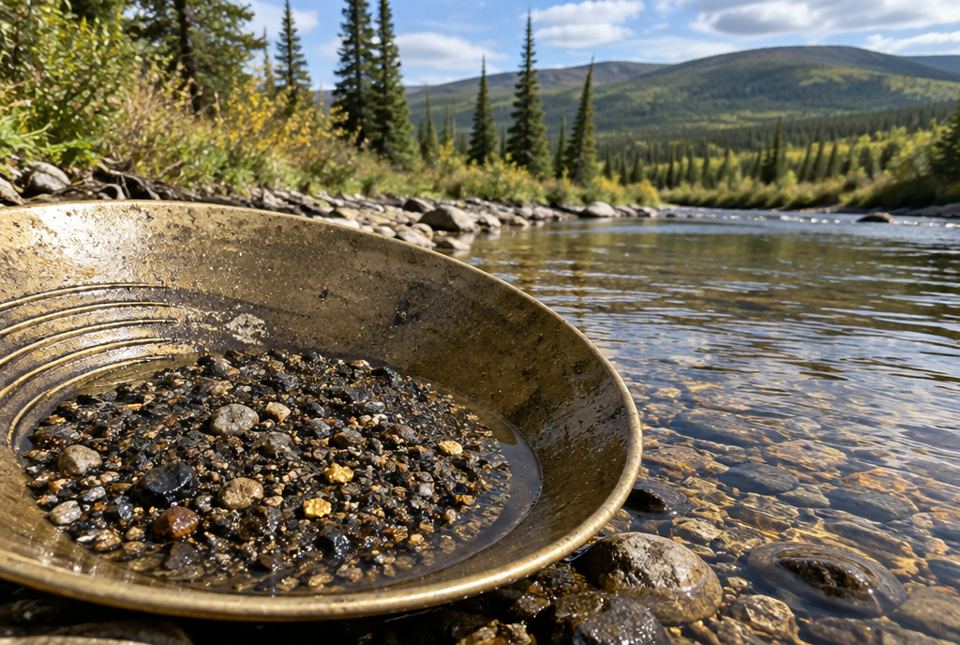 Prospectors swirled gravel and water in a pan like this one so the heavy gold sank to the bottom. Imagine doing this for hours in an icy Yukon creek, hoping to see a few flakes shine. AI-generated image
The trail and the rules
Most stampeders climbed the steep Chilkoot Pass or the White Pass from Alaska, then built boats and travelled about 800 km down lakes and the Yukon River to Dawson City.
The North-West Mounted Police guarded the border passes. They required every stampeder to bring about a tonne of supplies, enough food and gear for a year, so that people would not starve. Many people climbed the Chilkoot Pass 30 or 40 times to haul all their goods up.
The police presence also showed that the Yukon was Canadian territory, not American.
Dawson City and the new territory
Dawson City became a boom town. The population of the Klondike peaked at 25,000 or more. There were hotels, theatres, dance halls and newspapers, all in a place with no road to the outside world.
To govern this sudden crowd, Parliament created the Yukon Territory on 13 June 1898, with Dawson as its capital.
The rush was short. Most of the best claims were already taken by 1897, and many stampeders found nothing. When gold was found in Nome, Alaska, in 1899, many left. Within about ten years, the population of the Klondike had fallen to a few hundred. Gold mining continued, using big machines owned by companies.
What did the gold rush mean for First Nations?
The Klondike is the homeland of the Tr'ondëk Hwëch'in. The fishing camp at the mouth of the Klondike River was an important place for them. The rush pushed them aside: their land was taken over for claims and the town, game animals were overhunted, and new diseases spread.
Chief Isaac led his people to a new village at Moosehide, a few kilometres downriver, to keep some distance from the crowds, and he worked to protect his people's culture.
The rush also led directly to Treaty 8 in 1899 (next lesson): the government wanted a treaty because of the flood of newcomers passing through northern Alberta and British Columbia on the way to the Klondike.
A century later, land claim and self-government agreements brought the Tr'ondëk Hwëch'in some redress and self-government. In 2023, the Tr'ondëk-Klondike area was named a UNESCO World Heritage Site, telling the story of the gold rush from a First Nations perspective as well.
Alberta and Saskatchewan (1905)
Remember Sifton's settlers from the lesson Settling the West. By the early 1900s, hundreds of thousands of people lived in the North-West Territories, which were run largely from Ottawa. Settlers wanted roads, schools and their own government: they wanted provincial status.
On 1 September 1905, two new provinces were created: Alberta (capital Edmonton) and Saskatchewan (capital Regina).
Two arguments shaped the deal:
- Natural resources: Ottawa kept control of the new provinces' land and natural resources, unlike the older provinces. Alberta and Saskatchewan did not get them until 1930.
- Schools: The new provinces kept a system that allowed Catholic (and Protestant) separate schools. Clifford Sifton resigned from Laurier's Cabinet in 1905 because he thought the original plan protected separate schools too much. This was another French-English and Catholic-Protestant debate, like the Manitoba Schools Question.
Northern Ontario grows
Ontario changed too.
- The Ontario government built a railway north from North Bay, the Temiskaming and Northern Ontario Railway. While it was being built in 1903, silver was found at Cobalt, starting a mining rush.
- In 1909, gold was found in the Porcupine area, where Timmins grew.
- Treaty 9 (1905–06) was signed with Cree and Anishinaabe (Ojibwe) nations of northern Ontario, opening the land to railways and mines (next lesson).
- In 1912, Parliament extended the borders of Ontario, Quebec and Manitoba north to the shores of Hudson Bay and Hudson Strait, giving the provinces roughly their present shapes.
| Year | Change to the map |
|---|
| 1867 | Confederation: Ontario, Quebec, Nova Scotia, New Brunswick |
| 1870 | Manitoba joins; Rupert's Land becomes the North-West Territories |
| 1871 and 1873 | British Columbia and Prince Edward Island join |
| 1898 | Yukon Territory created during the Klondike Gold Rush |
| 1905 | Alberta and Saskatchewan become provinces |
| 1912 | Ontario, Quebec and Manitoba extended north |
| 1949 | Newfoundland (now Newfoundland and Labrador) joins |
| 1999 | Nunavut created |
Worked exampleModelled example: A cause-and-consequence chain
Build a chain of causes and consequences starting with gold found on Rabbit Creek in 1896.
- Start: Gold is found on Rabbit Creek (August 1896).
- Consequence 1: News spreads in 1897; tens of thousands of stampeders head north.
- Consequence 2: Ottawa needs to govern and control the crowds: the NWMP enforce rules, and the Yukon Territory is created (1898).
- Consequence 3: Stampeders pass through northern Alberta and B.C., so the government seeks Treaty 8 (1899).
- Consequence 4 (for the Tr'ondëk Hwëch'in): land and game are lost, and the community moves to Moosehide.
- Long-term: the rush ends, but mining and the territory remain; much later, land claim agreements and a UNESCO World Heritage listing.
One discovery led to a new territory, a treaty, and big changes for First Nations: one cause can have many consequences, some intended and some not.
Short-term and long-term
When you explain consequences, separate short-term ones (a boom town in 1898) from long-term ones (a new territory still on the map today). Long-term consequences usually make an event more significant.
Just for funGym class stair challenge? Stampeders climbed the steep "Golden Stairs" up the Chilkoot Pass with a heavy pack, then went back down and did it again, as many as 40 times, to haul their tonne of supplies. No one gave them a participation ribbon.
Hands-on activityPack for the Chilkoot: the one-tonne challenge
You need: paper, a pencil, a bathroom or kitchen scale, and a grown-up.
- A tonne is 1,000 kg. Weigh a bag of flour, sugar or rice from your kitchen (often 1 to 10 kg). How many of these bags would make a tonne?
- Make a list of what a stampeder needed for a year: flour, beans, bacon, dried fruit, sugar, coffee, tent, stove, tools, warm clothes, boots, a gold pan.
- If you can carry about 25 kg up a mountain on each trip, how many trips would one tonne take? (1,000 ÷ 25 = 40 trips.)
- Write two sentences about why the NWMP made this rule, from the police's perspective, and two sentences from a tired stampeder's perspective.
Safety: lift only what is comfortable, and let a grown-up lift heavy bags.
Look for: the 40-trip calculation and two different perspectives on the rule.
Your turn
1Who found gold on Rabbit (Bonanza) Creek in August 1896?
George Carmack, Keish (Skookum Jim Mason) and Káa Goox (Dawson Charlie); many accounts also include Shaaw Tláa (Kate Carmack).
2Why did the NWMP require each stampeder to bring a tonne of supplies?
So people would have about a year's food and gear and would not starve in the North.
3When was the Yukon Territory created?
4How did the gold rush affect the Tr'ondëk Hwëch'in?
They were pushed aside: land was taken for claims and Dawson City, game was overhunted and disease spread. Chief Isaac moved his people to Moosehide.
5When did Alberta and Saskatchewan become provinces, and what are their capitals?
1 September 1905. Edmonton (Alberta) and Regina (Saskatchewan).
6What did Ottawa keep control of in the new provinces until 1930?
Their land and natural resources.
7What was found at Cobalt in 1903?
Silver, during the building of the Temiskaming and Northern Ontario Railway.
More practice: warm-up
1Which boom town grew at the Klondike?
2Which mountain pass did many stampeders climb?
The Chilkoot Pass (or the White Pass).
3Which treaty was linked to the gold rush in 1899?
4In what year were Ontario's borders extended north to Hudson Bay?
5Where did gold strikes start the town of Timmins?
The Porcupine area (1909).
More practice: on your own
1Explain how the NWMP helped Canada keep control of the Yukon.
By guarding the border passes, enforcing rules like the tonne of supplies, and keeping order, they showed that the Yukon was Canadian, even though most stampeders were American.
2Why did people in the North-West Territories want provincial status?
A large, growing population wanted their own government to build roads and schools and make local decisions, instead of being run largely from Ottawa.
3Why did Clifford Sifton resign in 1905?
He objected to the original plan for separate schools in the new provinces, believing it protected Catholic schools too much.
4Why is it unfair that Alberta and Saskatchewan did not control their natural resources until 1930?
The older provinces controlled their own resources and earned money from them. The new provinces were treated differently and had less money and power for 25 years.
5Give one short-term and one long-term consequence of the Klondike Gold Rush.
Short-term: Dawson City booms to 25,000+ people. Long-term: the Yukon Territory still exists; Treaty 8; lasting effects on the Tr'ondëk Hwëch'in, later addressed in part by land claim agreements.
Challenge
1Was the Klondike Gold Rush more significant for the stampeders or for the Tr'ondëk Hwëch'in? Argue with evidence.
A strong answer might argue it was more significant for the Tr'ondëk Hwëch'in: for most stampeders it was a few years' adventure, and most found little gold and left, but for the Tr'ondëk Hwëch'in it permanently changed their homeland, pushed them to Moosehide and affected them for over a century. Another answer could point to stampeders who became rich. Evidence and reasoning matter most.
2Compare the creation of Manitoba in 1870 with the creation of Alberta and Saskatchewan in 1905. Give one similarity and one difference.
Similarity: in both, Ottawa kept control of land and natural resources, and schools and religion were key issues. Difference: Manitoba was created after the Red River Resistance led by Louis Riel and the Métis; Alberta and Saskatchewan were created mainly because of the huge growth of settler population.
3How did railways connect the Klondike, northern Ontario and the new provinces in this period?
Railways (and plans for them) drove settlement on the Prairies, which led to new provinces; the T&NO Railway led to mining discoveries in northern Ontario; governments sought treaties (8 and 9) to open land for railways and mines. Railways were a cause of many changes to the map.
Quiz
1. Where was gold found in August 1896?
2. Why did the NWMP require a tonne of supplies?
3. When was the Yukon Territory created?
4. What did Chief Isaac do as the gold rush crowds arrived?
5. Which two provinces were created on 1 September 1905?
6. What did Ottawa keep control of in Alberta and Saskatchewan until 1930?
7. What happened in Ontario in 1912?
Big idea: This lesson covers significant events and developments (the Klondike, the Yukon Territory, Alberta and Saskatchewan, northern Ontario) and their causes and consequences (B3), with First Nations perspectives on the gold rush (B2).
Facts: Dates and numbers follow The Canadian Encyclopedia's Klondike article. Accounts differ on who exactly was present at the discovery; the lesson names those the main sources agree on and notes Shaaw Tláa (Kate Carmack) as included in many accounts.
How to help: Look at a map of Canada together and trace the stampeders' route from Skagway, Alaska, over the Chilkoot Pass to Dawson City. In Ontario, find Cobalt and Timmins on a map and talk about how mining towns grew.
Common difficulties: Thinking most stampeders got rich (most did not); forgetting that the Yukon is a territory, not a province; thinking Alberta and Saskatchewan got the same deal as older provinces.