B. Canada, 1890–1914: A Changing Society · Canada, 1890–1914: A Changing SocietyIndustrialization: Railways, Resources and Factories
B3 B1About 50 minutes
Learning goals- I can explain what industrialization means and how it changed Canada between 1890 and 1914.
- I can describe the wheat boom, new railways, resource industries and hydroelectric power.
- I can explain how the National Policy and tariffs encouraged factories, including American branch plants.
- I can explain who benefited from industrialization and who paid the costs.
Words to know
industrialization
The change from making things by hand to making them by machine in factories, using new energy sources.
tariff
A tax on goods brought in from another country, which makes them cost more than goods made at home.
National Policy
Macdonald's plan from 1879: tariffs to protect Canadian factories, a railway across the country, and western settlement.
branch plant
A factory in Canada owned by a company based in another country, such as the United States.
hydroelectricity
Electricity made using the force of falling or flowing water.
staple
A main natural product that a region sells to other places, such as wheat, fish, lumber or minerals.
navvy
A labourer who did heavy construction work, such as building railways.
Let's start with a question
Look at the light switch nearest you. Where does the electricity come from? If you live in Ontario, part of it may come from Niagara Falls, and the system that brings it to you started in 1906.
Between 1890 and 1914, machines, railways and electricity transformed Canada's economy. This is called industrialization.
The wheat boom
After 1896, world prices for wheat rose, shipping got cheaper, and the Prairies filled with farmers (remember Settling the West). Wheat became Canada's most important export.
- Scientists at the government's Experimental Farm in Ottawa developed new wheat types. Marquis wheat, developed by Charles Saunders in the early 1900s, ripened earlier, so farmers could harvest before the first fall frost.
- Grain elevators rose beside railway tracks in every Prairie town to store wheat until trains took it east.
- Wheat travelled by train to the Lakehead (now Thunder Bay), then by ship through the Great Lakes, and on to Europe.
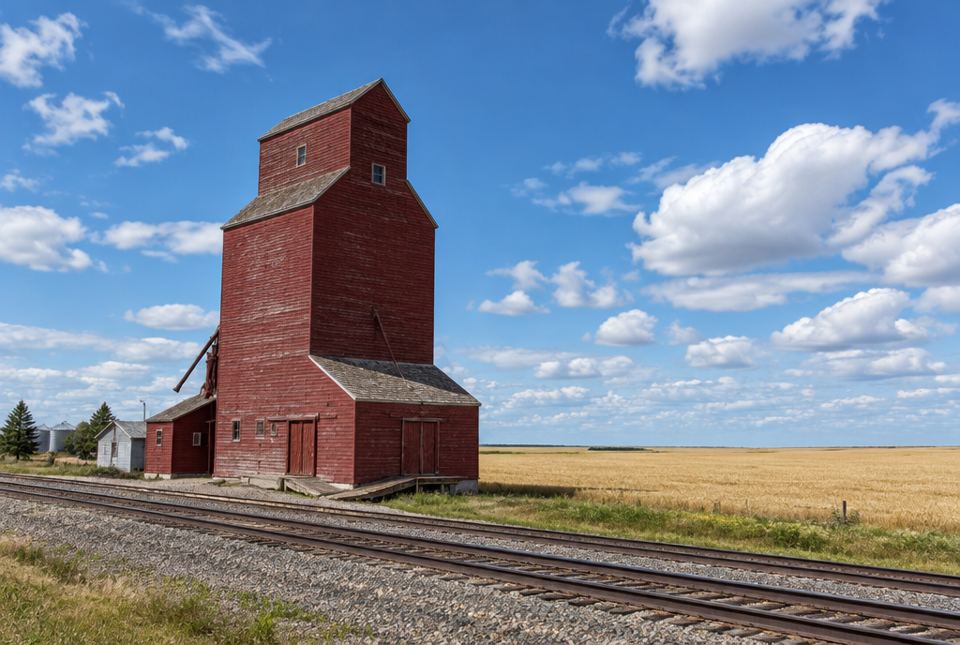 Grain elevators like this one stored wheat beside the tracks until trains carried it east. Notice how the elevator, the railway and the wheat field all belong together: they are the wheat boom in one picture. AI-generated imageWheat moved from farm to elevator to train to ship. Each step created jobs, which is why the wheat boom grew the whole economy.
More railways
The CPR (1885) was not enough for the booming West. Two more transcontinental railways were built:
- the Canadian Northern, and
- the Grand Trunk Pacific, with the government's National Transcontinental line in the East. The Grand Trunk Pacific reached Prince Rupert, B.C., in 1914.
Thousands of workers, many of them immigrants such as Italians, Ukrainians, Scandinavians and others, worked as navvies, often in dangerous conditions. The country now had more railway than it needed. After 1914, the two new railways went bankrupt, and the government took them over, creating what became Canadian National (CN) in the years after the First World War.
Remember from Black Canadians, 1890–1914: the railways' sleeping-car porters were Black men who faced long hours and job segregation.
Resources and new industries
- Mining: silver at Cobalt (1903), gold in the Porcupine (1909), nickel at Sudbury, coal in Nova Scotia and B.C., and the Klondike's gold.
- Forests: lumber, and the new pulp and paper industry, which made newsprint for newspapers in Canada and the United States.
- Steel: large steel mills in Sydney (Nova Scotia), Hamilton and Sault Ste. Marie made rails and other steel. In 1910, several Hamilton companies joined to form the Steel Company of Canada.
- Farm machinery: Toronto's Massey-Harris sold ploughs, binders and other machines across Canada and the world.
- Cars: the Ford Motor Company of Canada began in 1904 in Walkerville (now part of Windsor), and the McLaughlin company in Oshawa started building cars in 1907.
Tariffs and branch plants
Since 1879, the National Policy had put tariffs on many goods made in other countries. This made American goods more expensive in Canada.
American companies found a way around it: they built branch plants in Canada. Ford Canada in Walkerville is a famous example: by making cars in Canada, it avoided the tariff and could also sell to other parts of the British Empire.
- Benefits: jobs for Canadians, new technology and skills.
- Costs: profits and big decisions often went to head offices in the United States, and Canadians paid more for some goods because of tariffs.
Power for the people: Ontario Hydro
Factories needed energy. Ontario had little coal but plenty of falling water. Private companies built power plants at Niagara Falls, but many towns felt the price was too high.
A businessman and politician from London, Ontario, Adam Beck, led a campaign for publicly owned electricity, sold at cost. In 1906, Ontario created the Hydro-Electric Power Commission of Ontario, which built power lines to carry Niagara power to towns and cities across southwestern Ontario.
Electricity changed factories, streetcars, street lighting and, gradually, homes.
| Who | Benefits of industrialization | Costs |
|---|
| Factory and mine owners | Large profits | Strikes and conflict with workers |
| Workers | Jobs and wages, often better than on the farm | Long hours, low pay, dangerous work (next lesson) |
| Prairie farmers | Railways and grain elevators to reach world markets | High freight rates and tariffs that made machinery expensive |
| First Nations | Some wage work | Land taken for railways, mines and dams; treaties pushed north |
| Consumers | New products like cars, electric lights and telephones | Higher prices for some goods because of tariffs |
Worked exampleModelled example: Was the tariff good for Canada?
Use evidence to judge whether National Policy tariffs helped or hurt different Canadians around 1910.
- List who it helped: factory owners and workers in central Canada (Ontario and Quebec), because goods from away cost more, so people bought Canadian-made goods; American companies opened branch plants, creating jobs.
- List who it hurt: Prairie farmers who had to buy machinery and goods at higher prices, while selling their wheat at world prices.
- Think about region: the benefits were mostly in central Canada; the costs fell heavily on the West and the Maritimes.
- Make a judgement: it helped build Canadian industry but created regional anger. Western farmers' anger helped lead to Laurier's 1911 free-trade deal with the U.S. (which voters rejected).
The tariff helped central Canadian industry but hurt western farmers. Whether it was "good" depends on whose perspective you take, which is why it caused political conflict.
Made in Canada?
Check the labels on five things in your home. How many were made in Canada? In 1910, many Canadians would have found that most manufactured goods came from Ontario, Quebec, the U.S. or Britain. What has changed?
Just for funWhy did Ontario towns cheer for Adam Beck's public power?
They were tired of being overcharged. (Shocking, we know.)
Hands-on activityTrace a product's journey
You need: a box of cereal, a bag of flour or a loaf of bread, paper and a pencil.
- Draw a flow chart for wheat in 1910: Prairie farm → wagon to the grain elevator → train to the Lakehead (Thunder Bay) → ship through the Great Lakes → mill or ocean ship → bakery or kitchen.
- Beside each step, write one job it created (farmer, elevator agent, railway worker, sailor, miller, baker).
- Now look at your product's label. Where was it made? Draw its journey today (trucks, highways, maybe trains).
- Circle one step that is the same in both journeys (continuity) and one that is different (change).
Look for: a chain of at least five steps and a correct continuity and change.
Your turn
1What is industrialization?
The change from making things by hand to making them by machine in factories, using new energy sources.
2Why was Marquis wheat important?
It ripened earlier, so Prairie farmers could harvest before the first fall frost.
3Name the two new transcontinental railways built in this period.
The Canadian Northern and the Grand Trunk Pacific (with the National Transcontinental).
4What is a branch plant? Give an example.
A factory in Canada owned by a foreign company. Example: Ford Motor Company of Canada in Walkerville (1904).
5What did the Hydro-Electric Power Commission of Ontario do, and when was it created?
Created in 1906, it brought publicly owned electricity from Niagara to towns and cities across Ontario, sold at cost.
6Who led the campaign for public power in Ontario?
7Name two resource industries that grew in this period.
Any two: mining (silver, gold, nickel, coal), forestry/lumber, pulp and paper, wheat farming, steel.
More practice: warm-up
1Where was the Ford Motor Company of Canada founded?
In Walkerville (now part of Windsor), Ontario, in 1904.
A tax on goods brought in from another country.
3What were grain elevators used for?
To store grain beside the railway until trains took it to market.
4Which city did the Grand Trunk Pacific reach in 1914?
5What is hydroelectricity?
Electricity made using the force of falling or flowing water.
More practice: on your own
1Why did American companies build branch plants in Canada?
To avoid Canadian tariffs: goods made inside Canada did not pay the tariff, and they could also sell to other parts of the British Empire.
2Why did many Ontario towns want publicly owned electricity?
They felt private companies charged too much. Public power sold at cost would be cheaper and help local industry.
3Explain why the building of two extra railways became a problem.
Canada had more railway than it needed; the new lines did not earn enough, went bankrupt, and the government had to take them over (becoming CN).
4Why did Prairie farmers dislike tariffs?
They had to buy machinery and goods at higher, protected prices, but sold their wheat at world prices, so tariffs cut into their earnings.
5Compare energy in Ontario in 1914 with today in one way.
Continuity: Niagara and other hydroelectric stations still produce power, and much of it is publicly owned. Change: today Ontario also uses nuclear, wind, solar and gas, and almost every home has electricity.
Challenge
1Explain how wheat, railways and immigration were connected in a cycle between 1896 and 1914.
More immigrants became farmers and grew more wheat; more wheat meant more freight for railways, so more railways were built; new railway lines opened new land for more immigrants. Each part fed the others, creating the boom.
2Who benefited most from industrialization in this period, and who paid the highest cost? Defend your answer.
Benefited most: factory, railway and mine owners in central Canada, who earned large profits. Highest cost: you could argue First Nations, who lost land to railways and mines and saw treaties pushed north, or workers, who faced dangerous jobs for low pay. Use evidence from this and other lessons.
3Some historians say Canada in 1914 was still a "hewer of wood and drawer of water", meaning it mainly exported raw resources. Is this fair? Use evidence.
Partly fair: Canada's biggest exports were raw staples like wheat, lumber, pulp and minerals. But it also had growing manufacturing (steel, farm machines, cars) and hydroelectric power in central Canada. A balanced answer says the economy was mixed, with industry concentrated in Ontario and Quebec.
Quiz
1. What does industrialization mean?
2. Why did farmers value Marquis wheat?
4. What was created in Ontario in 1906?
5. Who were often hurt by National Policy tariffs?
6. What happened to the Canadian Northern and Grand Trunk Pacific railways?
Big idea: This lesson covers industrialization and economic development (B3) and asks who benefited and who paid the costs, comparing then and now (B1).
Ontario connection: Ontario was the heart of Canadian industry: Hamilton steel, Toronto farm machinery, Walkerville cars, Cobalt silver and Niagara power. If you can, visit the Sir Adam Beck generating stations viewpoint at Niagara, or a local industrial heritage museum.
How to help: Do the label-check together. Talk about a local factory, mine or mill and who works there.
Common difficulties: Thinking tariffs are paid by the foreign company (consumers usually pay higher prices); confusing the National Policy (1879) with things that happened in 1890–1914 because of it.