Strand A: Foundations of Language and Mathematics · Talking, Listening, Reading and WritingReading Pictures and Simple Books
A3.3 A3.5 A3.6About 20 minutes
Learning goals- I can use pictures to help me understand a book.
- I can guess what a book might be about before we read it.
- I can read a simple pattern sentence using the picture and the first letter.
- I can connect a book to my own life.
- I can tell facts I learned from a non-fiction book.
Words to know
predict
To make a smart guess about what will happen or what a book is about.
clue
Something that helps you figure something out.
pattern book
A book that repeats the same words on every page, like "I see a ___."
connect
To say how a book is like something in your own life.
fact
Something that is true, like "Beavers have big front teeth."
You are already a reader!
(Grown-up: read aloud.)
Did you know you can "read" a book before you know all the letters? You can read the pictures! Pictures are full of clues.
Pictures tell us a lot
Look at a picture and ask:
- Who is in it?
- Where are they?
- What is happening?
- How do they feel? (Look at their faces!)
For example: a picture shows a girl in a snowsuit at the top of a snowy hill with a sled. She is smiling. What is happening? She is going sledding, and she feels happy!
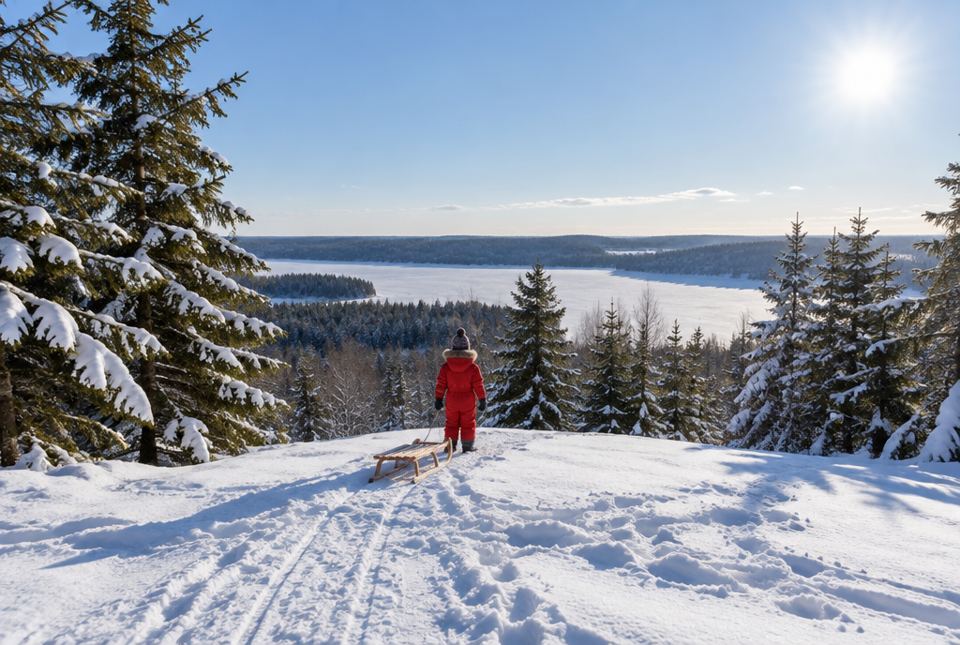 Read the picture! Who is in it? Where are they? What might happen next? AI-generated image
👧🛷❄️❄️❄️
A girl, a sled and snow. What do you think is happening?Guess before you read: predict!
Before we read a book, we can look at the cover and the title and make a smart guess. This is called predicting.
If the cover shows a bear in a cave with snow outside, we might predict: "It's about a bear sleeping in winter." Then we read to find out if we were right. It's okay if our guess was different. Readers change their guesses as they learn more.
Worked exampleLet's read a pattern book together
Each page of this little book says I see a ___. and has a picture. Page 1 has a picture of 🐶 and the words: I see a dog.
- Find the words you know. The book says I see a on every page. The grown-up reads it once. Now you can read it too: "I see a..."
- Look at the picture clue. The picture shows a dog 🐶.
- Check the first letter. The last word starts with d. Dog starts with /d/. It matches!
- Read the whole sentence, pointing under each word: "I see a dog."
I see a dog. You used the pattern, the picture and the first letter. That's real reading!
| Page | Words | Picture | First letter clue |
|---|
| 1 | I see a dog. | 🐶 | d |
| 2 | I see a cat. | 🐱 | c |
| 3 | I see a bus. | 🚌 | b |
| 4 | I see a moose. | 🫎 | m |
Making connections
When a book reminds you of your own life, say it! "This book is about a new baby. That reminds me of when my baby brother was born!"
Connections help us understand and remember what we read.
Learning facts from books
Some books teach real facts. Here are some facts from a book about beavers:
- Beavers have big orange front teeth for chewing trees.
- They use sticks and mud to build dams and homes called lodges.
- They have a flat tail. They slap it on the water to warn other beavers of danger.
The beaver is one of Canada's national symbols. It is on our 5-cent coin, the nickel!
Reader's tools
When you get stuck on a word, try your tools:
- Look at all the letters and sound them out: tap, slide, say.
- Use words you already know, like I, a, see and the.
- Check with the picture: does the word match?
- Think: does it make sense?
Just for funFunny but true: a beaver’s front teeth are orange because they have iron in them. That makes them extra strong for chewing trees! 🦫
Hands-on activityMake your own pattern book
You need: 4 pieces of paper, stapled or folded into a little book, and crayons.
- A grown-up writes I like on each page.
- Your child draws something they like on each page (snow, my cat, pizza, my mom).
- The grown-up writes the last word under the picture.
- Your child "reads" the book: "I like pizza." Point under each word.
- Read it to someone else in the family!
Fact retell: Read a short non-fiction book or watch a short nature clip together. Your child uses a stuffed animal or a drawing to tell you 2 facts they learned.
Your turn
1Look at the pattern book table. Read page 2.
I see a cat. The picture is a cat 🐱 and the word starts with c.
I see a bus. The picture is a bus 🚌 and the word starts with b.
3A book cover shows a pumpkin 🎃 and falling leaves 🍁. Predict: what season might the book be about?
Fall (autumn). Pumpkins and falling leaves are fall clues.
4A picture shows a boy with tears 😢 next to a broken toy. How does he feel? How do you know?
He feels sad. The tears and the broken toy are clues.
5Tell me one fact about beavers.
Any one: they have big front teeth, they build dams and lodges with sticks and mud, they have a flat tail they slap on the water.
6Does a book about going to the dentist remind you of anything in your life?
Answers will vary. Example: "Yes! I went to the dentist and got a new toothbrush." Look for "That reminds me of..."
More practice: warm-up
1Read page 1 of the pattern book.
2What do we call a smart guess about a book?
A prediction (predicting).
3Where can you find clues to help you read?
In the pictures (and the first letter of a word).
4A picture shows kids on skates ⛸️ on ice. What are they doing?
5Point to the word I in "I see a moose."
It is the first word, on the left. It is just one letter: I.
More practice: on your own
1Read page 4. What is the last word, and how do you know?
I see a moose. The picture is a moose 🫎, and the word starts with m for /m/.
2A page says "I see a ___" and the picture is a 🐟. The word starts with f. What is the word?
Fish. The picture shows a fish and fish starts with /f/.
3A book cover shows a girl with a suitcase at the airport ✈️. Predict what might happen.
Answers will vary. Good prediction: she is going on a trip (to visit family, on holiday). Look for a guess that uses the clues.
4Why do beavers slap their tails on the water?
To warn other beavers of danger.
5A picture shows a child holding an umbrella ☂️ with puddles everywhere. What is the weather?
Rainy. The umbrella and puddles are clues.
Challenge
1A page says "I see a ___". The picture shows a bear 🐻. Could the word be dog? Why or why not?
No. The picture shows a bear, and bear starts with b, not d. The word is bear.
2Use a stuffed animal or drawing to tell 2 facts about beavers.
Answers will vary. Any two: big front teeth for chewing trees; build dams and lodges with sticks and mud; flat tail slapped on water to warn others; on the Canadian nickel.
3We predicted a book was about a bear sleeping in winter. When we read it, the bear went fishing in summer. Was predicting a mistake?
No. A prediction is a smart guess. Good readers check their guesses and change their ideas as they read.
Quiz
1. A page says I see a ___ and shows 🐱. What is the missing word?
2. What can help you figure out a word?
3. A cover shows snowflakes ❄️ and a snowman ⛄. What season might the book be about?
4. Which is a fact about beavers?
5. "This book reminds me of my grandma!" What is this reader doing?
What the curriculum asks: Kindergarten children use what they already know, the pictures and the words to understand simple texts, make predictions, and connect books to their own lives, including information from non-fiction read with an adult. In the Kindergarten Curriculum (2026), this is part of understanding and responding to texts (A3.3 to A3.6). Children are also expected to read simple words with phonics and short sentences smoothly by the end of Kindergarten; see the lessons Reading and Spelling Short Words and Reading Short Sentences Smoothly.
How to help at home:
- Before reading, look at the cover and ask, "What do you think this book is about?"
- During reading, pause and ask, "What's happening in this picture?"
- Use simple pattern books ("I see a...", "I like...") and let your child read the repeated part.
- Include non-fiction. Children often love fact books about animals, vehicles and nature.
Common difficulties:
- Guessing only from the picture (saying "puppy" for dog). Praise the picture use, then say: "Good thinking! Now look at all the letters: d-o-g." Once your child knows letter sounds, sounding out comes first and the picture is for checking.
- Losing track of the words. Have them point under each word as they read.
- Some children are reluctant to guess. Make it clear that predictions don't have to be right.