C. Algebra · Algebra: Patterns, Rational Numbers, Equations, Inequalities, Coding and ModellingComparing Linear Patterns: Rates, Initial Values and Graphs
C1.1 C1.2 A1About 45 minutes
Learning goals- I can find the constant rate and initial value of a linear pattern, including ones with decimals, fractions and negative numbers.
- I can compare two linear patterns using equations, tables and graphs.
- I can find when two linear patterns are equal and explain which is greater before and after that point.
Words to know
constant rate
How much a linear pattern changes each step. It is positive for a growing pattern and negative for a shrinking one.
initial value
The value at term 0 (or time 0), before any change happens. On a graph, it's where the line crosses the vertical axis.
point of intersection
The point where two lines cross. There, both patterns have the same value.
steepness
How fast a line rises or falls. A larger rate (ignoring the sign) means a steeper line.
Remember from Grade 7
Every linear pattern can be written as
t = (constant rate) × n + (initial value)
For 7, 10, 13, 16 the rate is 3. Go back one jump from the first term to find the initial value: 7 − 3 = 4. So t = 3n + 4.
In Grade 8 the rate and initial value can be decimals, fractions or negative numbers, and you'll compare patterns that cross each other. In Grade 9 you'll meet the same two numbers with new names: slope and y-intercept.
Let's start with two rain barrels
(The numbers in this lesson are made up for practice.)
- Barrel A holds 120 L of water. A garden hose drains it at 6 L per minute.
- Barrel B holds 30 L. Rain from the downspout fills it at 4 L per minute.
Will they ever hold the same amount? When?
Barrel A: initial value 120, rate −6. V = 120 − 6t. Barrel B: initial value 30, rate +4. V = 30 + 4t.
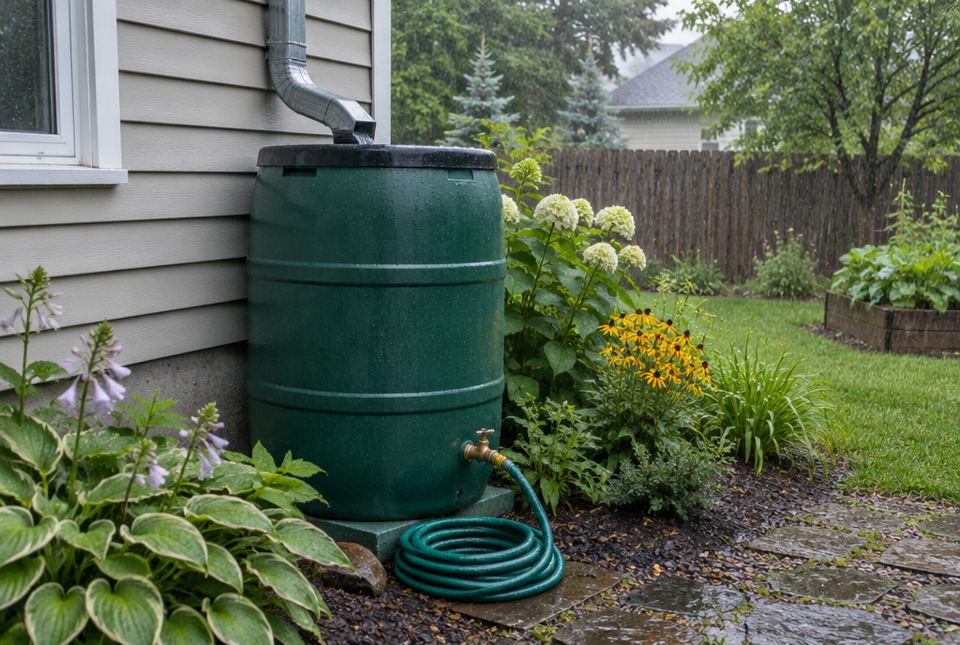 A rain barrel fills when rain runs in from the downspout and empties when a hose drains it. Filling adds water at a constant rate, and draining takes it away at a constant rate, just like Barrels A and B. AI-generated image
| t (min) | 0 | 3 | 6 | 9 | 12 |
|---|
| Barrel A (L) | 120 | 102 | 84 | 66 | 48 |
| Barrel B (L) | 30 | 42 | 54 | 66 | 78 |
Reading the graph
- The initial value is where each line starts on the vertical axis: A at 120, B at 30.
- The rate is the change for each step to the right. A goes down 6 L per minute, B goes up 4 L per minute. A's line is steeper, because 6 is bigger than 4.
- The lines cross at (9, 66). Before 9 minutes, A has more water. After 9 minutes, B has more.
You can also find the crossing point with an equation: 120 − 6t = 30 + 4t. Adding 6t to both sides gives 120 = 30 + 10t, so 90 = 10t and t = 9. (You'll practise this kind of equation in the lesson on equations with variables on both sides.)
Three ways to compare
- Equations: compare the rates and the initial values.
- Tables: line up the same term numbers and look where one passes the other.
- Graphs: steeper means faster change; the crossing point means equal values.
Worked exampleExample 1: Negative and decimal numbers
Find the rate, the initial value and an equation for −4, −1.5, 1, 3.5, ... (term 1 is −4).
- Differences: +2.5 each time. The rate is 2.5.
- Go back one jump from term 1: −4 − 2.5 = −6.5. That's the initial value.
- Equation: t = 2.5n − 6.5.
- Check term 3: 2.5 × 3 − 6.5 = 7.5 − 6.5 = 1 ✓.
t = 2.5n − 6.5 (rate 2.5, initial value −6.5)
Worked exampleExample 2: Two fitness passes
A community centre offers Plan A: $40 to join plus $12.50 per month, or Plan B: $25 per month with no joining fee. Which plan is cheaper?
- Plan A: C = 12.5m + 40. Plan B: C = 25m.
- B has the bigger rate, so B's cost grows faster. A has the bigger initial value, so A starts higher.
- Find when they're equal: 12.5m + 40 = 25m. Subtract 12.5m: 40 = 12.5m, so m = 3.2.
- Check whole months: 3 months: A = $77.50, B = $75. 4 months: A = $90, B = $100.
Plan B is cheaper for 3 months or fewer. Plan A is cheaper for 4 months or more.
Worked exampleExample 3: Two candles with fraction rates
Candle A is 20 cm tall and burns 1/2 cm per hour. Candle B is 15 cm tall and burns 1/4 cm per hour. When are they the same height? Which lasts longer?
- A: h = 20 − (1/2)t. B: h = 15 − (1/4)t. Both rates are negative (shrinking).
- Make a table: t = 0: 20 and 15. t = 10: 15 and 12.5. t = 20: 10 and 10. Equal at 20 hours.
- A is gone when 20 ÷ 1/2 = 40 hours. B is gone when 15 ÷ 1/4 = 60 hours.
Both are 10 cm tall after 20 hours. Candle B lasts longer (60 hours compared with 40).
Hands-on activityRace of the patterns
You need: about 40 coins, buttons or dried beans, and graph paper (or lined paper).
- Pattern A starts with 10 objects and adds 2 each step. Pattern B starts with 1 object and adds 5 each step.
- Write an equation for each. Predict the step where they have the same number of objects.
- Build step 1, step 2, step 3 of each with your objects to check.
- Plot both patterns on the same graph, with step number across and number of objects up.
What to look for: A: t = 2n + 10. B: t = 5n + 1. They are equal at step 3 (16 objects each). Before step 3, A is bigger; after step 3, B is bigger. B's points are steeper.
Math talk: "Which number in each equation tells you where the line starts? Which tells you how steep it is?"
Just for funWhy are parallel lines so sad?
They have so much in common (the same rate!), but they'll never meet.
Your turn
1Give the rate and initial value of t = −3n + 20. Is it growing or shrinking?
Rate −3, initial value 20. Shrinking.
2Write an equation for 4.5, 6, 7.5, 9, ... (term 1 is 4.5).
t = 1.5n + 3. Rate 1.5. Initial value 4.5 − 1.5 = 3.
3Which line is steeper: t = 2n + 10 or t = 5n + 1?
t = 5n + 1. Its rate (5) is bigger than 2.
4When are t = 2n + 10 and t = 5n + 1 equal?
At n = 3, where both are 16. 2n + 10 = 5n + 1 → 9 = 3n → n = 3.
5Write an equation for the shrinking pattern 50, 46.5, 43, ... (term 1 is 50).
t = 53.5 − 3.5n. Rate −3.5. Initial value 50 + 3.5 = 53.5. Check term 2: 53.5 − 7 = 46.5 ✓.
6Taxi A charges $3.50 plus $2 per km. Taxi B charges $5 plus $1.75 per km. When do they cost the same? Which is cheaper for a 10 km ride?
Same at 6 km ($15.50). Taxi B is cheaper for 10 km. 3.5 + 2d = 5 + 1.75d → 0.25d = 1.5 → d = 6. For 10 km: A = $23.50, B = $22.50.
7A line on a graph starts at (0, −4) and goes up 3 for every 1 to the right. Write its equation.
t = 3n − 4. Initial value −4, rate 3.
More practice: warm-up
1What is the initial value of t = 7n + 2?
2What is the rate of t = 15 − 4n?
3What are the rate and initial value of 10, 20, 30, ... (term 1 is 10)?
Rate 10, initial value 0. t = 10n.
4Is t = −2n + 8 growing or shrinking?
Shrinking. The rate is negative.
5What is the value of t = 3n + 5 when n = 0?
More practice: on your own
1Mila has $45 and saves $7.50 each week. Jun has $90 and spends $3.75 each week. When will they have the same amount? How much?
After 4 weeks, $75 each. 45 + 7.5w = 90 − 3.75w → 11.25w = 45 → w = 4. Check: 45 + 30 = 75 and 90 − 15 = 75 ✓.
2Write an equation for 2/3, 1, 4/3, 5/3, ... (term 1 is 2/3).
t = (1/3)n + 1/3. The rate is 1/3 (2/3 → 3/3 → 4/3). Initial value 2/3 − 1/3 = 1/3. Check term 2: 2/3 + 1/3 = 1 ✓.
3Pattern A: t = 0.5n + 12. Pattern B: t = 2n + 3. Which has the greater initial value? The greater rate? When are they equal?
A has the greater initial value (12); B has the greater rate (2). Equal at n = 6, where both are 15. 0.5n + 12 = 2n + 3 → 9 = 1.5n → n = 6.
4A table shows n: 0, 1, 2, 3 and t: −8, −5, −2, 1. Write the equation and find term 20.
t = 3n − 8; term 20 is 52. Initial value −8, rate 3. 3 × 20 − 8 = 52.
5Explain why t = 4n + 1 and t = 4n + 9 will never be equal.
They have the same rate, so they grow by the same amount each step. B always stays 8 more than A. Their graphs are parallel lines that never cross.
Challenge
1Snowblower rentals: Company A charges $60 plus $8 per hour, Company B charges $20 plus $16 per hour, and Company C charges $35 per hour. Which is cheapest for 3 hours? For 6 hours? At how many hours do A and B cost the same?
3 h: B ($68). 6 h: A ($108). A and B are equal at 5 h. For 3 h: A = $84, B = $68, C = $105. For 6 h: A = $108, B = $116, C = $210. 60 + 8h = 20 + 16h → 40 = 8h → h = 5.
2A linear pattern has initial value −2.5, and term 4 is 7.5. Find the rate and term 10.
Rate 2.5; term 10 is 22.5. From term 0 to term 4 is 4 jumps: 7.5 − (−2.5) = 10, and 10 ÷ 4 = 2.5. Term 10 = 2.5 × 10 − 2.5 = 22.5.
3Snow pile A is 180 cm tall and melts 4.5 cm a day. Pile B is 120 cm tall and melts 1.5 cm a day. When are they the same height? Which pile is gone first?
Same height (90 cm) after 20 days. Pile A is gone first, after 40 days. 180 − 4.5d = 120 − 1.5d → 60 = 3d → d = 20. A: 180 ÷ 4.5 = 40 days. B: 120 ÷ 1.5 = 80 days.
Quiz
1. In t = 4n − 9, what is the initial value?
2. What is the rate of 8, 6.5, 5, 3.5, ...?
3. Which line is the steepest?
4. Where do t = 2n + 7 and t = 4n + 1 meet?
5. Where on a graph do you read the initial value?
6. Which equation matches 11, 14, 17, 20, ... (term 1 is 11)?
Big idea: C1.1 asks students to compare linear patterns by their constant rates and initial values, and C1.2 asks them to move between equations, tables and graphs. Grade 8 adds rational numbers: rates like −1.5 or 1/3.
Common difficulties:
- Using term 1 as the initial value. The initial value is at term 0. Go back one jump.
- Thinking a bigger initial value means a steeper line. Steepness depends only on the rate.
- Forgetting the sign of the rate in shrinking patterns.
- Plotting carelessly. Use graph paper and label both axes with even steps.
How to help: Compare two real choices together, like two phone plans or two ways to get to a hockey game, and ask "When are they the same? Which is better before and after?" This lesson builds A1 skills: representing, connecting and reflecting.