B. Life Systems · Interactions in the EnvironmentEcological Succession: How Ecosystems Change Over Time
B2.6 A1.1 A1.5About 50 minutes
Learning goals- I can describe ecological succession as the gradual change in the community of an area over time.
- I can explain the differences between primary succession and secondary succession.
- I can describe the role of pioneer species and explain how each stage changes conditions for the next.
- I can identify stages of succession in places near me.
Words to know
ecological succession
The gradual, fairly predictable change in the species living in an area over time.
primary succession
Succession that starts where there is no soil, such as on bare rock, new sand or cooled lava.
secondary succession
Succession that starts where a disturbance removed the community but left the soil, such as after a fire, logging or on an abandoned farm field.
pioneer species
The first species to live in a bare or disturbed area. They are tough and grow or spread quickly.
lichen
A partnership between a fungus and an alga (or certain bacteria) that can grow on bare rock.
disturbance
An event that removes or damages a community, such as a fire, flood, storm, logging or disease.
mature community
A fairly stable community that forms late in succession and changes slowly unless a disturbance happens. Sometimes called a climax community.
The parking lot that turned into a forest
Imagine a parking lot that nobody uses or cares for. In the first year, small weeds poke up through the cracks. A few years later, there are tall wildflowers and grasses, and the pavement is breaking apart. After twenty or thirty years, shrubs and young trees are growing. Leave it long enough, and a forest could stand where cars once parked.
Ecosystems are always changing. The slow, step-by-step change in which species live in a place is called ecological succession.
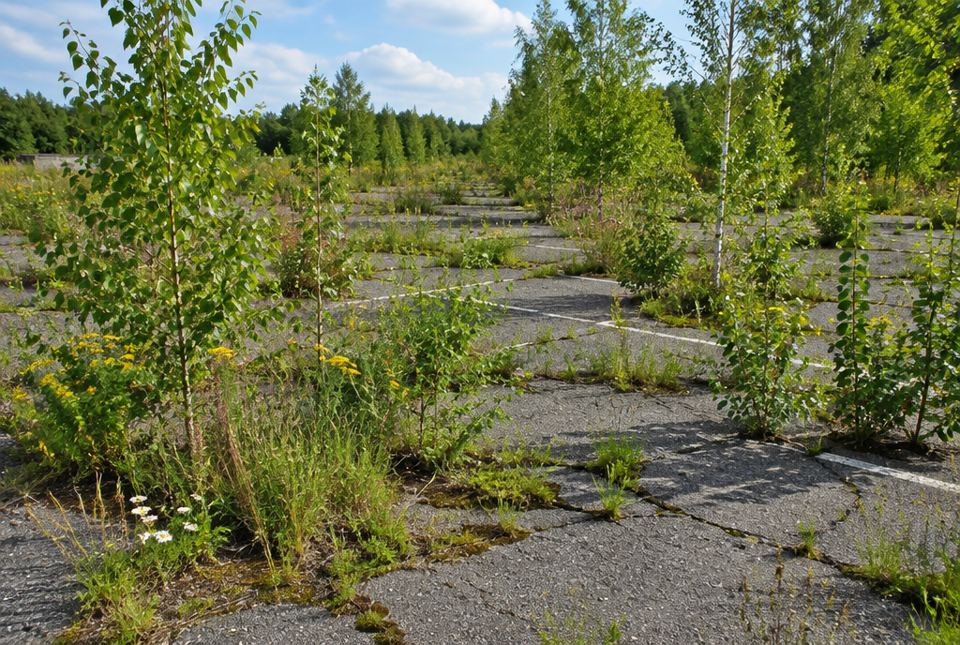 This is secondary succession: weeds came first, then shrubs and young trees. Over many years this lot could become a forest. AI-generated image
What is succession?
In succession, one community changes the conditions of a place, and that lets a new community move in. Each stage gets the place ready for the next.
- Early species are usually small, fast-growing and good at spreading (by wind-blown seeds or spores). They can handle full sun, wind and poor soil.
- As they live and die, they build soil, add nutrients, hold moisture and make shade.
- These new conditions suit larger, slower-growing species, which outcompete the early ones.
- Over time, the community usually gets more species, more layers (ground plants, shrubs, trees) and more stable.
There are two kinds of succession. The key difference is whether soil is there at the start.
Primary succession: starting from scratch
Primary succession happens where there is no soil at all:
- bare rock left behind when glaciers melt,
- new land made of cooled lava after a volcano erupts,
- new sand dunes along a lake shore,
- rock exposed by a landslide.
Pioneer species come first. On bare rock, these are usually lichens. A lichen is a partnership between a fungus and an alga (or certain bacteria): the alga makes food by photosynthesis, and the fungus holds water and clings to the rock. Lichens give off weak acids that slowly break down the rock surface. Bits of rock, dust and dead lichen begin to form a thin layer of soil.
Then mosses grow in the thin soil, hold more water, and add more dead matter. Next come grasses and small flowering plants, then shrubs, and finally trees. Primary succession is very slow: it can take hundreds or thousands of years.
In Ontario, glaciers covered the land until roughly 10 000 years ago. On the bare rock of the Canadian Shield, you can still see lichens and mosses growing on rock outcrops today, with trees rooted in cracks and hollows where soil has built up.
Secondary succession: starting over with soil
Secondary succession happens where a disturbance removed most of the living community but left the soil:
- after a forest fire,
- after logging,
- on a farm field that is no longer farmed,
- after a flood or a big storm,
- when a beaver dam breaks and the pond drains, leaving a wet meadow.
Because soil, seeds, roots and fungi are already there, secondary succession is much faster: often decades instead of centuries.
Example after a fire in the boreal forest: within weeks, fireweed (a tall plant with pink flowers) and grasses sprout. Jack pine cones, which often open after the heat of a fire, drop seeds onto the burned ground. Raspberries and young trembling aspen and white birch grow quickly in the sunny openings. Over many decades, shade-tolerant trees such as spruce and balsam fir can grow up underneath and eventually take over.
Example on an abandoned farm field in southern Ontario: first come annual weeds, then grasses, goldenrod and asters, then shrubs like sumac and dogwood, then sun-loving trees like white pine and aspen, and finally shade-tolerant trees like sugar maple and American beech.
| Primary succession | Secondary succession |
|---|
| Soil at the start? | No soil | Soil is already there |
| Where it happens | Bare rock after glaciers, new lava, new sand dunes | After fire, logging, flood, or on abandoned farmland |
| First species (pioneers) | Lichens and mosses | Weeds, grasses, fireweed, fast-growing shrubs and trees |
| Seeds and roots in the ground? | No | Often yes |
| How long it takes | Hundreds to thousands of years | Decades to about a century or two |
Disturbances restart the clock
A mature community, like an old sugar maple forest, can stay fairly similar for a long time. But disturbances such as fire, windstorms, insect outbreaks and floods are a natural part of many ecosystems. They open up patches where succession starts again. Because of this, a natural landscape is usually a patchwork of places at different stages, which adds to its biodiversity: some species need young, sunny openings, and others need old forest.
Worked exampleLet's decide: primary or secondary?
Classify each situation as primary or secondary succession, and give the reason: (a) a forest fire burns a stand of jack pine; (b) a glacier in the Rocky Mountains melts back, exposing bare rock; (c) a farmer in Ontario stops planting a hay field; (d) wind builds a brand-new sand dune on the shore of Lake Huron.
- (a) Fire: the trees burned, but the soil (and many seeds and roots) remain. Secondary.
- (b) Melting glacier: the rock underneath has never had soil. Primary.
- (c) Abandoned hay field: the soil is still there and full of seeds. Secondary.
- (d) New sand dune: loose sand with no soil and no living community yet. Primary. (On dunes, the pioneers are usually special grasses, like beach grass, whose roots hold the sand.)
Secondary: (a) and (c). Primary: (b) and (d). The question to ask is always: was there soil at the start?
Just for funLichens are the world's slowest construction crew: they turn solid rock into soil one tiny crumb at a time, and the job can take hundreds of years. No wonder nobody ever asks them, "Are you done yet?"
Careers connection
Ecological restoration workers, foresters and mine reclamation specialists use their understanding of succession. For example, after a mine closes, workers may spread topsoil and plant pioneer species to speed up recovery. In Sudbury, Ontario, where mining and smelting had left land bare and acidic, people have spread crushed limestone and planted millions of trees since the late 1970s to help the land recover.
Hands-on activitySuccession detective walk
You need: a notebook or phone camera, a pencil, and a grown-up. Optional: a magnifying glass.
- Find four places near your home at different stages, for example: (A) a crack in a sidewalk or a gravel patch, (B) a lawn, (C) an unmowed area such as a field edge, ditch or vacant lot, (D) a woodlot or older park with tall trees.
- At each place, record: the tallest plants, how many kinds of plants you see (estimate), how much shade there is, and what the ground is like (bare, thin soil, thick leaf litter).
- Look on rocks, tree trunks or old concrete for lichens (crusty, leafy or shrubby patches that may be grey-green, yellow or orange) and mosses.
- Put the places in order from earliest to latest stage of succession.
- For one place, predict what it would look like in 20 years if people left it alone. Is that primary or secondary succession? Why?
Safety: stay off private property without permission, watch for traffic, and don't touch unknown plants (poison ivy grows in many Ontario field edges and woodlots: "leaves of three, let it be"). Wash your hands afterwards.
What to look for: a sensible order (sidewalk crack → lawn → unmowed field → woodlot), with evidence such as plant height, number of species, shade and soil depth. The prediction should mention taller plants, shrubs or young trees and be called secondary succession (soil is present).
Your turn
1What is ecological succession?
The gradual change in the species living in an area over time.
2What is the main difference between primary and secondary succession?
Primary succession starts with no soil. Secondary succession starts where soil is still there after a disturbance.
3Name two places where primary succession could happen.
For example: bare rock after a glacier melts, cooled lava, a new sand dune, rock after a landslide.
4Name two disturbances that could start secondary succession.
For example: forest fire, logging, flood, windstorm, an abandoned farm field.
5What are pioneer species? Give an example for bare rock.
The first species to live in a bare or disturbed area. On bare rock: lichens (then mosses).
6How do lichens help make soil?
They release weak acids that break down rock, and their dead parts mix with rock bits and dust to form a thin layer of soil.
7Why is secondary succession faster?
Soil, seeds, roots and fungi are already there, so plants can grow right away.
More practice: warm-up
1Does primary succession start with soil?
2A forest fire leads to which kind of succession?
3Name a plant with pink flowers that grows quickly after a fire.
4Which usually comes first on bare rock: trees or lichens?
5Which takes longer: primary or secondary succession?
More practice: on your own
1Explain how each stage of succession "gets the place ready" for the next stage.
Each community changes conditions: it builds soil, adds nutrients, holds water and creates shade. These new conditions suit larger species, which then outcompete the earlier ones.
2Put these in order for an abandoned field in southern Ontario: sugar maple forest, goldenrod and grasses, annual weeds, white pine and aspen, sumac and dogwood shrubs.
Annual weeds → goldenrod and grasses → sumac and dogwood shrubs → white pine and aspen → sugar maple forest.
3A beaver dam breaks and the pond drains, leaving wet mud with seeds in it. Which kind of succession happens, and why?
Secondary. The pond bottom has soil (sediment) and seeds, so plants can grow right away.
4Why do sugar maple seedlings do well late in succession but not on a sunny abandoned field?
Sugar maple seedlings are shade-tolerant: they grow slowly in the shade of other trees. In open fields, sun-loving, fast-growing species outcompete them, and conditions are hot and dry.
5Why can a landscape with patches at different stages of succession have more biodiversity than one huge old forest?
Different stages have different conditions. Some species need young sunny openings (like fireweed, raspberries, some birds and deer), others need old forest. A patchwork gives habitat for more species.
Challenge
1Jack pine cones often stay closed until the heat of a fire opens them. Explain why this is an advantage for jack pine in secondary succession.
The fire removes competing plants and opens the ground to sunlight. Jack pine seeds are released exactly then, onto a sunny, open seedbed where the young trees can grow quickly before other species take over. Jack pine is adapted to be a pioneer after fire.
2Lava from a volcano cools on an island. Predict the order of species that would arrive, and explain why it would take so long to become a forest.
Order: lichens → mosses → grasses and small plants → shrubs → trees. It takes hundreds of years or more because there is no soil at first. Lichens and mosses must slowly break down rock and build soil before larger plants can grow. Seeds must also arrive by wind, water or birds.
3People sometimes stop small forest fires to protect homes. Use succession to describe one possible long-term effect on a forest that naturally burns sometimes, like jack pine forest.
Without fire, there are no new sunny openings, so fire-adapted pioneers like jack pine and fireweed decline. Shade-tolerant species take over, and the landscape loses its patchwork of stages, so biodiversity may drop. Dead wood can also build up, which may lead to a larger, hotter fire later. (Forest managers sometimes use planned burns for these reasons.)
Quiz
1. Primary succession begins...
2. Which is usually a pioneer species on bare rock?
3. Secondary succession is faster than primary succession mainly because...
4. A logging company cuts a forest. What happens next?
5. Which list shows a typical order of primary succession?
6. How do early species in succession help later species?
Big idea: ecosystems change over time through succession. Primary succession starts with no soil and is very slow; secondary succession starts after a disturbance that leaves soil and is much faster. Each stage changes the conditions for the next.
How to help at home:
- Take the succession detective walk together. Sidewalk cracks, vacant lots and ditches are great examples.
- Look for lichens on rocks, old gravestones or tree bark. They grow very slowly.
- If you travel through areas burned by forest fires, look for fireweed, young aspen and jack pine.
Safety: watch for traffic and poison ivy ("leaves of three, let it be"). Respect private property.
Common difficulties:
- Thinking a fire leads to primary succession. Ask: Is the soil still there? If yes, it's secondary.
- Thinking succession always ends in exactly the same "final" forest. Disturbances keep resetting patches, so real landscapes are a mix of stages.