B. Life Systems · Interactions in the EnvironmentCycles of Matter: Water, Carbon and Nitrogen
B2.5 A1.2 A1.4 A3.2About 55 minutes
Learning goals- I can explain the difference between how energy flows and how matter cycles in an ecosystem.
- I can describe the water cycle, the carbon cycle and the nitrogen cycle.
- I can explain how the cycling of matter keeps ecosystems sustainable.
- I can describe how human activities speed up or block parts of these cycles.
Words to know
matter
Anything that has mass and takes up space, such as water, carbon dioxide, soil and living things.
cycle
A series of steps that repeats, so materials end up back where they started and can be used again.
transpiration
The loss of water vapour from plant leaves into the air.
carbon sink
A place that stores more carbon than it releases, such as a growing forest, a peatland or the ocean.
fossil fuels
Fuels formed over millions of years from the remains of ancient living things: coal, oil and natural gas. Burning them releases carbon dioxide.
nitrogen fixation
Changing nitrogen gas from the air into a form plants can use. Some bacteria (and lightning) do this.
sustainability
Meeting the needs of today without using up or damaging what future generations will need.
Older than the dinosaurs
The water in your glass today may once have fallen as snow on a mountain, flowed down a river, been sipped by a dinosaur and floated in a cloud over the ocean. The carbon atoms in your body may once have been in a maple leaf, a bison or the air above the Pacific.
Earth gets a constant supply of energy from the Sun. But it gets almost no new matter. Living things have been reusing the same water, carbon and nitrogen for billions of years. That only works because matter cycles.
Energy flows, matter cycles
- Energy moves one way: Sun → producers → consumers, and most of it is lost as heat at each step (last lessons).
- Matter is reused. Atoms are not used up. They move from the air to plants, to animals, to decomposers, to the soil and back again.
When a living thing dies, its matter does not disappear. Decomposers break it down, and the same atoms become part of new living things. You will look at three important cycles: water, carbon and nitrogen.
The water cycle
You learned about the water cycle in earlier grades. Here is the full cycle, including the parts living things play:
- Evaporation: the Sun warms lakes, rivers and oceans, and water becomes invisible water vapour.
- Transpiration: plants pull water up from the soil through their roots and release water vapour from their leaves. A large tree can release hundreds of litres of water on a hot summer day.
- Condensation: water vapour cools high in the air and forms tiny droplets that make clouds.
- Precipitation: rain, snow, sleet or hail falls.
- Collection and runoff: water soaks into the ground (groundwater) or runs over the surface into streams and lakes.
Living things are part of the water cycle. Animals drink water and release it when they breathe out, sweat and get rid of wastes. Wetlands and forests soak up rain like sponges and release it slowly.
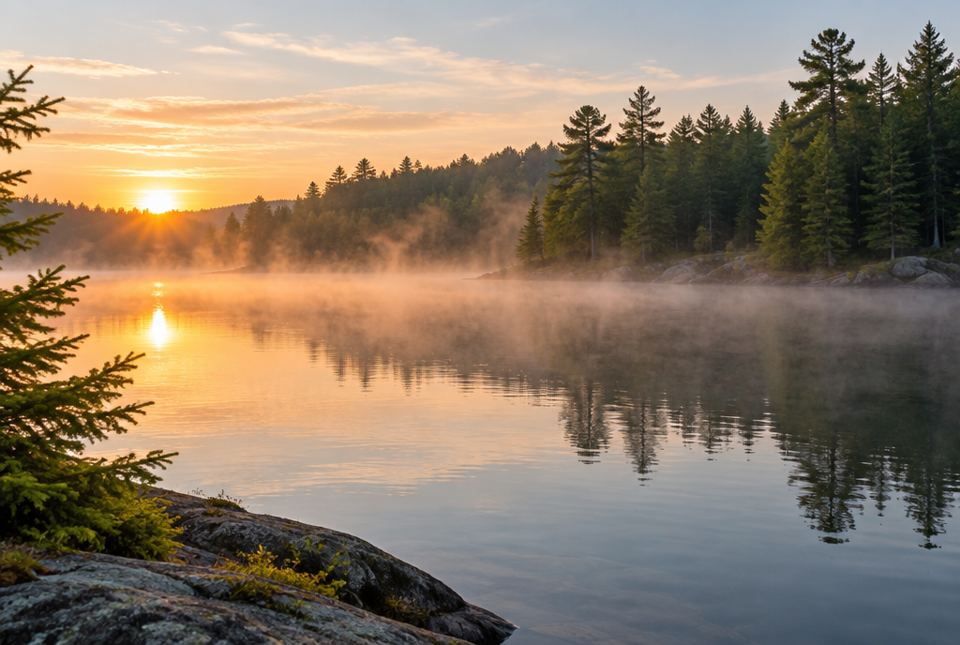 The mist shows the water cycle at work: water evaporates from the warm lake and condenses into tiny droplets in the cool morning air. AI-generated imageThe water cycle, including living things. Water evaporates from the lake and transpires from leaves, condenses into clouds, falls as precipitation, then flows back as runoff and groundwater.
The carbon cycle
Carbon is in every living thing: in sugars, fats, proteins and the wood of trees. Carbon moves like this:
- Photosynthesis: plants and algae take carbon dioxide from the air (or water) and build it into sugar.
- Cellular respiration: plants, animals and decomposers break down sugar for energy and release carbon dioxide back into the air.
- Eating: carbon moves from plants into animals when animals eat them.
- Death and wastes: dead plants, dead animals and wastes pass carbon to decomposers.
- Decomposition: decomposers use the dead matter and release carbon dioxide.
Some carbon gets stored for a long time. Forests store carbon in wood. Ontario's Hudson Bay Lowlands have huge peatlands, where cold, wet conditions slow decomposition so dead plants pile up over thousands of years. The oceans absorb carbon dioxide. And over millions of years, some buried remains of living things became fossil fuels: coal, oil and natural gas.
The nitrogen cycle
Living things need nitrogen to make proteins and DNA. The air is about 78% nitrogen gas, but plants and animals cannot use nitrogen gas directly. Here is how nitrogen gets into living things:
- Nitrogen fixation: certain bacteria in the soil, and bacteria living in bumps (nodules) on the roots of beans, peas, clover and alfalfa, change nitrogen gas into forms that plants can use. Lightning also fixes a little nitrogen.
- Plants take up these nitrogen compounds from the soil through their roots.
- Animals get nitrogen by eating plants (or other animals).
- Decomposers break down dead things and wastes and release nitrogen compounds back into the soil, where plants use them again.
- Other bacteria change some nitrogen compounds back into nitrogen gas, which returns to the air.
Remember the Three Sisters from Grade 6? The beans add nitrogen to the soil for the corn and squash. That is the nitrogen cycle at work, used by First Nations farmers for many centuries.
How cycling matter promotes sustainability
- Nothing is wasted. One organism's waste is another's food. Dead leaves become soil nutrients for next year's leaves.
- Ecosystems can last for thousands of years without running out of materials, because the same materials keep being reused.
- Balance: in a natural cycle, carbon dioxide released by respiration and decomposition is roughly balanced by carbon dioxide taken in by photosynthesis.
Humans can upset the cycles:
- Burning fossil fuels releases carbon that was stored for millions of years, much faster than plants and oceans can take it back. Extra carbon dioxide in the air traps more heat and is the main cause of climate change.
- Cutting or burning forests and draining peatlands releases stored carbon and removes carbon sinks.
- Too much fertilizer adds extra nitrogen and phosphorus. Rain washes it into lakes, where it can cause huge algae blooms.
- Sending food scraps and leaves to landfills buries them without oxygen. They break down slowly and release methane, a gas that traps even more heat than carbon dioxide. Composting and green bin programs return these nutrients to the soil instead.
Worked exampleLet's follow one carbon atom
Trace a carbon atom that starts in the air in a sugar maple forest, through as many steps of the carbon cycle as you can, until it returns to the air.
- In spring, a maple leaf takes in the carbon atom as carbon dioxide during photosynthesis. It becomes part of a sugar molecule.
- The sugar is stored in the tree's sap. A caterpillar eats the leaf; the carbon is now in the caterpillar.
- A chickadee eats the caterpillar. Carbon moves up the food chain.
- The chickadee uses some sugar for energy in cellular respiration, and breathes out carbon dioxide. Our atom could return to the air right here! But suppose it was built into a feather.
- In winter, the chickadee dies. Decomposers (bacteria and fungi) break down its body and release the carbon atom as carbon dioxide, back into the air.
- Next spring, the same atom could be taken in by another maple leaf.
Air → maple (photosynthesis) → caterpillar (eating) → chickadee (eating) → decomposers (death) → air (decomposition). The atom is never used up; it keeps cycling.
Just for funWhy is a water molecule never bored?
It's always going through a phase: ice, liquid, vapour, cloud, rain... and back again.
Did you know?
Maple syrup is mostly sugar that maple trees made by photosynthesis the summer before and stored in their roots and trunk. In early spring, the sap carries that sugar up the tree. First Nations peoples were making maple sugar long before Europeans arrived. It takes about 40 litres of sap to make 1 litre of maple syrup.
Hands-on activityBuild a sealed jar ecosystem
You need: a large clear glass jar with a lid (about 1 to 4 litres), small pebbles, potting soil or garden soil, a few small plants or moss (from a garden centre, or from your yard with permission), a spray bottle of water, a spoon, a notebook.
- Put a 2 cm layer of pebbles in the jar, then 5 to 8 cm of soil.
- Plant the small plants or press moss onto the soil. Spray with water until the soil is damp but not soggy.
- Close the lid. Place the jar in bright light but not direct hot sun.
- Observe every day for two weeks. Draw and record: Where do water droplets form? When? Does the water ever run back down? Do the plants grow?
- Answer: How is water cycling inside the jar (evaporation, transpiration, condensation, precipitation)? How is carbon cycling (photosynthesis in light, respiration day and night)? Why can the plants live for months in a closed jar?
Safety: a grown-up should handle the glass jar. Wash hands after handling soil. Don't put the jar in direct hot sun (it can overheat). If mould takes over, open the jar outside and empty it into the garden or compost.
What to look for: observations of droplets on the inside of the glass (condensation) that run back down (precipitation), and an explanation that the same water and carbon keep being reused, because matter cycles inside the jar while light energy comes in from outside.
Your turn
1What is the main difference between how energy and matter move through an ecosystem?
Energy flows one way and is lost as heat. Matter cycles: the same atoms are reused again and again.
2Name the five steps of the water cycle, including the one done by plants.
Evaporation, transpiration, condensation, precipitation, collection (runoff and groundwater).
3Which process takes carbon dioxide out of the air? Which processes put it back?
Photosynthesis takes it out. Cellular respiration, decomposition and burning (of fossil fuels or wood) put it back.
4Why can't plants use nitrogen from the air directly? How do they get it?
Nitrogen gas is in a form plants can't use. Bacteria in the soil and in root nodules of plants like beans and clover fix it into forms plants can absorb through their roots.
5How do animals get nitrogen?
By eating plants or other animals.
6Give two ways the cycling of matter makes ecosystems sustainable.
For example: nothing is wasted (wastes become food); materials are reused, so ecosystems don't run out and can last for thousands of years; cycles keep carbon dioxide and oxygen in balance.
7Why is composting better for the carbon and nitrogen cycles than putting food scraps in a landfill?
Composting lets decomposers return nutrients to the soil for plants. In a landfill, scraps are buried without oxygen and make methane, and their nutrients are not returned to the soil.
More practice: warm-up
1What gas makes up about 78% of the air?
Plants releasing water vapour from their leaves.
Coal, oil or natural gas.
For example a forest, a peatland or the ocean.
5Which crop in the Three Sisters adds nitrogen to the soil?
More practice: on your own
1Explain why peatlands in the Hudson Bay Lowlands store so much carbon.
Cold, wet conditions slow decomposition, so dead plants pile up instead of being broken down and releasing their carbon. Over thousands of years, huge amounts of carbon have been stored.
2A farmer spreads too much fertilizer before a heavy rain. Use the nitrogen cycle to explain what may happen to a nearby lake.
Rain washes the extra nitrogen (and phosphorus) into the lake. These nutrients make algae grow very fast (an algae bloom). When the algae die, decomposers use up oxygen, which can harm fish.
3Why does burning fossil fuels upset the carbon cycle, even though carbon dioxide is a natural part of the air?
It releases carbon that was stored for millions of years, much faster than plants and oceans can take it back. The extra carbon dioxide builds up in the air and traps more heat.
4In the sealed jar, where does the water come from that forms droplets on the inside of the glass?
From evaporation from the soil and transpiration from the plants. The water vapour condenses on the cooler glass.
5Describe the path of a nitrogen atom from the air to a moose and back to the soil.
Air → bacteria fix it in the soil (or in clover root nodules) → a plant takes it up → a moose eats the plant → the moose's wastes (or body, after it dies) are broken down by decomposers → nitrogen compounds return to the soil.
Challenge
1Some people say, "Planting trees helps fight climate change." Use the carbon cycle to explain why, and give one limit to this idea.
Growing trees take in carbon dioxide by photosynthesis and store carbon in their wood for many years, so they act as a carbon sink. Limits: trees take decades to grow; if the forest burns or is cut and burned, the carbon returns to the air; and trees can't absorb carbon as fast as we release it by burning fossil fuels, so reducing emissions is also needed.
2Explain why a world with only producers and consumers, but no decomposers, would eventually run out of nutrients for life.
Without decomposers, dead matter and wastes would not be broken down. Carbon, nitrogen and other nutrients would stay locked in dead bodies and leaves. Plants would use up the nutrients in the soil and air and nothing would return them, so new life could not grow.
3Your sealed jar has been closed for two months and the plants are still alive. Explain how both energy and matter are involved in keeping them alive.
Energy enters from outside as light and leaves as heat (energy flows through). Matter stays inside and cycles: water evaporates, transpires, condenses and falls; plants use carbon dioxide for photosynthesis and release it in respiration; decomposers in the soil recycle nutrients from dead plant parts.
Quiz
1. Which statement is correct?
2. Water vapour released from plant leaves is called...
3. Which process removes carbon dioxide from the air?
4. How does nitrogen from the air get into plants?
5. Why does burning fossil fuels add to climate change?
6. Which is the best example of how cycling matter promotes sustainability?
Big idea: energy flows through ecosystems, but matter cycles. Water, carbon and nitrogen are reused over and over by living things and the environment. This recycling is what lets ecosystems last, and human actions can speed up or block the cycles.
How to help at home:
- Set up the sealed jar together and check it daily. Ask: Where did the droplets come from? Where will they go?
- Start or visit a compost bin, or talk about your municipality's green bin program and where the compost goes.
- In late winter, if you visit a sugar bush, connect maple syrup to photosynthesis from last summer.
Safety: a grown-up handles the glass jar; wash hands after soil; keep the jar out of hot direct sun.
Common difficulties:
- Thinking energy is recycled. It is not; it is lost as heat.
- Thinking plants get nitrogen from the air through their leaves.
- Forgetting that respiration and decomposition release carbon dioxide.
- Mixing up evaporation (from water) and transpiration (from plants).