B. Life Systems · Interactions in the EnvironmentProducers, Consumers and Decomposers: Roles and Relationships
B2.3 A1.1 A1.4 A1.5 A3.1About 50 minutes
Learning goals- I can describe the role of producers, consumers and decomposers in an ecosystem.
- I can write the word equations for photosynthesis and cellular respiration.
- I can classify consumers as herbivores, carnivores, omnivores, scavengers or detritivores, and as primary, secondary or tertiary consumers.
- I can explain how producers, consumers and decomposers depend on each other.
Words to know
producer
An organism that makes its own food, usually from sunlight by photosynthesis. Plants, algae and some bacteria are producers.
consumer
An organism that cannot make its own food and gets energy by eating other organisms.
decomposer
An organism, mostly fungi and bacteria, that breaks down dead organisms and wastes and releases nutrients back into the soil, water and air.
photosynthesis
The process producers use to make sugar (glucose) and oxygen from carbon dioxide and water, using light energy.
cellular respiration
The process in the cells of almost all living things that uses sugar and oxygen to release energy, giving off carbon dioxide and water.
detritivore
An animal that eats dead plant and animal material (detritus), such as an earthworm, millipede or woodlouse (pill bug).
scavenger
An animal that eats the bodies of animals that are already dead, such as a raven or turkey vulture.
trophic level
A feeding level in an ecosystem: producers are the first level, primary consumers the second, and so on.
Who does which job?
A healthy ecosystem is like a team where every player has a role. Some players make the food. Some eat. Some clean up and recycle. If one role is missing, the whole team struggles.
In Grade 4 you met these three roles: producers, consumers and decomposers. Now you will look closer: how producers actually make food, how all living things get energy out of food, and how the three roles depend on each other.
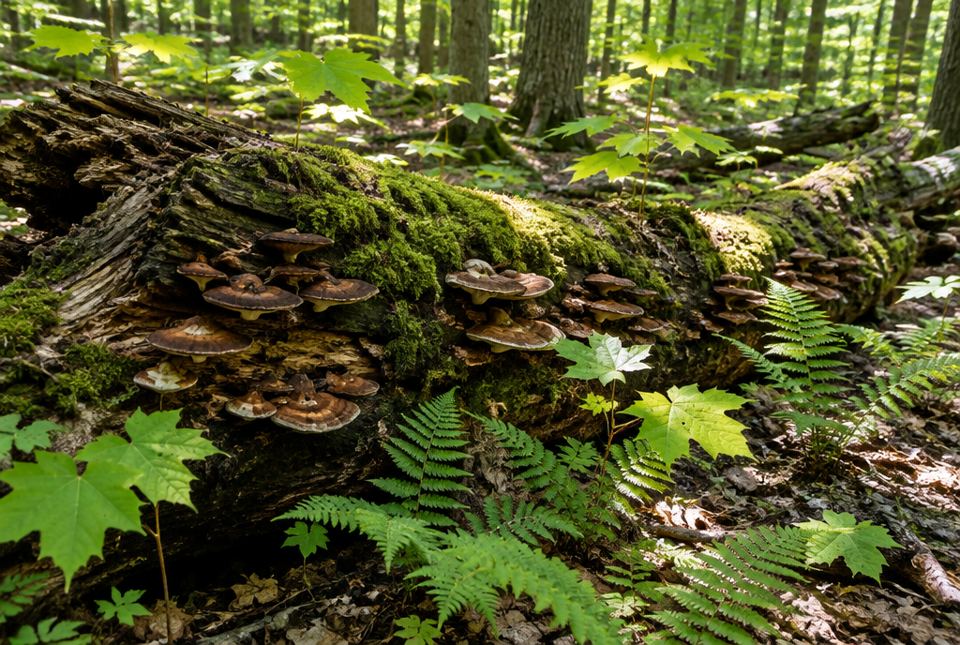 Mushrooms are decomposers breaking down this log. The nutrients they release feed producers like the ferns and young maples. AI-generated image
Producers: the food makers
Producers make their own food. On land, the main producers are plants: maple trees, grasses, mosses, wildflowers. In lakes and oceans, the main producers are algae and tiny phytoplankton that drift in the water.
Producers make food by photosynthesis. In their leaves (or in the cells of algae), they use light energy to turn carbon dioxide and water into sugar:
carbon dioxide + water → (light energy) → glucose (sugar) + oxygen
The sugar stores energy. Producers use some of it to live and grow, and the rest is stored in their leaves, stems, roots, fruits and seeds. That stored energy is food for everything else.
Getting energy out of food: cellular respiration
Almost every living thing, including plants, animals, fungi and most bacteria, gets energy from food by cellular respiration:
glucose + oxygen → carbon dioxide + water + energy
Notice that this is the reverse of photosynthesis. Producers take in carbon dioxide and give off oxygen. Respiration uses oxygen and gives off carbon dioxide. The two processes are linked, which is part of how matter cycles (you will study this later in the unit).
Careful: plants do both. They photosynthesize in the light, and they carry out respiration all the time, day and night.
Consumers: the eaters
Consumers get energy by eating other organisms.
- Herbivores eat only plants or algae: snowshoe hare, moose, white-tailed deer, caterpillars.
- Carnivores eat other animals: Canada lynx, wolf, great horned owl, dragonfly.
- Omnivores eat plants and animals: black bear, raccoon, American robin, humans.
- Scavengers eat animals that are already dead: common raven, turkey vulture.
- Detritivores eat dead plant and animal bits (detritus): earthworms, millipedes, woodlice.
Scientists also name consumers by trophic level (feeding level):
- Producers (first level): grass.
- Primary consumers eat producers: a grasshopper eats grass.
- Secondary consumers eat primary consumers: a frog eats the grasshopper.
- Tertiary consumers eat secondary consumers: a snake eats the frog.
The same animal can be at different levels. A black bear eating blueberries is a primary consumer. When it eats a fish that ate insects, it is a tertiary consumer.
Decomposers: the recyclers
Decomposers are mostly fungi (mushrooms, moulds) and bacteria. They break down dead plants, dead animals and animal wastes into simple materials: carbon dioxide, water and nutrients (minerals) such as nitrogen and phosphorus.
Detritivores like earthworms help by chewing dead leaves into small bits, which gives fungi and bacteria more surface to work on.
Without decomposers, dead leaves and logs would pile up, and the nutrients locked inside them would never return to the soil. Producers would run out of nutrients and stop growing.
| Relationship | What it means |
|---|
| Producers feed consumers | Every food chain starts with a producer. All the energy consumers use was first captured by producers. |
| Producers make oxygen for consumers | Photosynthesis releases the oxygen that animals use for respiration. |
| Consumers help producers | Bees and other animals pollinate flowers. Birds and mammals spread seeds. Herbivores' droppings add nutrients. |
| Consumers control populations | Predators keep herbivores from eating all the plants. |
| Decomposers feed producers | Decomposers return nutrients to the soil, so producers can grow. |
| Producers and consumers feed decomposers | Dead leaves, dead animals and wastes are the decomposers' food. |
Worked exampleLet's classify a boreal forest community
Classify each organism by role (and, for consumers, by diet): jack pine, blueberry bush, snowshoe hare, Canada lynx, black bear, common raven, earthworm, bracket fungus on a dead tree.
- Producers (make food by photosynthesis): jack pine, blueberry bush.
- Herbivore, primary consumer: snowshoe hare (eats plants, twigs and buds).
- Carnivore, secondary consumer: Canada lynx (eats hares, which eat plants).
- Omnivore: black bear (eats blueberries, insects, fish and sometimes young animals). It can be at several levels.
- Scavenger: common raven (often eats dead animals, but ravens also eat other foods, so many scientists also call them omnivores).
- Detritivore: earthworm (eats dead leaves). Decomposer: bracket fungus (breaks down the wood of the dead tree).
Producers: jack pine, blueberry. Consumers: hare (herbivore), lynx (carnivore), bear (omnivore), raven (scavenger), earthworm (detritivore). Decomposer: bracket fungus. Real animals don't always fit only one box, and that is OK.
Just for funWhy do mushrooms get invited to every party?
Because they're such fun-gi. (They're also great at cleaning up afterward: that's what decomposers do!)
Did you know?
Most earthworms found in Ontario today are not native. They came from Europe, carried in soil with plants and ships. The last glaciers had left much of Canada without native earthworms. In northern forests, these newcomers can eat the thick layer of fallen leaves too quickly, which changes the soil for plants that depended on it. So even a helpful detritivore can upset an ecosystem when it is new.
Hands-on activityDecomposer and detritivore hunt
You need: garden gloves, a large white sheet of paper or a white tray, a magnifying glass, a small trowel or spoon, a notebook. Do this with a grown-up in a backyard, park or woodlot (spring, summer or fall).
- Find a damp spot with fallen leaves or a log you are allowed to roll.
- Wearing gloves, scoop a handful of leaf litter onto the white paper. Or gently roll the log toward you (so anything underneath can escape away from you), look, then roll it back carefully.
- Use the magnifying glass. Look for detritivores (earthworms, millipedes, woodlice, springtails) and decomposers (white threads of fungus, mushrooms, mould, slimy rotting areas).
- Sketch three things you found and label each one producer, consumer, detritivore or decomposer.
- Look at the leaves: some are whole, some have holes, some are skeletons of veins, some are crumbly brown bits. Arrange them in order from least to most decomposed.
- Put everything back where you found it.
Safety: wear gloves, don't touch your face, and wash your hands afterwards. Never eat or taste mushrooms. Roll logs only with a grown-up and put them back.
What to look for: correct labels (for example, millipede = detritivore, mushroom = decomposer), and a sensible order of leaf decay, from whole to crumbly.
Your turn
1What is the role of a producer?
To make food (sugar) from carbon dioxide and water using light energy, by photosynthesis. This food feeds the rest of the ecosystem.
2Write the word equation for photosynthesis.
carbon dioxide + water → (light energy) → glucose + oxygen
3Write the word equation for cellular respiration.
glucose + oxygen → carbon dioxide + water + energy
4What is the difference between a scavenger and a decomposer?
A scavenger is an animal that eats dead animals (like a raven). A decomposer (mostly fungi and bacteria) breaks dead material down into simple nutrients that return to the soil.
5Grass → grasshopper → frog → snake. Name the trophic level of each.
Grass: producer. Grasshopper: primary consumer. Frog: secondary consumer. Snake: tertiary consumer.
6Name two ways consumers help producers.
For example: pollinating flowers, spreading seeds, adding nutrients with droppings, eating plant-eaters that could overeat the plants.
7What would happen to a forest if all the decomposers disappeared?
Dead leaves, logs and bodies would pile up, and nutrients would stay locked inside them. The soil would run out of nutrients, and plants would stop growing well.
More practice: warm-up
1Is a moose a producer, consumer or decomposer?
A consumer (a herbivore).
For example a mushroom, mould or bacteria.
3What gas do producers give off during photosynthesis?
4Is an earthworm a detritivore or a carnivore?
5What is the main producer in a lake?
Algae and phytoplankton (also water plants).
More practice: on your own
1Explain why plants carry out both photosynthesis and cellular respiration.
Photosynthesis makes the sugar. Plants also need to use that sugar for energy to live and grow, which they do by cellular respiration, all day and night.
2A raccoon eats crayfish, frogs, berries and corn. Classify it by diet, and name two trophic levels it can be at.
Omnivore. Eating berries or corn, it is a primary consumer. Eating a crayfish or frog (which eat other animals), it is a secondary or tertiary consumer.
3Why do earthworms make decomposers' work faster?
They chew dead leaves into small pieces and mix them into the soil, giving fungi and bacteria more surface area to break down.
4Describe the loop that connects producers, consumers and decomposers.
Producers make food → consumers eat producers (and each other) → dead producers, dead consumers and wastes are eaten by decomposers → decomposers release nutrients → producers take up the nutrients to grow.
5Why can a forest have animals but not a world with only animals?
Animals are consumers; they can't make food. Without producers capturing light energy, there would be no food (and little new oxygen) for any animal.
Challenge
1Compare the two word equations. Explain why scientists say photosynthesis and cellular respiration are "opposites" that work together.
Photosynthesis uses carbon dioxide and water and makes glucose and oxygen (storing light energy). Respiration uses glucose and oxygen and makes carbon dioxide and water (releasing energy). The products of one are the reactants of the other, so together they keep oxygen and carbon dioxide cycling between living things and the air.
2Non-native earthworms are spreading into some northern Ontario forests. Predict two effects on the forest ecosystem.
Model answer: 1. They eat the thick leaf litter layer fast, so less leaf litter covers the soil, and plants and small animals that need it (like some wildflowers, insects and salamanders) may decline. 2. Nutrients are released and moved around faster, which changes the soil (it may get more packed and dry out more). Any two sensible effects that follow from faster leaf-litter loss are fine.
3A pond is sealed from the outside world except for sunlight. It has algae, snails, small fish and bacteria. Explain how each role keeps the others alive.
Algae (producers) use light to make food and oxygen. Snails and fish (consumers) eat algae (and each other) and breathe out carbon dioxide, which algae need. Bacteria (decomposers) break down wastes and dead bodies and release nutrients the algae need to grow. Each role supplies something another role needs.
Quiz
1. Which organism is a producer?
2. What are the products of photosynthesis?
3. Which process do both plants and animals carry out?
4. In the chain grass → mouse → owl, the owl is a...
5. Which is the main job of decomposers?
6. A turkey vulture eats a deer that was hit by a car. It is acting as a...
Big idea: producers capture energy and make food, consumers eat other organisms, and decomposers recycle nutrients. Each role depends on the others.
How to help at home:
- Do the decomposer hunt together. Turn it into a sorting game: producer, consumer, detritivore, decomposer?
- Look in the fridge: the mould on old bread or fruit is a decomposer at work. (Don't sniff mouldy food closely.)
- Quiz each other on the two word equations. Notice that one is the reverse of the other.
- If you have a compost bin or green bin, talk about the decomposers working inside it.
Safety: gloves for the leaf-litter hunt, wash hands, never taste mushrooms, and put logs back.
Common difficulties:
- Thinking plants don't do respiration (they do, all the time).
- Mixing up scavengers (animals) and decomposers (mostly fungi and bacteria).
- Expecting each animal to fit only one trophic level; many omnivores feed at several levels.