A. New France and British North America, 1713–1800 · New France and British North America, 1713 to 1800Life in New France, 1713 to 1760
A1 A3About 45 minutes
Learning goals- I can describe the seigneurial system and the lives of habitants, seigneurs and townspeople in New France.
- I can describe roles of the Catholic Church and of women in New France.
- I can compare life in New France with life in Canada today.
Words to know
habitant
A French farmer in New France who rented land from a seigneur.
seigneur
A landholder in New France who was granted a large piece of land and had to find habitants to farm it.
seigneurial system
The way land was divided and managed in New France: the king granted land to seigneurs, who granted farms to habitants.
cens et rentes
Yearly payments habitants made to their seigneur, in money or goods such as grain or chickens.
corvée
A few days of unpaid work each year that a habitant owed the seigneur, for example repairing roads.
tithe
A share of the harvest (in New France, one twenty-sixth of the grain) paid to support the parish priest.
voyageur
A paddler hired to carry goods by canoe in the fur trade.
Imagine a winter in 1740
It is January along the St. Lawrence River. The snow is deep. Your family's log house has thick walls and a big fireplace or stove. You sleep near the warmth. Outside, the river is frozen, so people travel on it by sleigh.
What would you eat? Who would you owe rent to? Where would you go to school, if you went at all? This lesson answers those questions.
Who lived in New France?
By the 1760s about 70 000 French colonists lived in New France, mostly along the St. Lawrence River between Quebec and Montreal. The British colonies to the south had far more people: more than a million. This difference will matter in the Seven Years' War (Lesson 6).
The French colonists were known as habitants or Canadiens. Most were born in North America, not in France. They lived alongside and traded with First Nations (Lesson 3), and some held enslaved Black and Indigenous people (Lesson 4).
The seigneurial system
As you learned in Grade 5, the king of France gave large pieces of land, called seigneuries, to seigneurs. Here is how it worked in daily life:
- Each seigneury was cut into long, narrow farms that ran back from the river. That way, almost every family had a piece of the river, the main "highway" for travel and trade.
- The habitant cleared and farmed the land. Each year the habitant paid the seigneur small rents called cens et rentes, paid to grind grain at the seigneur's mill, and often owed a few days of work (the corvée).
- The seigneur had to bring in settlers, build a mill and sometimes a manor house.
- Farm families also paid the tithe to the Church: one twenty-sixth of their grain.
The farms are still visible today: fly over the St. Lawrence valley and you can see long, thin fields running back from the river.
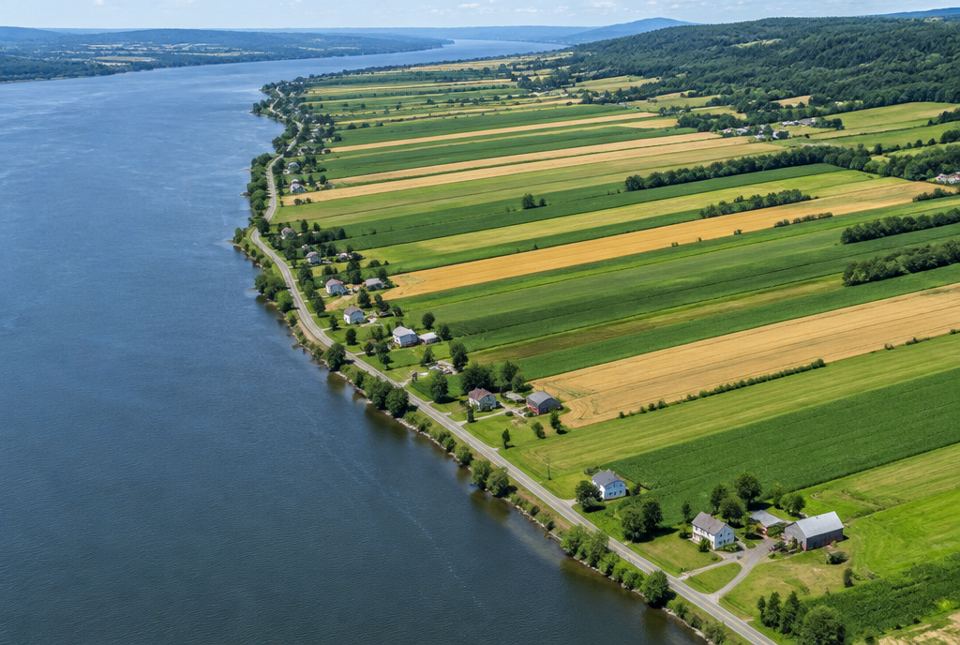 The long, thin seigneurial farm lots can still be seen along the St. Lawrence today. Notice how each farm touches the river and the road, just as the system was designed. AI-generated imageA seigneury along the St. Lawrence. Each strip (alternating green and yellow) is one family's farm. The small squares are houses, built near the river.
Work and seasons
- Spring and summer: plant and harvest wheat (the main crop), oats, peas and vegetables. Look after cattle, pigs, chickens and horses.
- Fall: harvest, thresh grain, slaughter animals and preserve meat for winter.
- Winter: cut wood, make and repair tools and clothing, travel by sleigh. Many young men worked in the fur trade as voyageurs, paddling canoes to the Great Lakes and beyond in spring and summer.
In the towns of Quebec, Montreal and Trois-Rivières, people worked as merchants, artisans (blacksmiths, carpenters, shoemakers), soldiers, servants and officials. Louisbourg, a fortress town France built on Île Royale after 1713, was a busy fishing and trading port.
The Church and schools
The Catholic Church was at the centre of life. The parish church was a place for worship, news and community gatherings. Priests kept records of births, marriages and deaths, which are important primary sources today.
There was no public school system. Religious orders ran a few schools, hospitals and orphanages. The Ursulines taught girls in Quebec, and the Hôtel-Dieu hospitals were run by nuns. Most habitant children learned at home and on the farm, and many adults could not read or write.
Women in New France
Women ran households and farms and did a huge amount of work: cooking, spinning, sewing, gardening, caring for animals and children. Under the law of New France, a widow often took over the family's property and business.
Marie-Anne Barbel of Quebec is an example. After her husband died in 1745, she ran the family's businesses: she leased fur-trading posts at Tadoussac, managed fishing and sealing posts in Labrador, invested in property, and started a pottery that made dishes when imported ones were scarce during wartime. The intendant (a top official) remarked that "Widow Fornel has a company."
Nuns ran hospitals, schools and charities. Their work was essential to the colony.
| New France (1740s) | Canada today |
|---|
| Who governs? | The king of France, through a governor and an intendant. No elections. | Elected governments (federal, provincial, municipal). |
| Land | Granted by the king to seigneurs; habitants pay rents. | People buy or rent land and homes; property taxes go to governments. |
| School | No public schools; a few run by religious orders. | Free public schools for all children. |
| Travel | Canoe, boat, walking; sleigh on the frozen river. | Cars, buses, trains, planes. |
| Religion | Catholic Church at the centre of life; other faiths not officially allowed. | Freedom of religion is protected by the Charter. |
| Women | Could not hold public office; widows could run businesses. | Equal rights protected by law; women vote and hold office. |
Worked exampleLet's compare then and now
Use the table to answer: What changed and what stayed the same about winter in the St. Lawrence valley from the 1740s to today?
- Stayed the same (continuity): winters are still long and snowy; people still need warm homes and warm clothes; the St. Lawrence still freezes in places.
- Changed: we heat homes with furnaces, not only wood fires; we travel by car on plowed roads instead of by sleigh on the river; we buy food year-round instead of preserving all of it in the fall.
- Why it matters: the climate shaped daily life in New France, and it still shapes life in Canada today.
Winter itself is a continuity; how people heat, travel and get food has changed a lot.
Just for funFun fact: Coins often ran short in New France. In 1685, when the soldiers' pay had not arrived from France, the intendant cut up playing cards, wrote amounts on them and signed them. This card money was used again on and off for decades. Imagine buying bread with half a queen of hearts!
Avoid a common mistake
Seigneurs were not like the powerful lords you might see in films about medieval Europe. Many seigneurs in New France were not rich, and habitants were not serfs: they could move, and many had more land and food than poor farmers in France.
Hands-on activityA habitant family's year
You need: a paper plate or a circle drawn on paper, a ruler, and pencil crayons.
- Divide the circle into 4 equal parts: spring, summer, fall, winter.
- In each part, draw or write two jobs a habitant family did in that season (use the Work and seasons section).
- Around the outside edge, write what your family does in each season (school, sports, holidays like Thanksgiving or the winter break, yard work, shovelling snow).
- Circle in one colour the things that are similar (continuity) and in another colour the things that are different (change).
- Write two sentences: Which season was hardest for a habitant family? Why?
Look for: accurate seasonal jobs (planting, harvest, preserving food, cutting wood, voyageur trips) and thoughtful then-and-now comparisons.
Your turn
A French farmer in New France who rented land from a seigneur.
2Why were farms in New France long and narrow?
So that almost every farm had access to the river, the main route for travel and trade.
3Name two things a habitant owed the seigneur.
Any two: yearly rents (cens et rentes), a fee to grind grain at the seigneur's mill, a few days of unpaid work (corvée).
4What was the tithe, and who received it?
A share of the grain (one twenty-sixth) paid to support the parish priest (the Catholic Church).
5Who was Marie-Anne Barbel?
A businesswoman in Quebec who ran fur-trading posts, fishing posts, property and a pottery after she became a widow in 1745.
6Name one way life in New France was different from life in Canada today.
Examples: no elections; no public schools; only the Catholic faith was officially allowed; travel by canoe and sleigh.
More practice: warm-up
1About how many French colonists lived in New France by the 1760s?
2Which river did most people in New France live along?
3What was the main crop of the habitants?
A paddler hired to carry goods by canoe in the fur trade.
5Which group of nuns taught girls in Quebec?
More practice: on your own
1Why were parish records of births, marriages and deaths important then, and why are they important now?
Then: they recorded families and community life for the Church. Now: they are primary sources that help historians (and families) learn who lived in New France.
2Why do you think young men from farm families became voyageurs?
To earn money for their families, since farm work slowed in some seasons, and for adventure. The fur trade was the colony's most important export.
3How did the size difference in population between New France and the British colonies put New France at risk?
With far fewer people, New France had fewer soldiers and settlers to defend itself and depended more on First Nations allies and soldiers from France.
4Find one continuity between New France and Ontario today.
Examples: farms along rivers; the French language (Franco-Ontarians, Quebec); Catholic churches and schools; cold snowy winters; maple syrup and other foods.
5What does the example of Marie-Anne Barbel tell us about women in New France?
Women could be active in business, especially as widows. They were not only working at home. (But they could not hold public office.)
Challenge
1A classmate says, "Habitants were poor peasants with no freedom, just like serfs." Use evidence to respond.
Not accurate. Habitants paid rents and owed some work, but these were usually modest; they could move, many had more land and food than poor farmers in France, and they were not owned by the seigneur. So they were not serfs.
2Explain one way the seigneurial system shows continuity and change in Quebec today.
Continuity: the long, narrow field pattern is still visible along the St. Lawrence. Change: the system itself was ended (in 1854), and people now own their land outright.
3Whose perspective is missing if we learn about New France only from the letters of governors and intendants? Name two groups and say where we might find their voices.
For example habitant women (court records, notarial contracts, parish records), First Nations (oral histories, wampum, records of councils), enslaved people (court records such as trials and sale records), voyageurs (contracts, songs).
Quiz
1. Why were farms in New France long and narrow?
3. Who ran Tadoussac trading posts, a pottery and other businesses after being widowed in 1745?
4. Which was true in New France?
5. About how many French colonists lived in New France by the 1760s?
6. Which is an example of continuity from New France to today?
Big idea: Your child learns what daily life was like in New France between 1713 and 1760 (the seigneurial system, habitants, the Church, towns, women's work) and compares it to life today (A1, A3).
How to help at home:
- Look at a satellite map of the St. Lawrence between Quebec City and Montreal together. Can you spot the long, narrow fields?
- Compare a winter day in 1740 with a winter day in your home today.
- If your family has French-Canadian roots, look up ancestors in parish records (many are online).
Common difficulties:
- Mixing up seigneurs with medieval lords: the system was lighter, and habitants were not serfs.
- Forgetting that New France was small: about 70 000 colonists compared with more than a million in the British colonies.
- Thinking women only worked at home: show the example of Marie-Anne Barbel and the work of nuns.