B. Number · Operations: Numbers to 100 000, Decimals, Fractions, Ratios and RatesMultiplying Whole Numbers by Unit Fractions
B2.8 A1About 40 minutes
Learning goals- I can multiply a one-digit whole number by a unit fraction, like 6 × 1/3.
- I can explain that 6 × 1/3 means 6 groups of one third, and also one third of 6.
- I can show the product with drawings, number lines and objects.
- I can write a product greater than 1 as a whole number or mixed number.
Words to know
unit fraction
A fraction with 1 as the numerator, like 1/2, 1/3 or 1/8.
product
The answer when you multiply.
mixed number
A whole number and a fraction together, like 2 1/3.
Remember from Grade 4
In Grade 4 you learned that adding the same unit fraction again and again is multiplying: 1/4 + 1/4 + 1/4 = 3 × 1/4 = 3/4. You also wrote answers greater than 1 as mixed numbers. In Grade 5 you'll see a second way to think about it: 3 × 1/4 is also one fourth of 3.
Let's start in the kitchen
Each pancake uses 1/3 cup of batter. How much batter do you need for 6 pancakes?
6 groups of 1/3 cup is 6 × 1/3 = 6/3. Three thirds make 1 cup, so 6 thirds make 2 cups.
So 6 × 1/3 = 2.
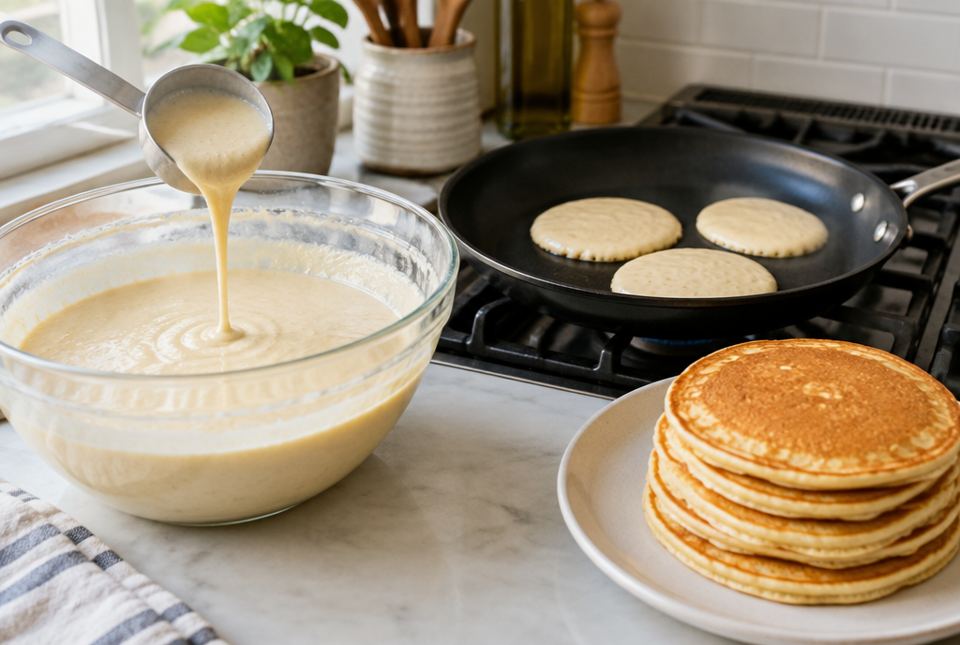 Every pancake uses the same amount of batter. Six pancakes need 6 groups of 1/3 cup. AI-generated imageA number line from 0 to 2 in thirds. Six jumps of 1/3 land on 6/3, which equals 2. So 6 × 1/3 = 2.
Two ways to see it
Way 1: Groups of a fraction. 6 × 1/3 means 6 groups of 1/3. Count thirds: 1/3, 2/3, 3/3, 4/3, 5/3, 6/3. That's 6/3 = 2.
Way 2: A fraction of a number. You can multiply in any order, so 6 × 1/3 is the same as 1/3 × 6, which means one third of 6. Split 6 into 3 equal groups. Each group has 2.
Both ways give 2!
🍎🍎🍎🍎🍎🍎
6 apples split into 3 equal groups. One third of 6 is 2.The pattern
When you multiply a whole number by a unit fraction:
- The whole number becomes the numerator: 5 × 1/4 = 5/4.
- If the numerator is bigger than the denominator, change it to a whole or mixed number: 5/4 = 1 1/4.
Notice: multiplying by a unit fraction makes the number smaller. 6 × 1/3 = 2, and 2 is less than 6. That's because you are taking only part of each one.
Worked exampleExample 1: An answer that is a mixed number
- 5 groups of 1/4 = 5/4.
- 4 fourths make 1 whole. 5/4 = 4/4 + 1/4 = 1 1/4.
Two strips cut into fourths. The first strip has all 4 fourths shaded (1 whole). The second strip has 1 fourth shaded. Together: 5/4 = 1 1/4.Worked exampleExample 2: A fraction of a number
- 8 × 1/2 is the same as 1/2 of 8, or half of 8.
- Half of 8 is 4.
- Check with groups: 8 halves = 8/2. Two halves make 1 whole, so 8 halves make 4 wholes. ✓
Worked exampleExample 3: A story problem
Lena runs laps of a park path. Each lap is 1/3 km. She runs 7 laps. How far does she run?
- 7 × 1/3 = 7/3.
- 3 thirds make 1, and 6 thirds make 2. 7/3 = 6/3 + 1/3 = 2 1/3.
Remember
- The denominator stays the same when you multiply a whole number by a unit fraction. 3 × 1/5 is 3/5, not 3/15.
- To change an improper fraction to a mixed number, ask: How many wholes fit? What's left over?
- If the whole number can be split evenly by the denominator (like 9 × 1/3), the answer is a whole number.
Just for funPancake math: a breakfast for 12 pancakes at 1/3 cup each needs 12 × 1/3 = 4 cups of batter. That's a lot of flipping! Hope the cook has a strong wrist.
Hands-on activityMeasuring cup multiplying
You need: a 1/4 cup measuring cup, a 1 cup measuring cup (or a clear container), and some dry rice, oats or water. Do this over a tray or the sink.
- Fill the 1/4 cup and pour it into the 1 cup measure 4 times. What is 4 × 1/4? (1 cup)
- Empty it. Now pour 6 scoops of 1/4 cup. How many cups? (6/4 = 1 2/4 cups, or 1 1/2 cups)
- Use 8 coins or buttons. Find 1/4 of 8 by splitting them into 4 equal groups. (2) Then show that 8 × 1/4 = 8/4 = 2 too.
Math talk: "Why does multiplying by 1/4 give a smaller number?"
Your turn
2. 4 halves = 4/2 = 2. (Half of 4 is 2.)
3. 9 thirds = 9/3 = 3. (One third of 9 is 3.)
2 1/2. 5 halves = 5/2 = 2 wholes and 1 half.
2. 8 fourths = 8/4 = 2. (One fourth of 8 is 2.)
3 1/2. 7/2 = 6/2 + 1/2 = 3 1/2.
7A batch of muffins uses 1/4 cup of maple syrup. How much syrup do 6 batches need?
1 2/4 cups (or 1 1/2 cups). 6 × 1/4 = 6/4 = 1 2/4.
More practice: on your own
2 1/4. 9/4 = 8/4 + 1/4 = 2 1/4.
6/8. The product is less than 1.
2 2/3. 8/3 = 6/3 + 2/3 = 2 2/3.
4A lap of the walking track is 1/2 km. Ella walks 7 laps. How far does she walk?
3 1/2 km. 7 × 1/2 = 7/2 = 3 1/2.
5Which is more: 5 × 1/2 or 9 × 1/4?
5 × 1/2 is more. 5 × 1/2 = 2 1/2 = 2 2/4, and 9 × 1/4 = 2 1/4. 2 2/4 > 2 1/4.
Challenge
1Find the missing number: □ × 1/3 = 3.
9. 9 × 1/3 = 9/3 = 3. (3 is one third of 9.)
2Is 6 × 1/4 more or less than 6? Explain without calculating.
Less. 1/4 is less than 1, so 6 groups of 1/4 is less than 6 groups of 1. (It's 6/4 = 1 2/4.)
3Write 6 × 1/6, 3 × 1/6 and 2 × 1/6 as fractions. Which one equals 1? Which one equals one half?
6 × 1/6 = 6/6 = 1. 3 × 1/6 = 3/6, which is one half (3 is half of 6). 2 × 1/6 = 2/6.
Quiz
3. 8 × 1/2 is the same as ...
5. On a number line, you make 9 jumps of 1/3 from 0. Where do you land?
6. Which product is less than 1?
Big idea: B2.8 asks Grade 5 students to multiply and divide one-digit whole numbers by unit fractions, using tools and drawings. This lesson covers multiplying. The key ideas are that 6 × 1/3 means "6 groups of one third" and also "one third of 6", and that multiplying by a unit fraction gives a smaller number.
Common difficulties:
- Multiplying the denominator too (3 × 1/5 = 3/15). Show with fraction strips that the pieces stay fifths.
- Changing improper fractions to mixed numbers. Ask "How many wholes fit? What's left?"
- Expecting multiplication to make numbers bigger. Talk about taking part of something.
How to help: Cooking and measuring cups are perfect: "We need 1/4 cup, 6 times. How many cups is that?" Ask your child to draw or model before calculating. Explaining two ways to see the same product builds A1 reasoning and communication.