B. Number · Operations: Numbers to 100 000, Decimals, Fractions, Ratios and RatesSmart Strategies: Properties and Relationships of Operations
B2.1 A1About 40 minutes
Learning goals- I can change the order or grouping of numbers to make adding and multiplying easier, with whole numbers and decimals.
- I can split a number to multiply in my head.
- I can adjust a number to a friendly one and then fix my answer.
- I can check a calculation with the inverse (opposite) operation.
Words to know
property
A rule that is always true for an operation, like "you can add in any order".
commutative property
The any order rule: 3.6 + 2.5 = 2.5 + 3.6 and 12 × 7 = 7 × 12.
associative property
The grouping rule: when you add or multiply three or more numbers, you can choose which two to do first.
distributive property
The splitting rule: 8 × 26 = 8 × 20 + 8 × 6.
inverse operations
Operations that undo each other: adding and subtracting, or multiplying and dividing.
compensation
Changing a number to a friendly one, doing the math, then fixing (compensating) the answer.
Remember from Grade 4
In Grade 4 you learned the math rules called properties: you can add or multiply in any order, you can group numbers in a smart way, adding 0 or multiplying by 1 changes nothing, multiplying by 0 gives 0, and you can split a number to multiply. You also checked subtraction with addition and division with multiplication.
In Grade 5 you will use these rules with bigger numbers and with decimals, and use them to check your work.
Let's start with a puzzle
At the school bake sale, Noor buys a muffin for $1.25, a juice for $2.60 and a cookie for $0.75. How much does she spend?
You could add from left to right. But look: $1.25 + $0.75 = $2.00. That's a friendly pair! Then $2.00 + $2.60 = $4.60.
Noor changed the order and the grouping to make the math easy. That's allowed, because of the properties of addition.
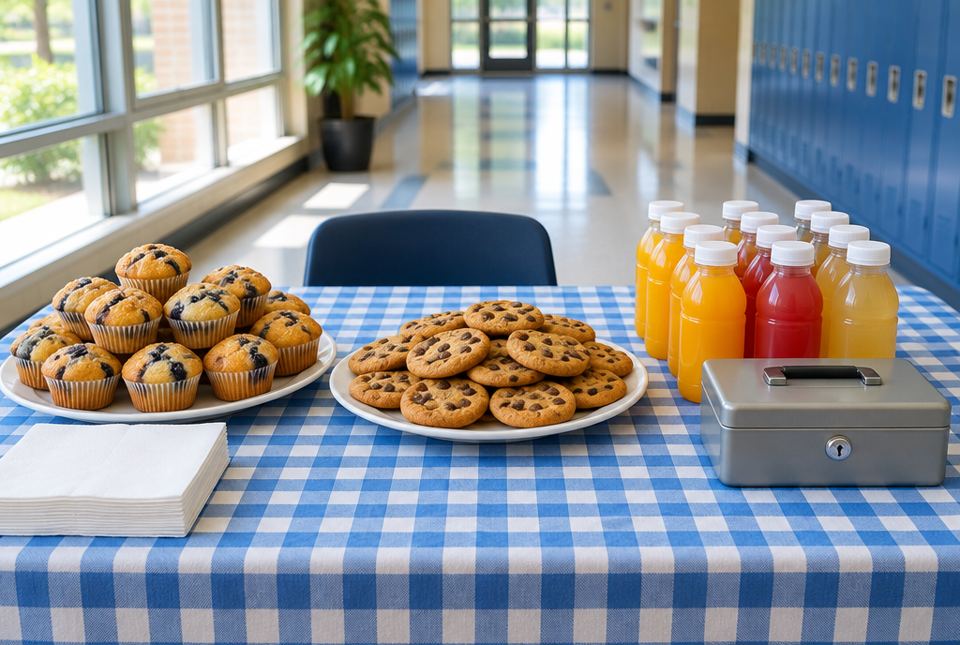 A school bake sale. When adding prices, you can change the order and grouping to find friendly pairs. AI-generated image
Rule 1 and Rule 2: Any order, any grouping
When you add or multiply, you can change the order and choose which numbers to do first. The answer stays the same.
- 2.5 + 4.8 + 7.5 → (2.5 + 7.5) + 4.8 = 10 + 4.8 = 14.8
- 25 × 37 × 4 → (25 × 4) × 37 = 100 × 37 = 3700
Look for pairs that make a whole number, 10 or 100: 0.25 + 0.75 = 1, 0.6 + 0.4 = 1, 2 × 5 = 10, 4 × 25 = 100, 20 × 5 = 100.
Careful: these rules do not work for subtraction or division. 10 − 4 is not the same as 4 − 10, and 24 ÷ 4 is not the same as 4 ÷ 24.
Worked exampleExample 1: Find friendly pairs
Solve 3.4 + 1.75 + 2.6 + 0.25.
- Look for pairs that make whole numbers. 3.4 + 2.6 = 6. 1.75 + 0.25 = 2.
- Add the whole numbers: 6 + 2 = 8.
3.4 + 1.75 + 2.6 + 0.25 = 8
Rule 3: Split it (the distributive property)
Split one factor into friendly parts. Multiply each part. Then put the parts back together.
12 × 15: split 15 into 10 + 5.
12 × 10 = 120 and 12 × 5 = 60. 120 + 60 = 180.
You can also split with subtraction. 9 × 99 is 9 groups of 100, take away 9 groups of 1:
9 × 100 = 900, then 900 − 9 = 891.
Worked exampleExample 2: Split to multiply in your head
- Split 26 into 20 + 6.
- 8 × 20 = 160.
- 8 × 6 = 48.
- Add the parts: 160 + 48 = 208.
Rule 4: Make it friendly, then fix it (compensation)
Some numbers are almost friendly. Change them to a friendly number, do the math, then fix your answer.
- 4.99 + 2.35: 4.99 is 0.01 less than 5. Add 5 + 2.35 = 7.35. You added 0.01 too much, so take it away: 7.34.
- 5000 − 2387: take 1 from both numbers. 4999 − 2386 = 2613. (The difference stays the same when you move both numbers the same amount.)
Rule 5: Operations are partners (inverse operations)
- Adding and subtracting undo each other. If 6.25 − 2.8 = 3.45, then 3.45 + 2.8 = 6.25.
- Multiplying and dividing undo each other. If 144 ÷ 12 = 12, then 12 × 12 = 144.
So you can always check a subtraction with addition, and a division with multiplication. Mathematicians check their work. You should too!
Worked exampleExample 3: Check with the inverse operation
Ella says 7.2 − 3.85 = 4.45. Is she right?
- Check with addition: 4.45 + 3.85 = 8.30.
- 8.30 is not 7.2, so Ella made a mistake.
- Try again. Count up from 3.85: + 0.15 makes 4, then + 3.2 makes 7.2. 0.15 + 3.2 = 3.35.
- Check: 3.35 + 3.85 = 7.20. ✓
Ella was not right. 7.2 − 3.85 = 3.35.
Think like a mathematician
Before you start a calculation, take a few seconds to look at the numbers. Ask: Can I change the order? Can I make a friendly pair? Can I split a number? Can I make a number friendly and fix it after? If one idea doesn't work, try another. Being flexible and not giving up is a big part of being a mathematician.
Just for funSilly what if: Multiply 0 × 4562 × 99 × 1 000 000 × 12 345. All that work, and the answer is still 0! Zero is the black hole of multiplication: anything that gets pulled in disappears.
Hands-on activityFlyer math with smart strategies
You need: a grocery flyer (paper or online), paper and a pencil. A calculator is optional, for checking only.
- Choose 4 items from the flyer. Write their prices.
- Look for friendly pairs (prices that add to a whole number of dollars). Add those first.
- Find the total in your head or on paper. Tell your grown-up which rule you used.
- Pretend you pay with a $20 bill. Find the change by counting up.
- Check your change with addition: change + total should equal $20.
Math talk: "Which items did you pair up first, and why?"
Your turn
7.4. 0.75 + 0.25 = 1. Then 1 + 6.4 = 7.4.
1700. 20 × 5 = 100. Then 100 × 17 = 1700.
38 × 26 = ? Split 26 into 20 + 6.
208. 8 × 20 = 160 and 8 × 6 = 48. 160 + 48 = 208.
180. 15 × 10 = 150 and 15 × 2 = 30. 150 + 30 = 180.
52.99 + 4.50 = ? Use a friendly number.
7.49. 3 + 4.50 = 7.50. You added 0.01 too much, so 7.50 − 0.01 = 7.49.
594. 6 × 100 = 600. Then take away 6 × 1 = 6. 600 − 6 = 594.
7Check with addition: is 7.2 − 3.85 = 3.35 correct?
Yes. 3.35 + 3.85 = 7.20, which is 7.2. ✓
More practice: warm-up
3.47. Adding 0 changes nothing.
4562. Multiplying by 1 changes nothing.
0. Zero groups of anything is 0.
3.6. You can add in any order.
584 ÷ 7 = 12. Write a multiplication that checks it.
7 × 12 = 84 (or 12 × 7 = 84).
More practice: on your own
3900. Group 4 × 25 = 100 first. Then 100 × 39 = 3900.
21.6 + 2.7 + 3.4 + 0.3 = ?
8. 1.6 + 3.4 = 5 and 2.7 + 0.3 = 3. Then 5 + 3 = 8.
154. 10 × 14 = 140, plus one more 14: 140 + 14 = 154.
48000 − 3456 = ? Take 1 from both numbers first.
4544. 7999 − 3455 = 4544. Check: 4544 + 3456 = 8000. ✓
5Sam says 132 ÷ 11 = 13. Check with multiplication. Is he right?
No. 11 × 13 = 143, not 132. The correct answer is 12, because 11 × 12 = 132.
Challenge
1Find 25 × 48 in two different ways.
1200 both ways.
- Grouping: 48 = 4 × 12, so 25 × 4 × 12 = 100 × 12 = 1200.
- Splitting: 25 × 40 = 1000 and 25 × 8 = 200. 1000 + 200 = 1200.
2Is (24 ÷ 4) ÷ 2 the same as 24 ÷ (4 ÷ 2)? Show why.
No. (24 ÷ 4) ÷ 2 = 6 ÷ 2 = 3. But 24 ÷ (4 ÷ 2) = 24 ÷ 2 = 12. The grouping rule does not work for division.
35.00 − 1.98 = ? Explain your strategy.
3.02. One way: count up. 1.98 + 0.02 = 2, then 2 + 3 = 5. The jumps are 0.02 + 3 = 3.02. Another way: 5 − 2 = 3, but you took away 0.02 too much, so add it back: 3.02.
Quiz
1. Which is equal to 3.8 + 4.5?
3. Which shows a way to find 14 × 6?
4. What is the best way to check 9.1 − 4.6 = 4.5?
Big idea: The Ontario curriculum (B2.1) asks Grade 5 students to use the properties of operations and the relationships between operations to solve problems with whole numbers and decimals, and to check their calculations. Your child does not need to memorize the formal names (commutative, associative, distributive), but should be able to explain what each rule lets them do.
Common difficulties:
- Using "any order" with subtraction or division. Try 10 − 4 and 4 − 10 with real objects to see that they differ.
- Splitting and multiplying only one part: 8 × 26 is not 8 × 20 + 6. Ask "8 groups of what?" for each part.
- Fixing compensation the wrong way. If you added a little too much, take it away at the end; if you subtracted too much, add it back.
How to help: Use real prices from flyers or receipts. Before your child calculates, ask "Is there a friendly pair?" After, ask "How could you check it?" This lesson also builds the social-emotional and process skills in A1: being flexible, persevering when a strategy doesn't work and explaining thinking out loud.