B. Number · Operations: Numbers to 100 000, Decimals, Fractions, Ratios and RatesMultiplying 2-Digit by 2-Digit Numbers: The Area Model
B2.6 B2.1About 45 minutes
Learning goals- I can multiply tens by tens, like 20 × 30.
- I can use an area model to multiply a 2-digit number by a 2-digit number.
- I can find and add the four partial products.
- I can estimate to check if my product makes sense.
Words to know
area model
A rectangle split into parts to show multiplication. The side lengths are the factors and the area is the product.
partial product
The answer to one part of a bigger multiplication. The partial products add up to the full product.
expanded form
A number written as the sum of its place values, like 23 = 20 + 3.
Remember from Grade 4
In Grade 4 you multiplied 2- and 3-digit numbers by 1-digit numbers. You split the big number by place value and drew an area model: for 6 × 47, you found 6 × 40 = 240 and 6 × 7 = 42, then added to get 282.
In Grade 5, both numbers can have 2 digits. You'll split both of them!
Warm-up: tens times tens
How much is 20 × 30?
20 × 30 = 2 tens × 3 tens. 2 × 3 = 6, and tens times tens are hundreds. So 20 × 30 = 600.
- 40 × 20 = 8 hundreds = 800
- 30 × 50 = 15 hundreds = 1500
- 10 × 10 = 100
Let's start with a garden
A community garden is 23 m long and 14 m wide. What is its area?
We need 23 × 14. Split both numbers by place value: 23 = 20 + 3 and 14 = 10 + 4.
Draw a rectangle and cut it into 4 parts. Find the area of each part, then add them.
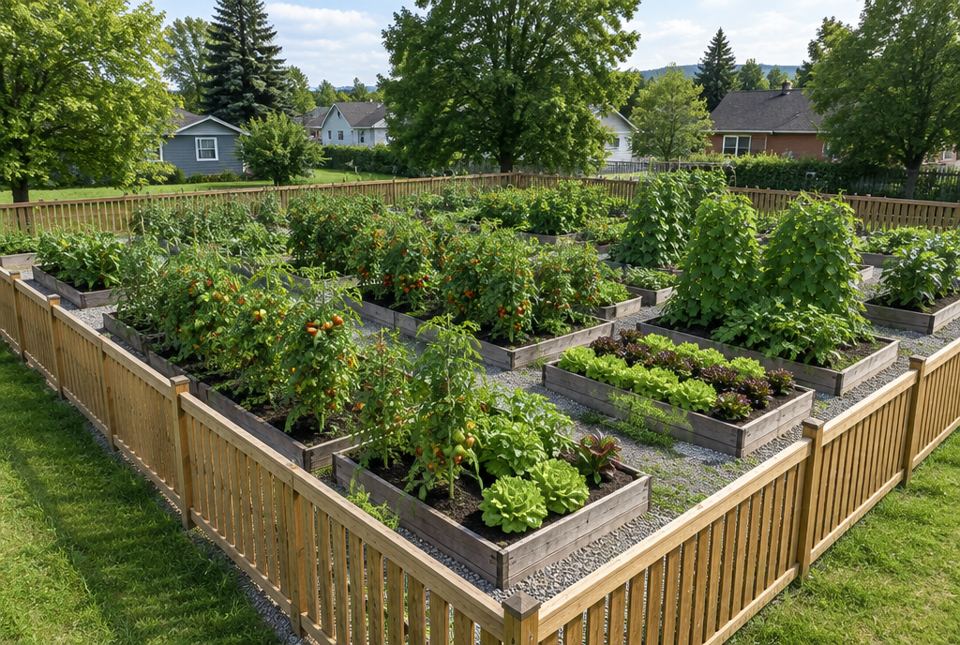 A community garden is a rectangle, so its area is length × width, just like the area model. AI-generated imageAn area model for 23 × 14. Across the top: 20 and 3. Down the side: 10 and 4. The four parts are 20 × 10 = 200, 3 × 10 = 30, 20 × 4 = 80 and 3 × 4 = 12.
Worked exampleExample 1: Use the area model
- Split: 23 = 20 + 3 and 14 = 10 + 4.
- Find the four partial products: 20 × 10 = 200, 3 × 10 = 30, 20 × 4 = 80, 3 × 4 = 12.
- Add them: 200 + 30 + 80 + 12 = 322.
- Estimate to check: 20 × 15 = 300. 322 is close. ✓
23 × 14 = 322. The garden's area is 322 square metres.
Worked exampleExample 2: Bigger digits
- Estimate: 35 is close to 30 and 26 is close to 30. 30 × 30 = 900, so the answer should be about 900.
- Split: 35 = 30 + 5 and 26 = 20 + 6.
- 30 × 20 = 600, 5 × 20 = 100, 30 × 6 = 180, 5 × 6 = 30.
- Add: 600 + 100 + 180 + 30 = 910. ✓
| Part | Partial product |
|---|
| 30 × 20 | 600 |
| 5 × 20 | 100 |
| 30 × 6 | 180 |
| 5 × 6 | 30 |
| Total | 910 |
Worked exampleExample 3: A story problem
The school gym has 18 rows of chairs with 24 chairs in each row. How many chairs are there?
- 18 rows of 24 is 18 × 24.
- Split: 18 = 10 + 8 and 24 = 20 + 4.
- 10 × 20 = 200, 10 × 4 = 40, 8 × 20 = 160, 8 × 4 = 32.
- 200 + 40 + 160 + 32 = 432.
Area model tips
- Every 2-digit × 2-digit area model has 4 parts. If you only have 2 partial products, you've missed some!
- Tens × tens = hundreds. Check that 20 × 40 gives 800, not 80.
- Estimate first by rounding one or both numbers to friendly tens.
Just for funRiddle: What did one partial product say to the other three?
"Let's stick together and make a total!"
Hands-on activityDraw and count an area model
You need: grid paper (or draw a grid of 1 cm squares with a ruler), coloured pencils and a ruler.
- Draw a rectangle 13 squares long and 12 squares wide.
- Draw a line after the 10th square across the top, and after the 10th square down the side. Now you have 4 parts.
- Colour each part a different colour. Find each area by multiplying: 10 × 10, 3 × 10, 10 × 2, 3 × 2.
- Add the 4 parts. Do you get 156? Count a few rows to check.
- Try your own: measure a rug, a window or a table in tiles or other squares, and use an area model to find how many squares cover it.
Math talk: "Why does splitting both numbers give four parts?"
Your turn
800. 2 × 4 = 8, and tens × tens = hundreds.
1500. 3 × 5 = 15 hundreds.
156. 10 × 10 = 100, 2 × 10 = 20, 10 × 3 = 30, 2 × 3 = 6. 100 + 20 + 30 + 6 = 156.
315. 20 × 10 = 200, 1 × 10 = 10, 20 × 5 = 100, 1 × 5 = 5. 200 + 10 + 100 + 5 = 315.
768. 20 × 30 = 600, 4 × 30 = 120, 20 × 2 = 40, 4 × 2 = 8. 600 + 120 + 40 + 8 = 768.
495. 40 × 10 = 400, 5 × 10 = 50, 40 × 1 = 40, 5 × 1 = 5. 400 + 50 + 40 + 5 = 495.
7A store has 16 boxes of granola bars. Each box holds 25 bars. How many bars?
400 bars. 10 × 20 = 200, 6 × 20 = 120, 10 × 5 = 50, 6 × 5 = 30. 200 + 120 + 50 + 30 = 400.
More practice: on your own
351. 20 × 10 = 200, 7 × 10 = 70, 20 × 3 = 60, 7 × 3 = 21. 200 + 70 + 60 + 21 = 351.
726. 30 × 20 = 600, 3 × 20 = 60, 30 × 2 = 60, 3 × 2 = 6. 600 + 60 + 60 + 6 = 726.
720. 40 × 10 = 400, 8 × 10 = 80, 40 × 5 = 200, 8 × 5 = 40. 400 + 80 + 200 + 40 = 720.
4A classroom floor is 14 tiles wide and 18 tiles long. How many tiles cover it?
252 tiles. 10 × 10 = 100, 4 × 10 = 40, 10 × 8 = 80, 4 × 8 = 32. 100 + 40 + 80 + 32 = 252.
About 2000. 50 × 40 = 2000. (Exact: 2028)
Challenge
1Draw an area model for 36 × 24. What are the four parts and the product?
Split 36 = 30 + 6 and 24 = 20 + 4. Parts: 30 × 20 = 600, 6 × 20 = 120, 30 × 4 = 120, 6 × 4 = 24. Product: 600 + 120 + 120 + 24 = 864.
2Which is bigger: 25 × 36 or 30 × 30?
They are equal! 25 × 36: 20 × 30 = 600, 5 × 30 = 150, 20 × 6 = 120, 5 × 6 = 30, total 900. And 30 × 30 = 900.
3Ami says 13 × 12 = 10 × 10 + 3 × 2 = 106. What did she forget? What is the right answer?
She forgot two of the four parts: 10 × 2 = 20 and 3 × 10 = 30. The right answer is 100 + 20 + 30 + 6 = 156.
Quiz
3. Which partial products do you need for 23 × 15?
5. A theatre has 15 rows of 22 seats. How many seats?
6. What is the best estimate for 48 × 21?
Big idea: The Grade 5 curriculum (B2.6) asks students to multiply two-digit by two-digit whole numbers using the area model and algorithms, and to connect the two methods. This lesson builds the area model; the next lesson connects it to the standard algorithm.
Common difficulties:
- Only multiplying tens by tens and ones by ones (23 × 14 = 200 + 12). The area model shows the two "middle" parts that are easy to forget.
- Tens × tens. 20 × 40 is 800, not 80. Say it as "2 tens times 4 tens is 8 hundreds".
- Adding four partial products. Encourage a neat list.
How to help: Use grid paper, or count tiles on a floor or squares on a game board. Ask your child to estimate before multiplying, and to compare the answer with the estimate.