A. Literacy Connections and Applications / C. Comprehension: Understanding and Responding to Texts · Understanding and Responding to TextsSummarizing and Drawing Well-Supported Conclusions
C2.6 C2.7 A1.2About 40 minutes
Learning goals- I can summarize the main idea and supporting details of a text in sequence, in my own words.
- I can draw a well-supported conclusion and back it up with evidence from the text.
- I can explain how strategies like visualizing, predicting, summarizing and connecting helped me understand.
- I can set a next step for myself as a reader.
Words to know
summary
A short retelling of only the most important ideas, in your own words, in order.
main idea
The most important point the whole text is about.
supporting details
Facts, examples or events that explain or prove the main idea.
conclusion
A judgment or decision you reach after thinking about the information.
well-supported
Backed up by several pieces of evidence from the text.
evidence
Words, facts or events from the text that prove an idea.
Remember from Grade 4
In Grade 4 you summarized the main idea and supporting details in sequence and added a simple conclusion. You used Somebody, Wanted, But, So, Then for stories.
In Grade 5 your conclusion must be well-supported: you will back it up with more than one piece of evidence and explain how the evidence proves it. You'll also explain which strategies helped you most.
Hook: The 20-word challenge
Can you tell what a whole movie or book is about in 20 words or fewer? Try it with a movie you know. It's harder than it sounds! You have to choose only the most important ideas. That's summarizing.
Nature's Engineers
This informational text was written for this website.
Beavers are among the few animals that change their environment in a big way. Using their strong front teeth, beavers cut down trees and branches. They pile the branches across a stream and pack them with mud and stones to build a dam.
The dam blocks the water and creates a pond. In the pond, beavers build a lodge, a home of sticks and mud with underwater entrances. The water protects them from predators, such as wolves.
The new pond and the wet land around it become a wetland. Wetlands are home to frogs, fish, ducks, insects and many plants. Moose come to eat the water plants. Wetlands also store water like a sponge, which can help slow down floods and keep streams flowing in dry weather.
Beavers can cause problems, too. Their dams sometimes flood roads, farm fields or trails. Some communities use special pipes that let water flow through a dam, so the beavers can stay and the flooding stops.
The beaver became an official symbol of Canada in 1975. It appears on the Canadian five-cent coin.
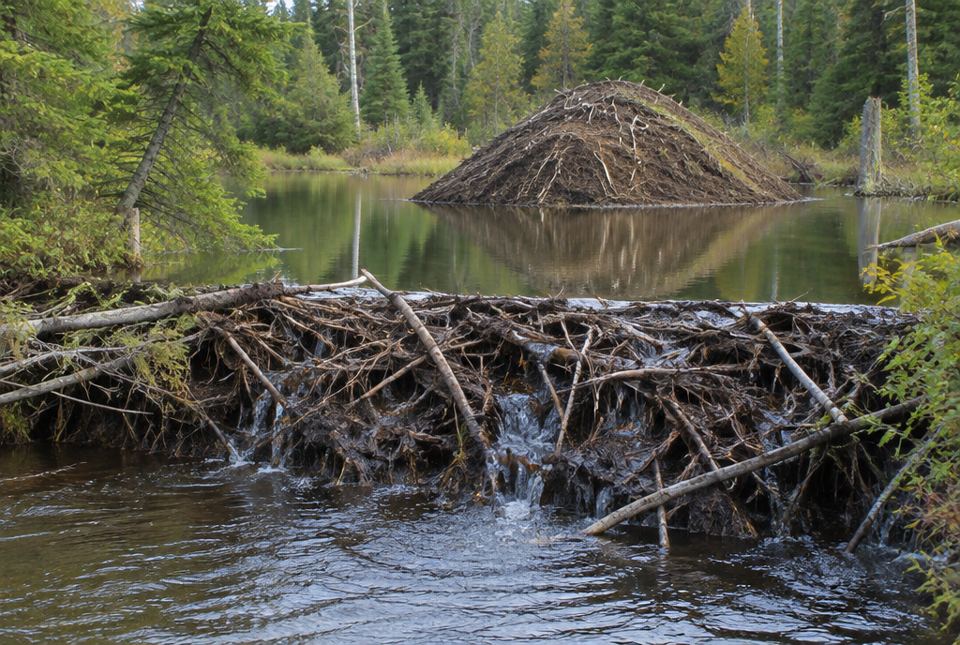 The dam blocks the stream and creates a pond, and the lodge sits in the pond with its entrances hidden underwater. Which details from the text can you find in this photo? AI-generated imageA summary plan: the main idea at the top, three supporting details in the middle, and a well-supported conclusion at the bottom that uses the details as evidence.
Worked exampleLet's summarize *Nature's Engineers*
Write a summary with the main idea and supporting details in sequence.
- Find the main idea: What is the whole text about? Beavers change their environment by building dams that create wetlands.
- Choose supporting details, in order: (1) Beavers cut trees and build dams of branches, mud and stones. (2) The dam makes a pond where they build a lodge, safe from predators. (3) The pond becomes a wetland, home to many animals, that stores water.
- Include the other side briefly: Dams can flood roads and fields, but pipes can help.
- Leave out small details: the five-cent coin is interesting but not part of the main idea.
- Use your own words and keep it short.
Beavers change their environment. They cut trees and build dams from branches, mud and stones. The dam makes a pond, where beavers build a safe lodge. The pond becomes a wetland that is home to many animals and stores water. Sometimes dams cause flooding, but pipes can help people and beavers share the land.
Drawing a well-supported conclusion
A conclusion goes beyond the summary. It's a judgment you make after thinking about all the information. A well-supported conclusion has:
- A clear conclusion statement.
- At least two or three pieces of evidence from the text.
- An explanation of how the evidence proves it.
Weak: Beavers are good. (No evidence. Good is vague.)
Well-supported: Beavers are important to other living things. Evidence: their dams create wetlands that are home to frogs, fish, ducks and insects; moose eat the plants that grow there; and wetlands store water that keeps streams flowing in dry weather. Explanation: many animals and plants depend on the habitat that beavers create.
Check your conclusion: Does the text give evidence against it? The text says dams can cause flooding. A careful conclusion might add: Beavers sometimes cause problems for people, but those problems can often be solved.
Worked exampleLet's summarize a story and draw a conclusion
Lucas wanted to win the snow sculpture contest. He built a giant dragon, but the warm sun melted its head. Instead of quitting, he asked his little brother to help. Together they packed wet snow on the shady side of the house and built a smaller, stronger turtle. They won second place, and Lucas said the turtle was more fun to build. Summarize and draw a conclusion about Lucas.
- Somebody: Lucas. Wanted: to win the snow sculpture contest. But: the sun melted his dragon's head. So: he asked his brother to help and built a turtle in the shade. Then: they won second place.
- Conclusion: Lucas is persistent and willing to change his plan.
- Evidence 1: Instead of quitting, he tried again.
- Evidence 2: he changed his plan (shady side, smaller, stronger sculpture).
- Evidence 3: he said the turtle was more fun, so he valued the experience, not just winning.
Summary: Lucas wanted to win a snow sculpture contest, but the sun melted his dragon, so he and his brother built a turtle in the shade and won second place. Conclusion: Lucas is persistent and flexible, supported by three pieces of evidence.
Reflecting on strategies
After reading, think about how you understood. Which strategy helped most?
- Visualizing: I pictured the lodge with underwater doors, so I understood how the water keeps beavers safe.
- Predicting: I predicted beavers would cause problems too, so I watched for that part.
- Summarizing: Summarizing each paragraph in one sentence helped me remember the order.
- Connecting: I've seen a beaver pond on a hike, so I understood how big it can be.
Then set a next step: Next time, I will stop after each paragraph and summarize it in my head. Knowing your strengths and goals is part of being an engaged learner.
Just for funA beaver's whole day, summarized in five words: chew, build, swim, chew, repeat.
Bonus true fact: beaver front teeth are orange because they contain iron, which makes them extra strong.
Summary, retell or conclusion?
A retell includes many details. A summary includes only the most important ideas, in order, in your own words. A conclusion is your judgment, backed by evidence. Summaries should not include your opinion; conclusions should!
Hands-on activitySummary card and conclusion court
You need: index cards or paper, a timer, and a short nonfiction article or picture book.
- Read the text. Write a summary on one card: main idea plus 3 details in order, in 40 words or fewer.
- On a second card, write a conclusion and three pieces of evidence.
- Conclusion court: read your conclusion to a family member. They are the judge and can ask: What is your evidence? Is there evidence against it? Defend your conclusion.
- On a third card, write which strategy helped you most and one next step.
- Bonus: summarize a movie your family watched in 20 words or fewer.
Your turn
1What is the main idea of Nature's Engineers?
Beavers change their environment by building dams that create ponds and wetlands.
2Put these in order: (a) the pond becomes a wetland, (b) beavers build a dam, (c) beavers build a lodge in the pond.
(b), (c), (a): dam, then lodge in the pond, then wetland.
3Why should the five-cent coin fact be left out of a short summary?
It's interesting but not part of the main idea about how beavers change their environment.
4What is the difference between a conclusion and a well-supported conclusion?
A well-supported conclusion is backed by several pieces of evidence from the text, with an explanation of how they prove it.
5Give two pieces of evidence that wetlands help animals.
Any two: they are home to frogs, fish, ducks, insects and plants; moose eat the water plants; they keep streams flowing in dry weather.
6Name one strategy that would help you understand how a beaver lodge works, and explain why.
Visualizing: picturing the lodge with underwater entrances shows how beavers stay safe from predators.
More practice: warm-up
1Should a summary be long or short?
2Should a summary use the author's exact words or your own words?
3What do beavers build their dams from?
Branches, mud and stones.
4Does a summary include your opinion?
5What does a conclusion need to be well-supported?
Evidence from the text (more than one piece).
More practice: on your own
1Summarize this in one sentence: Ana practised piano every day for a month. At first her fingers tripped over the notes. By the end of the month, she could play the whole song for her grandmother's birthday.
Example: Ana practised piano every day for a month and went from tripping over notes to playing the whole song for her grandmother's birthday.
2Draw a conclusion about Ana and give two pieces of evidence.
Ana is hard-working and determined. Evidence: she practised every day for a month; she kept going even when her fingers tripped over the notes; she reached her goal.
3What evidence in Nature's Engineers goes against the conclusion Beavers are always helpful to people?
Their dams sometimes flood roads, farm fields or trails.
4Rewrite this weak conclusion as a stronger one: Wetlands are nice.
Example: Wetlands are valuable habitats, because they are home to many animals and plants and they store water that helps slow floods.
5Write a reflection sentence about a strategy you used today, and a next step.
Example: Summarizing each paragraph helped me remember the order. Next time, I'll make notes as I go.
Challenge
1Write a summary of Nature's Engineers in 25 words or fewer.
Example (23 words): Beavers build dams that turn streams into ponds and wetlands. These habitats support many animals and store water, though dams sometimes cause flooding. Count to check.
2Two students draw different conclusions: (A) Beavers should be removed from all streams near towns. (B) Beavers and people can share land if we use smart solutions. Which is better supported by the text? Explain.
(B) is better supported. The text gives evidence that beavers help wetlands and many animals, and that pipes can stop flooding so beavers can stay. Nothing in the text supports removing all beavers.
3Explain how summarizing can help you in science or social studies.
Summarizing helps you remember the key ideas in order, take short notes for a project, study for a test, and explain what you learned to others in your own words.
Quiz
1. A summary should include...
2. Which is a well-supported conclusion?
3. What makes a conclusion different from a summary?
4. Which detail is LEAST important for a summary of Nature's Engineers?
5. I pictured the lodge with underwater doors, so I understood how beavers stay safe. Which strategy is this?
6. What should you do if the text gives some evidence against your conclusion?
What this lesson teaches: Grade 5 students summarize the main idea and supporting details in sequence and draw a well-supported conclusion (C2.6). They explain how strategies such as visualizing, predicting, summarizing and connecting helped them understand (C2.7), and reflect on next steps as engaged learners (A1.2).
How to help at home:
- After a movie or chapter, play the 20-word challenge.
- When your child gives an opinion, ask "What's your evidence?", and ask for two pieces.
- Ask "Which strategy helped you most today?"
Common difficulties:
- Summaries that are too long. Ask, "Would the text make sense without this detail?"
- Opinions in summaries. Keep opinions for the conclusion.
- Conclusions with one weak piece of evidence. Ask for more, and look for evidence against.
About the facts: Beaver dams create ponds and wetlands that support many species and store water; dams sometimes cause flooding, and flow devices ("pond levellers") are used in some communities. The beaver was made an official symbol of Canada in 1975 and appears on the five-cent coin. Texts were written for this site.