A. Literacy Connections and Applications / C. Comprehension: Understanding and Responding to Texts · Understanding and Responding to TextsBefore and During Reading: Prior Knowledge and Predictions
C2.1 C2.3About 35 minutes
Learning goals- I can explain what I already know about a topic and where that knowledge came from, including other school subjects.
- I can use my prior knowledge to understand a new text.
- I can make predictions using background knowledge and clues in the text.
- I can ask questions to check my predictions and change my thinking when the text surprises me.
Words to know
prior knowledge
What you already know before you read, from your experiences, other texts, school subjects and your community.
prediction
A thoughtful guess about what will happen or what you will learn, based on clues.
textual information
Clues in the text itself: the title, headings, pictures, and what the characters say and do.
confirm
To show that a prediction was right.
revise
To change your thinking when new information shows a prediction was wrong or incomplete.
Remember from Grade 4
In Grade 4 you used three kinds of clues to predict (background knowledge, text features and evidence from the text), and you checked predictions as you read.
In Grade 5 you will name where your prior knowledge comes from, especially learning in other subjects like science and social studies, and you will revise your understanding when the text surprises you. Good readers change their minds when the evidence says so!
Hook: What do you already know about monarch butterflies?
Before reading, take 1 minute. List everything you know about monarch butterflies. Then sort your list: Where did I learn this?
- From experience: I saw orange butterflies in the garden in August.
- From science class: Butterflies go through metamorphosis: egg, larva (caterpillar), pupa (chrysalis), adult.
- From social studies or geography: Mexico is south of the United States.
- From other texts or media: A video said monarchs fly south for the winter.
- From family and community: My aunt plants milkweed for monarchs.
Now read this informational text, written for this website.
The Long Flight of the Monarch
In late summer, monarch butterflies in Ontario feel the days getting shorter. Instead of laying eggs, the new generation of adults does something amazing: they fly south. Monarchs from eastern Canada travel thousands of kilometres to mountain forests in central Mexico. There, millions of them cluster together on fir trees for the winter.
Most adult monarchs live only a few weeks. But the butterflies that make the fall migration can live for months. In spring, they fly north and lay eggs on milkweed, the only plant monarch caterpillars eat. Their children and grandchildren continue the trip north. It takes several generations for monarchs to return to Canada each summer.
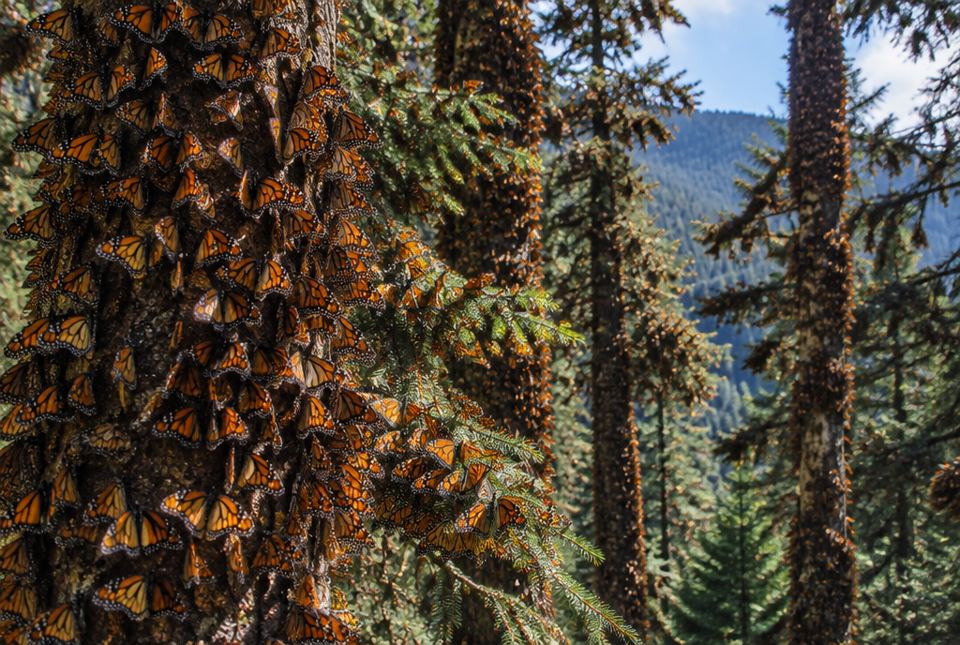 Monarchs from eastern Canada spend the winter clustered together on fir trees in the mountains of central Mexico. What did you already know about this before reading? AI-generated image
Worked exampleLet's use prior knowledge to understand the text
Which parts of the text were easier to understand because of prior knowledge? Which part surprised you?
- Science: I knew about metamorphosis, so I understood that the caterpillars hatch from the eggs on milkweed and become butterflies.
- Geography: I knew where Mexico is, so I could picture the long trip south across the United States.
- Experience: I've noticed days getting shorter in fall, so I understood the clue that tells monarchs to fly south.
- Surprise: I thought each butterfly flew all the way there and back. The text says it takes several generations to return. I revise my understanding: no single butterfly makes the whole round trip.
Prior knowledge from science, geography and experience helped me understand. The surprise about several generations made me revise my thinking.
| Source of prior knowledge | Example |
|---|
| Personal experience | I've seen monarchs on the milkweed in the park. |
| Other texts and media | A nature video showed butterflies in Mexico. |
| Science | Life cycle of a butterfly; habitats. |
| Social studies and geography | Where Canada, the United States and Mexico are. |
| Math | Thousands of kilometres is a very long distance. |
| Family and community | My family plants milkweed; our community garden has a pollinator patch. |
Making, checking and revising predictions
A strong prediction uses background knowledge plus textual information. As you read, stop at checkpoints and ask:
- Was my prediction right? What evidence confirms it?
- What new information changes it?
- What do I predict now?
If a prediction was wrong, that's not a mistake. It means you were thinking! Revising shows you are paying attention to the evidence.
Story: Mira's Monarch (in three parts)
This realistic fiction story was written for this website.
Part 1: At the end of August, Mira and her grandmother found a striped caterpillar munching a milkweed leaf in their garden. "It's a monarch," said Grandma. "Let's watch it, but we won't take it from its plant." Every morning, Mira checked the milkweed before breakfast. On the fifth morning, the caterpillar was gone.
Checkpoint 1: What do you predict happened to the caterpillar?
Part 2: Mira searched every leaf. Then she spotted it: a small green case, like a jade earring with tiny gold dots, hanging under the porch railing next to the garden. "A chrysalis!" she whispered. Grandma smiled. "Now we wait."
Checkpoint 2: What do you predict will happen next? When?
Part 3: Ten days later the chrysalis turned clear, and Mira could see orange and black wings folded inside. The next morning, a monarch hung from the empty case, slowly opening and closing its wings. But the sky was grey, and cold rain was falling. "It can't fly when it's this cold and wet," said Grandma. Mira wanted it to fly to Mexico right now. Instead, they waited. The next afternoon, the sun came out. The butterfly lifted off, circled the garden once, and flew south over the maple trees.
Worked exampleLet's check our predictions
At each checkpoint, make a prediction with evidence, then check it.
- Checkpoint 1 prediction: A bird ate it or It went to make a chrysalis. Evidence: science knowledge says caterpillars form a chrysalis; the story says it ate for days, so it was probably full-grown.
- Check: Part 2 shows a chrysalis under the railing. The second prediction is confirmed. The bird prediction is revised.
- Checkpoint 2 prediction: A butterfly will come out in about two weeks. Evidence: Grandma says Now we wait; from science, a chrysalis stage takes some days.
- Check: Part 3: a butterfly came out after about ten days. Confirmed (close!).
- Surprise: I predicted it would fly off right away, but the cold rain kept it waiting. I revise: weather matters for butterflies, which connects to what I know about cold-blooded insects.
Predictions are confirmed with evidence from the text, or revised when new information appears, like the cold rain.
Question stems for checking predictions
Was I right? What evidence proves it? What did I miss? What clue should I have noticed? What do I predict now?
Just for funWhy do monarch butterflies fly south for the winter?
Because it's much too far to walk!
Hands-on activityPrediction bookmark and knowledge web
You need: a strip of paper for a bookmark, a large sheet of paper, coloured pencils, and a chapter book or nonfiction book.
- Before reading a new book, make a knowledge web: write the topic in the middle and everything you know around it. Colour-code where each idea came from (experience, science, social studies, media, family).
- On your bookmark, draw 3 boxes: Predict → Evidence → Check.
- Stop at the end of each chapter or section. Write a prediction and your evidence.
- At the next stop, check it: write C (confirmed) or R (revised) and what changed.
- After reading, add new learning to your knowledge web in a different colour.
Your turn
1Name three sources of prior knowledge you could use before reading about monarch butterflies.
Any three: personal experience, science class (life cycles), geography (maps), other texts or videos, family and community (gardens), math (distances).
2How did science knowledge help you understand The Long Flight of the Monarch?
Knowing the life cycle (egg, caterpillar, chrysalis, adult) helped me understand why monarchs lay eggs on milkweed and how new generations continue the trip.
3What fact in the text might make a reader revise their understanding?
That it takes several generations to return north. Many readers think one butterfly flies both ways.
4At Checkpoint 1, what evidence supports the prediction that the caterpillar made a chrysalis?
It had been eating for several days (it was ready), and science knowledge says caterpillars form a chrysalis next.
5Why didn't the butterfly fly away right after it came out?
It was cold and rainy, and Grandma said it can't fly when it is this cold and wet.
6Write a question you can ask to check a prediction.
Example: Was I right? What evidence confirms or changes my prediction?
More practice: warm-up
What you already know before you read.
2What two things should a strong prediction use?
Background knowledge and clues from the text.
To show a prediction was right.
To change your thinking when new information appears.
5What plant do monarch caterpillars eat?
More practice: on your own
1Why is it helpful to know where your prior knowledge came from?
Some sources are more reliable than others. Knowing the source helps you decide whether to trust your knowledge or check it.
2A reader predicted that Mira would keep the butterfly as a pet. Which evidence from Part 1 makes that prediction weak?
Grandma said, We won't take it from its plant. They respect the caterpillar's natural home, so keeping it as a pet doesn't fit.
3How could knowledge from social studies help you read a story set in Upper Canada in the 1800s?
You already know about the time period, such as farms, travel and daily life then, so you can picture the setting and understand the characters' problems.
4Is a wrong prediction a failure? Explain.
No. A wrong prediction shows you were thinking and using evidence. Revising it shows you are paying attention.
5Before reading a book called Life on the Ice: A Year with Polar Bears, make a prediction and give two kinds of clues.
Example: I predict it explains how polar bears hunt seals on sea ice. Background knowledge: polar bears live in the Arctic and eat seals. Text clue: the title says on the ice and a year, so it may go season by season.
Challenge
1Write a short Part 4 for Mira's Monarch that would surprise a reader, then explain what prediction it would make readers revise.
Example: In October, Mira got a letter from her cousin in Texas: "A monarch landed on my window today!" Readers who predicted the story was over would revise: the story now connects to the migration route and wonders if it was the same kind of journey.
2Explain how prior knowledge can sometimes get in the way of understanding. Give an example.
If your prior knowledge is wrong or incomplete, you may misread the text. Example: thinking one butterfly flies to Mexico and back could make you misunderstand the part about generations unless you revise.
3Use knowledge from math to explain why thousands of kilometres is impressive for a butterfly.
A butterfly weighs less than a gram and is only a few centimetres wide. Even 1,000 km is farther than driving from Toronto to Québec City, so thousands of kilometres is a huge distance for something so small.
Quiz
1. Which is an example of prior knowledge from another school subject?
2. A strong prediction uses...
3. What should you do when the text shows your prediction was wrong?
4. Why did it take several generations for monarchs to return north?
5. In Mira's Monarch, what kept the butterfly from flying away right after it came out?
6. Which question checks a prediction?
What this lesson teaches: Grade 5 students identify and explain prior knowledge from various sources, including personal experiences and learning in other subject areas, and use it to understand new texts (C2.1). They make predictions using background knowledge and textual information, pose questions to check them, and revise their understanding (C2.3).
How to help at home:
- Before reading, ask "What do you already know? Where did you learn it?"
- Pause during a chapter book and ask for a prediction with evidence.
- Praise revisions: "Great, you changed your mind because of the evidence!"
Common difficulties:
- Predictions without evidence. Ask, "What clue made you think that?"
- Holding on to a wrong prediction. Model changing your own mind out loud.
About the facts: Monarchs from eastern North America migrate in fall to overwinter in mountain forests of central Mexico; the migrating generation lives for months, while summer adults live a few weeks; monarch caterpillars feed only on milkweed, and the return north takes several generations. Mira's Monarch and the informational text were written for this site. If you find a monarch caterpillar, the safest choice is to watch it where it is.