A. Literacy Connections and Applications / C. Comprehension: Understanding and Responding to Texts · Understanding and Responding to TextsCultural Elements in Texts: Norms, Values, Artifacts, Sports and Music
C3.4 A3.2About 40 minutes
Learning goals- I can identify cultural elements in texts: norms, values, artifacts, sports and music.
- I can investigate what a cultural element means to the people in the text.
- I can connect cultural elements in texts to my own lived experiences and culture.
- I can explain how texts help me understand identity and belonging.
Words to know
culture
The shared ways of life of a group: beliefs, customs, language, food, arts and more.
norm
An expected way of behaving in a group, such as greeting elders first.
value
An idea a group believes is important, such as generosity or respect.
artifact
An object made by people that has meaning in a culture.
identity
Who you are: your culture, language, family, interests and experiences.
belonging
The feeling of being accepted and part of a group.
Remember from Grade 4
In Grade 4 you looked for norms, values, artifacts, sports and music in texts about Lunar New Year, lacrosse, the Red River Jig and Arctic sports, and connected them to your own life.
In Grade 5 you will investigate cultural elements more deeply, compare how different cultures show similar values, and explore identity and belonging: how people keep their cultures strong in Canada.
Hook: An object that tells a story
Think of one object in your home that means something to your family: a dish, a quilt, a photo, a musical instrument, a piece of clothing. What story does it tell? Who uses it, and when? That object is an artifact, and it can tell a story about your culture.
Read these three short texts, written for this website.
Text 1: Lights for Diwali
The evening before Diwali, Anjali and her grandmother knelt at the front door with bowls of coloured powder. Grandmother's hands moved quickly, shaping a rangoli: a circle of petals in pink, orange and green. "To welcome guests and good fortune," she said.
When it was dark, Anjali lit rows of tiny clay lamps called diyas along the windowsill. Their small flames glowed against the November snow. Then the family carried boxes of sweets to their neighbours, even the ones who didn't celebrate Diwali. "Light is for sharing," said her dad.
Text 2: The Steel Drum Summer
Marcus's uncle tapped the shiny metal drum with two rubber-tipped sticks, and a bright, ringing melody filled the garage. "This is a steelpan," he said. "People in Trinidad and Tobago made them from old oil drums. They took something thrown away and made music."
All summer, Marcus practised with his uncle's steel band in Toronto. In August, they played at a Caribbean carnival parade, surrounded by dancers in costumes covered with feathers and sequins. Marcus had never seen his uncle smile so wide. "Our music came a long way to get here," his uncle said. "Now you're carrying it."
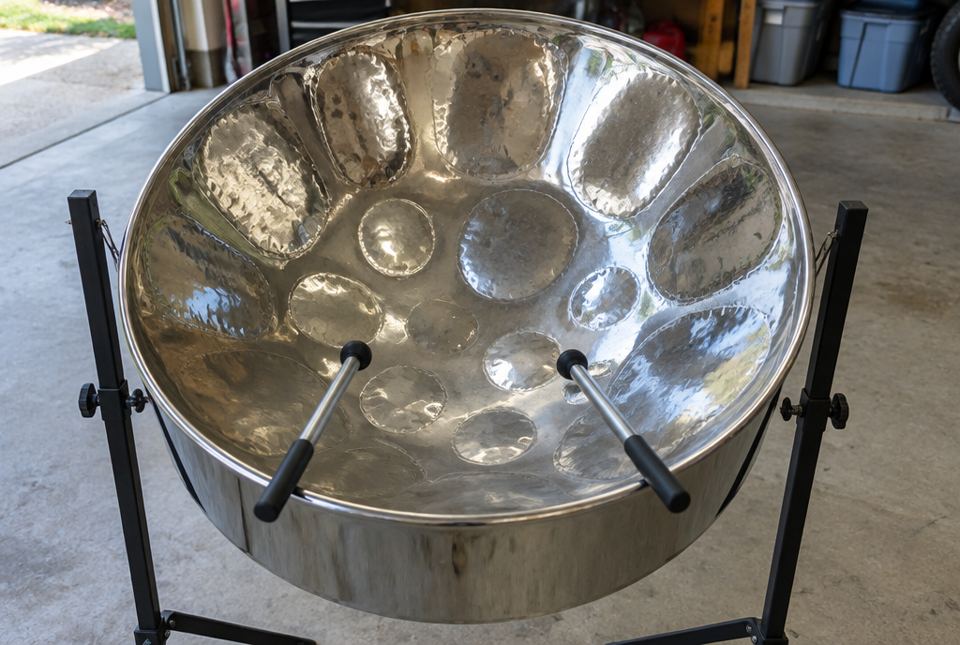 A steelpan is an artifact that tells a story: people in Trinidad and Tobago turned old oil drums into instruments. Each dented section plays a different note. AI-generated image
Text 3: Eid Morning
For a month, Yusuf's parents had been fasting from sunrise to sunset for Ramadan. Now it was Eid al-Fitr, the celebration at the end of the month. Yusuf put on the new clothes his mom had saved for this day. Before the morning prayer, his father gave money to help families in need. "No one should be hungry on Eid," he said.
After prayers, the whole community greeted each other: "Eid Mubarak!" Yusuf hugged his grandparents, who handed him an envelope with a little gift of money, and his cousins raced to show off their new shoes. That evening, the house was full of relatives, laughter and a table covered with food.
| Cultural element | Lights for Diwali | The Steel Drum Summer | Eid Morning |
|---|
| Norms | Making rangoli; lighting diyas; giving sweets to neighbours | Learning music from an older relative; playing in a parade | Wearing new clothes; morning prayer; greeting Eid Mubarak; visiting relatives |
| Values | Generosity, welcome, light and hope | Creativity, pride, passing culture to the next generation | Generosity and caring for people in need, family, community |
| Artifacts | Rangoli, diyas | Steelpan, costumes | New clothes, gift envelope |
| Music or sports | (not mentioned) | Steelpan music, steel band | (not mentioned) |
Worked exampleLet's investigate a cultural element
Investigate the steelpan in The Steel Drum Summer. What does it mean to Marcus's uncle?
- Identify: the steelpan is an artifact and part of the culture's music.
- Explicit evidence: People in Trinidad and Tobago made them from old oil drums. They took something thrown away and made music.
- Investigate the meaning: it stands for creativity and pride: turning something thrown away into something beautiful.
- Implicit evidence: Our music came a long way to get here... Now you're carrying it. The uncle sees Marcus as the next generation who will keep the music alive in Canada.
- Connect: My family passes down recipes. Like the steelpan, they connect us to where our family came from.
The steelpan shows creativity, pride and passing culture to the next generation. The uncle's smile and words show it is part of his identity.
Culture is like an iceberg. Artifacts, music and norms are above the water where you can see them; the values that give them meaning sit below, and you find them with evidence and inference.Worked exampleLet's compare values across cultures
What value do Lights for Diwali and Eid Morning share? Give evidence from both.
- Diwali: the family brings sweets to all their neighbours, even the ones who didn't celebrate. Light is for sharing.
- Eid: Yusuf's father gives money to help families in need before prayer. No one should be hungry on Eid.
- Both show generosity: sharing with others, especially at a celebration.
- Insight: different cultures can share similar values, shown through different norms and artifacts.
Both texts show generosity. Diwali: sharing sweets with all neighbours. Eid: giving to families in need.
The norms and artifacts are different, but the two texts share a value in the middle: generosity, sharing with others at a celebration.Sports and identity
Sports are cultural elements too. In Canada, hockey is part of many people's identities, and it brings new Canadians together too. Hockey games are broadcast in many languages, including Punjabi, so families can cheer in the language they speak at home. When people of many backgrounds play and cheer for the same team, sport becomes a way to belong.
When you read about a culture, ask:
- What do the people value, and how do I know?
- What artifacts, music or sports are important? What do they mean?
- How do the characters keep their culture strong in a new place?
- How does this connect to my culture and identity?
Just for funImagine archaeologists 1,000 years from now digging up your bedroom. Judging by the artifacts, they might decide your culture deeply valued... single socks. So many single socks.
Investigating respectfully
Every culture is diverse inside: not every family celebrates the same way. Say some families or many families, not all. If you want to learn more, read texts by people from that culture and ask respectful questions. Never treat another culture's clothing or sacred items as a costume.
Hands-on activityFamily artifact story
You need: an object that is important to your family, paper and a pencil, and a family member to interview.
- Choose an artifact from home. Ask a family member: Where did it come from? When do we use it? Why is it important?
- Write a short paragraph about it. Include a norm (how it's used), a value (why it matters) and, if possible, music or a sport connected to your family.
- Make a Venn diagram comparing your family's celebration with one in the texts. What's different? What values are shared?
- Share your artifact story with your family. How does the artifact connect to your identity?
Your turn
1Name two artifacts in Lights for Diwali.
Rangoli (coloured-powder design) and diyas (small clay lamps).
2What value does Light is for sharing show?
Generosity (sharing with others, including people of different backgrounds).
3Where were steelpans first made, and from what, according to Marcus's uncle?
In Trinidad and Tobago, from old oil drums.
4Name two norms in Eid Morning.
Any two: wearing new clothes, giving to families in need before prayer, morning prayer, greeting Eid Mubarak, visiting relatives, giving children a gift of money.
5What does Marcus's uncle mean by Now you're carrying it?
Marcus is now part of the next generation who will keep the music and culture alive.
6Which cultural element is hockey?
7Make a connection between one text and your own life.
Example: Like Yusuf, my family wears special clothes and visits relatives on holidays. It makes me feel part of a big family.
More practice: warm-up
An object made by people that has meaning in a culture.
An idea a group believes is important.
An expected way of behaving in a group.
4What do people say to greet each other on Eid?
5What instrument does Marcus learn?
More practice: on your own
1How does Lights for Diwali show the idea of light and hope?
The diyas glow against the November snow: light in the darkness. Sharing sweets spreads warmth and welcome to neighbours.
2Why might broadcasting hockey in Punjabi help people feel they belong?
Families can enjoy a Canadian sport in a language they speak at home, so they feel included and can share the game across generations.
3Why should you say many families instead of all families when describing a celebration?
Cultures are diverse inside: families celebrate in different ways. Saying all creates a stereotype.
4What value do the uncle and Marcus show by practising all summer?
Dedication and pride in their culture, and passing knowledge from one generation to the next.
5What could you investigate to learn more about rangoli?
Examples: What designs are common? Why at the doorway? What materials are used? Look for a book or video by someone who celebrates Diwali.
Challenge
1Compare how two of the texts show identity and belonging in Canada.
The Steel Drum Summer: Marcus's uncle feels pride sharing Caribbean music at a Toronto parade, and passes it to Marcus. Lights for Diwali: Anjali's family keeps Diwali traditions in a Canadian November and shares with neighbours of all backgrounds. Both show people keeping their culture strong while belonging to a Canadian community.
2Write 2 or 3 sentences for a story that shows a cultural element from your own family. Name the element.
Example: Every Sunday, my grandpa puts on his old fiddle records and teaches me a dance step. "Feet like this," he laughs. I'm slow, but he never gives up on me. Elements: music (fiddle), norm (Sunday dancing), value (patience, passing traditions on). Look for a named element and evidence.
3A text says, All people from Trinidad play the steelpan. What's wrong with this, and how would you fix it?
It's a stereotype: it overgeneralizes. Fix: The steelpan was first made in Trinidad and Tobago, and many people there are proud of it.
Quiz
2. Light is for sharing, said Anjali's dad. This shows the value of...
3. In the story, Marcus's uncle says steelpans were made from...
4. Eid al-Fitr celebrates...
5. Which is a norm in Eid Morning?
6. What is the best way to learn more about a culture?
What this lesson teaches: Grade 5 students identify cultural elements (norms, values, artifacts, sports, music) in texts, investigate their meanings, and connect them to their own lived experience and culture (C3.4). They explore identity and belonging in culturally responsive texts (A3.2).
How to help at home:
- Share the story of a family artifact, recipe, song or saying.
- When reading about another culture, ask "What do they value? How do we know?"
- Visit a community festival or library event and talk about what you notice.
Common difficulties:
- Overgeneralizing (all people from...). Model some and many.
- Naming elements without meaning. Always ask "Why is it important to them?"
About the facts: Diwali is a festival of lights celebrated by many Hindus, Sikhs and Jains, often with diyas and rangoli, and usually falls in October or November. The steelpan was developed in Trinidad and Tobago in the twentieth century; the earliest pans were made from biscuit tins and other metal containers, and steel oil drums soon became the standard. Eid al-Fitr marks the end of Ramadan, when many Muslims fast from dawn to sunset; giving charity before the Eid prayer is a common practice. Hockey Night in Canada has been broadcast in Punjabi. All stories were written for this site; families celebrate in many different ways.