A. Literacy Connections and Applications / C. Comprehension: Understanding and Responding to Texts · Understanding and Responding to TextsSummarizing, Drawing Conclusions and Reflecting on Strategies
C2.6 C2.7 A1.2About 40 minutes
Learning goals- I can summarize the main idea of a text and its supporting details in sequence.
- I can draw a simple conclusion from what I read.
- I can use Somebody, Wanted, But, So, Then to summarize a story.
- I can explain how strategies like visualizing, predicting, summarizing and connecting helped me understand.
Words to know
summary
A short retelling of the most important ideas, in your own words.
main idea
What a text is mostly about.
supporting details
Facts or events that tell more about the main idea.
sequence
The order in which things happen.
conclusion
A decision or idea you reach by thinking about what you read. It answers So what?
castings
Tiny bits of soil that worms leave behind after eating. They help plants grow.
Remember from Grade 3
In Grade 3 you found the main idea and supporting details, retold events in sequence and wrote short summaries.
In Grade 4 your summaries will include the main idea and supporting details in order, and you will add a simple conclusion: what the information means. You'll also explain which strategies helped you.
Hook: The movie in one breath
A friend asks, "What was the movie about?" You don't retell every scene. You give the big idea and the most important parts in order, in about 30 seconds. That's a summary!
Read: Underground Gardeners
You might not see them, but earthworms are some of the hardest workers in a garden.
In autumn, leaves fall from the trees and cover the ground. First, earthworms come up at night and pull leaves down into their burrows.
Next, the worms eat the leaves along with bits of soil. Then they leave behind tiny bits called castings. Castings are full of nutrients, the food that plants need to grow.
As worms move, they also dig tunnels. After a rain, water and air flow down these tunnels to reach plant roots.
Finally, in spring, the soil is soft, full of nutrients and easy for roots to grow through. Gardeners often find more worms where their plants are growing best.
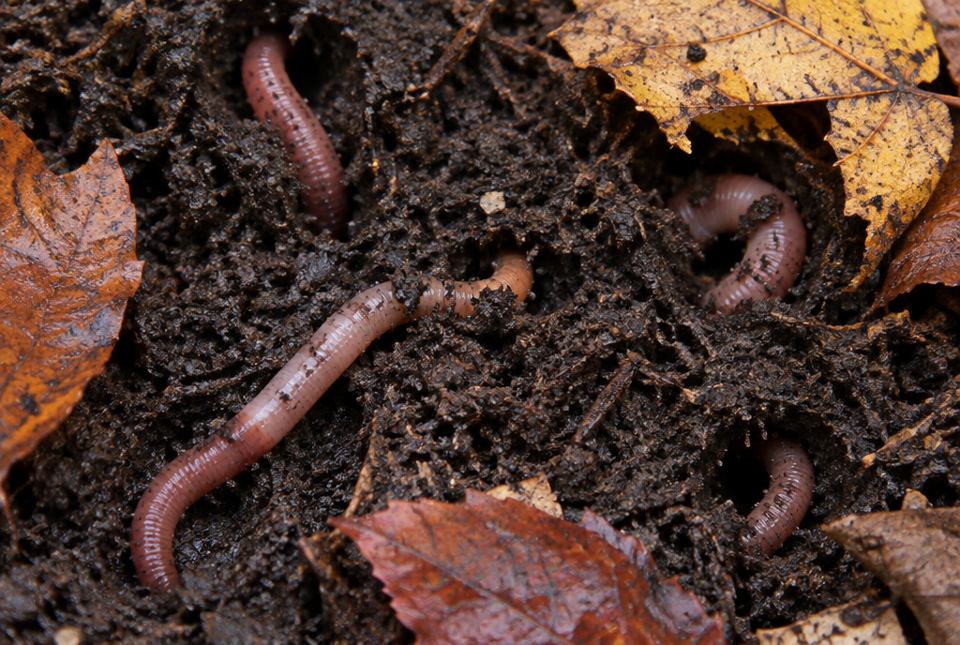 Earthworms pull fallen leaves underground and turn them into rich soil. Use details like these, in order, when you summarize the text. AI-generated imageA summary plan: the main idea at the top, the supporting details in order below it, and a conclusion that answers So what?
Worked exampleLet's summarize an informational text
Summarize Underground Gardeners. Include the main idea, supporting details in sequence and a simple conclusion.
- Main idea: What is it mostly about? Earthworms help gardens. (The first sentence calls them hard workers in a garden.)
- Supporting details in order: The signal words help: first (pull leaves into burrows), next/then (eat them and leave castings full of nutrients), after (water and air flow through tunnels), finally (soft, rich soil in spring).
- Leave out small details, like at night. They're interesting but not needed in a short summary.
- Use your own words and keep it short: 3 or 4 sentences.
- Conclusion (So what?): If worms make soil better, then protecting worms helps gardens grow. Leaving some fallen leaves on garden beds gives worms food.
Earthworms help gardens. In autumn, they pull fallen leaves into their burrows and eat them, leaving castings full of nutrients. Their tunnels let water and air reach plant roots. By spring, the soil is soft and rich. Conclusion: Worms are important for healthy gardens, so it's worth protecting them.
Summarizing a story: Somebody, Wanted, But, So, Then
For stories, use five words to find the most important parts in order:
- Somebody: the main character
- Wanted: what they wanted
- But: the problem
- So: what they did about it
- Then: how it ended
Worked exampleLet's summarize a story
Summarize The Sugar Bush (from the lesson on predictions) using Somebody, Wanted, But, So, Then. Then draw a conclusion.
- Somebody: Nadia
- Wanted: to taste syrup straight from a maple tree at Uncle Ray's sugar bush
- But: it had been freezing all week, and when the sap finally ran, it tasted like water
- So: she learned it takes about 40 litres of sap to make 1 litre of syrup, and they boiled the sap for hours
- Then: that night she ate pancakes with the syrup and said it was worth every drop.
- Conclusion: Making syrup takes a lot of time and work, which is one reason people value it so much.
Nadia wanted to taste syrup straight from a maple tree, but the sap tasted like water. So she and Uncle Ray boiled 40 litres of sap down for hours. Then she enjoyed the syrup on pancakes. Conclusion: Syrup takes a lot of work, so it is special.
Reflecting: Which strategies helped me?
After reading, think about how you understood. Good readers can explain which strategies helped:
- Visualizing: Picturing the worm pulling a leaf underground helped me remember the first step.
- Predicting: Predicting that the sap wouldn't taste like syrup made me read Part 2 carefully to check.
- Summarizing: Summarizing helped me remember the 4 steps in order.
- Connecting: I've dug in a garden and found worms where the soil was dark and soft. That helped me believe the text.
Then set a next step: Next time, I'll use signal words to find the sequence faster.
Summary or retell?
A retell includes lots of details. A summary is short: only the main idea and the most important details, in order, in your own words. Aim for about one sentence per paragraph or less.
Just for funThe summary of almost every movie ever made: Somebody wanted something, but there was a problem, so they did stuff, then it ended.
(Okay, a good summary needs a few more details than that!)
Hands-on activitySummary challenge: 30 seconds
You need: a timer, a short article (children's magazine or newspaper) and a favourite picture book or chapter.
- Read the article. Write the main idea on a sticky note and 3 or 4 supporting details in order on smaller notes.
- Say your summary aloud in 30 seconds or less while a grown-up times you. Add one conclusion sentence: So...
- Summarize the picture book with Somebody, Wanted, But, So, Then.
- Tell your grown-up one strategy that helped you most and why.
Your turn
1What is the main idea of Underground Gardeners?
Earthworms help gardens (by making soil rich and soft).
2Put these in order: tunnels let in water and air; worms pull leaves into burrows; soft rich soil in spring; worms leave castings.
- Worms pull leaves into burrows. 2. Worms leave castings. 3. Tunnels let in water and air. 4. Soft, rich soil in spring.
3What are castings, and why are they important?
Tiny bits worms leave after eating. They are full of nutrients that plants need to grow.
4Which detail could you leave out of a short summary: worms come up at night or castings are full of nutrients?
Worms come up at night. It's interesting, but not needed to explain how worms help gardens.
5What does a conclusion answer?
So what? What the information means or why it matters.
6Write a simple conclusion for Underground Gardeners.
Example: Worms are important for healthy gardens, so we should protect them.
7What do the letters in Somebody, Wanted, But, So, Then help you find?
The main character, what they wanted, the problem, what they did, and how it ended, in order.
More practice: warm-up
1Is a summary long or short?
2Should a summary use your own words?
3Name two sequence signal words from Underground Gardeners.
Any two: first, next, then, after, finally (also in autumn, in spring).
4In which season do worms pull leaves into their burrows?
5Name one reading strategy that can help you understand.
Any: visualizing, predicting, summarizing, connecting, asking questions, rereading.
More practice: on your own
1Summarize this: Ben wanted to build a birdhouse. He didn't have a hammer, so he borrowed one from his neighbour. He nailed the pieces together and painted it. By spring, a pair of chickadees moved in.
Example: Ben wanted to build a birdhouse but had no hammer, so he borrowed one, built and painted it, and chickadees moved in by spring.
2What simple conclusion could you draw from the birdhouse story?
Example: Asking for help can solve a problem, or building a birdhouse can give birds a home.
3Why should a summary keep events in sequence?
So the reader understands what happened first, next and last and how one step leads to another.
4Explain how visualizing could help you understand Underground Gardeners.
Picturing worms pulling leaves down, and water flowing through tunnels to roots, helps you understand and remember the steps.
5A summary of The Sugar Bush says: Nadia went to a forest. There were tubes. Water dripped from icicles. There was steam. What's wrong with it?
It lists small details and misses the main idea, the problem (sap tastes like water) and the ending. It doesn't use Somebody, Wanted, But, So, Then.
Challenge
1Write a 2-sentence summary of a book or show you know well, then add a conclusion.
Look for: main character, problem and ending in order, in 2 sentences, plus a So... conclusion about what it means.
2Can two readers draw different conclusions from the same text? Use Underground Gardeners as an example.
Yes, if both are supported. One reader might conclude protect worms; another might conclude leave fallen leaves on gardens to feed worms. Both fit the evidence.
3Which strategy helped you most in this lesson? Explain how, and set a next step.
Example: Using signal words helped me put the worm steps in order. Next step: I'll circle signal words in my science book to help me summarize. (Any strategy with a clear how and a next step.)
Quiz
2. What is the main idea of Underground Gardeners?
3. A conclusion answers the question...
4. In Somebody, Wanted, But, So, Then, the But is...
5. Which detail is LEAST important for a summary of Underground Gardeners?
6. Which sentence reflects on a strategy?
What this lesson teaches: Grade 4 students summarize the main idea and supporting details in sequence and draw a simple conclusion (C2.6). They explain how strategies such as visualizing, predicting, summarizing and connecting helped them comprehend (C2.7), and set next steps (A1.2).
Facts used: Some earthworms (such as the common nightcrawler) pull leaves into burrows; worm castings are rich in nutrients; burrows improve air and water movement in soil.
How to help at home:
- After a show or book, ask for a 30-second summary. Then ask "So what? What does it mean?"
- Model reflection: "Picturing the map helped me understand the directions."
- When a summary is too long, ask: "Which parts could we leave out and still understand?"
Common difficulties:
- Retelling everything. Limit the number of sentences.
- Out-of-order events. Use signal words (first, next, then, finally).
- Conclusions that just repeat a detail. A conclusion should say what the information means.