Strand B: Problem Solving and Innovating · Wonder, Explore, Build and CreateI Wonder! Asking Questions and Finding Out
B12.1 B12.2About 20 minutes
Learning goals- I can ask "I wonder" questions.
- I can make a guess about what will happen (a prediction).
- I can use my eyes, ears, nose and hands to look closely (observe).
- I can try again in a new way when my first idea does not work.
Words to know
wonder
To be curious and want to find out about something.
question
Something we ask when we want to know. It often starts with who, what, where, when, why or how.
predict
To make a thinking guess about what will happen.
observe
To look, listen, smell and touch carefully to notice things.
explore
To try things out and find out about them.
Let's start wondering!
(Grown-up: read this part aloud.)
Look out the window. What do you see? A bird? A tree? Snow? Rain?
Did you ever think, "I wonder why..."? Maybe: I wonder why the leaves fall down. I wonder where the birds go. I wonder how snow is made.
When you wonder, you are thinking like a scientist! Scientists are people who wonder about the world and then find out.
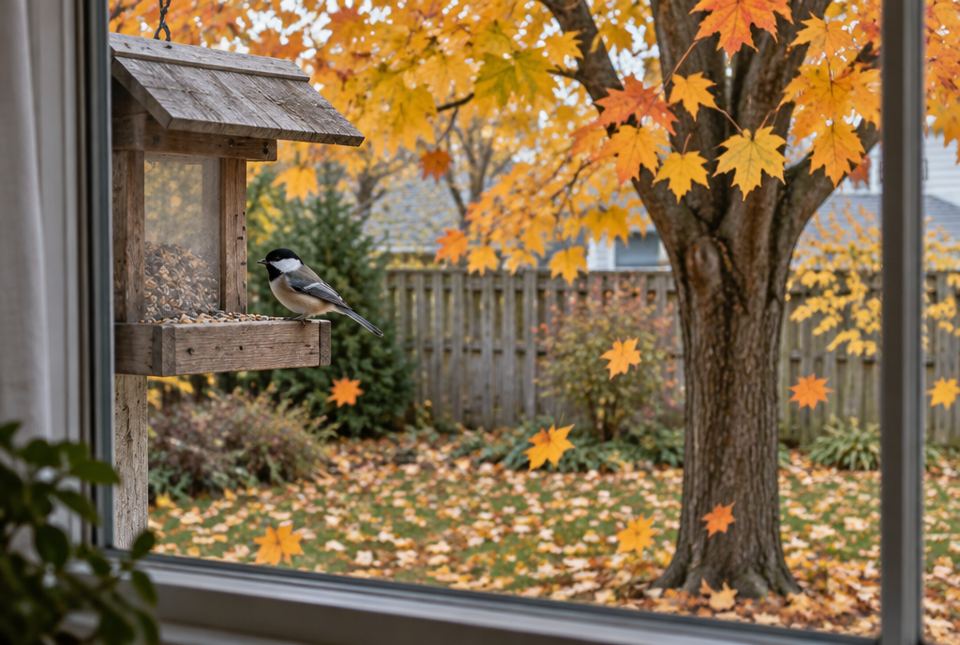 Look out this window! A little bird is eating seeds and leaves are falling. What do you wonder about? AI-generated image
Question words
A question is what we ask when we want to know something. Many questions start with a special question word.
Let's say them together: Who? What? Where? When? Why? How?
| Question word | A question you could ask |
|---|
| Who? 🧑 | Who made this nest? |
| What? ❓ | What is inside a pumpkin? |
| Where? 📍 | Where does the snow go in spring? |
| When? ⏰ | When will the tulips grow? |
| Why? 🤔 | Why is the sky dark at night? |
| How? 🛠️ | How does a caterpillar turn into a butterfly? |
How do we find out?
Scientists do four things. Let's count them on our fingers.
- I wonder. I ask a question.
- I guess. I think about what will happen. This thinking guess is called a prediction.
- I try and look. I test it and I observe. That means I look, listen, smell and touch very carefully.
- I tell. I tell what I saw. I can say it, draw it, or a grown-up can write it for me.
Worked exampleLet's wonder together: the melting ice cubes
We wonder: Will an ice cube melt faster on the kitchen counter, or in the fridge? 🧊
- I wonder. Say the question together: "Where will the ice cube melt faster?"
- I guess. Grown-up asks: "What do you think?" A child might say, "On the counter, because it's warmer there." Any guess is OK. A guess does not have to be right!
- I try and look. Put one ice cube on a plate on the counter. Put another ice cube on a plate in the fridge. Wait 15 minutes. Then look at both. Touch the water on the plates.
- I tell. "The ice cube on the counter got much smaller. There is more water on that plate. The one in the fridge is still almost the same."
The ice cube on the counter melts faster, because the kitchen is warmer than the fridge. Warm air makes ice turn into water.
After 15 minutes, the ice cube on the warm counter is tiny with a big puddle. The one in the cold fridge is still big.Every question is a good question
There are no silly questions. Every question helps us learn.
If a grown-up does not know the answer, that's great! They can say: "I don't know yet. Let's find out together!"
Our senses help us observe
👀 Eyes see colours and shapes.
👂 Ears hear sounds.
👃 Nose smells.
✋ Hands feel if something is soft, hard, bumpy or smooth.
👅 Tongue tastes. But we only taste food, and only when a grown-up says it is safe!
Try, try again
Sometimes our first idea does not work. Our tower falls. Our paper plane drops. That's OK!
We say: "Oops! Let me try a different way." Trying again in a new way is how we solve problems.
Hands-on activityA Wonder Walk
You need: your eyes, ears and hands, a paper and crayons.
- Take a walk with your grown-up, inside your home or outside.
- Stop 3 times. Each time, say "I wonder..." about something you see. For example: "I wonder why this rock is shiny."
- Your grown-up writes your 3 wonders on the paper. You draw a little picture beside each one.
- Pick one wonder. Make a guess. Then try to find out together: look closely, try something, or look in a book.
Talk about it: "What did you find out? Was your guess right, or were you surprised?"
Just for funWhat do you call a snowman in the summer?
A puddle! (Just like our ice cube on the counter.) ⛄💧
Your turn
1🐌 Look at this snail. Ask an "I wonder" question about it.
Answers will vary. For example: "I wonder where the snail goes when it rains?" or "I wonder why it has a shell?" Look for a question that is about the snail and starts with I wonder, why, how, where or what.
2Which word can start a question: "why" or "dog"?
Why. "Why" is a question word.
3🧊 We put an ice cube in a warm, sunny window. Make a guess: will it stay the same or melt?
It will melt and turn into water. Warm sunshine melts ice.
4Point to the parts of your body that help you observe. What does each one do?
Eyes see, ears hear, nose smells, hands touch. (The tongue tastes, but only food a grown-up says is safe.)
5Your block tower fell down. 🧱 What can you do?
Try again in a new way. For example, put the big blocks on the bottom, or build it wider. Trying again is how we solve problems.
6Listen: "The sky is blue." Is that a question or a telling sentence?
A telling sentence. A question would be: "Why is the sky blue?"
More practice: warm-up
1Say a question that starts with "What".
Answers will vary. For example: "What is for lunch?" or "What is that bird?"
2Thumbs up 👍 if this is a question: "How do birds fly?"
👍 Yes, it is a question. It starts with the question word how.
3Which one do we use to listen: 👀 or 👂?
4Point to the mark we write at the end of a question: ? or .
? This is a question mark.
5Finish this sentence: "I wonder ..."
Answers will vary. Any wondering is great! For example: "I wonder how big a whale is."
More practice: on your own
1🌧️ It is raining. Ask a "why" question about the rain.
Answers will vary. For example: "Why does rain fall down?" or "Why are there puddles?" Any question that starts with why and is about rain is correct.
2🏀 You hold a ball up high and let go. Predict: will it go up into the sky or fall down?
It will fall down to the ground. Things fall down when we let go of them.
3🚗 Predict: will a toy car roll farther on a smooth floor or on a fluffy carpet?
Most of the time it rolls farther on the smooth floor. The fluffy carpet rubs against the wheels and slows the car down. Test it to check!
4🧦 One sock is lost. Ask a "where" question, and name one place to look.
"Where is my sock?" Then any sensible place: under the bed, in the laundry basket, in the drawer.
5✋ Observe your hand. Tell 2 things you notice.
Answers will vary. For example: "I have 5 fingers." "I have little lines on my fingers." "My nails are smooth." Any 2 true things they notice are correct.
Challenge
1Turn this telling sentence into a question: "Snow is cold." ❄️
"Why is snow cold?" or "Is snow cold?" Changing the words so we are asking, not telling, makes a question.
2🍎 Sam guessed an apple would sink in water. He tried it, and it floated! Was his guess wrong? Is that OK?
His guess did not match what happened, and that is OK! Scientists are often surprised. A surprise means we learned something new: apples float.
3🧊 How could you find out if ice melts faster in warm water or cold water? Tell your plan.
A good plan: Get 2 cups. Put warm water (from the tap, not hot) in one and cold water in the other. Drop the same size ice cube into each. Watch which one melts first. (It will melt faster in the warm water.) Look for: two cups, same ice cubes, watch and compare.
Quiz
2. When we make a thinking guess about what will happen, we...
3. You want to observe a bird far away in a tree. What do you use most?
4. Your paper airplane ✈️ will not fly. What is the best idea?
5. An ice cube 🧊 sits on a hot, sunny sidewalk. What happens?
What this lesson is about. In the Kindergarten Curriculum (2026), children learn to investigate like scientists: they wonder, ask questions, predict, observe, and share what they found. This lesson gives them simple words for those steps.
How to help at home:
- Model wondering out loud: "Hmm, I wonder why the puddle is gone today." Children copy what they hear.
- When your child asks a question, try asking back: "What do you think?" before you answer. Then find out together by trying, looking closely, or reading a book.
- It is fine to say "I don't know. Let's find out!" That shows that learning never stops.
- Praise the trying, not just right answers: "You tried a new way. That was good thinking!"
Common difficulties:
- Young children often say a telling sentence when asked for a question ("The dog is brown"). Give a starter: "Start with why or how."
- Many children think a wrong guess is a mistake. Remind them that scientists are surprised all the time, and surprises teach us something.
- Supervise any water and ice experiments, and keep tasting to safe foods only.