Strands C and D: Self-Regulation and Well-Being; Belonging and Contributing · Me, My Feelings and My CommunityMy Groups and My Community
D20.1 D20.2 D22.1 D22.2About 20 minutes
Learning goals- I can name groups I belong to, like my family and my class.
- I can tell how all kinds of groups together make up Canada.
- I can tell how I help my groups.
- I can name people who help in my community and tell about their jobs.
- I can name places in my community and tell what each place is for.
Words to know
group
Some people who belong together, like a family, a class or a team.
community
The place where we live, and all the people who live and work there.
Canadian
A person who belongs to Canada. Canadians come from many different groups.
community helper
A person whose job helps people in the community, like a firefighter or a librarian.
rule
Something a group agrees to do so everyone is safe and happy.
natural
Made by nature, not by people. A pond is natural.
human-made
Built or made by people. A school is human-made.
You belong!
Grown-up, read this part out loud.
Let's count the people in your family. Who lives in your home? Who else is in your family, like grandparents, aunts, uncles or cousins?
Your family is a group. And you belong to it!
I belong to many groups
A group is some people who belong together. You can belong to lots of groups at the same time!
- My family 👨👩👧
- My class at school 🏫
- A team, like soccer or swimming ⚽
- A place of worship, like a church, mosque, synagogue, temple or gurdwara, for some families
- My neighbourhood 🏘️
Different groups, different ways
Each group has its own ways of doing things. These are often called rules.
- At the library, we use quiet voices. 🤫
- At hockey, we wear a helmet. 🏒
- At home, maybe we take off our shoes at the door.
- At school, we put up our hand to talk. ✋
Rules help everyone in the group feel safe and happy.
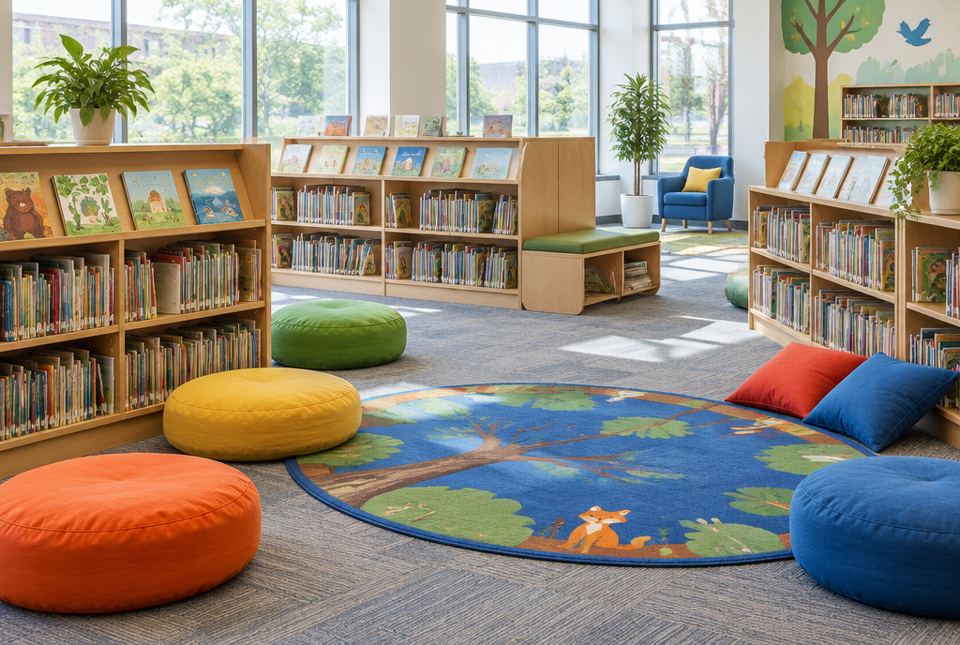 The library is a group place in our community. At the library, we use quiet voices and take care of the books. AI-generated image
I help my groups
Everyone in a group can help. Helping makes the group better.
At home you might set the table, feed the pet, or help tidy up. At school you might be the line leader or water the plants.
We all belong to Canada 🍁
Your family, your class and your neighbourhood are all part of a bigger group: Canada!
Canada is made up of many, many groups of people:
- First Nations, Métis and Inuit peoples, the First Peoples of this land.
- People who speak English and people who speak French. These are Canada's two official languages. Many people in Ontario speak French.
- Families who came to Canada from all over the world, long ago and not long ago, and brought their languages, foods, music and celebrations.
All of these groups together make Canada what it is. When you share your family's stories, songs and foods, you are helping to make Canada too!
Many Canadians also share some things: the red and white flag with the maple leaf, the song "O Canada", and Canada Day on July 1.
My community
A community is the place where you live, with all the people who live and work there.
Community helpers have jobs that help us.
| Helper | What they do |
|---|
| 🚒 Firefighter | Puts out fires and helps people in danger |
| 🚑 Paramedic | Drives the ambulance and helps people who are hurt or sick |
| 👮 Police officer | Helps keep people safe and helps people who are lost |
| 🩺 Doctor and nurse | Help us stay healthy and get better |
| 📬 Letter carrier | Brings the mail |
| 📚 Librarian | Helps us find books |
| 🦺 Crossing guard | Helps children cross the street safely |
| 🚛 Garbage and recycling collector | Takes away garbage and recycling |
| 🚜 Farmer | Grows food and raises animals |
| Place | What it is for |
|---|
| 🏫 School | Learning and playing with friends |
| 📚 Library | Borrowing books, story time and quiet reading |
| 🛝 Park | Playing, running and picnics outside |
| 🛒 Grocery store | Buying food |
| 🏥 Hospital | Getting care when people are very sick or hurt |
| 🚒 Fire station | Where firefighters and fire trucks wait, ready to help |
| ⛸️ Arena or community centre | Skating, hockey, swimming and classes |
| 🛐 Place of worship | Where some families pray, gather and celebrate |
Places made by nature, places made by people
Some places in a community are natural. Nature made them: a pond, a forest, a hill, a river.
Some places are human-made. People built them: a school, a store, a library, a hockey arena, a fire station.
Worked exampleLet's sort places
Is each place made by nature 🌳 or made by people 🏗️?
- Pond 🦆: Nature made the pond. → nature
- Grocery store 🛒: People built it. → people
- Forest 🌲: Trees grow on their own. → nature
- Hockey arena 🏒: People built it. → people
- Hospital 🏥: People built it. → people
Pond and forest are natural. Grocery store, arena and hospital are human-made.
People live in different ways
People adapt (change how they do things) to fit the place where they live.
- Children in a big city may live in a tall apartment building, walk on sidewalks, and ride the subway or bus. 🏙️
- Children in the country may live on a farm and take a school bus a long way to school. 🚌
- In Canada we have cold, snowy winters, so we wear snowsuits, toques and mitts, and snowplows clear the roads. ❄️
Just for funWhich building in your community has the most stories?
The library! 📚
Hands-on activityCommunity walk and map
You need: a walk outside with your grown-up, then paper and crayons.
- Go for a walk in your neighbourhood (or look out the window, or think about the drive to school).
- Spot places: houses, a park, a store, a school, trees, a pond.
- Spot community helpers: a crossing guard, a letter carrier, a bus driver.
- At home, draw a map. Draw your home first, then the places you saw.
Talk about it: "Which places did nature make? Which places did people build?"
Your turn
1Name two groups you belong to.
Answers will vary. Examples: my family, my class, my swim class, my neighbourhood. Look for two different groups.
2Tell me one way you help your family.
Answers will vary. Examples: set the table, feed the cat, put away my toys, help my little sister.
4📚 Who helps you find a book at the library?
5🌲 Is a forest made by nature or made by people?
Nature. Trees grow on their own.
6🏫 Is a school made by nature or made by people?
People. People built the school.
7Why do we use quiet voices in the library?
So people can read and think. Quiet voices are a library rule that helps everyone.
8Name one group of people that is part of Canada.
Examples: First Nations, Métis and Inuit peoples; people who speak French; people who speak English; families who came from other countries. Your own family is part of Canada too!
More practice: warm-up
1Who is in your family? Count them on your fingers.
Answers will vary. Every family is different. Look for counting each person once.
2🩺 Who helps you when you are sick?
4🦆 Is a pond made by nature or made by people?
5🛒 What do people do at a grocery store?
More practice: on your own
1Can a person belong to a family and a class and a team, all at once?
Yes! We can belong to many groups at the same time.
2At hockey, we wear a helmet. At home, we don't. Why are the rules different?
Different groups do things in different ways. At hockey, a helmet keeps our head safe from falls and pucks. At home we don't need one to be safe.
3🛒 🌳 🏥 🌊
Point to the two places made by people.
🛒 the grocery store and 🏥 the hospital. People built them. The tree and the waves of a lake are nature.
4Show me with your body (no words!) one job you do to help at school or at home.
Answers will vary. Look for acting out a job, like wiping the table, watering plants, or putting away blocks.
5A community has a library and a fire station. What is each one for?
The library is for borrowing books and story time. The fire station is where firefighters and fire trucks wait, ready to help. Each place has its own job.
Challenge
1Pretend there were no garbage collectors. What would happen?
Garbage would pile up and get smelly and messy. This shows how community helpers help everyone.
2Tell me about a group your family belongs to, like a language, a culture, a faith or a team. How does it help make Canada special?
Answers will vary. Example: "My family speaks Tagalog and makes lumpia for parties. Canada has lots of families like mine, so we all get to share our foods and languages." Look for a group and the idea that many groups together make Canada.
3Your class is a group. Tell me one rule your class has and why it helps.
Answers will vary. Example: "We walk inside, so nobody falls and gets hurt." Look for a rule and a reason.
Quiz
2. 🚑 Who drives an ambulance and helps people who are hurt?
3. Which place is made by nature?
4. Which is a way to help your family?
Big idea: Children belong to many groups at once (family, class, team, language, faith or cultural community), and all of these groups together make up Canada (D20.1). They talk about how they help their groups (D20.2), and learn about community members and their jobs (D22.1) and the places in a community and what each is for (D22.2).
How to help at home:
- Give your child a real family job they do every day and thank them for it: "You helped our family when you fed the cat."
- Talk about the groups your family belongs to: languages you speak, where your family's stories come from, your traditions. Point out other groups you see in your community and how they add to Canada.
- On errands, name community helpers and the places you visit, and ask "What is this place for?" Let your child thank a helper (the librarian, the cashier, the bus driver).
- Compare rules: "At the pool we walk. At the park we can run. Why?"
Common difficulties:
- Thinks a group means only "my friends". Name groups often: "Our family", "your class", "your swim group".
- Thinks being Canadian means being one way. Remind them: "Canadians speak many languages and come from many places. Our family is Canadian, and so is your friend's family."
- Mixes up natural and human-made. Ask "Did people build it, or did it grow or form by itself?" A park can have both: the trees are natural, the slide is human-made.
- Fear of police officers or doctors. Talk about how these helpers keep us safe and healthy. Many communities have open houses at fire and police stations.