D. Structures and Mechanisms · Systems in ActionMechanical Advantage of Pulleys, Ramps, Wheels and Gears
D2.6 D2.5 A3.1About 45 minutes
Learning goals- I can find the ideal mechanical advantage of a pulley system by counting supporting rope segments.
- I can find the ideal mechanical advantage of an inclined plane and a wheel and axle.
- I can explain how gears trade speed for turning force.
- I can use the force and distance trade-off to solve problems.
Words to know
pulley
A wheel with a groove that a rope or cable runs over.
fixed pulley
A pulley attached to something that does not move. It changes the direction of the force (IMA = 1).
movable pulley
A pulley attached to the load, so it moves with the load. It reduces the force needed.
block and tackle
A pulley system with fixed and movable pulleys working together.
inclined plane
A ramp: a flat, sloping surface used to raise a load with less force.
wheel and axle
A large wheel joined to a smaller rod (the axle) so they turn together, like a doorknob or steering wheel.
gear ratio
How the numbers of teeth on two meshing gears compare. It tells how their speeds and turning forces compare.
Hook: lifting an engine by hand
In an auto repair shop, a mechanic can lift a heavy engine out of a car with a chain hoist. The engine weighs much more than the mechanic, yet one person can raise it smoothly by pulling a chain. The hoist's pulleys and gears give an enormous mechanical advantage. Let's see how.
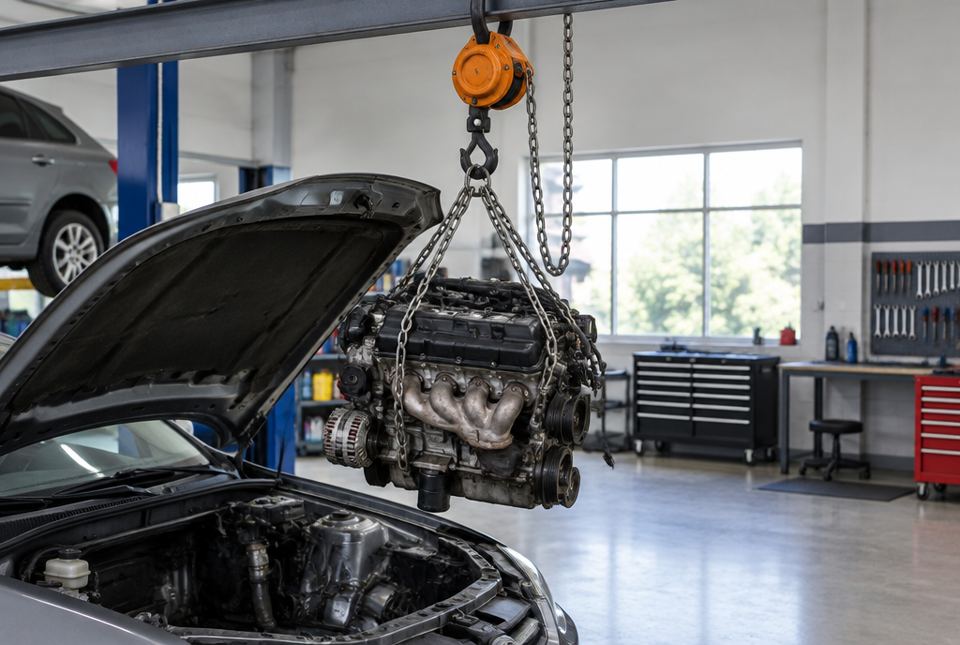 Inside the hoist, pulleys and gears give a huge mechanical advantage, so one person pulling the hand chain can lift a heavy engine. AI-generated image
Remember from Grade 4
In Grade 4 you built pulley systems and saw that a fixed pulley changes direction and a movable pulley makes lifting easier but you pull more rope. You also learned that a small gear turning a big gear makes the big gear turn slower. Now you will put numbers on these ideas.
Pulleys: count the supporting ropes
IMA of a pulley system = the number of rope segments that hold up the load (the movable pulley).
- Fixed pulley: 1 segment, IMA = 1. It only changes direction.
- One movable pulley: 2 segments, IMA = 2.
- A block and tackle with 4 supporting segments: IMA = 4.
The trade-off: with IMA = 4, you pull 4 m of rope to lift the load 1 m. Do not count the rope segment you pull on if it is pulling down from a fixed pulley; it does not hold the load up.
Inclined planes (ramps)
IMA = length of ramp ÷ height of ramp
A ramp 3 m long that rises 0.5 m has IMA = 3 ÷ 0.5 = 6. Ideally you push with one sixth of the load's weight, but you push it 3 m instead of lifting it 0.5 m.
Accessible ramps for people who use wheelchairs are made long and gentle. Accessibility guidelines commonly call for a ramp that rises no more than 1 unit for every 12 units of length. A wedge and a screw are inclined planes too: a screw is an inclined plane wrapped around a rod, which is why it has a very large mechanical advantage.
Wheel and axle
When you turn the wheel (big) to turn the axle (small):
IMA = radius of wheel ÷ radius of axle
A screwdriver handle, a doorknob, a steering wheel and a water tap are all wheels and axles that multiply your turning force.
When the axle turns the wheel instead (like a car's axle turning its wheels), the MA is less than 1, and the wheel's edge moves farther and faster.
Gears
When a small driving gear turns a larger driven gear:
- the driven gear turns more slowly
- it turns with more turning force
If the driving gear has 12 teeth and the driven gear has 36 teeth, the ratio is 36 ÷ 12 = 3. The driven gear turns 3 times more slowly and (ideally) with 3 times the turning force.
A bicycle does the opposite in a high gear: a big front gear (where you pedal) drives a small rear gear on the wheel, so the wheel turns faster than the pedals. That is great on flat roads but hard on hills. On a hill, you shift to a low gear for more turning force at the wheel.
Worked exampleExample 1: A block and tackle
A block and tackle with 4 supporting rope segments lifts an 800 N load 1 m. Ignoring friction, what input force is needed, and how much rope must you pull?
- IMA = number of supporting segments = 4.
- Input force = 800 N ÷ 4 = 200 N.
- Rope pulled = 4 × 1 m = 4 m.
- Check the work: 200 N × 4 m = 800 J, and 800 N × 1 m = 800 J. ✓
200 N of force, pulling 4 m of rope.
Worked exampleExample 2: A ramp onto a stage
Stage crew roll a 600 N cart of equipment up a ramp 3 m long onto a stage 0.5 m high. Find the IMA and the ideal pushing force.
- IMA = length ÷ height = 3 m ÷ 0.5 m = 6.
- Ideal force = 600 N ÷ 6 = 100 N.
- Check: 100 N × 3 m = 300 J and 600 N × 0.5 m = 300 J. ✓
IMA = 6; ideal pushing force 100 N.
Worked exampleExample 3: Wheel and axle and gears
a) A steering wheel has a radius of 18 cm. Its column (axle) has a radius of 2 cm. Find the IMA. b) A 12-tooth gear turns a 36-tooth gear. If the small gear turns 6 times, how many times does the big gear turn?
- a) IMA = 18 cm ÷ 2 cm = 9.
- b) Each turn of the small gear moves 12 teeth past the big gear. Six turns move 6 × 12 = 72 teeth.
- The big gear has 36 teeth, so it turns 72 ÷ 36 = 2 times.
a) IMA = 9. b) The big gear turns 2 times (slower, with about 3 times the turning force).
Careers connection (A3.1)
Skilled trades use these ideas every day. Riggers and crane operators choose pulley systems to lift heavy loads safely. Automotive service technicians use chain hoists and jacks. Bicycle mechanics adjust gear systems. Construction workers and carpenters build ramps that meet accessibility rules.
Just for funWhat has lots of teeth but never bites?
A gear. (A comb has lots of teeth too, but its mechanical advantage is terrible.)
Hands-on activityBroom-handle block and tackle
You need: two broom handles (or two strong, smooth sticks), about 4 to 5 m of strong rope, two helpers (ideally adults).
Safety: pull slowly and steadily, never jerk. Keep fingers away from where the rope wraps. Stop if anyone says stop.
- Two helpers face each other about 1 m apart, each holding a broom handle horizontally.
- Tie one end of the rope to one handle. Loop it around the other handle, then back around the first, so there are 2 rope segments between the handles.
- The helpers try to pull the handles apart while you pull the free end of the rope. Can you move them together?
- Add more loops: 4 segments, then 6. Each time, note how hard you pull and how much rope you must pull to bring the handles 10 cm closer.
- Record: number of segments, effort (easy/medium/hard), rope pulled (cm).
What to look for: with more segments, pulling becomes easier, but you must pull more rope: about 20 cm for 2 segments, 40 cm for 4 and 60 cm for 6 to bring the handles 10 cm closer. Friction where the rope rubs the handles means you never get the full ideal advantage.
Your turn
1A single fixed pulley has an IMA of 1. Why is it still useful?
It changes the direction of the force: you pull down to lift a load up, using your body weight to help, like raising a flag.
2A pulley system has 3 supporting rope segments and lifts a 450 N load. What is the ideal input force?
3A ramp is 6 m long and 1 m high. What is its IMA?
4Using the ramp from the last question, what ideal force is needed to push a 540 N cart up it?
5A wheel has a radius of 30 cm and its axle has a radius of 3 cm. If you turn the wheel, what is the IMA?
6A 10-tooth driving gear turns a 40-tooth gear. How do the speed and turning force of the 40-tooth gear compare?
The 40-tooth gear turns 4 times more slowly (once for every 4 turns of the small gear) but with about 4 times the turning force.
7A block and tackle has IMA 4. To lift a load 2 m, how much rope must be pulled?
More practice: warm-up
1How do you find the IMA of a pulley system?
Count the rope segments that support the load (the movable pulley).
2What is the formula for the IMA of a ramp?
3Two ramps reach the same height. Which needs less force, the longer one or the shorter one?
The longer one (it has a bigger IMA).
4A doorknob is an example of which simple machine?
5What simple machine is a screw made from?
An inclined plane wrapped around a rod.
More practice: on your own
1A cart loaded with firewood weighs 1 200 N. It is pushed up a ramp 2.4 m long onto a trailer 0.6 m high. Find the IMA and the ideal force.
IMA = 2.4 ÷ 0.6 = 4. Ideal force = 1 200 ÷ 4 = 300 N.
2An accessible ramp must rise 0.75 m with a slope of 1 to 12. How long must it be, and what is its IMA?
Length = 0.75 × 12 = 9 m. IMA = 9 ÷ 0.75 = 12.
3A movable pulley (IMA 2) lifts a 500 N load, but the measured input force is 280 N. Find the actual MA. Why is it less than 2?
Actual MA = 500 ÷ 280 ≈ 1.79. It is less than 2 because of friction in the pulley and because you also lift the weight of the pulley itself.
4A screwdriver's handle has a radius of 1.5 cm and its shaft has a radius of 0.3 cm. Find the IMA. Why do some screwdrivers have fat handles?
IMA = 1.5 ÷ 0.3 = 5. A fatter handle (bigger wheel radius) gives a bigger IMA, so you can turn tight screws more easily.
5On a bicycle, the front gear has 42 teeth and the rear gear has 14 teeth. How many times does the back wheel turn for each full turn of the pedals? Is this a good gear for climbing a steep hill?
42 ÷ 14 = 3 turns. It is not good for a steep hill: the wheel turns fast, but you need a lot of force on the pedals. Shift to a lower gear (a smaller front gear or a bigger rear gear).
Challenge
1A worker can pull with at most 250 N. They need to lift a 960 N load with a pulley system. What is the smallest number of supporting rope segments that could work in an ideal system? Why might they choose more?
Needed IMA = 960 ÷ 250 = 3.84, so at least 4 segments (4 × 250 = 1 000 N ≥ 960 N). Because real pulleys have friction, the actual MA will be less than 4, so 5 or 6 segments would be a safer choice.
2A 400 N box must be raised 1 m. Ramp A is 2 m long and ramp B is 5 m long. Ignoring friction, find the force and the work for each ramp. What do you notice?
Ramp A: force = 400 ÷ 2 = 200 N, work = 200 × 2 = 400 J. Ramp B: force = 400 ÷ 5 = 80 N, work = 80 × 5 = 400 J. The work is the same (400 J = 400 N × 1 m); the longer ramp just spreads it over more distance with less force.
3Gear A (10 teeth) turns gear B (30 teeth). Gear C (10 teeth) is fixed on the same axle as B, so they turn together. Gear C turns gear D (40 teeth). If gear A turns 12 times, how many times does D turn? What is the ideal force multiplier of the whole gear train?
A turns 12 times → B turns 12 × 10 ÷ 30 = 4 times. C turns with B: 4 times. D turns 4 × 10 ÷ 40 = 1 time. Speed is divided by 12, so the ideal turning-force multiplier is 3 × 4 = 12.
Quiz
1. A pulley system has 4 supporting rope segments. Ideally, what force lifts a 600 N load?
2. A ramp is 8 m long and 2 m high. What is its IMA?
3. What is the main benefit of a single fixed pulley?
4. A 15-tooth gear drives a 45-tooth gear. The 45-tooth gear turns...
5. A screwdriver handle has a radius of 2 cm and the shaft a radius of 0.4 cm. What is its IMA?
6. What is the trade-off when you use a long ramp instead of lifting straight up?
Big idea (D2.6, D2.5): Students determine the mechanical advantage of various mechanical systems, including simple machines. Quick rules for ideal MA: pulleys, count supporting rope segments; ramps, length ÷ height; wheel and axle, wheel radius ÷ axle radius; gears, driven teeth ÷ driving teeth (for turning force). Every one shows the same trade-off: less force, more distance, with the same ideal work (D2.5).
How to help: The broom-handle activity is memorable; supervise and pull slowly. Look for ramps, taps, doorknobs and bicycle gears together. On a bike ride, try different gears on a hill and talk about why low gears help.
Common difficulties:
- Counting the pull rope as a supporting segment when it runs down from a fixed pulley.
- Using the slope's angle or base instead of its length and height. Use the sloped length ÷ vertical height.
- Mixing up which gear turns faster. The gear with fewer teeth always turns faster.