D. Structures and Mechanisms · Systems in ActionFood Processing Systems: From Farm to Table
D2.2 D2.3 A3.1 A3.3About 45 minutes
Learning goals- I can describe the purpose, inputs and outputs of a food processing system.
- I can identify the steps in a food processing system that keep food safe.
- I can identify steps and technologies that make food processing more efficient.
- I can describe how First Nations peoples developed maple sugar making, and careers in food processing today.
Words to know
food processing
Changing raw farm, forest or ocean products into food that is safe, lasts longer and is ready to sell or eat.
pasteurization
Heating a food, such as milk, to a set temperature for a set time to kill harmful bacteria, then cooling it quickly.
homogenization
Pushing milk through tiny openings under high pressure to break the fat into tiny droplets, so the cream does not rise to the top.
concentrate
To make a liquid stronger by removing water.
evaporator
A large, shallow pan heated from below, used to boil maple sap into syrup.
reverse osmosis
A process that pushes sap (or water) through a very fine filter. Water passes through, and the sugar stays behind.
Hook: where did breakfast come from?
Pour a glass of milk and some maple syrup on your pancakes. The milk was inside a cow on a farm a few days ago. The syrup was sap inside a maple tree last spring. Between the farm and your table, both went through a food processing system: a series of steps, machines, people and rules that turn raw products into safe food.
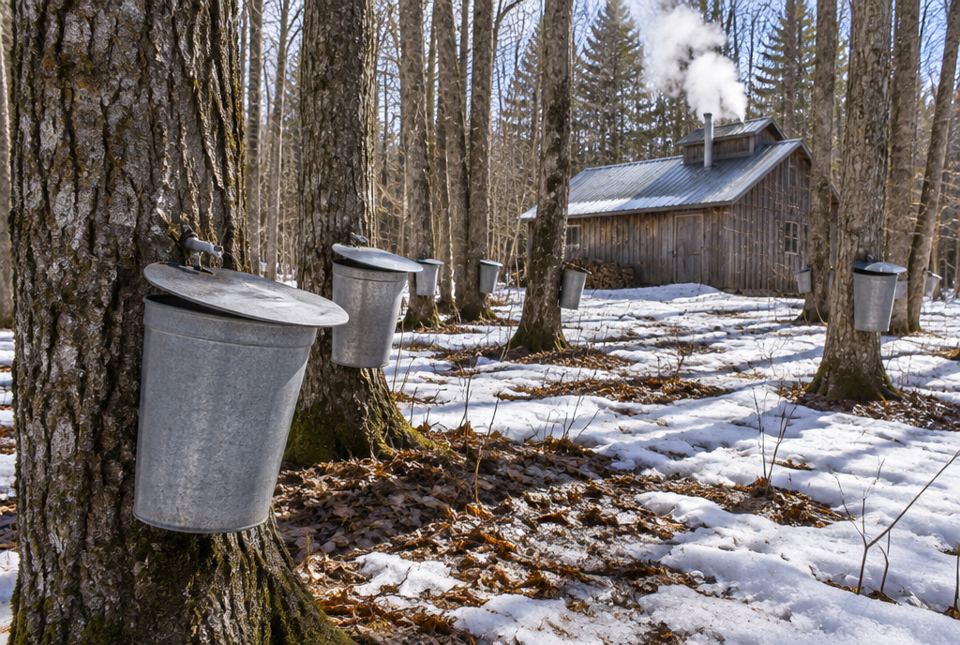 Maple syrup starts here: sap is collected from the trees, then boiled down in the sugar shack. Each step is part of a food processing system. AI-generated image
What food processing systems do
The Ontario curriculum asks you to study systems related to food processing. Food processing systems have several purposes:
- make food safe to eat (kill harmful bacteria, remove contaminants)
- make food last longer (cooling, freezing, drying, canning, packaging)
- make food easier to use (washing, cutting, mixing, cooking)
- move food to where people live (transportation and storage)
They are combination systems. They have mechanical parts (pumps, conveyors, mixers), electrical parts (sensors, refrigeration), natural parts (the cows, trees and the bacteria we must control) and social parts (farmers, workers, inspectors, food safety laws).
Example system 1: milk
- Farm: cows are milked by milking machines (on some farms, by robotic milking systems). The milk is cooled right away in a refrigerated tank.
- Transport: an insulated tank truck carries the cold milk to a processing plant.
- Testing: every load is tested at the plant before it is used. Milk that fails the tests is not used.
- Pasteurization: the milk is heated to at least 72 °C for at least 16 seconds, then cooled quickly. This kills harmful bacteria.
- Homogenization: the milk is pushed through tiny openings under high pressure so the cream stays mixed in.
- Packaging: machines fill and seal jugs, bags or cartons and print a best-before date.
- Cold storage and delivery: the milk is kept cold all the way to the store and your fridge (4 °C or colder).
| Part of the milk system | Helps with safety | Helps with efficiency |
|---|
| Refrigerated tanks and trucks | slow the growth of bacteria | milk lasts longer, so less is wasted |
| Testing each load | keeps unsafe milk out of the system | finds problems before time and energy are spent processing |
| Pasteurization | kills harmful bacteria | plants can reuse heat from hot milk to warm the next cold milk coming in |
| Pipes, pumps and filling machines | milk is not touched by hands, so it stays clean | thousands of containers can be filled every hour |
| Inspectors and food safety laws | the Canadian Food Inspection Agency (CFIA) checks that rules are followed | clear rules mean every plant uses proven methods |
Example system 2: maple syrup
Maple syrup is made from the sap of maple trees, mostly sugar maples, in early spring when nights are below freezing and days are above freezing.
First Nations peoples of the eastern woodlands, including the Anishinaabe and Haudenosaunee, were making maple sugar long before Europeans arrived, by collecting sap and concentrating it. Many First Nations families and communities continue to tap maple trees and make syrup and sugar today, and European settlers learned the process from First Nations people (A3.3).
Today Canada produces most of the world's maple syrup, and Québec produces most of Canada's.
Steps in a modern sugar bush
- Tap: drill a small hole in the tree and put in a spout (a spile).
- Collect: sap flows into buckets, or into plastic tubing that links many trees. Large producers often add a vacuum pump to pull more sap through the tubing.
- Concentrate: many producers use reverse osmosis to remove much of the water before boiling. Less water to boil means less fuel is burned.
- Boil: an evaporator boils off more water until the sap becomes syrup. The syrup is ready when it reaches about 4 °C above the boiling point of water.
- Filter: remove gritty minerals (called sugar sand).
- Bottle hot: filling containers while the syrup is hot helps keep it from spoiling.
Inputs: sap, energy (wood, oil, gas or electricity), equipment and workers. Outputs: syrup (intended), water vapour and sugar sand (unintended). It takes about 40 L of sap to make 1 L of syrup, though this changes with how sweet the sap is.
Worked exampleLet's calculate a sap-to-syrup problem
A family sugar bush hopes to make 12 L of syrup this spring. Using about 40 L of sap for every 1 L of syrup, how much sap do they need? How much water must be removed?
- Sap needed = 12 × 40 = 480 L.
- The syrup left at the end is 12 L, so water removed ≈ 480 − 12 = 468 L.
- That is a lot of water to boil off. This is why reverse osmosis (removing some water first, without boiling) saves fuel.
About 480 L of sap; about 468 L of water must be removed.
Careers connection (A3.1)
Food processing needs many kinds of workers: farmers, food science technologists who test products, CFIA inspectors, bakers and cooks, truck drivers, and skilled tradespeople such as industrial mechanics (millwrights) and refrigeration and air conditioning mechanics who keep the machines and cold storage running safely.
Just for funFunny but true: Québec keeps a strategic reserve of maple syrup in big warehouses. In 2011 and 2012, thieves quietly stole thousands of barrels of it, a crime the news called the Great Canadian Maple Syrup Heist. Police later arrested many of the people involved, which left them in a very sticky situation.
Hands-on activityMake butter in a jar: a tiny food processing system
You need: a clean glass jar with a tight lid (or a plastic container with a tight lid), about 250 mL of cold whipping cream (35%), a pinch of salt (optional), a strainer, a bowl, a clock.
Safety: wash your hands first. Make sure the lid is on tightly. Do this activity only if no one has a milk allergy. Keep the finished butter in the fridge.
- Pour the cream into the jar, about half full. Close the lid tightly.
- Shake hard. Take turns. Note the time when the cream turns to whipped cream (it goes quiet), and when a lump of butter suddenly separates from a thin liquid (usually 5 to 15 minutes).
- Pour off the liquid (buttermilk) through the strainer. Rinse the butter with very cold water, pressing it with a spoon until the water runs clear. Add a pinch of salt if you like.
- Draw an IPO diagram: inputs (cream, your shaking force, time), process (shaking makes fat droplets stick together), outputs (butter: intended; buttermilk: an output that can be used in baking).
- Write two ways a dairy factory makes this process faster or safer than your jar.
What to look for: a correct IPO diagram, and ideas like machines churn instead of people shaking, the cream is pasteurized first, workers wear hairnets and gloves, the butter is kept cold.
Your turn
1Name two purposes of food processing.
Any two: make food safe, make it last longer, make it easier to use, move it to where people live.
2What does pasteurization do to milk?
It heats the milk (to at least 72 °C for at least 16 seconds) to kill harmful bacteria, then cools it quickly.
3Why is milk kept cold from the farm to your fridge?
Cold slows the growth of bacteria, so the milk stays safe and fresh longer.
4What are the inputs of a maple syrup system?
Sap, energy (wood, oil, gas or electricity) for boiling and pumping, equipment (spouts, tubing, evaporator) and workers.
5Which First Nations peoples made maple sugar long before Europeans arrived?
First Nations of the eastern woodlands, including the Anishinaabe and Haudenosaunee. Many communities still make maple syrup and sugar today.
6Why does reverse osmosis save energy in a sugar bush?
It removes much of the water without boiling, so the evaporator has less water to boil off and burns less fuel.
7Name one unintended output of making maple syrup.
Water vapour (steam rising from the evaporator), sugar sand, or smoke and exhaust from burning fuel.
More practice: warm-up
1What is the name of the pan used to boil sap into syrup?
2What does homogenization stop from happening to milk?
It stops the cream from rising to the top.
3About how many litres of sap make 1 L of syrup?
4What does a best-before date tell you?
How long an unopened food should keep its best quality when stored properly.
5Which federal agency checks that food processors follow food safety rules?
The Canadian Food Inspection Agency (CFIA).
More practice: on your own
1About how much sap is needed to make 7.5 L of syrup?
2A producer collected 1 000 L of sap. About how much syrup can they make?
1 000 ÷ 40 = 25 L of syrup.
3Explain why testing every load of milk before processing makes the system efficient as well as safe.
If unsafe milk is caught at the start, the plant does not waste energy, time and packaging processing milk that would be thrown away, and it cannot mix with and spoil good milk.
4Describe the inputs and outputs of a bakery making bread.
Inputs: flour, water, yeast, salt, energy for mixers and ovens, bakers' skills and time. Outputs: bread (intended); thermal energy from the ovens, crumbs and flour dust, unsold bread (unintended).
5In the milk system, the hot pasteurized milk can be used to warm the cold milk coming in. Why does this improve efficiency?
The heat that would have been lost when cooling the hot milk is reused to warm the next batch, so the plant needs less new energy for heating and less for cooling.
Challenge
1Sap from one sugar bush is sweeter this year, so it takes only 32 L of sap for 1 L of syrup. How much less sap is needed for 20 L of syrup than in a year that needs 40 L of sap per litre?
Sweeter year: 20 × 32 = 640 L. Usual year: 20 × 40 = 800 L. 160 L less sap (800 − 640).
2A food processing plant could save money by skipping the testing step. Using what you know about systems, explain what could happen.
Unsafe milk could get into the system, mix with good milk, and reach people, causing illness. The plant might have to recall products, throw away large amounts of food and lose customers' trust. The testing component protects the safety of the whole system, and also saves money in the long run.
3Compare a family boiling sap in a pot on an outdoor fire with a modern sugar bush. Name two ways the modern system is more efficient and one advantage of the smaller method.
Modern efficiencies: tubing and vacuum collect sap from many trees without carrying buckets; reverse osmosis removes water before boiling, saving fuel; a large evaporator boils sap faster. Advantage of the smaller method (any one): low cost, simple equipment, keeps family and cultural traditions alive, little electricity needed.
Quiz
1. What is the main purpose of pasteurizing milk?
2. In a sugar bush, reverse osmosis is used to...
3. About how much sap is needed to make 3 L of maple syrup?
4. Which part of the milk system is mainly a safety component?
5. Which statement about maple sugar making is accurate?
6. Which is an unintended output of a bakery?
Big idea (D2.2, D2.3): The curriculum specifically names food processing systems. Students describe purpose, inputs and outputs and identify the components and processes that keep the system safe and efficient (testing, pasteurization, refrigeration, inspection, heat reuse, reverse osmosis).
Facts used here: milk pasteurization at 72 °C for at least 16 seconds is the standard high-temperature short-time method; the 40 to 1 sap-to-syrup ratio is a common rule of thumb that changes with sap sweetness. Maple sugar making was developed by First Nations peoples (A3.3).
How to help: Read food labels together and ask what processing each food went through. If you visit a sugar bush in spring or a farm with tours, ask staff about their equipment. The butter activity needs supervision only for allergies and cleanliness.
Common difficulties:
- Thinking processing only means factories. A family sugar bush and a home kitchen are food processing systems too.
- Forgetting the social parts (inspectors, laws, workers). Ask, "Who makes sure this is safe?"
- Calculations: multiply by 40 to go from syrup to sap; divide by 40 to go from sap to syrup.