C. Matter and Energy · FluidsPascal's Law: Forces in Fluids
C2.7 A1.2 A1.5About 50 minutes
Learning goals- I can calculate pressure using pressure = force ÷ area.
- I can describe how a fluid passes a force in all directions.
- I can state Pascal's law and use it to calculate the forces in a hydraulic system.
- I can explain the trade-off between force and distance in a hydraulic system.
Words to know
force
A push or a pull, measured in newtons (N). On Earth, a 1 kg mass weighs about 10 N.
area
The amount of surface something covers, in cm² or m².
pressure
Force ÷ area: how much force pushes on each unit of area. Units: N/cm², or pascals (1 Pa = 1 N/m²).
Pascal's law
Pressure applied to a fluid in a closed container is passed on equally to every part of the fluid and to the walls of the container.
piston
A disc or plug that fits snugly inside a cylinder and slides up and down, pushing on a fluid or being pushed by it.
hydraulic system
A system that uses a liquid in a closed container to pass on and multiply forces.
Lifting a car with one hand
At a garage, a mechanic pumps a handle with one hand, and a whole car rises into the air. A car's weight is many thousands of newtons. How can a small push lift something so heavy?
The answer is a fluid, and a rule discovered by Blaise Pascal, a French scientist and mathematician of the 1600s.
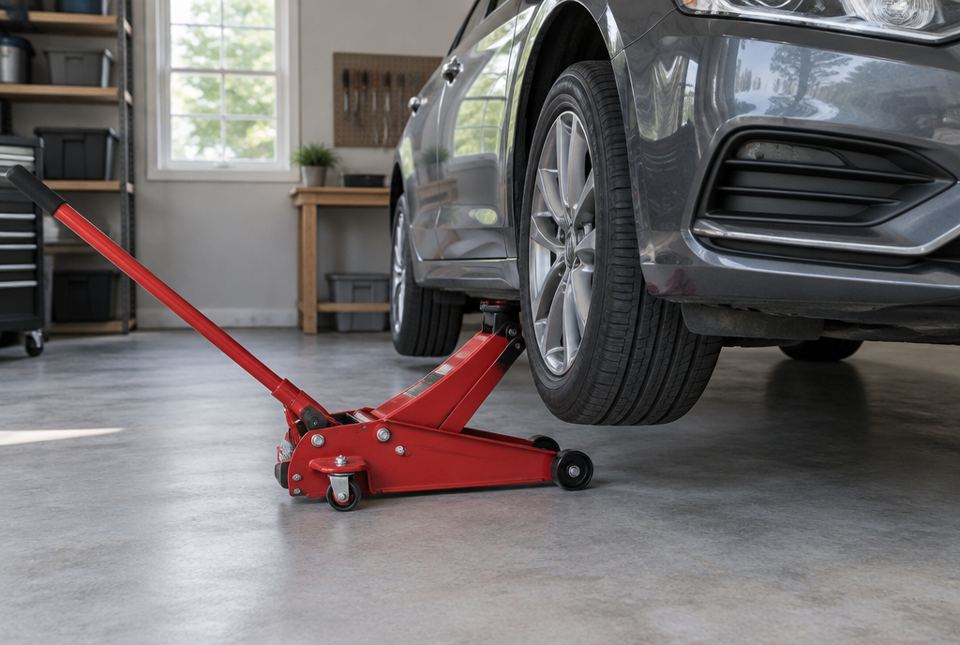 A floor jack is a hydraulic machine. A small push on the long handle becomes a large force under the car because pressure is passed through the oil inside. AI-generated image
Pressure = force ÷ area
Pressure tells us how concentrated a force is.
P = F ÷ A
- F is the force in newtons (N).
- A is the area the force pushes on, in cm² or m².
- P is the pressure, in N/cm², or in pascals (Pa), where 1 Pa = 1 N/m². 1 kPa = 1000 Pa.
The same force on a smaller area makes a bigger pressure. That's why a sharp knife cuts better than a dull one. A bigger area spreads the force out and makes a smaller pressure. That's why snowshoes keep you from sinking into deep snow.
Worked exampleLet's calculate pressure: boots or snowshoes?
Amira's weight is 600 N. Standing in winter boots, the area touching the snow is about 400 cm². On snowshoes, it is about 2400 cm². Find the pressure on the snow each way.
- Step 1. Write the formula. P = F ÷ A.
- Step 2. Boots. P = 600 N ÷ 400 cm² = 1.5 N/cm².
- Step 3. Snowshoes. P = 600 N ÷ 2400 cm² = 0.25 N/cm².
- Step 4. Compare. 1.5 ÷ 0.25 = 6. The snowshoes cut the pressure to one-sixth, so she sinks much less.
- Step 5. In pascals (optional). 400 cm² = 0.04 m², so in boots P = 600 ÷ 0.04 = 15 000 Pa = 15 kPa.
Boots: 1.5 N/cm². Snowshoes: 0.25 N/cm², six times less pressure on the snow. Many First Nations have made and used snowshoes for a very long time, with different shapes for different kinds of snow, and some makers still build them by hand today.
Amira's weight is the same both ways. Spreading it over 6 times the area gives one-sixth the pressure, so the snowshoes barely sink. (Not to scale.)Fluids push in all directions
A solid block pushes mostly down on whatever it sits on. A fluid is different. Its particles move in every direction, so a fluid pushes on every surface it touches: the bottom, the sides, and on anything inside it, from all sides.
Squeeze a plastic bottle full of water with holes poked in it, and water squirts out of every hole, sideways, up and down. Your squeeze was passed through the water in all directions.
Also, the deeper you go in a fluid, the more fluid is above pushing down, so pressure increases with depth. You can feel it in your ears at the bottom of a deep pool.
Pascal's law
Pascal's law: when pressure is applied to a fluid in a closed container, that pressure is passed on equally to every part of the fluid and to the walls of the container.
This works best with a liquid, because liquids are nearly incompressible: none of the push is wasted squeezing the fluid.
The hydraulic trick
Connect a small piston and a large piston with a closed pipe full of liquid.
- Push down on the small piston. That creates a pressure: P = F₁ ÷ A₁.
- By Pascal's law, the same pressure pushes up on the large piston.
- The large piston has a much bigger area, so the force on it is much bigger: F₂ = P × A₂.
Put together: F₂ = F₁ × (A₂ ÷ A₁). The force is multiplied by the ratio of the areas.
Worked exampleLet's solve a hydraulic lift problem
In a hydraulic lift, the small piston has an area of 2 cm² and the large piston has an area of 50 cm². You push the small piston down with 20 N. (a) What is the pressure in the liquid? (b) What is the upward force on the large piston? (c) If you push the small piston down 25 cm, how far does the large piston rise?
- (a) Pressure. P = F ÷ A = 20 N ÷ 2 cm² = 10 N/cm².
- (b) Pascal's law. The same 10 N/cm² acts on the large piston. F₂ = P × A₂ = 10 N/cm² × 50 cm² = 500 N. The force is multiplied by 50 ÷ 2 = 25.
- (c) The trade-off. The liquid pushed out of the small cylinder must go into the large one. Volume moved = area × distance = 2 cm² × 25 cm = 50 cm³.
- In the large cylinder, 50 cm³ ÷ 50 cm² = 1 cm. The large piston rises only 1 cm.
- Check: the force was multiplied by 25, and the distance was divided by 25. You never get something for nothing: a bigger force means a shorter distance.
(a) 10 N/cm². (b) 500 N. (c) The large piston rises 1 cm.
Just for funWhy did the hydraulic lift get promoted?
It could handle a lot of pressure. (And it passed it on equally to everyone.)
Hands-on activitySyringe hydraulics
You need: two needle-free medicine syringes of different sizes (for example 10 mL and 60 mL), about 30 cm of clear plastic tubing that fits snugly on the syringe tips (aquarium tubing works; ask at a pet or hardware store), water, a towel, and a ruler.
Part 1: set up
- Over the sink, fill the large syringe with water, attach the tubing and push water through the tubing until no air bubbles are left.
- Push the small syringe's plunger all the way in and attach it to the other end of the tubing. Adjust so both syringes have some water and there's no air.
Part 2: feel Pascal's law
- Hold one syringe in each hand. Push the small plunger. Feel how hard the large plunger pushes back on your other hand.
- Now push the large plunger. Which way is easier to push? Which plunger moves farther?
- Measure: push the small plunger in 4 cm. How far does the large one move? Compare with the ratio of the syringe sizes.
Part 3: forces in all directions (with a grown-up)
- A grown-up uses a pushpin to poke 4 or 5 small holes around an empty plastic bottle, at different heights and on different sides. Fill it with water over the sink, put the cap on, and squeeze.
What to look for: pushing the small plunger is easy and makes the large plunger push back strongly, but the large plunger moves only a short distance. Water squirts out of every hole when you squeeze the bottle, showing that pressure is passed in all directions.
Safety: use needle-free syringes. A grown-up pokes the holes. Work over a sink or towel, and wipe up water so nobody slips.
Your turn
1Write the formula for pressure and name each part.
P = F ÷ A: pressure equals force divided by area.
2A force of 100 N pushes on an area of 20 cm². What is the pressure?
Pressure applied to a fluid in a closed container is passed on equally to every part of the fluid and to the walls of the container.
4A hydraulic system has a small piston of 1 cm² and a large piston of 10 cm². You push the small piston with 30 N. What force acts on the large piston?
P = 30 ÷ 1 = 30 N/cm². F₂ = 30 × 10 = 300 N.
5In the same system, the small piston moves down 20 cm. How far does the large piston move?
Volume = 1 × 20 = 20 cm³. Distance = 20 ÷ 10 = 2 cm.
6Why do snowshoes stop you from sinking into deep snow?
They spread your weight over a bigger area, so the pressure on the snow is smaller.
7When you squeeze a bottle of water with holes all around it, water squirts out of every hole. What does this show?
The pressure from your squeeze is passed through the fluid in all directions, as Pascal's law says.
More practice: warm-up
1What is the unit of force?
250 N on 10 cm². Pressure?
3Same force, bigger area: more or less pressure?
4Who is Pascal's law named after?
Blaise Pascal, a French scientist and mathematician of the 1600s.
5In which directions does a fluid push on its container?
In all directions: on the bottom, the sides and the top.
More practice: on your own
1A 600 N person stands on an area of 0.04 m². Find the pressure in pascals and kilopascals.
P = 600 ÷ 0.04 = 15 000 Pa = 15 kPa.
2A hydraulic jack has a small piston of 3 cm² and a large piston of 60 cm². You push with 150 N. What force does the large piston give?
P = 150 ÷ 3 = 50 N/cm². F₂ = 50 × 60 = 3000 N. (The force is multiplied by 60 ÷ 3 = 20.)
3A car lift needs to give 8000 N on a large piston of 400 cm². The small piston is 5 cm². What force is needed on the small piston?
Pressure needed = 8000 ÷ 400 = 20 N/cm². F₁ = 20 × 5 = 100 N.
4Why does a sharp knife cut better than a dull one, even with the same push?
A sharp edge has a much smaller area, so the same force makes a much bigger pressure on the food.
5A hydraulic lift multiplies your force by 20. Does that mean you get "free" work? Explain.
No. The small piston must move 20 times as far as the large piston rises. You trade a longer push for a bigger force.
Challenge
1A garage lift has a small piston of 4 cm² and a large piston of 200 cm². (a) What force on the small piston lifts a 12 000 N car? (b) How far must the small piston move in total to raise the car 10 cm? (c) Why does the mechanic pump the handle many times instead of pushing once?
(a) P = 12 000 ÷ 200 = 60 N/cm². F₁ = 60 × 4 = 240 N. (b) Volume = 200 × 10 = 2000 cm³. Distance = 2000 ÷ 4 = 500 cm (5 m). (c) A small cylinder can't be 5 m long, so a pump pushes the liquid over in many short strokes, with valves stopping it from flowing back.
2Two circular pistons: the small one is 2 cm across (diameter). You want the large one to multiply the force by 25. How wide should it be? (Hint: area grows with the square of the diameter.)
The area must be 25 times as big. Since area grows with the square of the diameter, the diameter must be √25 = 5 times as wide: 2 × 5 = 10 cm across.
3Dams are built much thicker at the bottom than at the top. Use what you know about pressure in fluids to explain why.
Pressure increases with depth: the deeper the water, the more water is above pushing down. The water at the bottom of the reservoir pushes on the dam with the greatest pressure, so the dam must be strongest (thickest) there.
Quiz
1. Pressure is calculated as...
2. A 40 N force acts on 8 cm². The pressure is...
3. Pascal's law says that pressure applied to a fluid in a closed container...
4. A hydraulic system has pistons of 2 cm² and 40 cm². A 10 N push on the small piston gives what force on the large one?
5. In a hydraulic system that multiplies force, the small piston...
6. Snowshoes work because they...
Big idea (C2.7): a fluid passes forces in all directions. Pascal's law says pressure applied to an enclosed fluid is passed on equally everywhere in it. With P = F ÷ A, students calculate how a hydraulic system multiplies force (F₂ = F₁ × A₂ ÷ A₁) and see the trade-off in distance.
How to help: practise the formula with real situations: skates vs boots on ice, a thumbtack's point, snowshoes. If you have a car jack or adjustable office chair, look at how it works together (safely, without anyone under the car).
Common difficulties:
- Thinking pressure and force are the same thing. Same force, different area → different pressure.
- Multiplying instead of dividing when finding pressure.
- Forgetting the distance trade-off: force goes up, distance goes down by the same factor.
- Mixing cm² and m² units. Keep units the same throughout a problem.
Safety: needle-free syringes only. You poke any holes in bottles. Never go under a car held up only by a jack.