C. Matter and Energy · FluidsViscosity and Flow Rate
C2.1 A1.2 A1.4 A1.5About 50 minutes
Learning goals- I can explain what a fluid is and give examples of liquids and gases.
- I can describe the factors that affect viscosity, using the particle theory.
- I can calculate volumetric flow rate and use it to compare the viscosity of fluids.
- I can plan and carry out a fair test about viscosity.
Words to know
fluid
Any substance that can flow and take the shape of its container. All liquids and gases are fluids.
viscosity
A fluid's resistance to flowing. High viscosity means it flows slowly (honey). Low viscosity means it flows easily (water).
volumetric flow rate
The volume of fluid that flows past a point in a certain time. Flow rate = volume ÷ time, in units such as mL/s or L/min.
particle theory of matter
The scientific model that says matter is made of tiny moving particles with spaces between them that attract each other.
fair test
An investigation in which only one variable is changed and all others are kept the same.
Remember from earlier grades
In Grade 5 you held a viscosity race and found that honey and maple syrup flow slowly while water flows fast. In Grade 7 you learned the particle theory of matter: all matter is made of tiny particles that are always moving, have spaces between them, and attract each other.
This year you will use the particle theory to explain why some fluids are thick and others are runny, and you will measure how fast fluids flow with numbers.
The pancake problem
It's a cold Saturday morning in February. You pour maple syrup that has been in the fridge, and it creeps out of the bottle. Your grandfather says, "Warm it up first." A minute in a bowl of warm water later, it pours easily. What changed?
To answer that, we need to talk about fluids and viscosity.
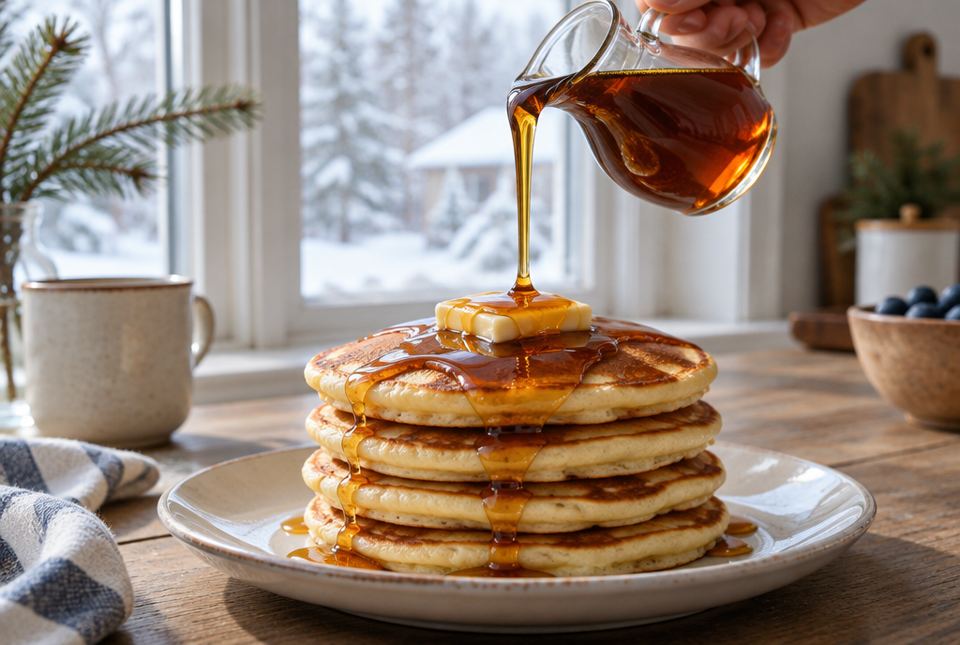 Maple syrup is a viscous fluid: it flows in a slow, thick stream. Warming it lowers its viscosity, so it pours faster. AI-generated image
What is a fluid?
A fluid is any substance that can flow. It has no fixed shape. It takes the shape of its container.
- All liquids are fluids: water, milk, maple syrup, cooking oil.
- All gases are fluids too: air, helium, the carbon dioxide bubbles in soda water.
Sand and sugar can be poured, but each grain is a tiny solid that keeps its own shape. So sand and sugar are not fluids.
What is viscosity?
Viscosity is a fluid's resistance to flow. You can think of it as how "thick" or "thin" a fluid is.
- High viscosity: flows slowly. Examples: honey, cold maple syrup, ketchup.
- Low viscosity: flows easily. Examples: water, juice, air.
In general, from lowest to highest viscosity: air → water → cooking oil → maple syrup → honey.
What affects viscosity?
The particle theory helps explain it. Three main factors change viscosity.
- Attraction between particles. When particles pull strongly on each other, it is harder for them to slide past each other. The liquid flows slowly. Honey is thick because its sugar particles attract each other and the water around them strongly.
- Size and shape of particles. Large, long particles get tangled with each other, like a bowl of cooked spaghetti. Cooking oil and motor oil are made of long particles, so they flow more slowly than water, which has small particles.
- Temperature. When you heat a liquid, its particles move faster. They can break away from their neighbours more easily and slide past each other. So warm liquids flow more easily than cold ones. That's why warmed syrup pours better.
Also, dissolving more of something in a liquid can change its viscosity. Dissolving lots of sugar in water makes a thick syrup.
A surprise about gases
Gases also have viscosity, but it is very low. And here is a surprise: gases behave the opposite way to liquids. A gas becomes slightly more viscous when it is heated. For this unit, remember the rule for liquids: warmer means runnier.
Measuring flow: volumetric flow rate
Scientists and engineers measure how fast a fluid flows with the volumetric flow rate. It tells how much volume passes a point in a certain amount of time.
Flow rate = volume ÷ time
Common units are millilitres per second (mL/s) and litres per minute (L/min).
If you pour different fluids through the same funnel in the same way, the fluid with the higher viscosity has the lower flow rate. So flow rate gives us a way to compare viscosity with numbers.
Worked exampleLet's compare two fluids with flow rate
Kai pours 250 mL of water through a kitchen funnel. It takes 10 s to drain. Then he pours 250 mL of cold maple syrup through the same funnel. It takes 125 s. Find each flow rate. Which has the higher viscosity?
- Step 1. Write the formula. Flow rate = volume ÷ time.
- Step 2. Water. 250 mL ÷ 10 s = 25 mL/s.
- Step 3. Syrup. 250 mL ÷ 125 s = 2 mL/s.
- Step 4. Compare. 25 ÷ 2 = 12.5, so the water flowed 12.5 times as fast as the syrup.
- Step 5. Conclude. The same funnel and the same volume were used, so this is a fair comparison. The slower flow means a higher viscosity.
Water: 25 mL/s. Cold maple syrup: 2 mL/s. The maple syrup has the higher viscosity, because it has the lower flow rate through the same funnel.
Kai's results as a bar graph. The syrup's bar is tiny: its flow rate is 12.5 times smaller, so it has the much higher viscosity.| Factor | Change | Effect on a liquid's viscosity | Particle theory reason |
|---|
| Temperature | warmer | lower (runnier) | faster particles slide past each other more easily |
| Temperature | colder | higher (thicker) | slower particles stay held by their attractions |
| Attraction between particles | stronger | higher | particles are harder to pull apart |
| Particle size and shape | larger, longer | higher | long particles tangle together |
| Dissolved sugar | more | higher | more particles that attract and get in the way |
The world's slowest dripSince 1927, a funnel of tar-like pitch has been dripping at the University of Queensland in Australia. Pitch looks solid (you can smash it with a hammer!), but it's actually a super-viscous fluid: only about one drop falls every decade. Talk about a slow pour.
Hands-on activityFlow-rate investigation: does temperature change viscosity?
Ask a grown-up to help with the warm water. Use hot water from the tap, never boiling water from a kettle.
You need: a kitchen funnel (or a paper cup with a small hole poked in the bottom by a grown-up), a measuring cup, two equal amounts of a food-safe thick liquid such as maple syrup, pancake syrup or honey (about 100 mL each, or 50 mL if you have less), two small jars, a bowl, a timer, and a plate to catch drips.
- Question: Does warming a syrup change its flow rate?
- Predict: Write a prediction with a because that uses the particle theory.
- Put one jar of syrup in the fridge for 30 minutes. A grown-up puts the other jar in a bowl of hot tap water for 10 minutes.
- Keep it fair: same funnel, same volume, same way of pouring (pour all at once), and start the timer when you start pouring.
- Pour the cold syrup through the funnel into a clean jar. Stop the timer when the funnel is empty (or when it slows to drips). Record the time.
- Clean and dry the funnel, then repeat with the warm syrup.
- Calculate each flow rate in mL/s. Repeat once more if you have enough syrup, and find the average.
- Communicate: write a short lab report: question, prediction, materials, method, results table, conclusion.
What to look for: the warm syrup has a much higher flow rate, so it has a lower viscosity. The warmed particles move faster and slide past each other more easily.
Safety: a grown-up handles the hot water. Don't eat syrup that went through a funnel that wasn't clean. Wipe up spills right away so nobody slips.
Your turn
1What is a fluid? Give one example of a liquid and one of a gas.
A fluid is any substance that can flow and take the shape of its container. Examples: liquid: water (or milk, oil); gas: air (or helium).
Viscosity is a fluid's resistance to flow: how slowly or easily it flows.
3Which has the higher viscosity, water or honey? Which would have the higher flow rate through the same funnel?
Honey has the higher viscosity. Water would have the higher flow rate.
4600 mL of juice flows out of a jug in 20 s. What is its flow rate?
5Use the particle theory to explain why heating a liquid lowers its viscosity.
Heating makes the particles move faster. Fast particles can break away from the attraction of their neighbours and slide past each other more easily, so the liquid flows more easily.
6Sand can be poured. Why is it not a fluid?
Each grain of sand is a solid that keeps its own shape. The grains tumble over each other, but the sand itself is not a liquid or a gas.
7Name two units for volumetric flow rate.
mL/s and L/min (also L/s or m³/s).
More practice: warm-up
1True or false: gases are fluids.
True. Liquids and gases can both flow.
2Which flows faster: cold maple syrup or warm maple syrup?
3Finish the formula: flow rate = ___ ÷ ___.
Flow rate = volume ÷ time.
4100 mL flows out in 5 s. What is the flow rate?
5Name a fluid with a low viscosity.
Examples: water, juice, air.
More practice: on your own
1A shower fills a 10 L bucket in 50 s. What is the flow rate in L/s and in L/min?
10 L ÷ 50 s = 0.2 L/s. There are 60 s in a minute, so 0.2 × 60 = 12 L/min.
2Shampoo A: 30 mL flows out of a bottle in 15 s. Shampoo B: 30 mL flows out of the same bottle in 40 s. Which is more viscous? Show the flow rates.
A: 30 ÷ 15 = 2 mL/s. B: 30 ÷ 40 = 0.75 mL/s. Shampoo B is more viscous, because it has the lower flow rate in the same bottle.
3Why do some people stand a jar of honey in warm water before using it?
Warming the honey makes its particles move faster, so they slide past each other more easily. The honey's viscosity drops and it pours or spreads more easily.
4What happens to the viscosity of water as you dissolve more and more sugar in it? Why?
The viscosity increases (it becomes a syrup). There are more dissolved sugar particles that attract the water particles and get in the way, so the particles slide past each other less easily.
5Car engine oil labels include a "W" rating for winter, such as 5W-30. Why does a cold-weather rating matter in a Canadian winter?
Oil becomes more viscous when it is cold. An oil that still flows well in the cold can reach and protect the moving engine parts quickly when the car starts on a freezing morning.
Challenge
1A kitchen tap fills a sink at 8 L/min. How long will it take to put 60 L of water in a tub? How long would it take at 0.1 L/s?
At 8 L/min: 60 ÷ 8 = 7.5 min. 0.1 L/s × 60 = 6 L/min, so 60 ÷ 6 = 10 min.
2Rania tests two liquids through the same funnel. Liquid X: 12 mL/s at 20 °C and 30 mL/s at 40 °C. Liquid Y: 10 mL/s at 20 °C. Rania says, "Y is way more viscous than X, because 10 is much less than 30." What is wrong with her reasoning, and what can she fairly conclude?
She compared results at different temperatures, so it isn't a fair test. Temperature changes viscosity. Comparing at the same temperature (20 °C): Y is 10 mL/s and X is 12 mL/s, so Y is only a little more viscous than X at 20 °C. To compare at 40 °C she would need to test Y at 40 °C too.
3Design a fair test to find out whether dish soap or shampoo is more viscous. Name the independent variable, the dependent variable, and three controlled variables.
Independent variable: the type of liquid (dish soap or shampoo). Dependent variable: the flow rate (or the time to flow out). Controlled variables (any three): same volume, same funnel or container, same temperature, same way of pouring, same person timing. Repeat each trial and average the results.
Quiz
1. Which of these is not a fluid?
3. What usually happens to a liquid's viscosity when it is heated?
4. 250 mL of milk flows out of a carton in 25 s. What is the flow rate?
5. Why does cooking oil flow more slowly than water?
6. Through the same funnel, liquid P has a flow rate of 5 mL/s and liquid Q has 20 mL/s. Which statement is true?
Big idea (C2.1): viscosity is a fluid's resistance to flow. It depends on the attraction between particles, the size and shape of the particles, and temperature. Students compare viscosities using volumetric flow rate (volume ÷ time). The activity practises a fair test (A1.2), safety (A1.4) and a written lab report (A1.5).
How to help: cooking is full of viscosity: honey, syrup, batter, gravy that thickens as it cools. Ask "Is that more or less viscous? Why?" Practise flow-rate maths with real taps: time how long the kitchen tap takes to fill a 1 L measuring jug.
Common difficulties:
- Mixing up viscosity and density. Oil is more viscous than water but less dense (it floats). Thick does not mean heavy. (Density comes in a later lesson in this unit.)
- Flipping the flow-rate relationship. Higher viscosity → lower flow rate.
- Dividing the wrong way. Flow rate is volume ÷ time, so units are mL/s, not s/mL.
- Unfair comparisons at different temperatures or with different funnels.
Safety: you handle the hot tap water. Never use boiling water from a kettle for this activity.