E. Spatial Sense · Spatial Sense: Angles, Tessellations, Transformations, Scale, Pythagoras and Composite MeasurementTransformations in Tessellations
E1.1 A1About 50 minutes
Learning goals- I can identify the translations, reflections and rotations that move one tile of a tessellation onto another.
- I can describe a tessellation by the transformations that create it.
- I can design my own tessellating tile by changing the sides of a polygon that tessellates.
Words to know
translation
A slide. Every point moves the same distance in the same direction.
reflection
A flip over a line (the line of reflection). The image is a mirror image.
rotation
A turn around a fixed point (the centre of rotation) by a given angle, clockwise or counterclockwise.
translation tessellation
A tessellation in which every tile can be reached from any other tile by translations alone.
maps onto itself
After the transformation, the pattern lands exactly on top of itself and looks unchanged.
Remember from earlier grades
You have translated (slid), reflected (flipped) and rotated (turned) shapes since the early grades, and in Grade 7 you described them on the Cartesian plane with coordinate rules. In the last lesson you found which shapes tessellate. Now you'll look at a tessellation as a chain of transformations: every tile is a copy of one starting tile that has been slid, flipped or turned into place.
Let's start with a brick wall
Look at a brick wall. Pick one brick. You can reach any other brick by sliding your brick: across the row, or diagonally up into the next row. No flipping or turning is needed. Because translations alone build the whole pattern, a brick wall is a translation tessellation.
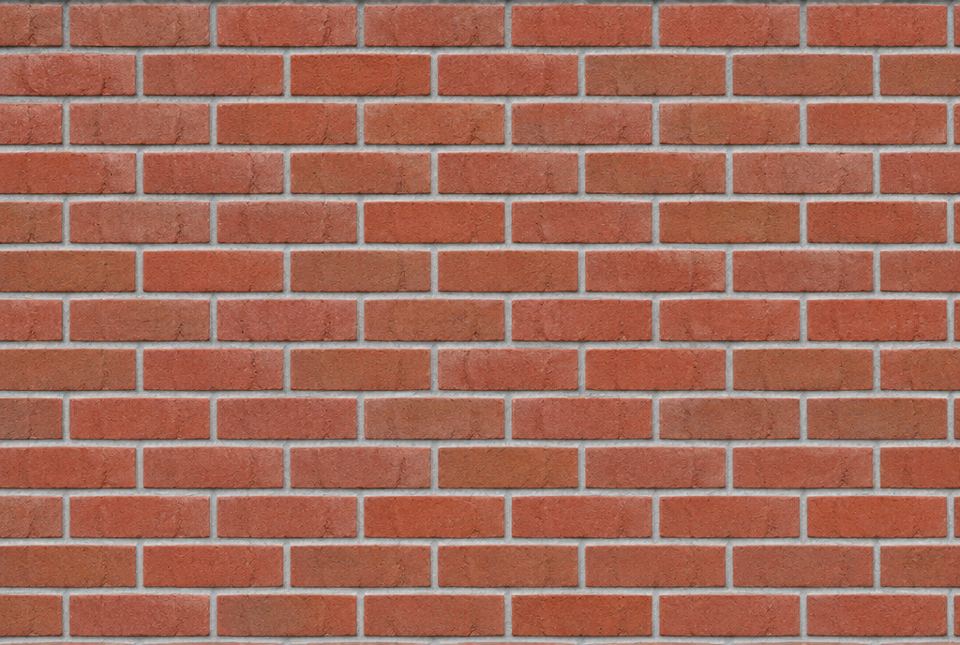 Pick any brick: you can reach every other brick just by sliding it across the row or diagonally into the next row. That makes the wall a translation tessellation. AI-generated imageA brick wall. The arrow shows a translation 3 brick-lengths to the right that moves the shaded brick onto the other shaded brick. Sliding half a brick-length sideways and one row up or down moves any brick onto a brick in the next row.
Finding the transformations
To describe the transformations in a tessellation, pick one tile and ask, "How can I move it onto a neighbour?"
- Translation: the neighbour faces the same way. Describe the slide (the direction and the distance).
- Rotation: the neighbour is turned. Find the centre of rotation (often the midpoint of a shared side, or a vertex) and the angle.
- Reflection: the neighbour is a mirror image. Find the line of reflection.
A whole tessellation can also map onto itself. For example, if you turn a hexagon tessellation 60° around the centre of a hexagon, every hexagon lands on a hexagon and the pattern looks unchanged.
| Tessellation | Translations? | Rotations that map it onto itself | Reflections? |
|---|
| Squares (like a checkerboard without colours) | Yes, by one side length in any row or column direction | 90° around the centre of a square or around a vertex | Yes, in lines through the middle of a row or column of squares, and in the diagonals of a square |
| Regular hexagons (honeycomb) | Yes, from each hexagon to any other one | 60° around the centre of a hexagon; 120° around a vertex | Yes, for example in a line through opposite vertices of a hexagon |
| Brick wall (bricks twice as long as tall) | Yes | 180° around the centre of a brick | Yes, in a vertical line through the middle of a brick |
| Scalene triangles (as in the picture) | Yes (each green triangle to every other green triangle) | 180° around the midpoint of any side | No: a scalene triangle is never the mirror image of its neighbours in this pattern |
Designing your own tile
Artists change the sides of a simple tile to make tessellations of birds, fish or lizards. The Dutch artist M. C. Escher became famous for this. The trick is to change one side, then copy the change to another side using a transformation, so the tiles still fit.
- Translation method: cut a piece from one side of a square (or parallelogram, or hexagon) and slide it straight across to the opposite side. The tiles fit together by translation.
- Rotation method: change half of one side, then rotate that change 180° around the midpoint of the side. Neighbouring tiles fit together by rotation.
Tessellations in art and culture
Tessellating patterns appear in quilts, beadwork, weaving, tiled floors and buildings in cultures all over the world. For example, the star blanket is a quilt made and gifted by many First Nations, especially Plains Nations, to honour a person at an important event. Its large eight-pointed star is built from many small diamond (rhombus) pieces. At the centre, eight diamond points meet: 8 × 45° = 360°. If you see a star blanket, at a powwow or in a museum, notice the transformations that place each diamond, and remember that the blanket carries meaning for the people who made and received it.
Worked exampleExample 1: Describe the transformation
In the triangle tessellation above, how can you move the green triangle onto the blue triangle that shares the side marked with a dot?
- The blue triangle is upside down compared with the green one, so it is not a translation.
- It is not a mirror image either. Label the green triangle's corners 1, 2, 3 going counterclockwise. On the blue triangle the matching corners also go counterclockwise. A reflection would reverse the order.
- Turning the green triangle half a turn around the dot (the midpoint of the shared side) puts each corner exactly onto the blue triangle.
A rotation of 180° around the midpoint of the shared side.
Worked exampleExample 2: Rotations that map a tessellation onto itself
A tessellation is made of regular hexagons. Name every angle smaller than 360° that rotates the pattern onto itself, turning around the centre of one hexagon.
- A regular hexagon looks the same after every turn of 360° ÷ 6 = 60°.
- The hexagons around it are arranged the same way, so the whole pattern also lines up after each 60° turn.
- The multiples of 60° smaller than 360° are 60°, 120°, 180°, 240° and 300°.
60°, 120°, 180°, 240° and 300° (clockwise or counterclockwise).
Think like a mathematician
To tell the three transformations apart, label the corners of one tile (1, 2, 3...) and find them on its neighbour:
- Same order and same direction it faces → translation.
- Same order going around, but turned → rotation.
- Order going around is reversed (clockwise becomes counterclockwise) → reflection (or a reflection combined with a slide).
Hands-on activityDesign an Escher-style tile
You need: an index card or thin cardboard, a ruler, scissors (a grown-up should help), tape, a pencil, a large sheet of paper and markers.
- Draw a 5 cm by 5 cm square on the card and cut it out.
- Draw a curvy line from the top-left corner to the bottom-left corner. Cut along it.
- Slide the cut piece straight across to the right side (don't flip it!) and tape it there, matching the corners.
- Do the same from the bottom side to the top side if you like.
- Trace your tile on the paper, slide it so the bump fits the notch, and trace again. Fill the page.
- Look at your shape. Does it remind you of an animal or object? Add details so every tile looks like it.
What to look for: the tiles fit with no gaps or overlaps, and every tile is a translation of the first one. If a piece got flipped, the tiles won't fit; that shows why the transformation matters.
Extension: try the rotation method on a triangle. Change half of one side, then rotate the change 180° around the side's midpoint.
Funny but trueM. C. Escher's 1943 print Reptiles shows a flat tessellation of lizards. A few of them crawl right off the page, climb over a book and some other objects, and then crawl back down into the pattern. Apparently being a tile got a little boring.
Your turn
1In a brick wall, what single transformation moves one brick onto the brick right beside it in the same row?
A translation of one brick-length along the row.
2In a square tessellation, what is the smallest rotation around the centre of a square that maps the pattern onto itself?
90°. A square looks the same after each quarter turn.
3In a hexagon tessellation, what rotation around a vertex (where three hexagons meet) maps the pattern onto itself?
120° (or 240°). Three hexagons meet there, and 360° ÷ 3 = 120°.
4A tile was made by cutting a piece from the bottom of a square and sliding it to the top. What kind of tessellation will it make?
A translation tessellation. The tiles fit together by sliding, with no turning or flipping.
5Two neighbouring tiles are mirror images of each other. What transformation moves one onto the other?
A reflection in the line between them (or a reflection combined with a slide).
6How can you check whether a neighbour is a rotation or a reflection of a tile?
Label the corners and check the order going around. If the order runs the same way (both clockwise), it is a rotation. If it runs the opposite way, it is a reflection.
More practice: warm-up
1Which transformation is a slide?
2Which transformation is a turn?
3Which transformation is a flip?
4In a checkerboard of squares, how far must you translate a square to land on the next square in its row?
One side length of a square.
5What does "maps onto itself" mean?
After the transformation, the pattern lands exactly on top of itself and looks unchanged.
More practice: on your own
1List all rotation angles smaller than 360° that map a square tessellation onto itself when you turn around the centre of a square.
90°, 180° and 270°. 360° ÷ 4 = 90°, so every multiple of 90° works.
2Describe a reflection that maps a brick wall onto itself.
A reflection in a vertical line through the middle of any brick. The brick flips onto itself, and the bricks in the rows above and below also land on bricks. (A horizontal line through the middle of a row of bricks also works.)
3Ava cut a piece from the left side of her square tile and flipped it over before taping it to the right side. Will her tiles fit together by translation? Explain.
Not in general. The bump on the right is now a mirror image of the notch on the left, so it won't fit into the notch of the next tile (unless the piece happened to be symmetric). It must be slid, not flipped, for translations to work.
4An eight-pointed star is made from 8 identical diamonds meeting at the centre. What is the angle at each diamond point at the centre, and what rotation maps the star onto itself?
45°, and a rotation of 45° (or any multiple of 45°). 360° ÷ 8 = 45°.
5In a tessellation of equilateral triangles, what rotation around a vertex maps the pattern onto itself?
60° (or any multiple of 60°). Six triangles meet at each vertex, and 360° ÷ 6 = 60°.
Challenge
1Explain why every quadrilateral tessellates by using a transformation.
Rotate the quadrilateral 180° around the midpoint of one side. The image shares that side exactly. Keep rotating 180° around the midpoints of the sides. At each vertex, the four different angles of the quadrilateral meet once each, and they add to 360°, so the tiles fit with no gaps or overlaps.
2A tessellation of regular hexagons maps onto itself with a 60° rotation around the centre of a hexagon. Does a 60° rotation around a vertex also map it onto itself? Explain.
No. Only 3 hexagons meet at a vertex, so the pattern repeats every 120° there. After a 60° turn, the edges coming out of the vertex point between where the old edges were, so the pattern does not line up.
3Design challenge: describe how to make a tessellating tile from a regular hexagon using the translation method.
Model answer: change one side of the hexagon (for example, draw a wave) and translate the same change to the opposite, parallel side. Do the same with the other two pairs of opposite sides if you like. Because opposite sides of a regular hexagon are parallel and equal, each change fits into its neighbour's matching side, and the tiles fit by translation. Look for: changes copied to opposite sides, not flipped.
Quiz
1. A brick wall can be built from one brick using only:
2. What rotation around the centre of a square maps a square tessellation onto itself?
3. In a triangle tessellation, a triangle and its neighbour share a side. The neighbour is upside down but not a mirror image. What transformation is it?
4. To make a translation tessellation tile from a square, a piece cut from one side must be:
5. What rotation around a vertex maps a regular hexagon tessellation onto itself?
6. Two tiles are mirror images. Which transformation moves one onto the other?
Big idea: The Ontario curriculum (E1.1) asks Grade 8 students to identify the transformations that occur in tessellations. Your child already knows translations, reflections and rotations; now they look for them inside patterns and use them to design tiles.
Common difficulties:
- Telling a rotation from a reflection. Labelling the corners of a tile and checking whether the order runs clockwise or counterclockwise settles it.
- Flipping the cut piece in the tile design. For the translation method, the piece must slide straight across without flipping.
- Finding the centre of rotation. It is usually the midpoint of a shared side, the centre of a tile, or a vertex where tiles meet.
How to help: Look at tiled floors, brick walls, quilts and fabric together. Ask, "How could you slide, flip or turn this tile onto that one?" The Escher-style tile makes a great piece of art for the fridge. Safety: help with scissors. When talking about star blankets or other cultural designs, treat them as meaningful works made by living communities, not just as math examples. This lesson also builds A1 skills: reasoning, representing and creative thinking.