E. Spatial Sense · Spatial Sense: Angles, Tessellations, Transformations, Scale, Pythagoras and Composite MeasurementWhich Shapes Tessellate?
E1.1 A1About 50 minutes
Learning goals- I can explain what a tessellation is.
- I can explain why the angles that meet at each vertex of a tessellation must add to 360°.
- I can decide whether a regular polygon, or a combination of regular polygons, will tessellate.
- I can explain why every triangle and every quadrilateral tessellates.
Words to know
tessellation
A pattern of shapes that covers a flat surface with no gaps and no overlaps, and could go on forever in every direction. Also called a tiling.
tessellate
A shape tessellates if copies of it can make a tessellation.
vertex (of a tessellation)
A point where corners of the tiles meet. The angles around it add to 360°.
regular tessellation
A tessellation made of just one kind of regular polygon, all the same size.
semi-regular tessellation
A tessellation made of two or more kinds of regular polygons, with the same arrangement of polygons around every vertex.
Let's start with a floor
Look down at a tiled kitchen floor, a brick wall or a paved sidewalk. The tiles fit together perfectly, with no gaps and no overlaps. A pattern like that is called a tessellation. Bees make one too: the cells of a honeycomb are hexagons.
But not every shape works. Try tiling a floor with circles and you'll get gaps. Today you'll find out exactly which shapes tessellate, and the angle rule behind it. (You'll use the polygon angles from the last lesson.)
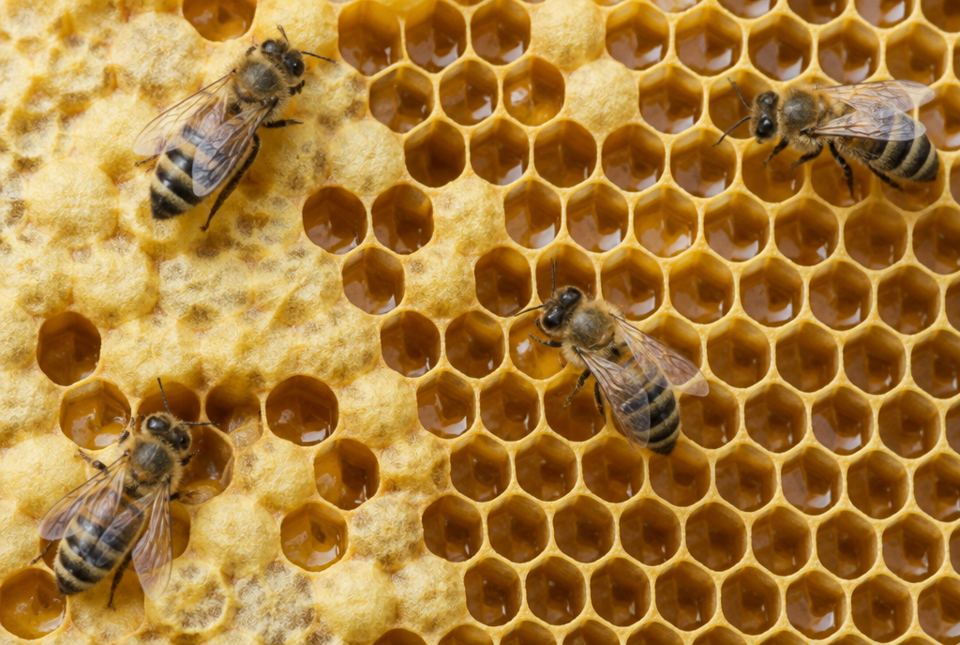 Each honeycomb cell is close to a regular hexagon. Three hexagon corners of 120° meet at each point, and 3 × 120° = 360°, so the cells fit together with no gaps. AI-generated image
The 360° rule
Look at any point where corners of tiles meet (a vertex of the tessellation). The angles fill the space around that point exactly, with nothing left over and nothing overlapping. So:
At every vertex of a tessellation, the angles add to 360°.
This gives a test. A regular polygon tessellates on its own only if its interior angle divides evenly into 360°.
| Regular polygon | Interior angle | 360° ÷ angle | Tessellates on its own? |
|---|
| Equilateral triangle | 60° | 6 | Yes |
| Square | 90° | 4 | Yes |
| Regular pentagon | 108° | 3.33... | No |
| Regular hexagon | 120° | 3 | Yes |
| Regular octagon | 135° | 2.67... | No |
| Regular decagon | 144° | 2.5 | No |
Only three regular tessellations
Polygons with more than 6 sides have interior angles bigger than 120° (but less than 180°). Two of them make less than 360°, and three of them make more than 360°. So a regular polygon with more than 6 sides can never tessellate on its own. That means there are only three regular tessellations: triangles, squares and hexagons.
Mixing regular polygons
Two or more kinds of regular polygons can work together, as long as the angles at each vertex add to 360° and the sides are the same length. If every vertex has the same arrangement, it is called a semi-regular tessellation. Here are some combinations that add to 360°:
- 2 octagons + 1 square: 135° + 135° + 90° = 360°
- 3 triangles + 2 squares: 60° + 60° + 60° + 90° + 90° = 360°
- 2 triangles + 2 hexagons: 60° + 60° + 120° + 120° = 360°
- 1 triangle + 2 dodecagons (12-gons): 60° + 150° + 150° = 360°
Every triangle and every quadrilateral tessellates
The shape doesn't have to be regular!
- Any triangle: its angles a, b and c add to 180°. Around one vertex of a triangle tessellation, each angle appears twice: 2 × 180° = 360°.
- Any quadrilateral, even a strange lopsided one: its four angles add to 360°, so one copy of each corner fills a vertex exactly.
Some special non-regular pentagons and hexagons tessellate too, but many don't. For those shapes you have to check carefully.
Worked exampleExample 1: Does it tessellate?
Will regular pentagons tessellate on their own?
- Each interior angle of a regular pentagon is 108°.
- 360° ÷ 108° = 3.33..., which is not a whole number.
- Three pentagons make 324° (a gap of 36°). Four would make 432° (they would overlap).
No. Regular pentagons can't fill the space around a point.
Worked exampleExample 2: Fill the gap
Two regular dodecagons (12-gons) meet at a point. What regular polygon could fill the rest of the space?
- Each interior angle of a regular dodecagon is 150° (from the polygon table).
- Two of them: 2 × 150° = 300°.
- Space left: 360° − 300° = 60°. That is the angle of an equilateral triangle.
One equilateral triangle fills the gap: 150° + 150° + 60° = 360°.
Worked exampleExample 3: An irregular quadrilateral
A tile is a quadrilateral with angles 70°, 100°, 80° and 110°. Will it tessellate?
- 70° + 100° + 80° + 110° = 360°.
- Place four copies so that one of each corner meets at a point (turn a copy 180° around the midpoint of a side to fit it on).
- The four different corners fill the 360° exactly, and the matching sides line up.
Yes. Like every quadrilateral, it tessellates.
Think like a mathematician
To decide whether shapes fit at a vertex, add the angles and compare with 360°. Less than 360° means a gap; more than 360° means an overlap. For mixed polygons, also check that the sides are the same length, so edges match up.
Hands-on activityMake your own tessellation
You need: thin cardboard (a cereal box), a ruler, a pencil, scissors (a grown-up should help with cutting), and a large sheet of paper.
- Draw a lopsided quadrilateral on the cardboard, about 5 cm across, with no two sides equal. Cut it out. Label its corners 1, 2, 3, 4.
- Trace it on the paper. To place the next copy, turn the tile 180° around the midpoint of one side so that the matching side lines up. Trace again.
- Keep going until you've covered part of the page. Colour your tessellation.
- Find a vertex where four tiles meet. Which numbered corners meet there?
- Try the same thing with a regular pentagon (trace one from a picture or draw it with a protractor: all angles 108°, all sides equal). What happens?
What to look for: at every vertex of the quadrilateral tessellation, corners 1, 2, 3 and 4 meet once each (360°). The pentagons leave gaps.
Math talk: "How do you know your pattern could go on forever?"
Funny but trueRegular pentagons can't tessellate, but some lopsided ones can. Mathematicians spent about a century hunting for them. In 2015 a team at the University of Washington Bothell used a computer search to find the 15th kind, and in 2017 a mathematician announced a proof that there are no more. Your tessellation homework is a lot shorter.
Your turn
1What is the interior angle of a regular hexagon, and how many hexagons meet at each vertex of a hexagon tessellation?
120°, and 3 hexagons. 3 × 120° = 360°.
2Will regular octagons tessellate on their own? Explain.
No. Each angle is 135°. Two make 270° (a gap) and three make 405° (an overlap).
3In the octagon-and-square tessellation, how many octagons and how many squares meet at each vertex?
2 octagons and 1 square. 135° + 135° + 90° = 360°.
4Can 2 squares and 3 equilateral triangles meet at a point with no gaps or overlaps?
Yes. 2 × 90° + 3 × 60° = 180° + 180° = 360°.
5A quadrilateral has angles of 60°, 120°, 75° and x. Find x. Will the shape tessellate?
x = 105°, and yes. 360° − 255° = 105°. Every quadrilateral tessellates, because one of each corner fills 360°.
6Name two places you could see a tessellation at home or in your community.
Examples: floor or wall tiles, a brick wall, interlocking paving stones, a chessboard or checkerboard, a honeycomb, a quilt made of repeating blocks, a chain-link fence. Any pattern that covers a surface with no gaps or overlaps counts.
7Explain why any triangle tessellates.
Its three angles add to 180°. In a triangle tessellation, each of the three angles appears twice around a vertex: 2 × 180° = 360°, so the space is filled exactly.
More practice: warm-up
A pattern of shapes that covers a flat surface with no gaps and no overlaps.
2What do the angles around a point add to?
3What is the interior angle of an equilateral triangle? How many fit around a point?
60°, and 6. 6 × 60° = 360°.
4Do regular pentagons tessellate on their own?
No. 108° doesn't divide evenly into 360°.
5Do squares tessellate? How many meet at each vertex?
More practice: on your own
1Will regular decagons (interior angle 144°) tessellate on their own? Explain.
No. 360° ÷ 144° = 2.5. Two decagons make 288° and three make 432°.
2A regular hexagon and two squares meet at a vertex. What regular polygon would fill the remaining space?
An equilateral triangle. 120° + 90° + 90° = 300°, and 360° − 300° = 60°.
3Will a rhombus with angles of 70° and 110° tessellate? Explain.
Yes. Its angles are 70°, 110°, 70°, 110°, which add to 360°. Like every quadrilateral, it tessellates (a row of rhombuses can slide along to make the next row).
4How many equilateral triangles fit with 2 regular hexagons around a point?
2. 2 × 120° = 240°, and 360° − 240° = 120° = 2 × 60°.
5Two regular octagons meet at a point. Can an equilateral triangle fill the gap? Explain.
No. 2 × 135° = 270°, so the gap is 90°. A triangle's 60° is too small. A square (90°) fits instead.
Challenge
1Explain why no regular polygon with more than 6 sides can tessellate on its own.
Its interior angle is more than 120° and less than 180°. Two of them make less than 360° (a gap), and three make more than 360° (an overlap). No whole number of them fits exactly.
2Find every way that equilateral triangles and squares (same side length) can fill the space around a point.
Three ways: 6 triangles (360°); 4 squares (360°); 3 triangles + 2 squares (180° + 180°). Reason: you need 60° × (triangles) + 90° × (squares) = 360°. Trying 0 to 4 squares, only 0, 2 and 4 squares leave a gap that is a multiple of 60°.
3A tile store sells regular octagon tiles with sides of 10 cm. What shape and size of second tile is needed to cover a floor with no gaps?
A square with 10 cm sides. Two octagons leave a 90° gap at each vertex (360° − 270°), and the square's sides must match the octagon's 10 cm sides.
Quiz
1. What must the angles at every vertex of a tessellation add to?
2. Which regular polygon does not tessellate on its own?
3. How many regular hexagons meet at each vertex of a hexagon tessellation?
4. Two regular octagons meet at a point. What regular polygon fills the gap?
6. How many regular tessellations (using one kind of regular polygon) are there?
Big idea: The Ontario curriculum (E1.1) asks Grade 8 students to identify the geometric properties of tessellating shapes and the transformations in tessellations (the next lesson). The key property is that the angles at each vertex add to 360°. This lesson uses the polygon angle facts from the previous lesson.
Common difficulties:
- Thinking only regular shapes tessellate. Every triangle and every quadrilateral does. Making the cardboard tessellation shows this clearly.
- Forgetting that the sides must match. For mixed tessellations, the polygons need equal side lengths.
- Guessing instead of checking. Encourage your child to add the angles at a vertex and compare with 360°.
How to help: Go on a tessellation hunt at home, at school or in a store: tiles, bricks, paving stones, quilts, fabric patterns. For each one, ask which shapes are used and how many meet at a corner. Safety: help with scissors when cutting cardboard. This lesson also builds A1 skills: reasoning and proving, and persevering through trial and error.