C. Matter and Energy · Pure Substances and MixturesWater: The Universal Solvent
C2.6 C2.4 A1.2 A1.4 A1.5About 40 minutes
Learning goals- I can explain why water is called the universal solvent.
- I can describe how the shape and charges of a water molecule help it dissolve many substances.
- I can give examples of why water's dissolving power matters for living things and the environment.
Words to know
universal solvent
A nickname for water, because it dissolves more substances than any other common liquid.
polar molecule
A molecule with a slightly negative end and a slightly positive end. Water is a polar molecule.
aqueous solution
A solution in which water is the solvent. Aqua means water.
hard water
Water with a lot of dissolved minerals, such as calcium and magnesium.
runoff
Rain or melted snow that flows over the ground into streams and lakes, carrying substances with it.
The crust in the kettle
Look inside an old kettle. You may see a white, chalky crust on the bottom. Where did it come from? Nobody put it there. It was dissolved in the tap water, invisible. When the water boiled away again and again, the minerals were left behind.
Water picks up a little of almost everything it touches. That's why scientists call it the universal solvent.
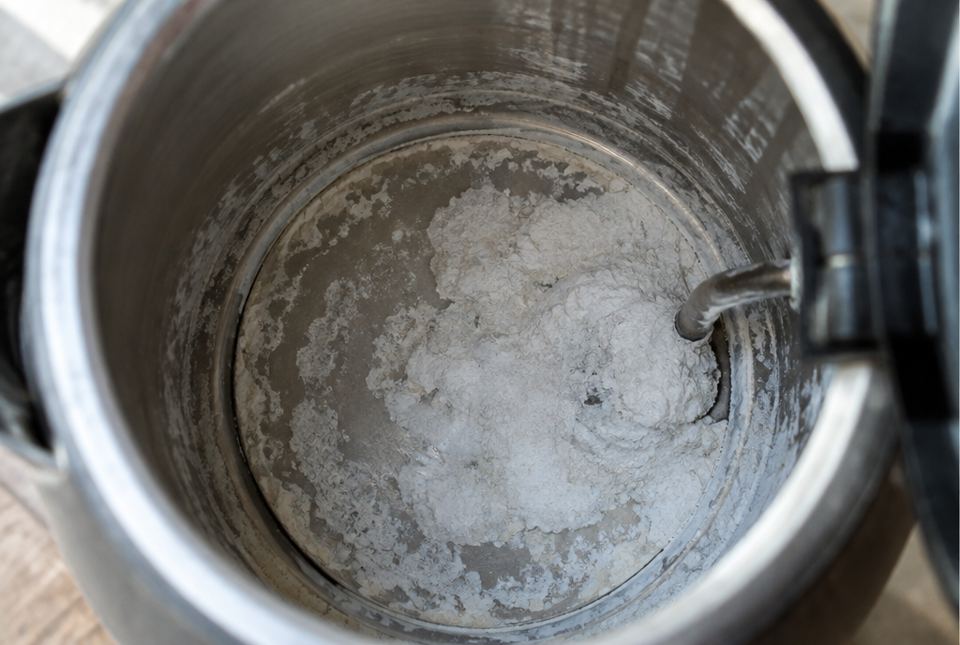 The white crust is minerals that were dissolved in the tap water. When the water boiled away, the minerals were left behind. AI-generated image
Why universal?
Water dissolves more substances than any other common liquid: salt, sugar, minerals from rocks, oxygen and carbon dioxide from the air, and much more. Solutions with water as the solvent are called aqueous solutions.
But universal is an exaggeration. Water does not dissolve everything. Oil, wax, sand, most plastics and grease are insoluble in water. If water dissolved everything, it couldn't be stored in any container!
The secret: a molecule with two ends
A water molecule (H₂O) has one oxygen atom and two hydrogen atoms, joined in a bent shape, like a wide letter V.
- The oxygen end is slightly negative.
- The hydrogen ends are slightly positive.
A molecule like this is called polar. (Remember from Grade 6: opposite charges attract.) Many substances, like salt and sugar, have particles with charged or slightly charged parts. Water molecules turn toward them: the negative oxygen ends attract positive parts, and the positive hydrogen ends attract negative parts. Lots of water molecules surround each solute particle and pull it away from the solid. That's dissolving.
Oil particles have no charged ends, so water molecules aren't attracted to them. Water molecules stick to each other instead, and the oil is squeezed out into its own layer.
| Where | What water dissolves | Why it matters |
|---|
| Your body | Nutrients, salts, wastes | Blood is mostly water; it carries dissolved nutrients to cells and wastes to the kidneys |
| Plants | Minerals from soil | Roots can only take in minerals that are dissolved in water |
| Lakes and oceans | Oxygen, carbon dioxide, salts | Fish breathe dissolved oxygen; sea water is salty |
| Underground | Minerals from rock | Over thousands of years, water can dissolve limestone and form caves |
| Home | Dirt (with soap), sugar, drink crystals | Cleaning, cooking, making drinks |
| Pollution | Road salt, fertilizers, some chemicals | Runoff can carry dissolved substances into streams, lakes and groundwater |
Worked exampleLet's explain an environmental problem
In winter, salt is spread on Ontario roads. In spring, it can end up in nearby streams and lakes. Explain how, using what you know about water as a solvent.
- Salt is soluble in water. When snow and ice melt, the salt dissolves in the meltwater.
- The salt water becomes runoff: it flows over the ground and into storm drains, ditches and streams.
- Because the salt is dissolved, you can't see it, and it can't be filtered out with a simple screen.
- Too much salt in fresh water can harm plants and animals that live there.
Water dissolves the road salt, and the runoff carries it, invisibly, into streams and lakes. That's why towns try to use only as much salt as they need.
Just for funFunny but true: the white crust inside an old kettle is made of minerals from rocks. Water dissolved them, carried them all the way to your kitchen, then left them behind when it boiled away. Rude!
Other solvents
Water isn't the only solvent. Oil-based stains and paints need other solvents, such as the ones in nail polish remover or paint thinner. Those solvents are not food-safe, and their fumes can be harmful and catch fire, so only adults use them, with a window open. In this unit, you only test water and cooking oil. Never mix household chemicals or cleaners together.
Hands-on activityWater versus oil: which is the better solvent?
You need: 6 small clear cups or jars, room-temperature water, cooking oil (vegetable or canola), salt, sugar, liquid food colouring, a spoon, labels.
- Put about 50 mL of water in 3 cups and 50 mL of cooking oil in the other 3. Label them.
- Predict which solvent will dissolve each solute.
- Add ¼ teaspoon of salt to one water cup and one oil cup. Add ¼ teaspoon of sugar to another water cup and oil cup. Add 1 drop of food colouring to the last water cup and oil cup.
- Stir each one 20 times with a clean spoon. Wait 2 minutes and observe.
- Record: solute | dissolved in water? | dissolved in oil? | evidence.
- Bonus: pour a little coloured water into an oil cup. What happens?
What to look for: salt, sugar and food colouring dissolve in water but not in oil. In oil, the salt and sugar sit at the bottom, and the food colouring forms little beads that sink. The coloured water sinks below the oil and forms its own layer. Water is the better solvent for these substances.
Safety: wipe up oil spills right away (slippery floor). Don't pour lots of oil down the sink; wipe the oil cups with paper towel and put it in the garbage or green bin as your town allows.
Your turn
1Why is water called the universal solvent?
Because it dissolves more substances than any other common liquid.
2Name two substances that do not dissolve in water.
Any two: oil, wax, sand, grease, most plastics.
3Which end of a water molecule is slightly negative?
4What is a polar molecule?
A molecule with a slightly negative end and a slightly positive end.
5What is an aqueous solution? Give an example.
A solution where water is the solvent. Examples: salt water, sugar water, tea.
6Why do plants need water to get minerals from the soil?
Roots can only take in minerals that are dissolved in water.
7Where does the white crust inside an old kettle come from?
From minerals dissolved in the tap water. When the water boils away, the minerals are left behind.
More practice: warm-up
2Does salt dissolve in cooking oil?
3True or false: water dissolves absolutely everything.
4What is the formula for water?
5What gas do fish get from water?
Oxygen (dissolved oxygen).
More practice: on your own
1Explain why salt dissolves in water using the idea of attraction.
Salt particles have charged parts. The slightly negative oxygen ends and slightly positive hydrogen ends of water molecules attract them, surround them and pull them away from the crystal.
2Why doesn't oil dissolve in water?
Oil particles have no charged ends, so water molecules aren't attracted to them. The water molecules attract each other instead, and the oil stays in its own layer.
3A river carries water from farm fields. Explain how fertilizer can get into the river even though nobody dumped it there.
Rain dissolves some of the fertilizer, because it is soluble in water. The runoff carries it, dissolved, into the river.
4Why is water's dissolving power important in your blood?
Blood is mostly water, so it can carry dissolved nutrients (like sugar and salts) to your cells and carry wastes away to the kidneys.
5Why would it be a problem if water truly dissolved everything?
It would dissolve its containers, pipes, rocks, and even living things. We couldn't store it or use it safely.
Challenge
1Soap helps water wash greasy dishes. One end of a soap particle is attracted to water and the other end to grease. Use this to explain how soap works.
Water alone can't dissolve grease. Soap particles act as go-betweens: one end grabs the grease, the other end is attracted to water. The grease gets surrounded by soap particles and washed away with the water.
2Rainwater is nearly pure when it forms in clouds, but well water is often hard water. Explain why.
As rainwater soaks into the ground and moves through soil and rock, it dissolves minerals like calcium and magnesium. By the time it reaches a well, it carries many dissolved minerals: hard water.
3Suggest one way a town could reduce the road salt reaching a lake, and explain why it helps.
Examples: use only as much salt as needed (pre-wetting or measuring spreaders), use sand for grip in some places, store salt under cover so rain can't dissolve it, plant buffer strips of plants along the shore. Each one means less salt dissolves into runoff.
Quiz
1. Water is called the universal solvent because it...
2. Which substance does not dissolve in water?
3. In a water molecule, the oxygen end is...
4. A solution with water as the solvent is called...
5. Road salt gets into lakes mainly because...
6. Which is the safest choice for an at-home solvent test?
Big idea: Ontario expectation C2.6 asks students to explain why water is called the universal solvent. The key idea: water molecules are polar (slightly negative and slightly positive ends), so they attract and pull apart many kinds of particles. The water-versus-oil test is a simple fair test (A1.2) done safely (A1.4).
How to help: Look for the kettle crust or water spots on glasses; talk about road salt after a snowfall. Ask: "What did the water dissolve here?"
Common difficulties:
- Taking "universal" literally. Water doesn't dissolve oil, wax, sand or plastic.
- Thinking polar means magnetic or electrically charged overall. A water molecule has no overall charge; its ends are only slightly charged.
Safety: use only water and cooking oil. Keep nail polish remover, paint thinner and all cleaners out of the activity, and never mix household chemicals.