C. Matter and Energy · Electrical Phenomena, Energy, and DevicesUsing Less Electricity: Choices and Advocacy
C1.2 A2.1 A2.2 A3.2About 50 minutes
Learning goals- I can assess choices that reduce my use of electrical energy at home and at school.
- I can explain why saving electricity matters, whether it comes from renewable or non-renewable sources.
- I can use watts and hours to compare how much energy devices use.
- I can read and write code that uses input from sensors to save energy.
- I can plan a campaign that encourages my school to use electricity responsibly.
Words to know
conserve
To use carefully, so less is used up or wasted.
watt (W)
A unit that tells how fast a device uses energy. A 60 W bulb uses energy faster than a 9 W bulb.
kilowatt-hour (kWh)
A unit of electrical energy: 1000 watts used for 1 hour. Electricity bills are measured in kWh.
standby power
Electricity some devices use even when they are "off" but still plugged in. Also called phantom power.
EnerGuide label
A Canadian label on appliances that shows how much electricity they use in a year.
sensor
A device that measures something (light, motion, temperature) and sends it to a computer as input.
advocate
To speak up and work to persuade others to support an idea.
The power is in your hands
Power stations, dams and wind farms are huge. But the choices that decide how much electricity we need are often small ones: turning off a light, unplugging a game console, hanging laundry to dry. Millions of small choices add up to a big difference.
In this lesson you'll assess choices that reduce electricity use, do some energy math, write code for smart lights, and plan a campaign to get your school saving electricity.
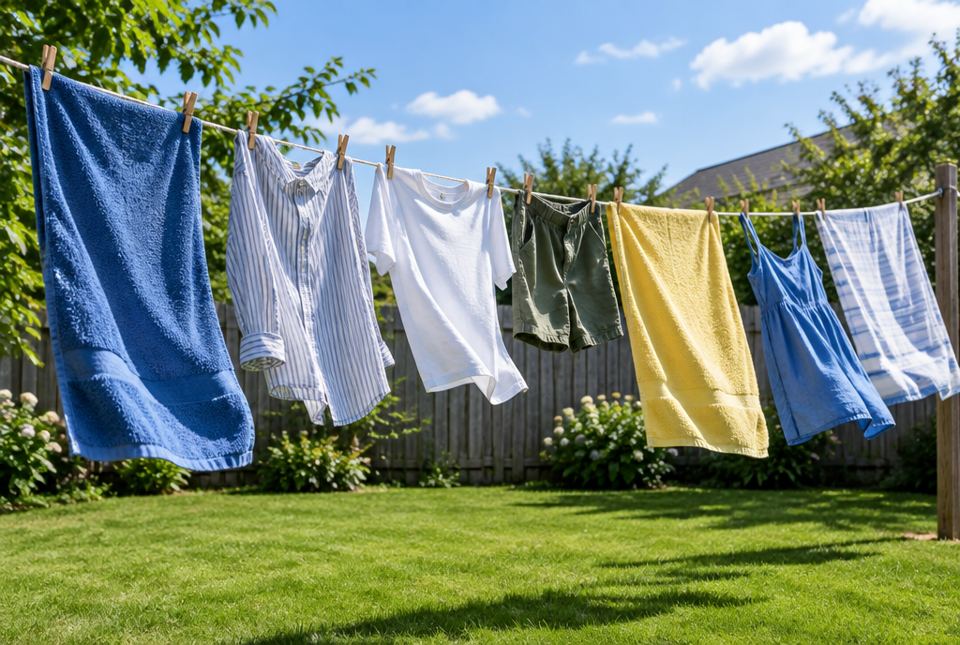 Hanging laundry outside uses the sun and wind instead of an electric dryer, which saves electricity. AI-generated image
Remember from Grade 5
In Grade 5 you learned about EnerGuide labels, standby power, and you traced code for a smart hallway light that used a motion sensor. This year you'll go further: assess which choices help most, calculate energy with watts and hours, write code that uses more than one kind of input, and advocate for change at your school.
Why save electricity, even if it's "clean"?
- Non-renewable sources (natural gas, uranium) will run out, and burning natural gas releases greenhouse gases.
- Renewable sources also have impacts: dams flood land, and wind and solar farms need land and materials. Using less means fewer new stations need to be built.
- When lots of people use electricity at the same time, the extra electricity often comes from natural gas stations. Cutting use at busy times helps reduce that.
- Saving electricity saves money for families and schools.
| Choice | Why it saves electricity | How easy? |
|---|
| Turn off lights and screens when you leave a room | Devices that are off use no energy (except standby) | Very easy |
| Switch to LED bulbs | LEDs use much less electricity for the same light | Easy (costs a little at first) |
| Unplug chargers and use a power bar to switch off TVs and game consoles completely | Stops standby power | Easy |
| Hang laundry to dry, or use a drying rack in winter | Clothes dryers use a lot of electricity | Takes more time |
| Wash clothes in cold water | Less energy to heat water (if the water heater is electric) | Easy |
| Keep the fridge door closed; let leftovers cool before putting them in | The fridge doesn't have to work as hard | Easy |
| Open curtains for daylight instead of turning on lights | Free light from the Sun | Easy on sunny days |
| Choose appliances with a low number on their EnerGuide label, or the ENERGY STAR symbol | They're designed to use less electricity | When replacing an appliance |
| Run the dishwasher or laundry in the evening or on weekends | Doesn't save electricity itself, but uses it when fewer people need it (and it often costs less in Ontario) | Easy |
Worked exampleLet's compare two bulbs (A3.2: science + math)
A desk lamp is on for 4 hours every evening. Compare an old-style 60 W bulb with a 9 W LED that gives the same light. How much energy does each use in one day? In 30 days?
- Energy = watts × hours.
- Old-style bulb: 60 W × 4 h = 240 watt-hours (Wh) per day.
- LED: 9 W × 4 h = 36 Wh per day.
- Difference: 240 − 36 = 204 Wh saved per day.
- In 30 days: 204 × 30 = 6120 Wh, which is about 6.1 kWh (1 kWh = 1000 Wh).
The LED uses 36 Wh a day instead of 240 Wh, saving 204 Wh a day, or about 6.1 kWh a month, for one lamp.
The bulb comparison from the example as a bar graph. The LED uses 36 Wh a day instead of 240 Wh, saving 204 Wh every day.Technology that helps (A2.2)
Emerging technologies are changing how we use electricity:
- Smart meters measure how much electricity a home uses each hour. Many Ontario homes pay different prices at different times (time-of-use pricing); electricity usually costs less in the evening, overnight and on weekends.
- Smart thermostats learn when people are home and lower the heat or air conditioning when they're not.
- Motion and daylight sensors turn lights off in empty rooms and dim them when there's sunlight.
- Smart power bars cut standby power when a TV is turned off.
These devices run on code. They also use some electricity themselves, so they help most when they replace a bigger waste. Programmers, electricians and HVAC technicians (a skilled trade that installs heating and cooling systems) install and set them up.
Coding with input (A2.1)
A program can get input in different ways: a person typing or pressing a button, a sensor measuring light, motion or temperature, or a clock or timer. Here is code for smart classroom lights that uses input from two sensors.
# Smart classroom lights
forever:
brightness = light_sensor.read() # input 1: 0 (dark) to 100 (bright sun)
someone_here = motion_sensor.read() # input 2: True or False
if someone_here == False:
lights = "off"
else if brightness > 70:
lights = "off" # enough daylight
else:
lights = "on"
wait 10 seconds
The program gets input in two different ways: a light sensor measures how bright the room is, and a motion sensor checks whether anyone is there. The lights are on only when someone is in the room and it isn't already bright.
Worked exampleLet's trace the code
What does the code do in each case? (a) Someone is here, brightness = 40. (b) Someone is here, brightness = 85. (c) No one is here, brightness = 20.
- (a)
someone_here is True, so skip the first rule. Is 40 > 70? No. So go to else: lights = on. (Someone is here and it's fairly dark.) - (b)
someone_here is True. Is 85 > 70? Yes. Lights = off. (There's enough sunlight.) - (c)
someone_here is False, so lights = off right away. (No one is in the room.) - Debug check: if the programmer had written
brightness < 70 by mistake, the lights would turn off when it was dark and on when it was bright: the opposite of what we want!
(a) on, (b) off, (c) off. The lights are on only when someone is there and the room isn't already bright.
Just for funStandby power is so sneaky that people call it vampire power: a TV or console that is "off" can keep quietly sipping electricity all night. A power bar switched off is the garlic!
Hands-on activityHome audit and school campaign
Part 1: Home electricity audit
- With a grown-up, walk through your home and list devices that are plugged in. Mark any with a glowing light, clock or remote sensor while "off": these use standby power.
- Find an EnerGuide label on an appliance or its manual (or look up its model number online with a grown-up). Write how many kWh it uses in a year.
- Choose three choices from the table that your family could try for one week. For each, rate it: How much does it help? How easy is it? Write which one you'd recommend most, and why. That's assessing your choices.
Part 2: Advocate at school (C1.2)
- Notice: Are lights left on in empty rooms? Computers left on overnight? Doors open with the heat on?
- Plan a campaign to persuade your school community to use electricity responsibly. Choose one or more: posters with a catchy slogan, a short morning announcement, a letter to the principal, "lights-out" monitors for each class, or stickers for light switches.
- Use facts from this unit (e.g., the LED math, why even clean electricity has impacts). Persuasive writing is a great place to use your language skills (A3.2).
- Measure success: how could you tell if it worked? (Count rooms with lights left on at recess before and after the campaign.)
What to look for: choices are assessed for impact and ease; the campaign targets a real problem, uses facts, and has a way to measure success.
Safety: don't unplug devices yourself unless a grown-up says it's okay; pull plugs by the plug, never the cord, with dry hands. Don't unplug fridges, freezers, medical equipment, or anything that needs to stay on.
Your turn
1Name three choices that reduce the electricity you use at home.
Any three, e.g. turn off lights and screens; use LED bulbs; unplug chargers or switch off power bars; air-dry laundry; wash in cold water; keep the fridge door closed; use daylight.
Electricity some devices use while they are "off" but still plugged in.
3Why should we save electricity even when it comes from renewable sources?
Even renewable sources have impacts (flooding, land use, materials). Using less means fewer new stations are needed, and at busy times extra electricity often comes from natural gas. It also saves money.
4A 10 W LED is on for 5 hours. How many watt-hours of energy does it use?
5In the smart-light code, what are the two inputs, and how does each one get information?
Brightness from a light sensor and someone_here from a motion sensor.
6In the code, what happens if someone is here and brightness is 50?
50 is not greater than 70, so lights = on.
7Give one way to advocate for responsible electricity use at your school.
Any one, e.g. posters, a morning announcement, a letter to the principal, lights-out monitors, switch stickers.
More practice: warm-up
1What does a watt measure?
How fast a device uses energy.
2How many watt-hours are in 1 kilowatt-hour?
3What Canadian label shows how much electricity an appliance uses in a year?
4Name one kind of sensor that could help save electricity.
Any one: a motion sensor, a light (daylight) sensor, a temperature sensor.
5What does it mean to advocate?
To speak up and work to persuade others to support an idea.
More practice: on your own
1A 60 W bulb and a 9 W LED are each on for 3 hours. How much energy does the LED save?
60 × 3 = 180 Wh; 9 × 3 = 27 Wh. 180 − 27 = 153 Wh saved.
2Rank these by how much they would save in a typical home, from most to least: switching off one 9 W LED for an hour, air-drying one load of laundry instead of using the dryer. Explain.
Air-drying the laundry saves more. A clothes dryer uses a lot of electricity (thousands of watts for about an hour), while one 9 W LED for an hour uses only 9 Wh.
3Why is running the dishwasher at night helpful, even though it uses the same amount of electricity?
It moves electricity use to a time when fewer people need it, so less extra electricity is needed from natural gas stations at busy times. In Ontario, it often costs less too.
4Add a third input to the smart-light code: a button that a teacher presses to turn the lights off for a movie. Where would you put it?
Sample answer: at the start of the loop, read button_pressed = movie_button.read(), then add a rule first: if button_pressed == True: lights = "off", before the other if rules, using else if for the rest. (Any code that checks the button before turning lights on is fine.)
5Name one way emerging technology helps save electricity, and one downside.
Help (any one): smart thermostats lower heat when no one is home; sensors turn off lights in empty rooms; smart power bars cut standby power; smart meters show when electricity is used. Downside (any one): the devices use some electricity themselves, cost money, need materials to make, and can break or need updates.
Challenge
1A school has 20 classrooms. Each classroom's lights use 400 W. Lights are left on for 1 extra hour after school every day. How much energy is wasted in one day? In 5 school days? Give your answers in kWh.
One day: 20 × 400 W × 1 h = 8000 Wh = 8 kWh. Five days: 8 × 5 = 40 kWh.
2Write a short persuasive message (2 or 3 sentences) for your school's morning announcements using one fact from this unit.
Sample: "Good morning! Leaving the lights on in an empty classroom wastes electricity, and every way of making electricity has impacts on the land, water or climate. Last week we counted 9 empty rooms with lights on. Be a power saver: hit the switch when you leave!" Look for: a clear request, at least one fact, and a positive tone.
3Assess this choice: "Replace a working old fridge with a new ENERGY STAR fridge." Give one reason for and one reason against.
For: the new fridge uses less electricity every year for many years. Against: making a new fridge uses materials and energy, the old one must be disposed of safely (fridges contain chemicals that need special recycling), and it costs money. Sample judgement: it makes most sense when the old fridge is very old and inefficient, or needs replacing anyway.
Quiz
1. Which choice reduces standby power?
2. A 9 W LED is on for 10 hours. How much energy does it use?
3. Why save electricity even if it comes from renewable sources?
4. In the smart-light code, what happens when no one is in the room?
5. Which is an example of a program getting input from a sensor?
6. What does the EnerGuide label tell you?
7. Which is the best way to advocate for saving electricity at school?
Big idea (C1.2): assess choices that reduce personal use of electricity from renewable and non-renewable sources, and advocate for responsible use by the school community. The lesson connects to coding with input from sensors (A2.1), emerging technologies such as smart meters and thermostats (A2.2), and math and language through energy calculations and persuasive writing (A3.2).
How to help: do the audit together and let your child choose a family challenge for a week. Look at an EnerGuide label or your electricity bill together (kWh used, time-of-use periods). Support the school campaign by helping with a poster or letter, and encourage your child to check with their teacher first.
Common difficulties:
- Watts vs. watt-hours. Watts tell how fast energy is used; watt-hours (or kWh) tell how much energy was used over time (watts × hours).
- Thinking shifting use to off-peak saves energy. It uses the same energy, but at a better time for the grid (and often for your bill).
- Code logic. The order of
if / else if matters: the first rule that is true decides.
Safety: children should unplug devices only with permission, by the plug and with dry hands, and never unplug fridges, freezers or medical equipment.