B. Life Systems · BiodiversityTaking Action: A Local Biodiversity Issue
B1.2 A1.1 A1.5 A3.1 A3.3About 60 minutes
Learning goals- I can analyse a local issue related to biodiversity from different perspectives.
- I can plan a realistic course of action in response to the issue.
- I can carry out my plan, share it, and reflect on how it went.
Words to know
issue
A problem or question that people disagree about or need to solve.
perspective
A point of view: how a person or group sees an issue, based on their needs, values and experiences.
stakeholder
A person or group who is affected by, or has an interest in, an issue.
course of action
A plan of steps to deal with an issue.
conservation authority
In Ontario, a local agency that protects and manages watersheds: rivers, wetlands and the land around them.
Two-Eyed Seeing
An approach described by Mi'kmaw Elder Albert Marshall: learning to see with the strengths of Indigenous knowledges through one eye and Western knowledges through the other, and using both together.
Turtles on the road
Every spring, female turtles leave ponds and wetlands to find sandy, sunny places to lay their eggs. Sometimes the best spot is on the gravel shoulder of a road, and they have to cross the road to get there. Most of Ontario's turtle species are listed as species at risk, and being hit by cars is one of the threats they face.
Issues like this happen in real communities across Ontario. Today you will learn how to analyse a local biodiversity issue, consider different perspectives, and plan and take action.
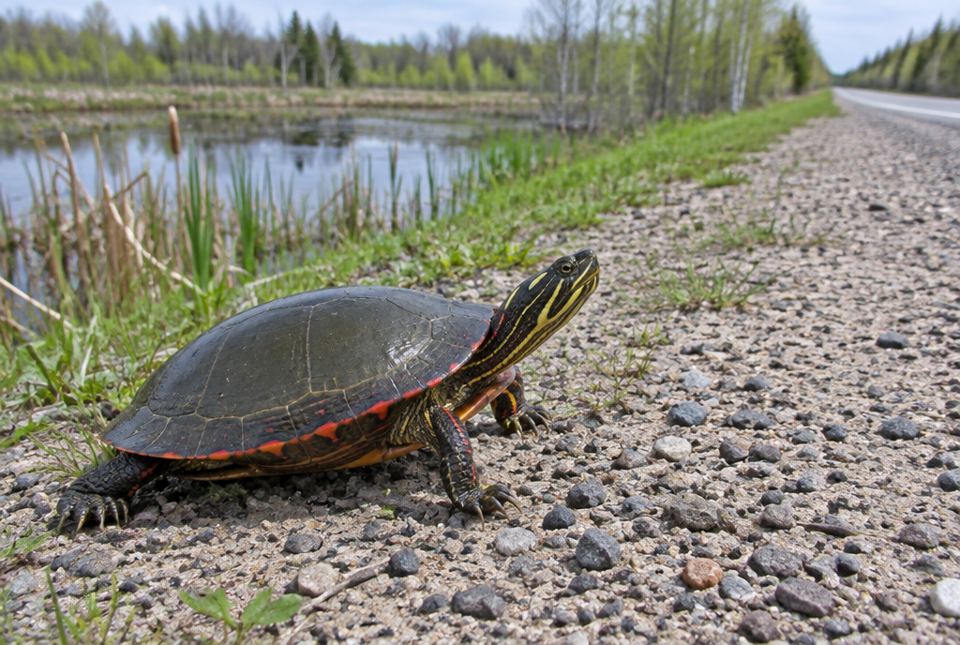 In spring, turtles like this painted turtle cross roads to lay eggs in sunny, sandy spots. That puts them at risk from cars. AI-generated image
Step 1: Identify and research the issue
Local biodiversity issues might include:
- a road that cuts through a wetland where turtles and frogs cross;
- a plan to build houses or a store on a woodlot, meadow or wetland;
- an invasive plant, like garlic mustard or Phragmites, spreading in a local park;
- a schoolyard that is all pavement and mowed grass, with few pollinators;
- litter or pollution in a creek.
Research the facts: What species are affected? What is causing the problem? Use reliable sources, such as your local conservation authority, municipal website, provincial science agencies, nature centres and local naturalist clubs. Observe the place yourself if it is safe, with a grown-up.
Step 2: Consider different perspectives
Different people see the same issue differently. A stakeholder is anyone affected by an issue or interested in it. Before deciding what to do, find out what each stakeholder needs and values.
It is also important to seek the perspectives of local First Nations and Métis communities. Many have knowledge of the area built over generations, cultural connections to its plants, animals and waters, and rights and responsibilities related to the land. One approach is Two-Eyed Seeing, described by Mi'kmaw Elder Albert Marshall: using the strengths of Indigenous knowledges and Western science together.
| Stakeholder | Possible perspective on a road through a turtle wetland |
|---|
| Drivers and commuters | need a safe, quick road to get to work and school |
| Town council | must balance safety, cost and the environment, and answers to residents |
| Conservation authority biologist | turtles are species at risk; road deaths of nesting females harm the population |
| Local First Nation | may have long-standing knowledge of the wetland and its turtles, and cultural teachings about turtles; responsibilities to care for the land and water |
| Nearby farmer | needs to move farm equipment along the road |
| Students at a nearby school | want to protect turtles and learn about the wetland |
Step 3: List options and plan a course of action
Brainstorm several possible actions, then compare them: How well would it help? How much would it cost? Is it realistic for us? Who would support it?
Actions you might take as a student or family:
- Raise awareness: posters, a school announcement, a short presentation, a letter to the local newspaper.
- Write to decision-makers: a polite letter or email to the town council or your councillor with facts and a suggestion.
- Join a project: many conservation authorities and nature groups run tree plantings, invasive plant pulls and clean-ups that families can join.
- Create habitat: plant native wildflowers for pollinators, leave a "no-mow" patch, build a brush pile for small animals.
- Collect data: report sightings to a citizen science program, so scientists can track species.
A good plan says: what we will do, who will do each part, when, what materials we need, and how we will know if it worked.
Worked exampleLet's analyse and plan for the turtle road
Students near a wetland notice turtles crossing a road every June. Analyse the issue and plan a course of action.
- Identify the issue: female turtles crossing a busy road to nest are being hit by cars. Turtles are species at risk.
- Research: check the conservation authority website for turtle species in the area; observe (with a grown-up, from a safe place away from traffic) when turtles cross; read about turtle crossing signs and road fences.
- Perspectives: drivers want a safe, quick road; council worries about cost; the biologist explains that losing nesting females can harm the whole population; the local First Nation may share knowledge of the wetland and teachings about turtles; students want to help.
- Options: (a) ask council for turtle-crossing signs in June; (b) ask for a fence and an under-road tunnel; (c) make posters for drivers; (d) report turtle sightings to a citizen science program.
- Compare: signs are cheap and fast; a tunnel works well but costs a lot and takes years to plan; posters and reports are things students can do right away.
- Plan: in May, the class writes a letter to council asking for seasonal signs (with facts and a map), makes posters for local stores, and records sightings with a teacher. In September, they check whether signs were installed and how many turtles were seen.
A strong plan uses facts, considers every stakeholder, chooses realistic actions, and includes a way to check results.
A simple sketch of the turtle road. Turtles cross from the wetland to the nesting area. One option: a fence that guides them to a tunnel under the road.Just for funWhat do you call a turtle that loves taking pictures?
A snapping turtle!
Act safely and respectfully
Students never go onto roads to move turtles; that is a job for adults, and only when it is safe. Never pick up a snapping turtle. When you write to decision-makers, be polite, use facts, and suggest solutions, not just complaints.
Hands-on activityYour own action project
You need: a notebook, a pencil, a grown-up helper, and access to the internet or library.
- Choose a local biodiversity issue (in your neighbourhood, school, park or town). Write it as a question, for example: "How can we help pollinators in our schoolyard?"
- Research: find at least three facts from two reliable sources. Observe the place if you safely can.
- Perspectives: make a table of at least four stakeholders and what each might think. If possible, ask real people (a neighbour, a teacher, a park worker).
- Options: list three possible actions and rate each one for helpfulness, cost and how realistic it is (1 to 3 stars).
- Plan: write the steps: what, who, when, materials, and how you'll measure success.
- Act! Carry out at least one part of your plan: plant native seeds in a pot or garden, send a letter, make a poster, or join a community event.
- Share and reflect: present your project to your family or class. What worked? What would you change?
Safety: a grown-up should be with you for any outdoor work or meeting new people. Wear gloves for clean-ups and never pick up sharp objects or needles; tell an adult. Stay away from roads and deep or fast-moving water.
What to look for: a clear question, facts with sources, several perspectives treated fairly, a realistic plan, at least one action actually taken, and an honest reflection.
Your turn
A person or group affected by or interested in an issue.
2Why is it important to consider different perspectives before acting?
So your plan is fair, uses more knowledge, and is more likely to be supported and to work.
3Name two reliable sources for researching a local biodiversity issue.
For example: the local conservation authority, the municipal website, a provincial or federal science agency, a nature centre or a museum.
4What should a good action plan include?
What you'll do, who does each part, when, materials needed, and how you'll know it worked.
An approach described by Mi'kmaw Elder Albert Marshall: using the strengths of Indigenous knowledges and Western science together.
6Give two actions a Grade 6 student could take to help local biodiversity.
For example: plant native wildflowers, join an invasive plant pull or clean-up, write a polite letter to council, make awareness posters, report sightings to a citizen science program.
7Why should students never move turtles off roads themselves?
Roads are dangerous because of traffic; some turtles (like snapping turtles) can bite. It is a job for adults, only when safe.
More practice: warm-up
1What does perspective mean?
A point of view: how a person or group sees an issue.
2What does a conservation authority do in Ontario?
It protects and manages watersheds: rivers, wetlands and the land around them.
3Is "planting native flowers" an action, a perspective or a stakeholder?
4Name one local biodiversity issue.
For example: turtles crossing a road, invasive plants in a park, building on a wetland, a schoolyard with few pollinators, litter in a creek.
5When writing to council, should you be angry or polite?
Polite, with facts and solutions.
More practice: on your own
1A developer wants to build homes on a meadow where monarchs feed on milkweed. Give the perspective of three stakeholders.
Example: Developer: wants to build homes and earn money; people need housing. Family looking for a home: needs an affordable place to live. Naturalist club: the meadow is habitat for monarchs and pollinators. (Others: council, nearby residents, local First Nation, children who play there.)
2Suggest a compromise for the meadow issue that respects more than one perspective.
For example: build on part of the land and protect a section of the meadow with milkweed; plant native gardens in the new neighbourhood; create a park connecting to other green spaces.
3Rate these options for helping pollinators at school (helpful? cheap? realistic?): (a) build a greenhouse, (b) plant a native wildflower bed, (c) put up a poster.
(b) wildflower bed is likely best: very helpful, fairly cheap, realistic with permission. (a) is costly and less directly helpful. (c) is cheap and realistic but helps less on its own; it works best with (b).
4How could you measure whether your pollinator garden worked?
Count pollinators (bees, butterflies) visiting for 10 minutes on several sunny days before and after planting, and compare; record how many plants bloom.
5Why should you ask real people about their perspectives instead of only guessing?
Guesses can be wrong or stereotyped. Real people may have knowledge and concerns you didn't think of.
Challenge
1Your class wants council to ban mowing in a whole park to help pollinators. Some residents use the park for soccer. Analyse the issue from both perspectives and propose a better plan.
Pollinator supporters: unmowed areas let wildflowers bloom and provide food and shelter. Soccer players: need short grass for a safe, usable field. Better plan: keep the field mowed and create no-mow or native wildflower areas along the edges and corners. Add signs explaining why. Both needs are met.
2Your action was to write to council asking for turtle-crossing signs. Council replies that there is no money this year. Plan your next steps.
Ask what it would take for next year's budget; offer to share data (sighting counts) to show the need; look for a partner such as the conservation authority or a nature group; meanwhile, do low-cost actions (posters for drivers, reporting sightings). Reflect and keep trying politely.
3Explain how using both Indigenous knowledge and Western science (Two-Eyed Seeing) could improve a plan to restore a local wetland.
Indigenous knowledge may include long-term observations of the wetland over generations, knowledge of which plants and animals belong there and how they were cared for, and teachings about responsibility to the land and water. Western science may add measurements like water quality testing and species counts. Together they give a fuller picture and a plan that respects the community and the land. (It is important to involve Indigenous communities directly and respectfully, not just borrow ideas.)
Quiz
1. A person or group affected by an issue is called a...
2. Why should you consider several perspectives when analysing an issue?
3. Which is the most realistic first action for a Grade 6 class to help pollinators?
4. Two-Eyed Seeing, described by Mi'kmaw Elder Albert Marshall, means...
5. A good action plan includes...
6. If you see a turtle crossing a busy road, you should...
Big idea: students can analyse a real local biodiversity issue by researching facts, considering the perspectives of different stakeholders (including First Nations and Métis communities), comparing options, planning a realistic course of action, and acting on it.
How to help at home:
- Help your child choose a manageable local issue. Pollinator gardens, invasive plant pulls and creek clean-ups are great for families.
- Look up your local conservation authority's events page; many hold family-friendly tree plantings and clean-ups, especially in spring and fall.
- Help with the letter or email to a councillor. Encourage facts, politeness and a clear request.
- Celebrate the action, even if the result is small, and talk about what to try next.
Safety: supervise all outdoor work. Never let children handle turtles on roads, go near traffic, or pick up sharp litter or needles. Use gloves for clean-ups.
Respect note: when discussing First Nations and Métis perspectives, avoid speaking for communities. Encourage your child to learn from sources created by Indigenous people or organizations, and to say "may" rather than assuming what a community thinks.
Common difficulties:
- Jumping straight to an action without researching or considering perspectives.
- Choosing actions that are too big. Start with something realistic, then build.