B. Foundations of Language · Listening, Speaking and Word PowerSpeaking Precisely: Descriptive Words, Varied Sentences and Cohesion
B1.5 B2.2 A1.2About 40 minutes
Learning goals- I can choose precise nouns and verbs and descriptive adjectives and adverbs when I speak.
- I can elaborate without piling on too many describing words.
- I can vary my sentence types to keep listeners interested.
- I can make my sentences cohesive by linking them with pronouns, transition words and key words.
Words to know
precise
Exact; saying exactly what you mean.
descriptive
Helping the listener picture something clearly.
elaborate
To add details, reasons or examples.
cohesive
Sticking together; sentences that connect clearly to each other.
cohesive tie
A word that links one sentence to another, like a pronoun (it, they), a transition (however) or a repeated key word.
transition
A word or phrase that shows how ideas connect, like as a result or for example.
Remember from Grade 5
In Grade 5 you used new vocabulary, varied adjectives and adverbs, different sentence types and transitions to elaborate when you spoke. In Grade 6 you'll make your word choice more precise, and you'll make your sentences cohesive, so they connect smoothly and your audience can follow every idea.
Let's start with a puzzle
Which description helps you picture the scene?
- "The dog went across the yard. It was nice. It did a thing with the snow."
- "The husky bounded across the backyard. Its thick fur was dusted with snow. It plunged its nose into a drift and sneezed."
Version 2 uses precise words: husky (not just dog), bounded (not went), plunged and sneezed (not did a thing). Your listener sees a movie in their mind.
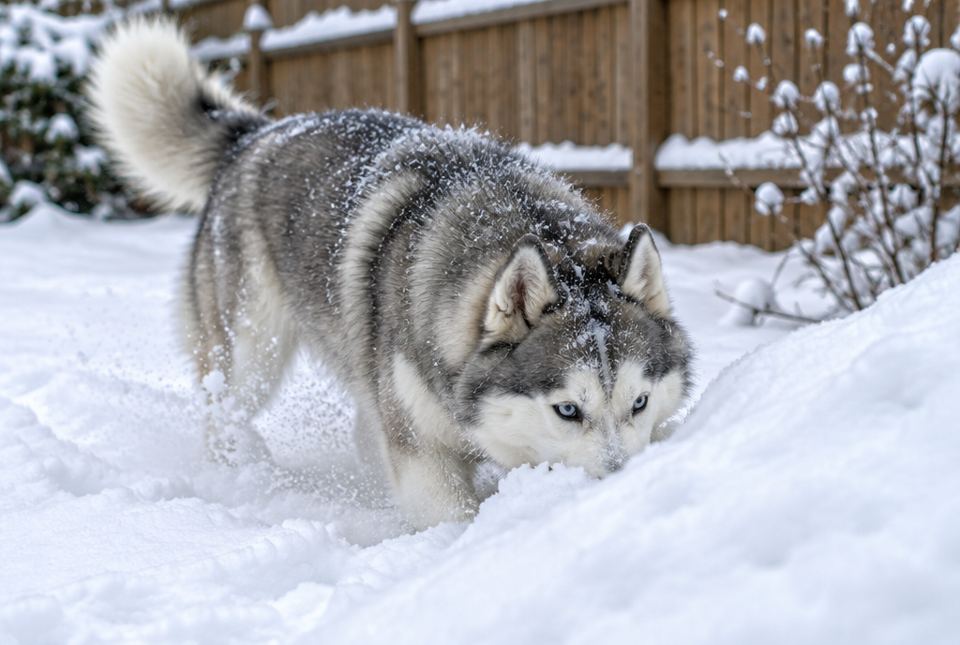 Its thick fur was dusted with snow. It plunged its nose into a snowbank. Precise words help a listener picture exactly what this husky is doing. AI-generated image
Precise nouns and verbs come first
Before adding adjectives, choose a precise noun or verb. One strong word often does the job of three weak ones:
- walked slowly → trudged, strolled or shuffled
- said loudly → shouted or announced
- a big storm → a blizzard
- ate quickly → gobbled or wolfed down
Then add descriptive adjectives and adverbs that give new information: a fierce blizzard, announced proudly.
| Vague | Precise | Even better (with a detail) |
|---|
| thing | sled | a wooden toboggan |
| went | raced | raced downhill |
| nice | peaceful | peaceful, with only the sound of falling snow |
| good | delicious | delicious, warm maple taffy |
| said | whispered | whispered nervously |
Don't overload
Too many describing words can bury your meaning: "The big, huge, giant, enormous, tall tree..." Choose the best one or two. Ask: Does this word tell my listener something new?
Vary your sentences
Listeners get bored when every sentence sounds the same. Mix:
- Types: statements, questions ("Have you ever seen the northern lights?"), exclamations ("What a sight!") and commands ("Picture this.").
- Lengths: short sentences for impact; longer sentences for explanation.
- Beginnings: start with the subject, a time (At midnight,), a place (Above the lake,) or an -ly word (Slowly,).
Cohesion: making sentences stick together
When sentences are cohesive, each one connects to the last. Cohesive ties link them:
- Pronouns point back: Maya built a birdhouse. She painted it green.
- Transitions show how ideas connect: for example, however, as a result, also, then.
- Repeated key words or synonyms keep the topic clear: Bats eat insects. These animals can eat ...
Without ties, sentences feel like a list of separate facts. With them, they feel like one connected idea.
Be careful with pronouns: if listeners can't tell who he or it is, use the name again.
Worked exampleLet's make a talk more precise and cohesive
Ravi's first draft: "Beavers are cool. Beavers make dams. Beavers use stuff. The dams make ponds. It's good for other animals."
- Precise words: cool → remarkable builders; make → build; stuff → branches, mud and stones.
- Cohesive ties: replace some repeated Beavers with They; add transitions as a result and also.
- Fix an unclear pronoun: It's good (what's good?) → These ponds give homes to fish, frogs and birds.
- Vary sentences: start with a question to hook listeners.
- New version: "Have you ever seen a beaver dam? Beavers are remarkable builders. They build dams from branches, mud and stones. As a result, deep ponds form behind the dams. These ponds also give homes to fish, frogs and birds."
The new version uses precise words, a question to vary sentences, and cohesive ties (They, As a result, These ponds, also) so each sentence links to the one before.
Ravi's revised talk. The bold cohesive ties link each sentence to the one before, so listeners hear one connected idea instead of a list.Read it aloud
Cohesion is easier to hear than to see. Say your sentences aloud. If one sounds like it came out of nowhere, add a tie.
Just for funRiddle: Which word gets shorter when you add two letters to it?
Short: add -er and you get shorter! Now that's a precise word.
Hands-on activityDescribe-and-draw challenge
You need: a partner, two pieces of paper, two pencils, and a small object from home (a mug, a toy, a mitten). Keep the object hidden from your partner.
- Sit back to back. Describe the object in five sentences without naming it. Your partner draws what you describe.
- Use precise nouns and verbs (handle, curves, zigzag stitching), descriptive adjectives, and at least two cohesive ties (it, its, also, on top of that).
- Compare the drawing to the object. Which words helped most? Which were vague?
- Switch roles with a new object.
What to look for: specific shape, size and texture words; sentences that connect ("It has a handle. The handle curves..."); no long lists of extra adjectives.
Your turn
1Replace the vague verb: The fox went through the snow.
Examples: crept, trotted, bounded, slunk.
2Replace the vague words: It was a good thing to eat.
Example: It was a delicious snack (or a crunchy apple, a warm bowl of soup).
3What is a cohesive tie? Name three kinds.
A word that links sentences. Kinds: pronouns (it, they), transitions (however, as a result), repeated key words or synonyms.
4Join with a cohesive tie: The rink opened. Everyone went skating.
Example: The rink opened. As a result, everyone went skating. (or Soon, everyone went skating.)
5What's wrong with this description? "The sky was blue, bright, sunny, clear, cloudless, nice and pretty."
It's overloaded with describing words, and some repeat each other. Choose one or two: "The sky was bright and cloudless."
6Change this statement into a question to hook listeners: Polar bears have black skin.
"Did you know that polar bears have black skin under their fur?"
7Find the unclear pronoun and fix it: Zack and Owen built a fort. He put a flag on top.
He could mean Zack or Owen. Fix: Owen put a flag on top.
More practice: warm-up
Exact; saying exactly what you mean.
2Give a more precise word for big storm.
Examples: blizzard, thunderstorm, hurricane.
3Name the four sentence types.
Statement, question, exclamation, command.
4Which is a transition: however or husky?
5Give a precise verb for said quietly.
More practice: on your own
1Rewrite with precise words: The person did stuff in the kitchen.
Example: The chef chopped carrots and stirred the soup.
2Add cohesive ties to make this smoother: Canada geese fly south. They fly in a V shape. Flying in a V saves energy.
Example: Canada geese fly south in the fall. They often travel in a V shape. This formation helps them save energy.
3Why should you sometimes repeat a name instead of using a pronoun when speaking?
Listeners can't look back to check **who he or she is, so repeating the name keeps the meaning clear**.
4Vary the beginnings: We packed the car. We drove to the lake. We set up the tent.
Example: First, we packed the car. After a two-hour drive, we reached the lake. Before dark, we set up the tent.
5Choose the most precise verb for a hockey player who moved very fast: went, skated, streaked. Explain.
streaked, because it shows both speed and smooth movement; went is vague, and skated doesn't show speed.
Challenge
1Describe a winter morning in four sentences. Use at least two precise verbs, one question or exclamation, and two cohesive ties.
Example: "Have you ever stepped outside on a morning so cold the snow squeaks? Frost coated every window. It sparkled as the sun crept over the rooftops. Then a chickadee swooped onto the feeder." (Precise verbs: squeaks, coated, crept, swooped; question; ties: It, Then.)
2Explain why cohesion matters more when speaking than when writing.
Listeners can't reread. If sentences don't connect, they may get lost and miss ideas. Cohesive ties help them follow each idea as they hear it.
3Improve this oral report opening: "Volcanoes. They're things. Volcanoes erupt. It's lava. It's hot."
Example: "Imagine a mountain that can explode! Volcanoes are openings in Earth's crust. When a volcano erupts, melted rock called lava pours out. This lava can be over 1000 °C." Precise words, varied sentences and ties (When, This lava).
Quiz
1. Which verb is most precise?
3. What is the problem with "the big, huge, enormous, giant hill"?
4. Lena found a puppy. She named it Maple. What do She and it do?
5. Which sentence is a command?
6. Why vary sentence types and lengths when speaking?
Big idea (B1.5, B2.2, A1.2): Grade 6 students use precise and descriptive word choice, varied adjectives and adverbs, a variety of sentence types and cohesive sentences to support audience comprehension. (Active and passive voice, also part of B1.5, is in the next lesson.)
How to help at home:
- When your child says "It was good," ask, "What exact word fits better?"
- Play describe-and-draw or "20 questions" to practise precise words.
- Listen for cohesive ties in a news story or audiobook and point them out.
Common difficulties:
- Stacking adjectives. Encourage one precise word over several weak ones.
- Unclear pronouns ("he," "it") when two people or things were just mentioned.
- Using the same sentence start every time ("And then... and then...").