A. Dance / C. Music · Music and DanceMusic: Bass Clef, Key Signatures and Guitar Tablature
C1.5 C1.4 C1.1About 40 minutes
Learning goals- I can name the lines and spaces of the bass clef staff and find middle C in both clefs.
- I can read key signatures for C, G, D, F and B♭ major, and know that each one is shared by a minor key.
- I can read simple guitar tablature.
- I can play or sing pitches accurately, observing key signatures and accidentals (for example, B, A and G on the recorder).
Words to know
clef
A sign at the start of a staff that tells you the names of the lines and spaces.
bass clef
A clef for low sounds. Its two dots sit on either side of the F line (line 4), so it is also called the F clef.
key signature
The sharps or flats right after the clef. They tell you which notes are sharp or flat all through the piece.
accidental
A sharp, flat or natural sign written before one note. It lasts until the end of the bar.
relative minor
The minor key that shares a key signature with a major key. A minor is the relative minor of C major.
tablature (tab)
A way to write guitar music using lines for strings and numbers for frets.
fret
A metal strip on a guitar's neck. Pressing a string behind a fret changes its pitch.
Remember from Grade 4
In Grade 4 you read notes in treble clef (lines E G B D F, spaces F A C E), met middle C on a ledger line, learned sharps, flats and naturals, and read the key signatures for C major (none), G major (F♯) and F major (B♭).
This year you'll learn a second clef, two new key signatures, and a completely different kind of notation used by guitar players: tablature.
The bass clef
Low instruments and voices, like the tuba, cello, bassoon, bass guitar, the piano's left hand and low men's voices, read music in bass clef.
The bass clef starts with a dot on line 4 and has two dots, one on each side of that line. Line 4 is F, so it is also called the F clef.
- Lines, bottom to top: G, B, D, F, A. Saying: Good Boys Do Fine Always.
- Spaces, bottom to top: A, C, E, G. Saying: All Cows Eat Grass.
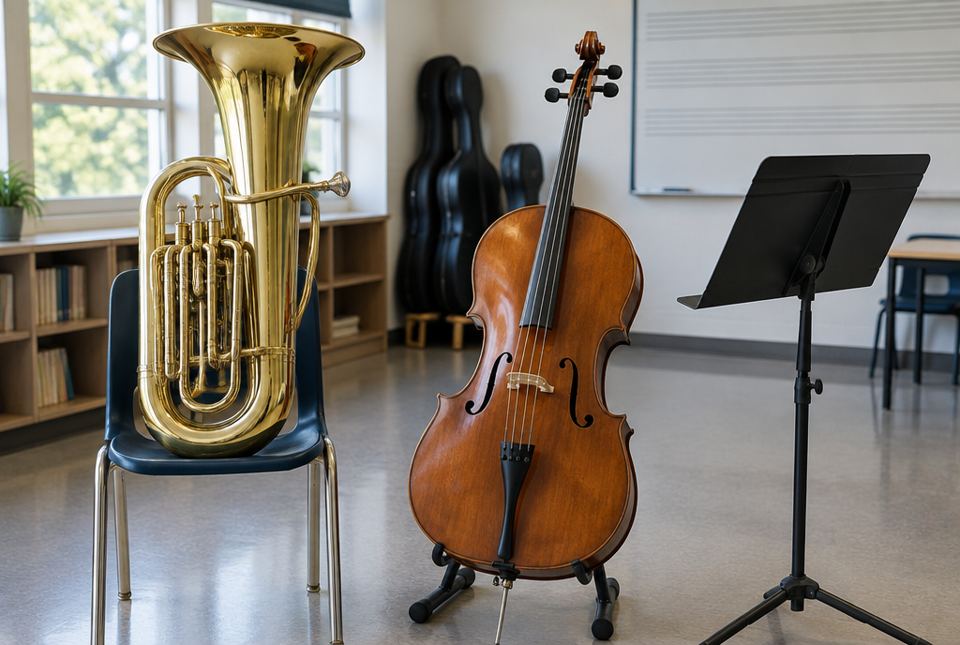 The tuba and the cello play low notes, so their music is usually written in bass clef. AI-generated imageBass clef: the lines are G, B, D, F, A and the spaces are A, C, E, G, from bottom to top. The clef's dots sit on either side of the F line.
Middle C in both clefs
Middle C is the same pitch in both clefs. In treble clef it sits on a ledger line just below the staff. In bass clef it sits on a ledger line just above the staff. On a piano, the treble and bass staffs are often joined (a grand staff), and middle C is the bridge between them.
Key signatures
A key signature sits right after the clef at the start of every line. If there is an F♯ in the key signature, every F in the piece is played as F♯, unless a natural sign cancels it.
Sharps and flats are always written in the same order:
- Sharps: F♯, C♯, then more for other keys.
- Flats: B♭, E♭, then more for other keys.
| Key signature | Major key | Its scale | Relative minor |
|---|
| no sharps or flats | C major | C D E F G A B C | A minor |
| 1 sharp: F♯ | G major | G A B C D E F♯ G | E minor |
| 2 sharps: F♯, C♯ | D major | D E F♯ G A B C♯ D | B minor |
| 1 flat: B♭ | F major | F G A B♭ C D E F | D minor |
| 2 flats: B♭, E♭ | B♭ major | B♭ C D E♭ F G A B♭ | G minor |
Tricks to name the key
- Sharps: the last sharp is ti (note 7). The major key is the next note up, a half step higher. Last sharp C♯ → key of D major.
- Flats: the second-last flat names the major key. B♭, E♭ → key of B♭ major. (With only one flat, B♭, remember: F major.)
- Major or minor? Look at the music: does it seem to rest on do (major) or la (minor)? The last note is often a strong clue.
Guitar tablature
Guitarists often read tablature (tab) instead of the staff.
- Tab has six lines, one for each string. The top line is the thinnest, highest string (high e). The bottom line is the thickest, lowest string (low E).
- A number on a line tells you which fret to press on that string. 0 means play the string open (without pressing).
- Read from left to right, like the staff.
Basic tab shows where to play, but not how long each note lasts, so guitarists often listen to the song too, or read tab and staff notation together.
Playing what you read: the recorder
Many Grade 5 students play the recorder. Good technique helps you play pitches accurately:
- Left hand on top, right hand on the bottom.
- Your left thumb covers the hole on the back.
- Cover holes with the soft pads of your fingers, not the tips, so no air leaks.
- Sit or stand tall and blow gently, like warm air on a cold window. Start each note with your tongue: "too".
B: thumb + left finger 1. A: thumb + fingers 1 and 2. G: thumb + fingers 1, 2 and 3. Each finger you add makes the note a step lower.
Worked exampleExample: Let's name a key signature and read a melody in it
A song in treble clef has two sharps in its key signature: F♯ and C♯. The melody is: D E F G A and it ends on D. What key is it in, and how do you play the F?
- Two sharps, F♯ and C♯: the last sharp is C♯. A half step above C♯ is D. So it's D major.
- Check: the melody ends on D, which is do in D major. That fits.
- The F: the key signature says every F is F♯, so the third note is played F♯, even though there is no sign right before it.
- The notes you play: D, E, F♯, G, A ... D.
The key is D major. Every F is played as F♯ (and every C as C♯) because of the key signature.
Worked exampleExample: Let's read the bass clef
These whole notes are written in bass clef: line 2, space 3, space 1, line 3. Name them and say what word they spell.
- Bass clef lines from the bottom: G, B, D, F, A. So line 2 = B and line 3 = D.
- Bass clef spaces from the bottom: A, C, E, G. So space 3 = E and space 1 = A.
- Put them in order: line 2 = B, space 3 = E, space 1 = A, line 3 = D.
B, E, A, D: they spell BEAD. Try your own: in bass clef, "BAG" is line 2, space 1, line 1.
Just for funWhat do you get if you drop a piano down a mine shaft?
A-flat minor! (A♭ minor is a real key. The joke works because the piano is now flat and in a mine.) 🎹
Hands-on activityClef and key detectives
You need: paper, a pencil, a ruler, and a recorder, a keyboard app or a guitar if you have one.
- Draw two staffs with a ruler (5 lines each). Draw a treble clef on one and a bass clef on the other (the bass clef: a dot on line 4, a curve, and two dots on either side of line 4).
- Write the word CAGE in both clefs. (Bass clef: C = space 2, A = space 1, G = line 1, E = space 3.)
- Write the key signatures for G major, D major, F major and B♭ major. Check them with the picture in this lesson.
- If you have a keyboard app, play the D major scale. Listen: the F♯ and C♯ are black keys.
- If you have a recorder, play B, A, G slowly, then Hot Cross Buns: B A G, B A G, G G G G, A A A A, B A G.
- If you have a guitar (ask first), play the tab for Mary Had a Little Lamb on the B string.
Your turn
1Name the lines of the bass clef staff, from bottom to top.
G, B, D, F, A (Good Boys Do Fine Always).
2Name the spaces of the bass clef staff, from bottom to top.
A, C, E, G (All Cows Eat Grass).
3Why is the bass clef also called the F clef?
Its two dots sit on either side of line 4, which is F.
4Where is middle C in bass clef?
On a ledger line just above the staff.
5A key signature has F♯ and C♯. What major key is it?
D major (the last sharp, C♯, is ti; one half step up is D).
6In tab, what does a 0 on a line mean?
Play that string open (don't press any fret).
7On the recorder, which hand goes on top?
More practice: warm-up
1Which clef is used for low sounds?
2How many lines does guitar tab have? Why?
Six, one for each string.
3What does a key signature tell you?
Which notes are sharp or flat all through the piece.
4Which major key has no sharps or flats?
5Which recorder note uses the thumb and one finger?
More practice: on your own
1In bass clef, name these notes: line 3, space 2, line 4.
Line 3 = D, space 2 = C, line 4 = F.
2A key signature has B♭ and E♭. What major key is it? What is its relative minor?
B♭ major (the second-last flat is B♭). Its relative minor is G minor.
3In G major, a bar has an F with a natural sign before it, and then another F later in the same bar. How do you play both Fs?
Both as F natural. The natural cancels the F♯ from the key signature, and an accidental lasts until the end of the bar.
4Write the D major scale. Which two notes are sharp?
D E F♯ G A B C♯ D. The sharps are F♯ and C♯.
5Tab on the B string shows 1, 3, 5. Which notes are they?
C, D, E (fret 1 = C, fret 3 = D, fret 5 = E on the B string).
Challenge
1Why does the D major scale need F♯ and C♯? Use the pattern whole, whole, half, whole, whole, whole, half.
D to E (whole), E to F♯ (whole: F must be raised), F♯ to G (half), G to A (whole), A to B (whole), B to C♯ (whole: C must be raised), C♯ to D (half). Without the sharps, E to F and B to C would be half steps in the wrong places.
2Middle C looks different in treble and bass clef. Explain why it is still the same note.
The two clefs are like two maps of the same keyboard. Treble clef mostly shows notes above middle C; bass clef mostly shows notes below it. Middle C sits between them, on a ledger line below treble and above bass, so it is the same pitch in both.
3A friend can play a song from tab, but plays all the notes the same length and it sounds wrong. Explain the problem and suggest a fix.
Basic tab shows which string and fret, but not how long each note lasts (rhythm). Fix: listen to the song, or read standard notation (or tab with rhythm marks) along with the tab, so the rhythm is right.
Quiz
1. The lines of the bass clef staff, from bottom to top, are ___.
2. In bass clef, middle C is written ___.
3. A key signature with F♯ and C♯ is the key of ___.
4. A key signature with one flat (B♭) is shared by F major and ___.
5. In guitar tab, the top line stands for ___.
6. On the recorder, adding one more finger (from B to A to G) makes the note ___.
7. A key signature has B♭ and E♭. In the music, you see an E with no sign. You play ___.
Big idea: Students show their understanding of standard and other notation, including clefs, key signatures and guitar tablature (C1.5), use musicianship such as good recorder posture and interpreting accidentals and key signatures when playing (C1.4), and sing or play from notation (C1.1).
How to help at home:
- Practise the sayings: bass clef lines Good Boys Do Fine Always; spaces All Cows Eat Grass.
- A free keyboard app helps a lot: find middle C, play the D major scale and notice the black keys F♯ and C♯.
- If your child plays recorder at school, short daily practice (5 minutes) with gentle breath is best.
- If you play guitar, show your child how tab works. Many free tabs exist online, but check them against the recording.
Common difficulties:
- Reading bass clef as if it were treble. Every note shifts! Line 1 is G (not E) in bass clef. Say the saying out loud while pointing.
- Forgetting the key signature halfway through a song. Circle every F (in G or D major) in pencil before playing.
- Squeaky recorder. Blow more gently and check that finger pads fully cover the holes, especially the thumb hole.