B. People and Environments: The Role of Government and Responsible Citizenship · Government and CitizenshipRights and Responsibilities of Citizens
B3.1About 40 minutes
Learning goals- I can explain what it means to be a citizen of Canada.
- I can describe some major rights protected by the Canadian Charter of Rights and Freedoms.
- I can describe major responsibilities of citizens.
- I can explain how rights and responsibilities go together.
Words to know
citizen
A member of a country, with rights and responsibilities in that country.
right
Something you are allowed to have or do, that the law protects.
responsibility
Something you are expected to do, a duty.
Charter of Rights and Freedoms
The part of Canada's Constitution, since 1982, that lists and protects people's rights and freedoms.
Constitution
Canada's highest set of laws. Other laws must follow it.
jury
A group of citizens who listen to a trial in court and decide if a person is guilty or not guilty.
What if nobody had rights?
Imagine a class where the teacher says: "Only kids with red shoes can talk today. Everyone else must be silent, and nobody may leave their desk, ever."
That would feel unfair. You would want to say: "Hey, I have a right to speak too!"
In Canada, our most important rights are written down and protected by law. And along with those rights come responsibilities. Today you will learn what both of these mean for citizens of Canada.
What is a citizen?
A citizen is a member of a country. Citizens have rights (things the law protects for them) and responsibilities (things they are expected to do).
You can become a Canadian citizen in two main ways:
- Most people who are born in Canada are Canadian citizens from birth.
- People who move to Canada can apply to become citizens. After living here for some time (and, for many adults, passing a test about Canada), they take an oath (a promise) at a citizenship ceremony. Many ceremonies end with everyone singing O Canada.
Kids are citizens too! You do not have to be a grown-up to have rights.
The Canadian Charter of Rights and Freedoms
In 1982, Canada added the Canadian Charter of Rights and Freedoms to its Constitution. The Constitution is Canada's highest set of laws. Every government in Canada, from Ottawa to your town council, must respect the Charter.
The Charter protects rights in several groups. Here are the main ones, in kid-friendly words.
| Kind of right | What it means | An example |
|---|
| Fundamental freedoms | Freedom of religion, of thought and expression (saying and writing what you think), of peaceful assembly (gathering peacefully) and of association (joining groups) | Writing a letter to the newspaper about a park you love |
| Democratic rights | Every citizen 18 or older can vote in elections and can run to be elected | An adult voting for a mayor or a Member of Parliament |
| Mobility rights | Citizens can enter, stay in and leave Canada, and can live and work in any province or territory | A family moving from Halifax to Sudbury for a new job |
| Legal rights | The right to life, liberty and security, and to be treated fairly if accused of a crime, such as a fair trial | Someone accused of a crime has the right to a lawyer |
| Equality rights | Everyone is equal under the law, no matter their race, religion, sex, age or disability, among other things | A town or a provincial office cannot refuse to hire someone just because they use a wheelchair |
| Language rights | English and French are Canada's two official languages | You can get federal government services in English or French |
| Minority language education rights | In some situations, English- or French-speaking families who are the minority in a province can have their children taught in their language | French-language public and Catholic schools in Ontario |
Rights have limits
Rights are strong, but they are not unlimited. The Charter says rights can have reasonable limits.
For example, freedom of expression means you can share your opinions. It does not mean you can threaten someone or spread hate against a group of people. Your rights stop where they would hurt the rights and safety of others.
Responsibilities of citizens
Canada's guide for new citizens lists responsibilities like these:
- Obeying the law. Laws keep everyone safe and treat people fairly.
- Taking responsibility for yourself and your family. For adults, this includes working to take care of themselves and their families.
- Serving on a jury when asked (adults).
- Voting in elections (citizens 18 and older).
- Helping others in the community, for example by volunteering.
- Protecting and enjoying our heritage and environment, for example by not littering and caring for parks, lakes and historic places.
Another big responsibility is respecting the rights of others. If I have the right to be treated equally, so do you.
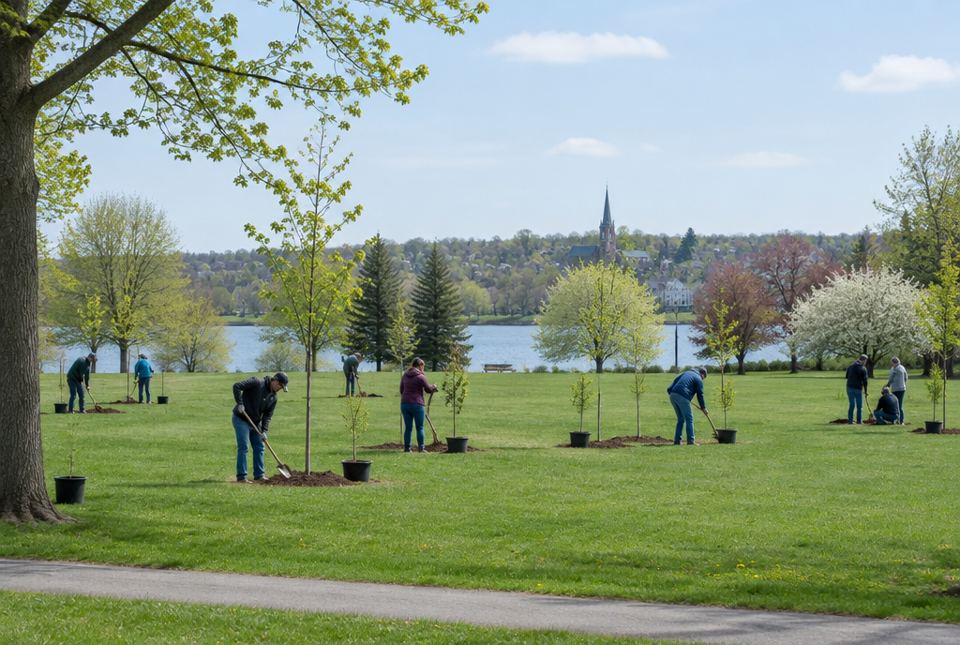 Volunteering and caring for parks and the environment are two responsibilities of citizens. Every new tree helps the whole community. AI-generated image
Rights and responsibilities are partners
Almost every right comes with a responsibility.
- The right to vote → the responsibility to learn about the choices and actually vote.
- Freedom of expression → the responsibility to speak respectfully and not bully.
- The right to equality → the responsibility to include others and treat them fairly.
- The right to enjoy parks → the responsibility to keep them clean.
Kids also have rights in a world agreement called the United Nations Convention on the Rights of the Child, which Canada agreed to in 1991. It includes the right to learn, to play, to be safe and to be heard.
Worked exampleLet's match a right with a responsibility
Maya says, "I have freedom of expression, so I can post anything I want about my classmate online." Is Maya using her right responsibly?
- Name the right: freedom of expression. Maya can share her opinions.
- Check the limits: rights stop where they harm other people. Mean posts can hurt someone and may be bullying.
- Find the responsibility that goes with it: to speak respectfully and respect the rights of others (her classmate has a right to be safe and treated with dignity).
- Decide: Maya's right does not cover hurtful posts about a person.
No. Freedom of expression comes with the responsibility to respect others. Maya can share her opinions, but not in a way that bullies or harms a classmate.
Worked exampleLet's sort: right or responsibility?
Sort these: (a) voting at age 18, (b) picking up your litter at the beach, (c) practising your religion, (d) serving on a jury, (e) moving to Alberta to live.
- Ask: is it something the law protects for you (a right), or something you are expected to do (a responsibility)?
- (a) Voting is a democratic right. It is also a responsibility. It is both!
- (b) Picking up litter is a responsibility (caring for the environment).
- (c) Practising your religion is a right (a fundamental freedom).
- (d) Serving on a jury is a responsibility.
- (e) Moving to another province is a right (a mobility right).
Rights: (c), (e), and (a). Responsibilities: (b), (d), and (a). Voting fits in both groups.
Just for funFreedom of expression means you can share your opinion about pineapple on pizza. Responsibility means you share it kindly, even with pineapple fans.
Hands-on activityMake a family charter
You need: a large sheet of paper, markers, and your family.
- Draw two columns: Our rights at home and Our responsibilities at home.
- Talk with your family. What should everyone at home be allowed (for example, to be listened to, to have quiet time)?
- For each right, write a matching responsibility (for example, to listen when others talk, to keep the noise down after 8 p.m.).
- Everyone signs the bottom, like a real charter.
- Hang it up. After a week, talk about it: Is it working? Do you need to change anything?
What to look for: each right has a matching responsibility, and the rules are fair to everyone in the family.
Your turn
A member of a country who has rights and responsibilities there.
2In what year did the Charter of Rights and Freedoms become part of Canada's Constitution?
3Name two fundamental freedoms.
Any two: freedom of religion, of thought and expression, of peaceful assembly, of association.
4How old must a citizen be to vote in Canadian elections?
5Name two responsibilities of citizens.
Any two: obey the law, vote (at 18+), serve on a jury, help others in the community, take care of yourself and your family, protect our heritage and environment, respect others' rights.
6What are Canada's two official languages?
7True or false: rights have no limits at all.
False. Rights can have reasonable limits, so they do not harm the rights and safety of others.
More practice: warm-up
1Is serving on a jury a right or a responsibility?
2Is moving from Manitoba to Ontario to live a right or a responsibility?
A right (a mobility right).
3What do we call the ceremony where people from other countries become Canadian citizens?
4Which right says everyone is treated equally under the law?
5Name one way a 10-year-old can help protect the environment.
Any one: pick up litter, recycle, save water, walk or bike, plant a tree, care for a park.
More practice: on your own
1Explain why voting can be called both a right and a responsibility.
The Charter protects every adult citizen's right to vote, so it is a right. Citizens are also expected to use it, learn about the choices and help choose the government, so it is also a responsibility.
2A store will not hire Sam because he is 60 years old, even though he can do the job. Which right is this about?
Equality: Sam is being treated unfairly because of his age. The Charter's equality rights protect people from this kind of unfair treatment by governments. For a business like a store, Ontario's Human Rights Code protects workers in the same way.
3Give a responsibility that goes with freedom of peaceful assembly (gathering together).
Keep it peaceful: don't hurt people or damage property, and respect others' safety and rights (for example, not blocking an ambulance).
4Why does Canada want every government to follow the Charter?
So that no government, big or small, can take away people's basic rights. The Charter is part of the Constitution, the highest law, so it protects everyone the same way across the country.
5A new law says a town's park is for adults only. Which right might this break, and why?
Equality rights, because it treats people unfairly based on their age without a good reason. (A court could decide whether it is a reasonable limit.)
Challenge
1Freedom of expression is a right. Why might a law against threats still be fair?
Because rights have reasonable limits. A threat can make someone unsafe, which harms their right to security. Limiting threats protects others' rights while people are still free to share opinions.
2Jacob says, "Kids can't vote, so citizenship has nothing to do with me." Write a reply with two reasons he is wrong.
Kids are citizens with rights now (equality, freedom of expression and religion, mobility with their families, rights under the Convention on the Rights of the Child). Kids also have responsibilities: obeying laws, respecting others, helping in the community and caring for the environment. Kids can also share their views with governments in other ways, such as letters and petitions.
3Think about the right to live and work in any province. What is one good thing about this right for Canada as a whole?
Sample: people can move to where jobs are, families can stay together, and it helps Canadians feel like one country, since no province can keep other Canadians out.
Quiz
1. What is the Canadian Charter of Rights and Freedoms?
2. Which is a responsibility of citizens?
3. Which is a mobility right?
4. Which is an example of a right being used responsibly?
5. What are Canada's two official languages?
6. Why do rights have reasonable limits?
Big idea: Canadians have rights protected by the Charter of Rights and Freedoms (1982), and those rights come with responsibilities such as obeying laws, voting, jury duty, helping others and caring for the environment.
How to help at home:
- Make the family charter together, and revisit it after a week.
- When you vote (in the Ontario municipal election on Monday, October 26, 2026, or any election), tell your child how you learned about the choices. Many families bring children along to see the polling station.
- If your family includes people who became citizens, share that story.
Common difficulties:
- Thinking rights are unlimited. Use playground examples: your freedom to run does not include knocking others over.
- Thinking kids have no rights because they cannot vote yet.
- Confusing the Charter with the whole Constitution. The Charter is one important part of it.