E. Earth and Space Systems · Conservation of Energy and ResourcesWhere Does the Energy Go? Energy That Spreads Out
E2.4 A1.2 A1.4About 40 minutes
Learning goals- I can explain that when energy changes form, some of it dissipates (spreads out) as heat, light or sound.
- I can tell the difference between useful energy and dissipated energy.
- I can explain why a bouncing ball bounces lower each time.
- I can do a fair test with a bouncing ball and explain my results.
Words to know
dissipate
To spread out into the surroundings. Dissipated energy is not destroyed, but it is hard to collect and use again.
useful energy
The energy that does the job we want, like the light from a lamp.
friction
A force that happens when two surfaces rub together. Friction changes motion energy into heat.
efficient
Doing a job with less wasted energy. An efficient device turns more of its energy into the form we want.
Rub your hands!
Rub your hands together fast for 10 seconds. What do you feel? Heat!
Your hands had motion energy. Rubbing changed some of it into thermal energy. That heat then spreads into the air around you. You can't get it back to rub your hands again. This lesson is about energy that spreads out like this.
Energy that spreads out
In the last lesson you learned that energy is never destroyed. But when energy changes form, some of it usually dissipates. That means it spreads out into the environment as heat, light or sound, usually energy we didn't want.
- A laptop or phone charger gets warm while working: heat.
- A car engine gets hot and makes noise: heat and sound.
- A bike with a rusty chain squeaks: sound (and heat from rubbing).
- An old-style light bulb gets very hot (remember Grade 4?): lots of heat.
- A stove burner glows when it's on high: light, when we only wanted heat.
The dissipated energy is not destroyed. It just spreads out so much that it is very hard to collect and use again.
Useful energy and dissipated energy
For every device, ask: What job do we want it to do? The energy that does that job is useful energy. The rest is dissipated into the environment.
Be careful: the same form can be useful in one device and dissipated in another!
- In a toaster, heat is useful. That's the job.
- In a TV, heat is dissipated. We only wanted light and sound.
A device that turns more of its energy into the useful form is called efficient. An LED bulb is more efficient than an old-style bulb, because less of its energy dissipates as heat.
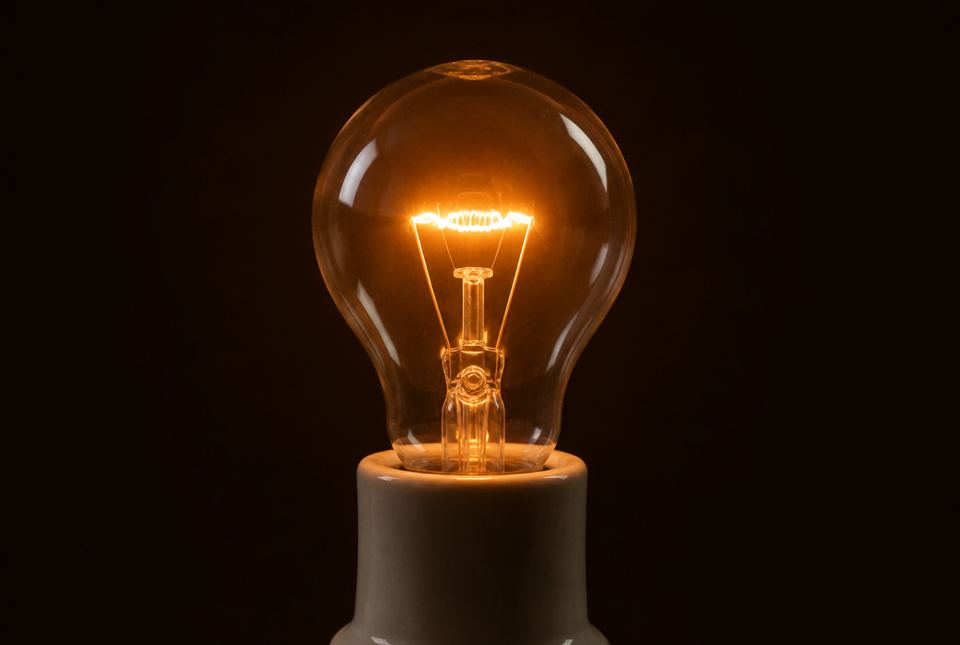 An old-style bulb makes light by heating a thin wire until it glows. Most of its energy spreads out as heat, which is why an LED bulb is more efficient. AI-generated image
| Device | Useful energy | Dissipated energy |
|---|
| TV | light, sound | heat |
| Electric fan | motion (moving air) | heat, sound (hum) |
| Toaster | heat | light (glowing wires), sound (ticking) |
| Car | motion | heat, sound |
| Old-style light bulb | light | lots of heat |
| LED bulb | light | a little heat |
Why does a ball bounce lower and lower?
When you drop a ball, its stored energy changes into motion. When it hits the floor, it squishes and makes a sound. The ball and the floor also get a tiny bit warmer. That energy dissipates, so the ball has less energy left to bounce back up. After many bounces, all of its motion energy has spread out and the ball stops.
Friction is a big cause of dissipation. Friction happens when surfaces rub together, like brakes on a bike wheel, skates on ice, or your hands. Friction changes motion energy into heat (and often sound).
Worked exampleLet's explain a bounce test
Noah dropped the same ball from 100 cm onto three floors. He did 3 trials for each and found the middle result.
- wood floor: bounced to 60 cm
- tile floor: bounced to 65 cm
- carpet: bounced to 25 cm
Which floor made the ball lose the most energy? Why?
- Was it a fair test? Same ball, same drop height, same way of dropping. Only the floor changed. Yes.
- The ball started with the same stored energy each time (same height).
- The lower the bounce, the more energy dissipated.
- Carpet: the ball lost the most height: 100 − 25 = 75 cm. Tile: 100 − 65 = 35 cm. Wood: 100 − 60 = 40 cm.
- The soft carpet squishes a lot. More of the ball's motion energy changes into heat in the carpet fibres (and a small sound).
Carpet made the ball lose the most energy. More energy dissipated as heat (and sound) into the soft carpet, so less was left for bouncing.
The lower the bounce, the more energy dissipated. On carpet the ball lost 75 cm of its 100 cm drop height, more than on wood (40 cm) or tile (35 cm).Just for funRiddle: Why did the bouncy ball keep getting quieter and lower?
It was slowly giving its energy away to the floor, the air, and everyone's ears!
Hands-on activityBounce investigation
You need: a bouncy ball or tennis ball, a tape measure or metre stick, masking tape, a partner, paper and a pencil.
- Tape the tape measure to a wall with 0 at the floor.
- Question: Which floor in your home lets the ball keep the most energy?
- Predict which floor will give the highest bounce.
- Hold the bottom of the ball at 100 cm and let go (don't throw). Your partner watches the bottom of the ball and reads how high it bounces. Do 3 trials.
- Repeat on at least two other floors (carpet, wood, tile, a yoga mat on the floor). Keep the same ball and the same drop height.
- Make a table and a bar graph of your results.
- Conclude: where did the most energy dissipate? How do you know?
What to look for: the ball never bounces back to 100 cm. Hard floors usually give higher bounces; soft floors (carpet, mats) give lower bounces, because more energy dissipates as heat in the soft material.
Safety (A1.4): use a clear space away from windows, lamps and stairs. Don't stand on furniture to drop the ball; 100 cm is enough. Get your eyes down to the measuring level by kneeling, not leaning over stairs.
Your turn
1What does dissipate mean?
To spread out into the surroundings. Dissipated energy is not destroyed, but it is hard to use again.
2In what three forms does energy usually dissipate?
3Why does a bouncing ball bounce lower each time?
Every time it hits the floor, some energy dissipates as sound and heat, so it has less energy left to bounce up.
4When you rub your hands together, what energy transformation happens?
Motion (kinetic) → thermal (heat), because of friction.
5Is dissipated energy destroyed?
No. It has spread out into the environment. Energy is never destroyed.
6Which bulb dissipates more energy as heat: an old-style bulb or an LED?
The old-style (incandescent) bulb.
More practice: warm-up
1A laptop gets warm while you use it. Is the warmth useful or dissipated?
Dissipated. We wanted light and sound, not heat.
2A kettle heats water. Is the heat useful or dissipated?
Useful. Heating water is the kettle's job.
3A swing squeaks. Energy is dissipating as...
Sound (and a little heat).
4Bike brakes rub on the wheel. Motion energy changes into...
Heat (thermal energy), by friction.
5True or false: a ball can bounce higher than the height it was dropped from, if nobody throws it.
False. Some energy dissipates every bounce, so it always bounces lower.
More practice: on your own
1A ball is dropped from 100 cm. It bounces to 60 cm, then 36 cm. How much lower is the second bounce than the first? Why is it lower?
24 cm lower (60 − 36 = 24). More energy dissipated as sound and heat when it hit the floor again.
2Why does oiling a squeaky bike chain make the bike easier to pedal?
Oil reduces friction, so less of your energy is dissipated as heat and sound, and more goes into moving the bike.
3For a TV, name the useful energy and the dissipated energy.
Useful: light and sound. Dissipated: heat (the TV gets warm).
4For an electric fan, name the useful energy and the dissipated energy.
Useful: motion (moving air). Dissipated: heat in the motor and the humming sound.
5Noah's ball bounced to 20 cm on carpet and 55 cm on wood. On which floor did more energy dissipate? Explain.
Carpet. The bounce was lower, so less energy was left. The soft carpet squished and changed more motion energy into heat.
Challenge
1Pretend lamp A and lamp B each use 100 units of electrical energy. Lamp A gives off 20 units of light. Lamp B gives off 80 units of light. Which is more efficient? How much energy dissipates as heat in lamp A?
Lamp B is more efficient: more of its energy becomes useful light. Lamp A dissipates 80 units as heat (100 − 20 = 80).
2Why can't a playground swing keep going forever after one push?
Each swing, some energy dissipates: rubbing at the chains and hooks makes heat and squeaks, and pushing through the air makes heat too. The swing's motion energy gets smaller each time until it stops.
3After a drive on a cold January day, a gas car's engine is hot. Many cars use this engine heat to warm the inside of the car. Explain how this is a smart use of dissipated energy.
Heat from the engine is energy that would dissipate into the air anyway. Sending it to warm the car turns some of that wasted heat into useful heat, so less extra energy is needed to warm the people inside.
Quiz
1. When energy dissipates, it...
2. A ball bounces lower each time because...
3. In a toaster, the heat is...
4. Friction changes motion energy mostly into...
5. Which is the most efficient lamp?
6. In Noah's test, the lowest bounce came on the carpet. This means...
Big idea (E2.4): when energy is transformed, some of it may dissipate into the environment as heat, light and/or sound. It is not destroyed (link to the law of conservation of energy), but it is no longer useful. The bounce investigation practises fair testing, repeated trials and graphing (A1.2) and safe procedures (A1.4).
How to help: feel (safely) the back of a TV, a phone charger or a laptop after use and talk about where the warmth came from. Ask your child to name the useful and the dissipated energy for appliances in your home.
Common difficulties:
- Thinking dissipated energy is destroyed. It spreads out; it is not gone.
- Thinking heat is always "wasted". In a toaster, kettle or furnace, heat is the useful energy.
- Measuring the top of the ball instead of the bottom. Be consistent.
Safety: only touch devices that are warm, never ones that could be hot (stove, iron, old-style bulbs). Keep the bounce area clear of breakable items and stairs.