E. Spatial Sense · Spatial Sense: Angles, Triangles, Transformations and AreaTriangles: Sorting by Sides and Angles
E1.1 A1About 40 minutes
Learning goals- I can sort triangles by their sides: equilateral, isosceles or scalene.
- I can sort triangles by their angles: acute, right or obtuse.
- I can give a triangle two names, one for its sides and one for its angles.
- I can use the fact that the angles of a triangle add up to 180° to find a missing angle.
Words to know
equilateral triangle
A triangle with 3 equal sides. Its 3 angles are also equal (60° each).
isosceles triangle
A triangle with 2 equal sides. The 2 angles opposite those sides are also equal.
scalene triangle
A triangle with no equal sides. Its angles are all different too.
acute triangle
A triangle where all 3 angles are acute (less than 90°).
right triangle
A triangle with one right angle (90°).
obtuse triangle
A triangle with one obtuse angle (more than 90°).
property
Something that is always true about a shape, like "has 3 sides".
Remember
A triangle is a polygon with 3 straight sides, 3 vertices and 3 angles. In Grade 4 you learned to call angles acute, right or obtuse, and in the last lessons you learned to measure them in degrees. Now you can use all of that to describe triangles like a mathematician.
Let's start with a bridge
Look closely at a metal railway bridge, the frame of a roof, or a hydro tower. You will see triangles everywhere! Builders use triangles because a triangle keeps its shape when you push on it. A square made of sticks can be squashed into a diamond, but a triangle made of sticks can't change shape at all.
Not all triangles are the same, though. Mathematicians sort them in two ways: by their sides and by their angles.
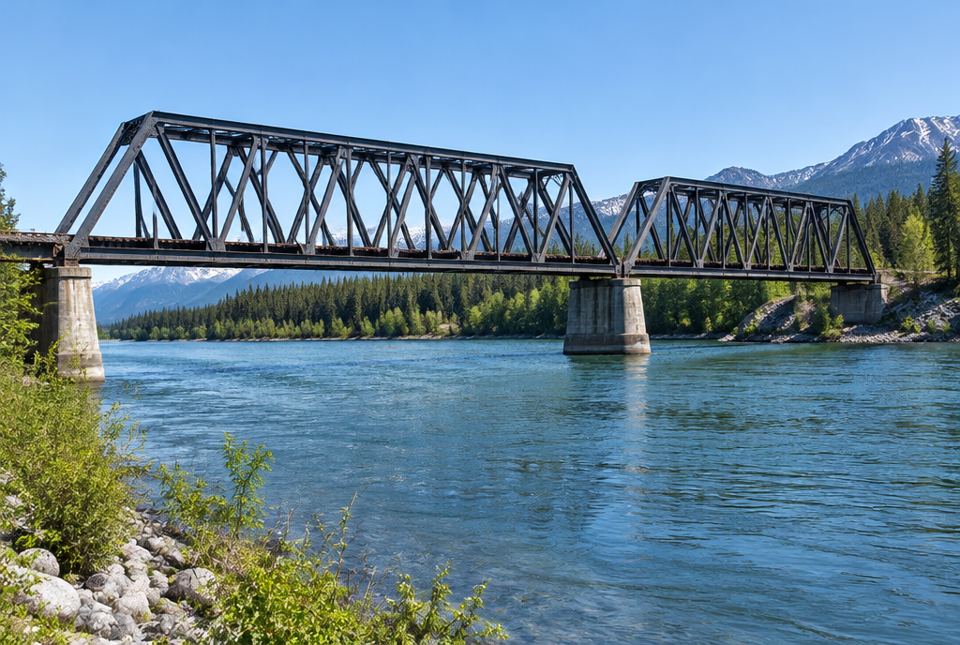 The steel beams of this railway bridge form triangles. Triangles keep their shape, so they make the bridge strong. AI-generated image
Sorting by sides
Measure the sides with a ruler. On a drawing, sides with the same number of tick marks are equal.
- Equilateral: all 3 sides equal. ("Equi" means equal, "lateral" means side.)
- Isosceles: 2 sides equal.
- Scalene: no sides equal.
Sorting by angles
Look at the biggest angle. Measure it, or check it with the corner of a sheet of paper.
- Acute triangle: all 3 angles are acute (less than 90°).
- Right triangle: one angle is a right angle (exactly 90°).
- Obtuse triangle: one angle is obtuse (more than 90°).
Sides and angles are connected
- In an equilateral triangle, all 3 angles are equal too. Each one is 60°.
- In an isosceles triangle, the 2 angles opposite the equal sides are equal.
- In a scalene triangle, all 3 angles are different.
So every triangle gets two names, like "right isosceles" or "obtuse scalene".
The angles always add up to 180°
Here is an amazing property. In every triangle, the three angles add up to 180°, a straight angle. You can test it yourself: tear off the three corners of a paper triangle and put their points together. They line up to make a straight line!
That also means a triangle can never have two right angles or two obtuse angles. There isn't enough room: 90° + 90° = 180° already, with nothing left for the third angle.
Worked exampleExample 1: Two names
A triangle has sides of 6 cm, 6 cm and 6 cm. Name it by its sides and by its angles.
- All 3 sides are equal, so it is equilateral.
- In an equilateral triangle, each angle is 60°. All the angles are less than 90°, so it is acute.
An acute equilateral triangle.
Worked exampleExample 2: Use the angles
A triangle has angles of 90°, 35° and 55°. Name it by its angles and by its sides.
- One angle is 90°, so it is a right triangle.
- All 3 angles are different, so all 3 sides are different too. It is scalene.
A right scalene triangle.
Worked exampleExample 3: Find the missing angle
Two angles of a triangle are 40° and 75°. What is the third angle?
- The three angles add up to 180°.
- Add the two you know: 40 + 75 = 115.
- Subtract from 180: 180 − 115 = 65.
- Check: 40 + 75 + 65 = 180. ✓
The third angle is 65°. All three angles are acute and all different, so it's an acute scalene triangle.
Think like a mathematician
When you sort triangles, you think like a scientist: you collect evidence (measurements), then decide. If two people disagree about a triangle, measure together and look at the evidence. Respectful disagreement helps everyone learn.
Just for funRiddle: Why doesn't the scalene triangle bother wearing matching socks?
None of its sides match anyway!
Hands-on activityThe torn-corner test
You need: paper, a ruler, a pencil, scissors (with a grown-up's help) and a protractor if you have one.
- Draw three different triangles with a ruler: make one look acute, one right (use the corner of a sheet of paper) and one obtuse. Make them big, with sides about 10 cm or longer.
- Measure each side. Name each triangle by its sides (equilateral, isosceles, scalene).
- If you have a protractor, measure each angle and add the three measures. (You may get 179° or 181° because of tiny measuring errors. That's normal!)
- Cut out one triangle. Colour or number its three corners. Tear the corners off and fit their points together on a straight line. Do they make 180°?
- Give each triangle its two names.
Math talk: "Why can't a triangle have two right angles?"
Your turn
1A triangle has sides 5 cm, 5 cm and 8 cm. Name it by its sides.
Isosceles. Two sides are equal.
2A triangle has sides 4 cm, 6 cm and 7 cm. Name it by its sides.
Scalene. No sides are equal.
3A triangle has angles 30°, 60° and 90°. Give both names.
Right scalene. It has a 90° angle, and all three angles are different, so all three sides are different.
4A triangle has angles 110°, 35° and 35°. Give both names.
Obtuse isosceles. 110° is obtuse, and two angles are equal, so two sides are equal.
5Two angles of a triangle are 50° and 60°. Find the third angle.
70°. 50 + 60 = 110, and 180 − 110 = 70.
6Can a triangle have two obtuse angles? Explain.
No. Two obtuse angles would add up to more than 180°, but all three angles of a triangle must add up to exactly 180°.
7How big is each angle in an equilateral triangle?
60°. The three equal angles share 180°: 180 ÷ 3 = 60.
More practice: warm-up
1How many sides, vertices and angles does every triangle have?
3 sides, 3 vertices and 3 angles.
2What do we call a triangle with 3 equal sides?
3What do we call a triangle with one right angle?
4On a drawing, what do matching tick marks on two sides tell you?
Those sides are equal in length.
5What do the three angles of any triangle add up to?
More practice: on your own
1Two angles of a triangle are 90° and 48°. Find the third angle and name the triangle by its angles.
42°. 90 + 48 = 138, and 180 − 138 = 42. It is a right triangle.
2The top angle of an isosceles triangle is 40°. The two bottom angles are equal. How big is each one?
70° each. 180 − 40 = 140, and 140 ÷ 2 = 70.
3A triangle has angles 45°, 45° and 90°. Give both names.
Right isosceles. One angle is 90°, and two angles are equal, so two sides are equal.
4Can a right triangle be equilateral? Explain.
No. Every angle of an equilateral triangle is 60°, so it can never have a 90° angle.
5A triangle has sides of 7 cm, 7 cm and 7 cm. Name it by its angles. How do you know without measuring?
Acute. It's equilateral, so every angle is 60°, which is less than 90°.
Challenge
1An isosceles triangle has one angle of 100°. What are the other two angles?
40° and 40°. The 100° angle can't be one of the equal pair, because 100 + 100 is already more than 180. So the other two are equal: 180 − 100 = 80, and 80 ÷ 2 = 40.
2Ella says, "A right triangle can never be scalene." Is she right? Give an example.
No. A triangle with sides 3 cm, 4 cm and 5 cm has a right angle between the 3 cm and 4 cm sides, and no equal sides. Its angles are 90°, about 37° and about 53°. It is a right scalene triangle.
3An isosceles triangle has one angle of 50°. Find two different possibilities for the other two angles.
Possibility 1: 50° is one of the two equal angles. Then the angles are 50°, 50° and 180 − 100 = 80°. Possibility 2: 50° is the different angle. Then the other two share 180 − 50 = 130, so they are 65° and 65°.
Quiz
1. A triangle with exactly two equal sides is called:
2. A triangle has angles 100°, 50° and 30°. What kind of triangle is it by its angles?
3. Two angles of a triangle are 65° and 25°. What is the third angle?
4. Which triangle is impossible?
5. A triangle has no equal sides. What do you know about its angles?
6. Why can't a triangle have two right angles?
Big idea: The Ontario curriculum (E1.1) asks Grade 5 students to identify geometric properties of triangles and classify them. Children should be able to name triangles by sides (equilateral, isosceles, scalene) and by angles (acute, right, obtuse), and use these properties. The fact that a triangle's angles add up to 180° is a useful property to discover through the torn-corner activity.
Common difficulties:
- Thinking the name depends on how the triangle is turned. An upside-down or tilted isosceles triangle is still isosceles.
- Calling a triangle "acute" because one angle is acute. Every triangle has at least two acute angles. An acute triangle needs all three to be acute.
- Adding angles to 360° instead of 180°. 360° is a full turn, which belongs to four-sided shapes.
How to help: Help with scissors. Go on a triangle hunt (yield signs, roof shapes, sandwich halves) and ask for both names. Social-emotional learning (A1) is woven in through respectful discussion of evidence.