B. Life Systems · Growth and Changes in PlantsPlant Parts at Work: Flowers, Fruits, Seeds and Cones
B2.2 A1.4 A1.5About 35 minutes
Learning goals- I can identify the flower, stamen, pistil, fruit, seed and cone.
- I can explain how flowers, fruits, seeds and cones help plants make new plants.
- I can describe how pollen gets from the stamen to the pistil.
- I can describe ways seeds travel to new places.
Words to know
flower
The part of many plants that makes seeds.
stamen
The part of a flower that makes pollen. It is a thin stalk with a tip covered in pollen.
pistil
The part in the centre of a flower that catches pollen. Its bottom part (the ovary) grows into the fruit with seeds inside.
pollen
A fine powder made by the stamens. Pollen must reach the pistil for seeds to form.
pollination
Moving pollen from a stamen to a pistil.
seed
A tiny baby plant packed with stored food and wrapped in a seed coat.
fruit
The part of a flowering plant that holds and protects the seeds.
cone
The part of trees like pines and spruces that holds and protects their seeds. These trees do not have flowers.
Where do apples come from?
In May, apple trees in Ontario orchards are covered with pink and white flowers. Bees buzz from flower to flower. By September, in the same places where the flowers were, there are apples. Cut an apple across the middle and you find a star of seeds.
Flowers, fruits and seeds are all about one big job: making new plants. That is how plants survive year after year.
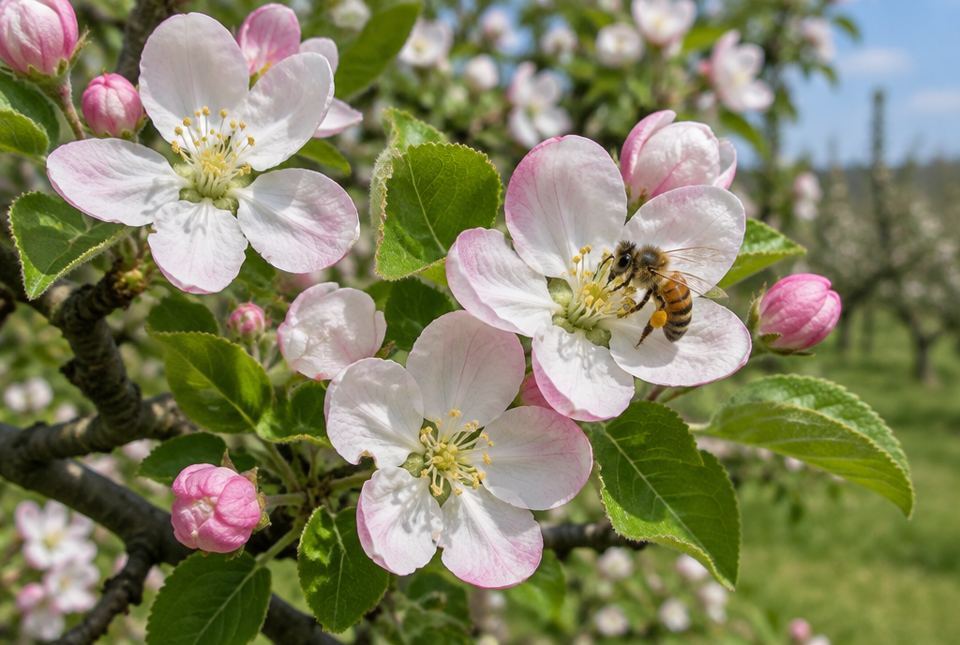 A bee visits an apple flower and carries pollen. Notice the petals that attract it and the stamens in the centre. Later, these flowers will become apples. AI-generated image
The parts of a flower
Flowers come in many sizes and colours, but most have the same main parts:
- Petals: often bright and sweet-smelling. They attract insects and birds.
- Stamens: thin stalks around the centre. Their tips make pollen, a fine powder.
- Pistil: in the very centre. Its sticky top catches pollen. Its round bottom, the ovary, is where seeds form.
Pollination: pollen goes on a trip
To make seeds, pollen has to move from a stamen to a pistil. This is called pollination.
- Insects: a bee drinks sweet nectar from a flower. Pollen sticks to its hairy body. At the next flower, some rubs off onto the sticky pistil.
- Birds: a hummingbird's head gets dusty with pollen while it sips nectar.
- Wind: grasses, corn and many trees have plain little flowers. The wind blows their pollen around.
After pollination, the ovary grows into a fruit, and seeds grow inside it. The petals dry up and fall off.
Worked exampleLet's follow a flower to a fruit
Put these stages of a pumpkin in order: pumpkin with seeds inside, yellow flower opens, bee carries pollen to the pistil, petals fall and the ovary swells.
- First the plant needs a flower: yellow flower opens.
- Next the pollen must move: bee carries pollen to the pistil (pollination).
- Then the flower is done with its petals: petals fall and the ovary swells.
- Last, the ovary becomes the fruit: pumpkin with seeds inside.
flower opens → pollination → petals fall and ovary swells → pumpkin (fruit) with seeds. Yes, a pumpkin is a fruit, because it holds seeds!
From flower to pumpkin. After a bee brings pollen, the petals fall and the ovary swells into a fruit full of seeds.Fruits protect and spread seeds
In science, a fruit is any plant part that holds seeds. Apples, strawberries and blueberries are fruits. So are tomatoes, cucumbers, pumpkins and peppers!
Fruits help seeds in two ways:
- They protect the seeds while they grow.
- They help seeds travel. An animal eats a tasty fruit and the seeds come out in its droppings far away.
Seeds: a baby plant in a lunch box
Inside every seed is a tiny baby plant and a supply of stored food. A tough seed coat protects it, like a lunch box. The seed can wait, sometimes for a long time, until it has water and warmth. Then it starts to grow.
Seeds need to travel away from the parent plant so the new plants have their own space, light and water. Seeds travel in many ways:
| How seeds travel | How it works | Example |
|---|
| wind | light seeds with fluff or wings float or spin away | dandelion fluff, maple "keys" (helicopters) |
| animals' fur or clothes | hooks grab onto fur or socks | burdock burrs |
| animals' food | animals eat fruit and drop seeds far away; squirrels bury nuts and forget some | blueberries, acorns |
| water | seeds float to a new shore | coconuts (in hot places by the ocean) |
| popping | the seed pod bursts and shoots seeds out | jewelweed (also called touch-me-not) |
Cones: seeds without flowers
Pine, spruce, fir and hemlock trees do not have flowers. They make seeds inside cones. These trees are called conifers (cone-bearers).
- A cone has many hard, woody scales. Seeds grow tucked between the scales, where they are protected.
- Small, soft pollen cones make pollen. The wind carries it to the bigger seed cones.
- When the seeds are ready, the scales of the seed cone open on dry days. Many pine seeds have a thin wing that helps them float away on the wind.
| Part | How it helps the plant survive |
|---|
| flower | makes seeds so new plants can grow |
| stamen | makes pollen |
| pistil | catches pollen; its ovary grows into the fruit and seeds |
| fruit | protects seeds and helps them travel |
| seed | holds a baby plant and its food; grows into a new plant |
| cone | protects the seeds of conifers and lets them out when they are ready |
Worked exampleLet's sort these seed holders
Sort these into fruit or cone: an apple, a pine cone, a tomato, a spruce cone, a maple key.
- Ask: Does it come from a flower? Then it is a fruit.
- Apple, tomato and maple key all come from flowers. (Maple trees have small flowers in spring.)
- Pine cones and spruce cones come from conifers, which have no flowers.
Fruits: apple, tomato, maple key. Cones: pine cone, spruce cone.
Just for funTrue story: an engineer noticed how many burdock burrs stuck to his dog's fur after a walk. Looking at their tiny hooks gave him the idea for Velcro!
Hands-on activityFlower and seed investigation
You need: a flower from a garden or a grocery store bouquet (a lily or tulip is easiest), an apple, a pine cone if you can find one, a magnifying glass if you have one, a plate, paper and pencil.
- Look at the flower. Find the petals, the stamens and the pistil. Gently touch a stamen tip with a cotton swab. Do you see pollen?
- A grown-up cuts the apple across the middle. Count the seeds. Where were they? (In the core, which was the ovary.)
- Look at the pine cone. Are the scales open or closed? Can you find any seeds? Put a closed cone in a warm, dry place for a day and see what happens.
- Draw and label each thing. Write one sentence about how it helps make new plants.
Safety: A grown-up does all cutting. Pollen can stain clothes and can make people with allergies sneeze; if someone has hay fever, skip touching the pollen. Do not eat seeds or flowers. Lilies are very poisonous to cats, so keep them away from pets. Wash your hands afterward.
Your turn
1What is the main job of a flower?
2Which part of a flower makes pollen?
3Which part of a flower catches pollen?
The pistil (its sticky top).
Moving pollen from a stamen to a pistil.
5Name two ways pollen can travel.
Any two: on insects like bees, on birds like hummingbirds, by the wind.
6What two things are inside every seed?
A baby plant and stored food (covered by a seed coat).
7Which trees make seeds in cones?
Conifers, like pine, spruce and fir trees.
8Is a cucumber a fruit or a vegetable to a scientist? Why?
A fruit, because it holds seeds.
More practice: warm-up
1What part of the flower is often bright and colourful?
2What fine powder do stamens make?
3What does a seed coat do?
4Name a fruit you ate this week.
Any fruit that holds seeds, for example an apple, banana, strawberry, tomato or cucumber.
5Do pine trees have flowers?
No. They make seeds in cones.
More practice: on your own
1Why do many flowers have bright petals and sweet nectar?
To attract insects and birds, which carry pollen from flower to flower.
2How does a maple key travel? Why does that help the new tree?
It has a wing and spins in the wind, landing away from the parent tree. The new tree gets its own space, light and water.
3A burr is stuck to your dog's fur after a walk. How is this helping the plant?
The burr has seeds inside. The dog carries them to a new place, where they can fall off and grow.
4Corn has plain little flowers with no bright petals. How does its pollen travel? Explain.
By the wind. It does not need bright petals because it does not need to attract insects.
5What does the ovary of a flower become?
The fruit, with seeds inside.
Challenge
1If all the bees in an apple orchard disappeared, what would happen to the apple crop? Explain.
There would be far fewer apples. Bees carry pollen between apple flowers. Without pollination, the ovaries do not grow into apples with seeds.
2Why do the scales of a pine cone open on dry days and stay closed on wet days? How does this help the tree?
When it is dry, the winged seeds can float far on the wind. When it is wet, closed scales protect the seeds, which would be heavy and not travel well. This helps the seeds reach new places to grow.
3A squirrel buries 20 acorns in the fall. In winter it finds and eats 17 of them. How many acorns are left that might grow into oak trees? How does the squirrel help the oak?
3 acorns (20 − 17 = 3). The squirrel carries and plants acorns away from the parent tree, and the forgotten ones can sprout into new oaks.
Quiz
1. Which part of a flower makes pollen?
3. Which of these is a fruit?
5. How do most dandelion seeds travel?
6. A spruce tree makes its seeds in...
7. Why is it good for seeds to travel away from the parent plant?
Big idea (B2.2, part 2): Flowers, fruits, seeds and cones are the plant's reproductive parts. Stamens make pollen, pistils receive it, and the pistil's ovary becomes a fruit containing seeds. Conifers produce seeds in cones instead of flowers. The investigation practises safe handling (A1.4) and labelled drawings (A1.5).
Simplifications we used: Some plants have stamens and pistils in separate flowers (pumpkins and corn do), and a few plants make seeds without pollination. Grade 3 does not need these details. If your child asks, it is fine to say, "Some plants have boy-part flowers and girl-part flowers separately."
Common difficulties:
- Mixing up stamen and pistil. Memory trick: the pistil is in the middle, by itself, like the main character; the stamens stand around it holding pollen.
- "Tomatoes and pumpkins are vegetables." In the kitchen we call them vegetables; in science anything that holds seeds is a fruit. Both are fine in their own setting.
How to help: Cut open different fruits and vegetables together (you do the cutting) and count or compare the seeds. Look for burrs on socks after a walk and maple keys in late spring. Watch for pollen allergies.