B. Number · Number Sense: Numbers to 1000 and FractionsCounting to 1000 by 1s, 10s, 25s, 50s, 100s and 200s
B1.4 A1About 35 minutes
Learning goals- I can count forward and backward to 1000 by 1s and 10s, starting from any number.
- I can skip count by 25s, 50s, 100s and 200s.
- I can count across a hundred, like 398, 399, 400, 401.
- I can count a big collection by putting things into groups of 10 and 100.
Words to know
skip count
To count by a number other than 1, like 50, 100, 150, 200.
one thousand
The number 1000. Ten hundreds make one thousand.
count forward
Counting so the numbers get bigger.
count backward
Counting so the numbers get smaller.
pattern
Something that repeats or changes in the same way each time.
Remember from Grade 2
In Grade 2 you counted to 200 by 1s, 10s, 20s, 25s and 50s, forward and backward. This year you will count all the way to 1000! You will also count by 100s and 200s, and start counting from any number.
The great food drive
Your school wants to collect 1000 cans of food for the local food bank. That is a LOT of cans! How will you keep track?
Counting by 1s would take a very long time. Good counters put things into groups and skip count. Let's learn how.
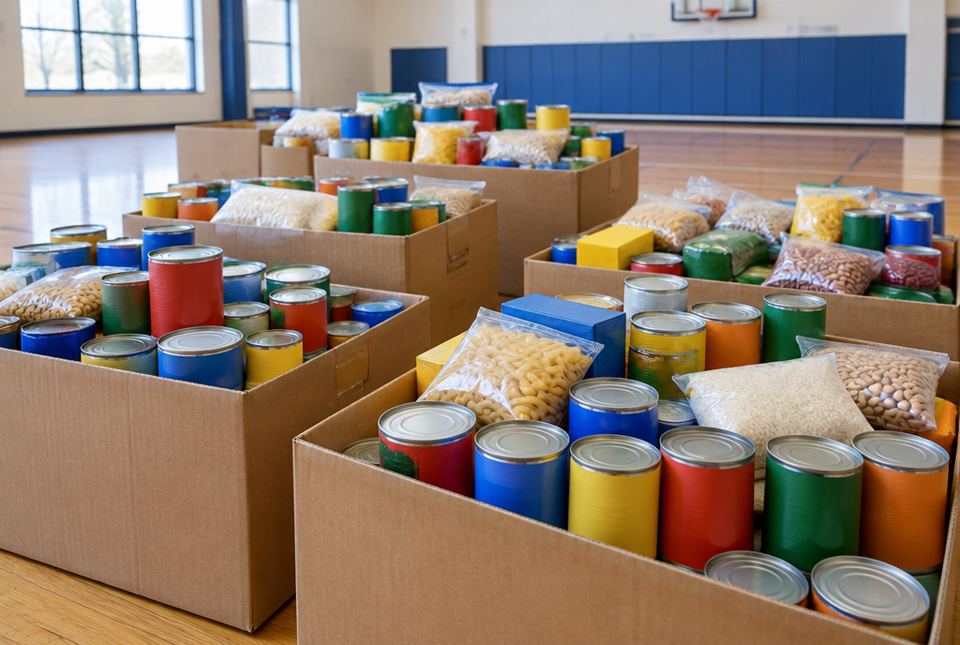 A food drive collects hundreds of cans. Packing them in boxes makes groups, so we can skip count instead of counting by 1s. AI-generated image
Counting by 100s and 200s
Count by 100s: 100, 200, 300, 400, 500, 600, 700, 800, 900, 1000.
After 900 comes 1000. We say "one thousand". Ten hundreds make one thousand.
Count by 200s: 200, 400, 600, 800, 1000. Each jump of 200 is the same as two jumps of 100.
| Count by | Numbers | Pattern I notice |
|---|
| 100s | 100, 200, 300, 400, 500 ... | The hundreds digit goes up by 1. The tens and ones stay 0. |
| 200s | 200, 400, 600, 800, 1000 | The hundreds digit goes up by 2. It takes 5 jumps to reach 1000. |
| 50s | 50, 100, 150, 200, 250, 300 ... | The numbers end in 50 or 00, over and over. |
| 25s | 25, 50, 75, 100, 125, 150, 175, 200 ... | The last two digits go 25, 50, 75, 00, over and over. |
Starting from any number
You don't always start at 0! You can count by 10s from 463:
463, 473, 483, 493, 503, 513
The tens digit goes up by 1 each time. The ones digit stays 3. After 9 tens, the tens are full, so the hundreds digit goes up: 493, then 503.
Counting by 1s across a hundred
Watch what happens at the end of a hundred:
397, 398, 399, 400, 401, 402
And at the very end: 997, 998, 999, 1000.
Counting backward
Counting backward works the same way, but the numbers get smaller:
- By 100s: 1000, 900, 800, 700, 600 ...
- By 10s: 530, 520, 510, 500, 490, 480 ...
- By 1s: 302, 301, 300, 299, 298 ...
Watch out for these tricky spots
- Counting by 10s, after 390 comes 400 (not 3100).
- Counting by 1s, after 999 comes 1000.
- Counting back by 10s, after 500 comes 490 (not 400).
- Counting back by 1s, after 300 comes 299.
Worked exampleExample 1: Counting by 50s
Count by 50s from 350 to 600.
- Start at 350. Add 50 each time.
- 350 + 50 = 400. (Two 50s make 100.)
- Keep going: 400, 450, 500, 550, 600.
350, 400, 450, 500, 550, 600
Worked exampleExample 2: Counting quarters
Jaya has 12 quarters. A quarter is worth 25¢. How many cents does she have?
- Count by 25s, one number for each quarter.
- 25, 50, 75, 100, 125, 150, 175, 200, 225, 250, 275, 300.
- We said 12 numbers, one for each quarter.
- Another way: 4 quarters make 100¢ ($1). 12 quarters is 3 groups of 4, so 100, 200, 300.
Jaya has 300¢. That is $3.
Worked exampleExample 3: Counting backward by 100s
Count back by 100s from 940. Stop when you can't count back any more.
- Take away 1 hundred each time. The tens and ones (40) stay the same.
- 940, 840, 740, 640, 540, 440, 340, 240, 140, 40.
- We can't take away another 100 from 40, so we stop.
940, 840, 740, 640, 540, 440, 340, 240, 140, 40
Worked exampleExample 4: Counting a big collection
Noah counts his button jar. He puts buttons in cups of 10. Then he puts 10 cups on a plate to make 100. He has 3 plates, 4 more cups and 7 loose buttons. How many buttons?
- Count the plates by 100s: 100, 200, 300.
- Keep counting the cups by 10s: 310, 320, 330, 340.
- Count the loose buttons by 1s: 341, 342, 343, 344, 345, 346, 347.
Noah has 347 buttons. Counting by 100s, then 10s, then 1s is fast and easy to check.
Stick with it
Counting a big collection takes patience. If you lose track, don't start over from 1! Go back to your last full group of 10 or 100 and keep going. Taking a deep breath and sticking with it is part of being a good math learner.
Just for funIf you counted by 1s from 1 to 1000 and said one number every second, it would take about 17 minutes. Counting to 1000 by 100s takes only 10 seconds!
Hands-on activityThe great count
You need: a big collection of small things (dry pasta, cereal pieces, buttons, LEGO bricks or pennies), small cups or paper squares, and paper plates.
Grown-up note: small items can be a choking danger for babies and toddlers, so keep them out of reach of little ones.
- Guess how many things are in your collection. Write your guess.
- Put the things into groups of 10 (one group in each cup or on each paper square).
- When you have 10 groups of 10, put them on a plate. That plate holds 100.
- Count: plates by 100s, then cups by 10s, then loose ones by 1s.
- Write the total. Was your guess close?
- Bonus: Take away one cup at a time and count backward by 10s.
Math talk: "Why is it easier to count in groups than one by one?"
Your turn
1Count by 100s from 300 to 1000.
300, 400, 500, 600, 700, 800, 900, 1000
2Count by 200s from 0 to 1000.
0, 200, 400, 600, 800, 1000
3Count by 50s from 600 to 900.
600, 650, 700, 750, 800, 850, 900
4Count by 10s from 572 to 632.
572, 582, 592, 602, 612, 622, 632. After 592 comes 602, because the tens are full and the hundreds go up.
5Count back by 1s from 403 to 397.
403, 402, 401, 400, 399, 398, 397
6What are the next two numbers? 125, 150, 175, ___, ___
200, 225. The pattern is counting by 25s.
7Count back by 100s from 870 to 70.
870, 770, 670, 570, 470, 370, 270, 170, 70
More practice: warm-up
1What number comes right after 999?
2Count by 100s: 100, 200, 300, ___
3Count by 200s: 200, 400, ___, ___
4Count by 10s: 340, 350, 360, ___
5Count by 50s: 50, 100, 150, ___
More practice: on your own
1Fill in the blanks: 780, 790, ___, 810, ___
800 and 820. We are counting by 10s. After 790 the tens are full, so the hundreds go up to 800.
2What is the counting rule? 450, 500, 550, 600
Count by 50s. Each number is 50 more than the one before.
3Find the mistake: 670, 680, 690, 6100, 6110
After 690 comes 700, not 6100. Ten tens make a hundred, so 6 hundreds and 10 tens is 7 hundreds. The next number is 710.
4How many jumps of 200 does it take to get from 0 to 1000?
5 jumps: 200, 400, 600, 800, 1000.
5Ben has 8 quarters. How many cents is that?
200¢ ($2). Count by 25s: 25, 50, 75, 100, 125, 150, 175, 200.
Challenge
1Count back by 50s from 1000 to 700.
1000, 950, 900, 850, 800, 750, 700. Each number is 50 less.
2Mira counts by 10s starting at 205. Will she say 305? Will she say 300? Explain.
She will say 305 (205, 215, 225 ... 295, 305). She will not say 300, because counting by 10s from 205 keeps the ones digit at 5. Every number she says ends in 5.
3A box holds 100 crayons. How many boxes do you need for 1000 crayons? If you count the crayons by 200s instead, how many numbers will you say?
10 boxes, because ten hundreds make 1000. Counting by 200s you say 5 numbers: 200, 400, 600, 800, 1000.
Quiz
1. Which number comes right after 699?
2. Counting by 200s from 0, which number will you say?
3. What comes next? 850, 900, 950, ___
4. Counting back by 10s: 420, 410, 400, ___
5. How many cents do 4 quarters make?
6. Counting by 100s starting at 160, which number will you say?
Big idea: Counting is more than saying numbers in order. Children use groups of 10 and 100 and patterns to count quickly. The Ontario curriculum (B1.4) asks Grade 3 students to count to 1000, including by 50s, 100s and 200s, using different tools and strategies.
Common difficulties:
- Crossing a hundred. Many children say "390, 3100" or "599, 5100". Use a number line or base-ten groups: 10 tens make a new hundred.
- Counting backward, especially across a hundred (500, 490). Practise backward counts often; they are harder than forward counts.
- Starting from a number that is not a multiple of 10 (463, 473, 483). Point out that only the tens digit changes until the tens are full.
- Losing track in big collections. Encourage grouping in cups or piles of 10.
How to help: Count out loud together in the car or on a walk: "Start at 250 and count by 50s." Count coins (quarters by 25s). Let your child do the activity with a real collection and talk about how grouping helps. Praise patience and effort (a Strand A skill), not just speed.