E. Earth and Space Systems · Air and Water in the EnvironmentAir Is All Around Us
E2.1 A1.2 A1.4 A1.5About 35 minutes
Learning goals- I can explain that air is all around us, even when I can't see it.
- I can show that air takes up space and has mass.
- I can describe how moving air (wind) can push things.
- I can do an experiment safely: predict, test and tell what I observed.
Words to know
air
The invisible gas all around us. We breathe it to stay alive.
gas
A kind of matter that spreads out to fill any space. Air is a gas.
property
Something you can notice about a thing, like its colour, its smell or how it moves.
takes up space
Fills a place, so nothing else can be in that same place at the same time.
mass
How much stuff is in something. Things with more mass feel heavier.
wind
Air that is moving.
predict
Make a smart guess about what will happen before you test it.
Something you can't see
Wave your hand fast in front of your face. Did you feel something touch your skin?
You can't see it. You can't usually smell it. But it is there! It is air.
Air is all around you right now. It is in your room, outside, inside your lungs and even inside a cup that looks "empty".
What is air?
Air is a gas. A gas has no shape of its own. It spreads out to fill any space it is in.
Air is made of tiny bits that are much too small to see. One part of air is called oxygen. People and animals need oxygen to live. We breathe it in every few seconds, all day and all night.
Air is everywhere around Earth. It is in the sky, in the soil between bits of dirt, and even in water. Those bubbles you see in a glass of water? Some of them are air!
Remember from Grade 1
In Grade 1 you learned that air is one of the basic needs of living things, along with water, food, heat, shelter and space. Now you will find out what air is like.
Properties of air
Scientists describe things by their properties. Here are some properties of air:
- Air is invisible. We can't see clean air.
- Clean air has no smell.
- Air takes up space. It fills balloons, tires and balls.
- Air has mass. It is very, very light, but it is not nothing!
- Air can move. Moving air is called wind. Wind can push things.
- Air can be squeezed into a smaller space. That is how we pump lots of air into a bike tire.
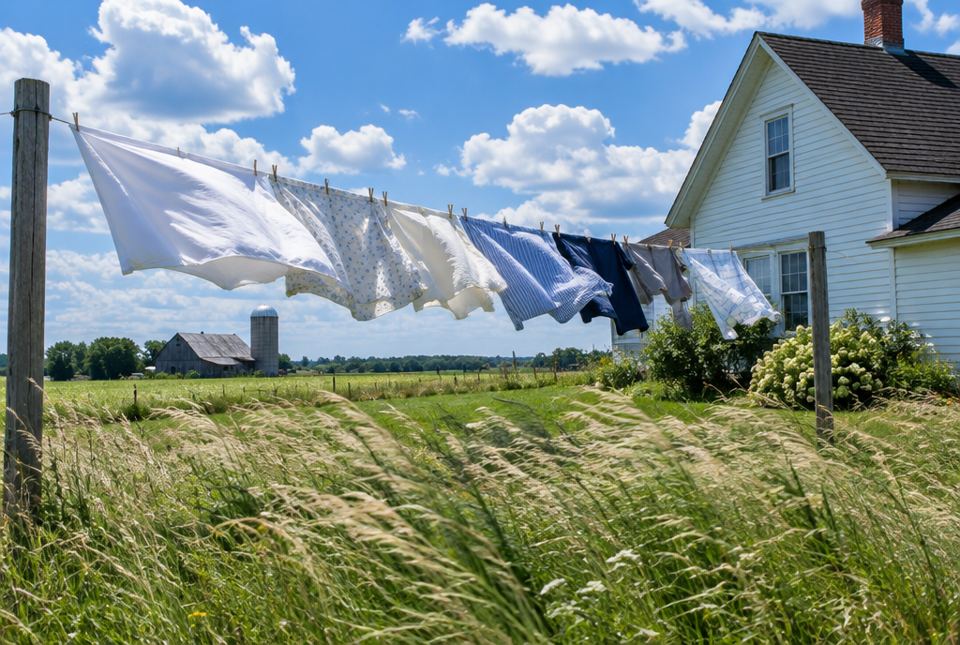 We can't see air, but we can see what moving air does. The wind is pushing the laundry and bending the grass. AI-generated image
🎈🚲⚽🪁⛵🌬️
Air at work: it fills a balloon, a bike tire and a ball. Moving air lifts a kite and pushes a sailboat.Worked exampleLet's test it: Is an "empty" cup really empty?
We stuff a dry paper towel into the bottom of a clear cup. We turn the cup upside down and push it straight down into a bowl of water. Will the paper towel get wet?
- Predict first. What do you think? Many people think the paper will get soaked.
- Push the cup straight down. Keep it upside down. Don't tip it!
- Observe. Look through the side of the cup. The water only goes in a tiny bit. Most of the cup stays dry inside.
- Pull the cup straight up and feel the paper towel. It is dry!
- Explain. The cup was full of air. The air takes up space, so the water could not get in.
The paper towel stays dry because air takes up space. The "empty" cup was really full of air.
The cup is pushed upside down into water. Air is trapped inside, so the water can't reach the paper towel.Air has mass
Air is so light that it is hard to believe it has any mass at all. But it does!
Scientists show this with a balance. Hang two balloons with the same amount of air from the ends of a stick, so the stick is level. Now let the air out of one balloon. The side with the full balloon goes down. The air inside it has mass!
You can also put a flat ball on a kitchen scale, then pump it up and weigh it again. The number goes up a little, because you added air.
Worked exampleLet's explain what we see: A tipped balance
Ava hangs two blown-up balloons on a coat hanger. The hanger is level. She lets the air out of the balloon on the left. Which side goes down?
- Before: both balloons have about the same amount of air, so the hanger is level.
- After: the left balloon has almost no air. The right balloon still has its air.
- Air has mass. More air means more mass.
- So the side with more air is heavier.
The right side goes down, because the full balloon has more air, and air has mass.
Moving air: wind
When air moves, we call it wind. You can't see wind, but you can see what it does.
- It bends trees and blows the leaves off in fall.
- It dries clothes on a clothesline.
- It lifts kites and pushes sailboats.
- It spins the blades of big wind turbines that make electricity.
Warm air rises (goes up) and cooler air moves in to take its place. That moving air is one reason we have wind.
Stay safe, scientist!
- Balloons can be a choking danger. Let a grown-up blow them up. Throw away broken balloon pieces right away.
- Never put anything over your nose or mouth. You need to breathe air!
- Wipe up spilled water so no one slips.
Just for funRiddle: You can't see me and you can't hold me, but I fill up every balloon at your birthday party. What am I?
Air!
Hands-on activityBe an air detective
You need: a clear cup, a paper towel, a big bowl or sink of water, a straw, a sheet of paper and (if you have one) a balloon.
- Cup test. Do the "empty cup" test from the example. Predict first, then try it. Was the paper dry?
- Tip the cup. Do it again, but this time tip the cup a little under the water. Watch for bubbles. That is the air escaping, and now water can get in. Is the paper wet now?
- Bubbles. Blow gently through a straw into a cup of water. What makes the bubbles? (Your breath, which is air!) Blow out only. Do not sip.
- Make wind. Fan a sheet of paper near a pile of small paper bits. What happens?
- Balloon. Ask a grown-up to blow up a balloon. What is inside it? Squeeze it gently. Can you feel the air pushing back?
Tell a grown-up what you predicted and what you observed for each test. Use the words air, takes up space and wind.
Your turn
No. Clean air is invisible.
2Name two places where you can find air.
Answers will vary. Examples: all around us, in our lungs, in a balloon, in a ball, in soil, in bubbles in water, in a bike tire.
3What do we call moving air?
4Why did the paper towel stay dry in the "empty cup" test?
The cup was full of air. Air takes up space, so the water could not get in.
5Name something wind can push or move.
Answers will vary. Examples: a kite, a sailboat, leaves, a flag, a pinwheel, wind turbine blades.
6True or false: Air has no mass at all.
False. Air is very light, but it does have mass.
7What part of air do people and animals need to breathe?
More practice: warm-up
1Is air a solid, a liquid or a gas?
2Does clean air have a smell?
No. Clean air has no smell.
3What fills up a balloon when you blow into it?
4How can you tell it is windy outside if you can't see the wind?
Answers will vary. Examples: trees bend, leaves blow, flags wave, you feel it on your face.
5Say this sentence: "Air takes up space." Now show it with your hands or a balloon.
Look for: your child says the sentence and points to something filled with air, like a balloon, a ball or puffed-up cheeks.
More practice: on your own
1Jay says, "My cup is empty." Is he right? Explain.
Not really. The cup has no juice or water in it, but it is full of air. Air takes up space.
2A soccer ball is flat. You pump it up. Does it get heavier, lighter or stay the same? Why?
It gets a little heavier, because you added air, and air has mass.
3In the cup test, you tip the cup under the water and bubbles come out. What are the bubbles? What happens to the paper towel?
The bubbles are air escaping from the cup. Water goes in to take its place, so the paper towel gets wet.
4How can you squeeze a lot of air into a bike tire?
Use a pump. Air can be squeezed into a smaller space, so the pump pushes more and more air in.
5Name two ways people use moving air.
Answers will vary. Examples: wind turbines make electricity, sailboats move, kites fly, clotheslines dry clothes, fans cool us.
Challenge
1Two balloons hang on a balance and it is level. The left balloon pops. Which side goes down? Explain.
The right side goes down. The right balloon still has its air. Air has mass, so the side with more air is heavier.
2How could you show a friend that air is inside an "empty" plastic bottle?
Answers will vary. Example: put a balloon over the bottle's mouth and squeeze the bottle. The air is pushed into the balloon and it puffs up a little. This shows the bottle was full of air.
3Why do you think wind turbines are often built on hills or near big lakes?
Answers will vary. Good answer: those places often have strong, steady winds. More moving air pushes the blades more, so they can make more electricity.
Quiz
1. Which word describes air?
2. In the cup test, the paper towel stays dry because...
4. You pump up a flat ball. Now the ball has...
5. Which of these is filled with air?
6. Which is a safe way to do air experiments?
Big idea (E2.1): Air is a real substance. It is a gas that surrounds us, takes up space, has mass and can move (wind). Children often think "empty" means "nothing there", so hands-on tests are important.
How to help: Do the cup test together over the sink. Ask your child to predict before each test and to tell you what they observed afterward (A1.2, A1.5). Point out wind at work on walks: flags, leaves, kites, clothes on a line.
Common difficulties:
- "Air weighs nothing." Air is very light, so a home scale may show only a tiny change. The balloon balance makes it easier to see.
- Tipping the cup. If the cup tips, air bubbles out and the paper gets wet. That is a great teaching moment: the bubbles show the air leaving.
Safety (A1.4): Uninflated or broken balloons are a choking hazard for young children. Supervise water play and wipe spills.