B. Number · Number Sense: Numbers to 50 and FractionsFair Sharing with 2 and 4 Friends
B1.6About 35 minutes
Learning goals- I can share things fairly so everyone gets the same amount.
- I can use a drawing to share among 2 or 4 people.
- I can tell what to do with leftovers.
- I know that fair shares must be the same size.
Words to know
share
To split something so each person gets some.
fair share
When everyone gets the same amount, or pieces that are exactly the same size.
sharer
A person (or animal!) who gets a share.
leftover
What is left when we can't give everyone one more whole thing. Also called a remainder.
equal
The same amount or the same size.
That's not fair!
Have you ever shared a snack with a brother, sister or friend and someone got more? That doesn't feel fair!
In math, fair sharing means that everyone gets the same amount. Today you will learn how to share things fairly between 2 people and among 4 people, and what to do when there are some left over.
Sharing by dealing
The easiest way to share fairly is to deal, just like dealing cards:
- Give one to each person.
- Then give one more to each person.
- Keep going around until there are not enough left to give everyone one more.
- Check: Does everyone have the same number?
Worked exampleSharing between 2
Lily and Ben share 8 strawberries fairly. How many does each get?
- Deal one to Lily, one to Ben. (2 given out, 6 left.)
- Again: one to Lily, one to Ben. (4 given out, 4 left.)
- Again: one each. (6 given out, 2 left.)
- Again: one each. (8 given out, 0 left.)
- Check: Lily has 4 and Ben has 4. They are equal!
Each person gets 4 strawberries.
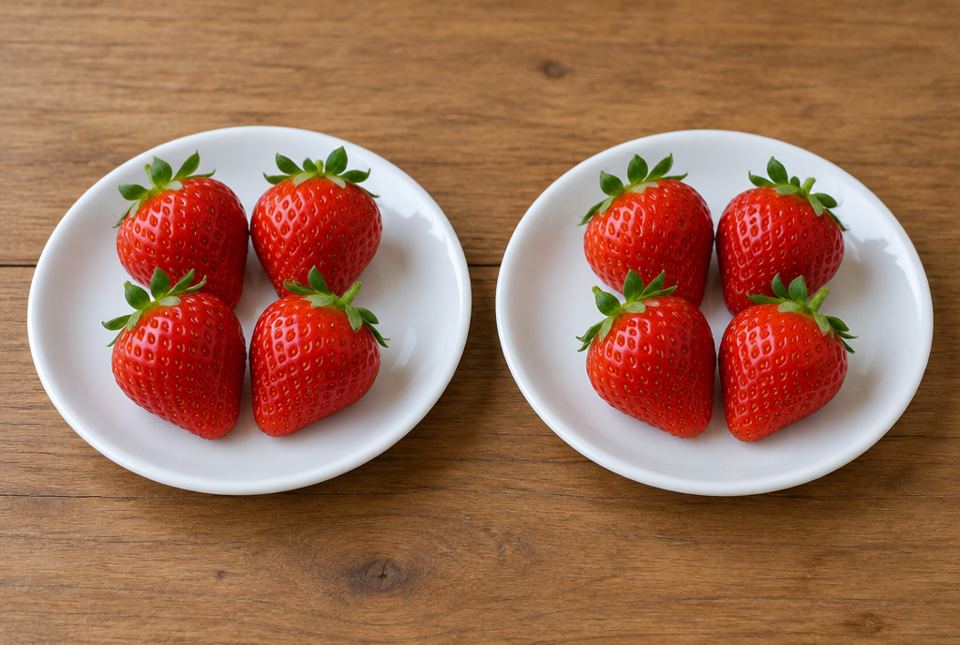 8 strawberries shared fairly between 2 people: each plate has 4. Count to check that both plates are the same. AI-generated image8 strawberries shared fairly on 2 plates: 4 and 4.
Worked exampleSharing among 4
Four friends share 12 crackers fairly. How many does each friend get?
- Draw 4 plates, one for each friend.
- Deal 1 cracker onto each plate. That uses 4 crackers. 8 are left.
- Deal 1 more onto each plate. That uses 4 more. 4 are left.
- Deal 1 more onto each plate. That uses the last 4. 0 are left.
- Count each plate: 3, 3, 3, 3. Every plate is the same.
Each friend gets 3 crackers.
12 crackers shared among 4 plates: 3 on each.When there are leftovers
Sometimes things don't share evenly. There might be 1 or 2 left over that can't go around to everyone.
What can we do with a leftover?
- Put it aside (save it for later, or give it to someone else).
- If it's something we can cut, like a cookie or a sandwich, we can cut it into equal pieces so everyone gets a piece!
Worked exampleSharing 9 cookies between 2
Max and Ruby share 9 cookies. How can they share fairly?
- Deal one at a time: Max 1, Ruby 1, Max 2, Ruby 2, Max 3, Ruby 3, Max 4, Ruby 4.
- That uses 8 cookies. There is 1 cookie left over. We can't give one more whole cookie to each person.
- Cut the leftover cookie into 2 equal pieces. These are called halves.
- Give each person one half.
Each person gets 4 cookies and one half of a cookie. That's fair!
Max and Ruby each get 4 whole cookies...... and the 1 leftover cookie is cut into 2 equal halves, one for each.Worked exampleSharing 10 granola bars among 4
Four cousins share 10 granola bars fairly. What happens?
- Draw 4 cousins. Deal 1 bar to each: 4 used, 6 left.
- Deal 1 more bar to each: 8 used, 2 left.
- There are 2 left over. We can't give everyone a whole bar again, because 2 is less than 4.
- Cut each leftover bar in half. Now there are 4 halves, one for each cousin!
Each cousin gets 2 whole bars and one half of a bar.
Each cousin gets 2 whole granola bars. The 2 leftover bars are cut into halves, so each cousin also gets 1 half.Fair shares must be the same size
When we cut one thing to share it, every piece must be exactly the same size. Having the same number of pieces is not enough. The pieces must be equal!
More shares than sharers
Here's something surprising: the number of pieces (shares) can be more than the number of people!
Say 4 friends share 2 pizzas. We can cut each pizza into 2 equal halves. Now there are 4 halves, and each friend gets 1 half.
Or we could cut each pizza into 4 equal pieces. Then there are 8 pieces for 4 friends, so each friend gets 2 pieces. Either way, it's fair, and each friend gets the same amount of pizza!
Fair sharing steps
- Give one to each sharer, again and again.
- Check that everyone has the same number.
- If there's a leftover you can cut, cut it into equal pieces so everyone gets one.
- Draw a picture to show your thinking!
Just for funA sneaky-smart sharing trick: when two people share one treat, one person cuts and the other person picks first. It is amazing how carefully people cut when they know that rule!
Hands-on activitySnack share
You need: a snack like crackers, grapes or apple slices, 2 or 4 small plates (or paper circles), and stuffed animals or family members to share with.
- Count out 8 grapes. Share them between 2 plates by dealing. Is it fair?
- Now share 8 grapes among 4 plates. How many on each?
- Try 7 crackers between 2 plates. What is left over? What could you do with it?
- Try 10 crackers among 4 plates. What is left over?
- With a grown-up's help, cut a leftover cracker or a slice of bread into equal pieces.
- Draw a picture of one of your shares.
Your turn!
1Share 6 apples fairly between 2 people. How many does each get?
3 apples each. (3 and 3 make 6.)
2Share 8 cookies fairly among 4 people. How many does each get?
3Share 5 muffins between 2 people. How many does each get? How many are left over?
Each gets 2 muffins and 1 is left over. You could cut it in half so each person gets 2 and a half muffins.
4Share 14 stickers between 2 friends. How many does each get?
5Share 9 pencils among 4 children. How many does each get? How many are left over?
Each gets 2 pencils, and 1 is left over. (4 groups of 2 is 8, and 9 is 1 more than 8.)
6Share 6 pancakes among 4 people. How many does each get? What can you do with the leftovers?
Each gets 1 pancake, and 2 are left over. Cut each leftover pancake in half to make 4 halves, so everyone gets 1 and a half pancakes.
7Jo cut a cake into 2 pieces. One piece is big and one is small. Is it a fair share?
No. Fair shares must be the same size.
More practice: warm-up
1Share these apples fairly between 2 people. How many does each get?
🍎🍎🍎🍎
2 apples each. (2 and 2 make 4.)
2Share 4 cookies fairly among 4 people. How many does each get?
3True or false: A fair share means everyone gets the same amount.
4Share these grapes fairly between 2 people. How many does each get?
🍇🍇🍇🍇🍇🍇🍇🍇🍇🍇🍇🍇
6 grapes each. (6 and 6 make 12.)
5When you share by dealing, how many do you give to each person at a time?
One to each person, then one more to each person, and so on.
More practice: on your own
1Share 16 crackers fairly among 4 friends. How many does each friend get?
Deal 1 to each friend 4 times. Each time uses 4 crackers: 4, 8, 12, 16. Each friend gets 4 crackers, with none left over.
2Share 11 strawberries between 2 people. How many does each get? What can you do with the leftover?
Deal them out: each person gets 5 and 1 is left over (5 and 5 make 10). Cut the leftover strawberry in half, so each person gets 5 and a half strawberries.
3Share these carrot sticks fairly between 2 children. How many does each child get?
🥕🥕🥕🥕🥕🥕🥕🥕🥕🥕🥕🥕🥕🥕🥕🥕🥕🥕
Deal them out one at a time. Each child gets 9 carrot sticks. Check: 9 and 9 make 18.
4Four friends share 13 cookies. How many whole cookies does each friend get? What can they do with the leftover?
Each friend gets 3 cookies, because 4 groups of 3 is 12. 1 cookie is left over. Cut it into 4 equal pieces (fourths) so each friend gets one piece.
5Two friends share 3 sandwiches fairly. How much does each friend get?
Each friend gets 1 whole sandwich. The leftover sandwich is cut into 2 equal halves, so each friend gets 1 and a half sandwiches.
Challenge
1Find the mistake! Mia shared 10 stickers among 4 friends. She gave out 3, 3, 2 and 2. Is that fair? What should she do?
Not fair. Two friends got more. Mia should deal 1 at a time: each friend gets 2 stickers, and 2 are left over. Stickers can't be cut, so she could put the 2 leftovers aside.
2Can 20 hockey cards be shared fairly among 4 friends with none left over? How do you know?
Yes. Deal them out: each friend gets 5 cards. Check by counting 4 groups of 5: 5, 10, 15, 20. All 20 are used.
3Sara and her 3 cousins (4 children altogether) share 14 grapes. How many whole grapes does each child get? How many are left over? How could they share the leftovers fairly?
Deal them out: each child gets 3 grapes (4 groups of 3 is 12). 2 are left over. Cut each leftover grape in half to make 4 halves, so each child gets 3 and a half grapes.
Quiz
1. Share 10 grapes fairly between 2 friends. How many does each get?
2. Share 7 cookies between 2 children. What happens?
4. 4 friends share 2 sandwiches. Each sandwich is cut into 2 equal halves. How many halves does each friend get?
5. Share 20 crayons fairly between 2 friends. How many does each get?
6. 4 friends share 9 crackers. Each gets 2. How many crackers are left over?
What your child is learning: to solve sharing problems for 2 and 4 people using drawings, making sure everyone gets equal shares. When things don't share evenly (1 or 2 left over), children learn that leftovers can be cut into equal pieces. This is the beginning of fractions and of division.
Common mistakes and how to help:
- Giving out several at once and losing track. Encourage dealing one at a time and checking at the end that every plate has the same number.
- Ignoring the leftover or giving it to one person. Ask, "Is it fair if one person gets the extra?" Talk about cutting or saving it.
- Thinking any 2 pieces are halves. Halves must be equal in size. Cut a sandwich unevenly and ask your child if it's fair.
- Thinking more pieces always means more food. Show that 2 fourths of a pizza is the same amount as 1 half.
Everyday practice: let your child share out snacks, toys or cards among family members. Ask them to draw what they did.
Math talk questions: "How do you know it's fair?" "What will you do with the one left over?" "Could you share it a different way?"