B. Number · Number Sense: Numbers to 50 and FractionsEstimating How Many
B1.4 B1.5About 30 minutes
Learning goals- I can make a smart guess (estimate) about how many objects there are.
- I can use a group of 10 to help me estimate.
- I can check my estimate by counting.
Words to know
estimate
A smart guess about how many, made by thinking, not by counting every object.
about
Close to, but maybe not exactly. "There are about 20 cars."
benchmark
A number we know well, like 10, that helps us estimate.
verify
To check if something is right, for example by counting.
How many jelly beans are in the jar?
At the school fall fair, there is a jar full of jelly beans. If you guess closest to the right number, you win! But you are not allowed to open the jar and count.
What can you do? You can estimate! An estimate is a smart guess. It is not a wild guess. You use what you can see and what you know to think of a number that is close.
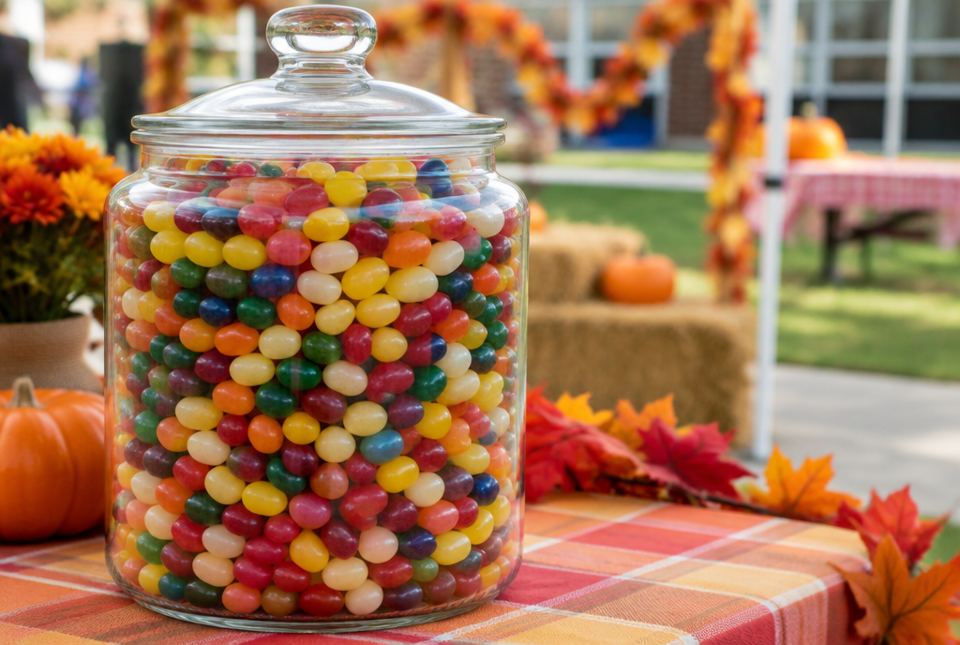 Too many to count quickly! Look at the jar and make a smart guess: about how many jelly beans could there be? AI-generated image
Estimating is not the same as counting
When we count, we find the exact number. When we estimate, we find a number that is about right. Both are useful!
We estimate when:
- there are too many things to count quickly,
- the things are moving (like birds in the sky),
- we only need to know about how many.
Remember
A good estimate does not have to be exactly right. It just has to be close. Being close is a success!
Using a benchmark of 10
A benchmark is a number you know well that helps you estimate. 10 is a great benchmark.
First, look carefully at a small group of 10. Remember what 10 looks like. Then look at the whole collection and ask: How many groups of 10 could fit?
🫐🫐🫐🫐🫐🫐🫐🫐🫐🫐
This is what 10 blueberries look like.🫐🫐🫐🫐🫐🫐🫐🫐🫐🫐🫐🫐🫐🫐🫐🫐🫐🫐🫐🫐🫐🫐🫐🫐🫐🫐🫐🫐🫐🫐🫐🫐🫐🫐🫐🫐
Now estimate: about how many blueberries are here? (Don't count yet!)Worked exampleEstimating the blueberries
Estimate how many blueberries are in the big picture above. Then count to check.
- Look at the first row. It looks just like our group of 10.
- There are about 3 rows that size, plus a shorter row. That is about 3 tens and a bit more. 3 tens is 30.
- A smart estimate is about 35.
- Now verify by counting. Count each full row by 10s: 10, 20, 30. Then count the short row by 1s: 31, 32, 33, 34, 35, 36.
There are exactly 36 blueberries. Our estimate of 35 was very close!
Is the estimate reasonable?
A reasonable estimate makes sense. If you see a small handful of beads, an estimate of 5 or 10 is reasonable. An estimate of 1000 is not!
Ask yourself:
- Is it more or less than 10?
- Is it more or less than 20?
- Is it closer to 10, 20, 30, 40 or 50?
Worked examplePick the best estimate
Look at these stars. Which is the best estimate: 5, 20 or 50?
- Remember what 10 looks like.
- The stars below look like about two groups of 10.
- 5 is too small. 50 is too big. 20 is closest.
20 is the best estimate. (There are really 19 stars. Count them!)
⭐⭐⭐⭐⭐⭐⭐⭐⭐⭐⭐⭐⭐⭐⭐⭐⭐⭐⭐
How many stars? Make your estimate before you count.Checking an estimate by counting
After you estimate, it's fun to find out how close you were. Count the objects. A great way to count a big collection is to move them into groups of 10, then count by 10s and 1s.
Then compare: Was the real number more than your estimate, less, or the same?
Getting better
Your next estimate gets better each time! If your estimate was too low, next time think a little higher. Estimating is a skill that grows with practice.
Just for funBird watchers really estimate like this! When a big flock flies by, they count a group of 10 birds, then guess how many groups of 10 fit in the whole flock.
Hands-on activityEstimation jar
You need: a clear jar or plastic container and some small things such as pasta, grapes, crayons, LEGO bricks, cotton balls or coins.
- A grown-up puts between 10 and 50 objects in the jar.
- First, look at a group of 10 of the same objects on the table. Then look at the jar.
- Write your estimate. Everyone in the family can write one too!
- Pour out the objects. Make groups of 10. Count by 10s, then by 1s.
- Whose estimate was closest? Talk about how each person made their estimate.
- Do it again with bigger objects (cotton balls) and smaller objects (dried beans). Does the size of the objects change how many fit?
Hands-on activityHandful estimates
Grab a handful of dried beans or cereal. Estimate how many. Count to check. Then grab a handful with your grown-up's bigger hand. Do you think there will be more or fewer? Estimate, then count!
Your turn!
A smart guess about how many, made by thinking, not counting every one.
2Your friend has a small handful of grapes. Which estimate is reasonable: 8 or 80?
8. A small handful can't hold 80 grapes.
3A jar holds 2 groups of 10 marbles and a few more. Is it closer to 10, 20 or 40?
20, because 2 groups of 10 is 20.
4You estimated 30 buttons. You counted 27. Was your estimate close?
Yes! 27 is only 3 away from 30.
5You estimated 15 crayons. You counted 41. Was the real number more or less than your estimate?
More. 41 is much more than 15. Next time, estimate higher.
6You see 3 full ten frames and a few more dots. Estimate how many dots.
About 30, or a bit more (like 33 or 35).
More practice: warm-up
1True or false: An estimate must be exactly right.
False. An estimate only needs to be close.
2Are there more than 10 or less than 10 grapes here? Try to tell without counting!
🍇🍇🍇🍇🍇🍇🍇
Less than 10. The row is shorter than a group of 10. (There are 7.)
3Which is a reasonable estimate for the number of children in a Grade 1 class: 2, 20 or 200?
20. 2 is too few and 200 is far too many for one class.
4You see 1 full ten frame and another ten frame that is almost full. Is that closer to 10 or to 20?
Closer to 20. One full ten frame is 10, and almost another 10 makes nearly 20.
5What word means to check if something is right?
Verify. We verify an estimate by counting.
More practice: on your own
1Here are 10 fish:
🐟🐟🐟🐟🐟🐟🐟🐟🐟🐟
Now look at the whole pond. Is the number of fish closer to 20, 40 or 50?
🐟🐟🐟🐟🐟🐟🐟🐟🐟🐟
🐟🐟🐟🐟🐟🐟🐟🐟🐟🐟
🐟🐟🐟🐟🐟🐟🐟🐟🐟🐟
🐟🐟🐟🐟🐟🐟🐟🐟
Closer to 40. There are 3 rows like the group of 10 and one row that is almost 10, so it is about 4 tens. (Count to check: 10, 20, 30, then 31 to 38. There are 38 fish.)
2Kai estimated 20 acorns. He counted 22. Was his estimate close? Was the real number more or less?
Yes, it was close. 22 is only 2 away from 20. The real number was a little more than his estimate.
3Amir estimated 45 cars in the parking lot. Then he counted 4 rows of 10 cars and 2 more cars. How many cars were there? Was his estimate close?
Count by 10s: 10, 20, 30, 40. Then 41, 42. There were 42 cars. Yes, 45 was close, only 3 away.
4Ella estimated 10 marbles. She counted 12. She says, "My estimate was wrong!" Do you agree? Why?
No. An estimate does not need to be exact. 10 is very close to 12, so it was a good estimate.
5A flock of Canada geese flies over your house. Why would you estimate how many geese there are instead of counting them?
The geese are moving, so it is very hard to count each one. An estimate tells us about how many.
Challenge
1Jin estimated 30 pinecones. Kim estimated 40. When they counted, there were 37. Whose estimate was closer? How do you know?
Kim's. From 37 to 40 is only 3 more (38, 39, 40). From 30 to 37 is 7 (31, 32, 33, 34, 35, 36, 37). 3 is less than 7, so 40 is closer.
2Two jars are the same size. One jar is filled with big cotton balls. The other jar is filled with small dried beans. Which jar holds more things? Explain how this helps you estimate.
The jar of beans holds more, because smaller objects take up less space, so more of them fit. When the objects are small, make a bigger estimate.
3Sophie estimated 20 buttons. Then she made 3 groups of 10 and had 4 left over. How many buttons were there? Was her estimate too high or too low? What should she think about next time?
10, 20, 30, then 31, 32, 33, 34. There were 34 buttons. Her estimate was too low. Next time she should think a little higher, maybe by remembering what 10 looks like and seeing how many groups of 10 fit.
Quiz
2. Which number is a good benchmark to help you estimate?
3. There are about 4 groups of 10 crayons on the table. What is the best estimate?
4. How can you check your estimate?
5. You see 2 full ten frames and 1 more dot. What is the best estimate?
6. Ty estimated 25 crayons. He counted exactly 25. What can he say?
What your child is learning: to estimate the size of a collection up to 50 and then count to check. Estimation builds number sense: a feel for how big 10, 20 or 50 really is.
Common mistakes and how to help:
- Counting instead of estimating. Give only a few seconds to look, or cover the collection after a quick peek.
- Wild guesses ("a million!"). Ask "Is it more or less than 10? More or less than 20?" and show a group of 10 as a benchmark.
- Feeling like a "wrong" estimate is a failure. Celebrate close estimates and talk about how to adjust next time. Avoid calling estimates right or wrong.
- Losing track when checking. Encourage grouping objects in tens before counting.
Everyday practice: estimate the number of grapes in a bowl, cars in a parking lot row, or steps to the mailbox, then count together.
Math talk questions: "How did you make your estimate?" "Why do you think that's reasonable?" "Was the real number more or less than you thought?"