Strand A: Foundations of Language and Mathematics · Patterns, Shapes, Measuring and SortingBuilding, Matching Halves and Shape Puzzles
A9.3 A9.4 A9.5About 25 minutes
Learning goals- I can build with blocks and boxes and name the 3D figures I used.
- I can find flat shapes on the faces of 3D figures.
- I can put shapes together to make new shapes and pictures, and take them apart.
- I can make a picture with matching halves.
Words to know
build
To put things together to make something, like a tower.
face
A flat part of a 3D figure. A face is a 2D shape.
put together, take apart
Joining shapes to make a new shape, or breaking a shape into smaller shapes.
matching halves
When one half is the same as the other half, like a mirror. Grown-ups call this symmetry.
Let's be builders!
Grown-up, read this out loud.
Builders use lots of shapes. A house might have a box for the walls, a triangle-shaped roof, and round windows.
Today you will build, look for shapes on your blocks, and make pictures with matching halves.
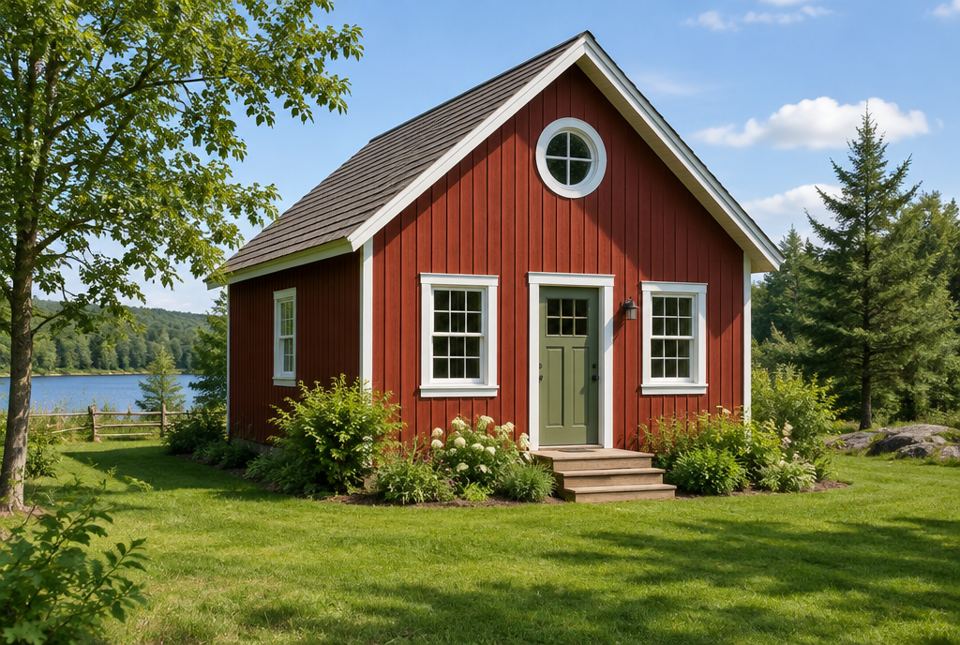 This house has a triangle roof, a round window, and rectangle windows and door. How many shapes can you find? AI-generated image
Look closely at a block. The flat parts are called faces. Every face is a flat shape.
If you dip a block in paint and stamp it on paper, you can see the shape of the face!
Worked exampleLet's trace a face
Trace around the bottom of a cereal box. What shape do you get?
- Stand the box on a piece of paper.
- Hold it still and trace around the bottom with a crayon.
- Lift the box. Look at the shape you drew. Count the sides: 1, 2, 3, 4.
A rectangle. The bottom face of a cereal box is a rectangle.
Shape puzzles
We can put shapes together to make new shapes. We can also take shapes apart into smaller shapes.
Pattern blocks are great for shape puzzles. A hexagon can be made in different ways: with 2 trapezoids, with 3 rhombuses, or with 6 triangles.
Worked exampleLet's cut a sandwich
Cut a square sandwich from corner to corner. What shapes do you get?
- Start with a square sandwich (or a square of paper).
- Cut from one corner straight across to the opposite corner.
- Look at each piece. Count the sides: 3 sides each.
You get 2 triangles. Push them back together and you have the square again!
Matching halves
Some things have two halves that match. If you fold them down the middle, one half lands right on top of the other half.
A butterfly's wings match. Your face is almost the same on both sides!
Hands-on activityBuilder's challenge and paint butterfly
Build: Use blocks or clean recycling (boxes, cans, tubes) to build a tower or a house. Then name the 3D figures you used: "I used a box, a can and a cone."
Paint butterfly:
- Fold a paper in half and open it.
- Put a few blobs of paint on one side only.
- Fold it closed and press gently.
- Open it. Both halves match!
Talk about it: "How do you know the halves match?"
Just for funWhat did one half of the sandwich say to the other half?
"Together, we make a perfect match!" 🥪
Your turn
1Trace the bottom of a soup can. What shape do you get?
2Stamp one face of a cube block in paint. What shape is the print?
3Cut a square of paper from corner to corner. What 2 shapes do you get?
4Put 2 same-size squares side by side. What shape do they make?
5Look at the hexagon pictures. How many trapezoids make the hexagon? How many triangles?
2 trapezoids, or 6 triangles. Count the pieces in each hexagon.
6🦋
Does a butterfly have matching halves?
Yes. The wings on one side match the wings on the other side.
7Build a tower with 3 different blocks or boxes. Name the figures you used.
Answers will vary. Example: "A box on the bottom, a cube in the middle, a cylinder on top." Look for: correct names and a tower that stands.
More practice: warm-up
1Which has matching halves: ❤️ or 🐌?
❤️ The heart. Its left and right sides match.
2What shape is the bottom face of a cereal box?
3Does a ball (sphere) have a flat face to stamp?
No. A sphere is round all over.
4Fold a square of paper in half, edge to edge. Do the halves match?
Yes. Both halves are the same size and shape.
5Name a block that is good for stacking.
Answers will vary. Examples: a cube, a rectangular prism (box), a cylinder standing up.
More practice: on your own
1What shape is the flat bottom of a cone?
A circle. Stand an ice cream cone upside down and trace it.
2Cut a square of paper in half, straight across from one side to the other. What 2 shapes do you get?
2 rectangles. Each piece has 4 sides: 2 long and 2 short.
3Which letter has matching halves when you fold it down the middle: A or F?
A. The left side of A matches the right side. F does not match.
4Draw half of a house. Ask a grown-up to draw the matching half.
Look for: the two halves are the same size and shape, like a mirror. The roof should meet in the middle.
5How can 4 small triangles make 1 big triangle?
Use 4 triangles that are all the same. Put 2 pointing up side by side on the bottom and 1 pointing up on top. Then fit the 4th triangle upside down in the gap in the middle. Look for: no gaps and no overlaps.
Challenge
1How many same-size squares do you need to make one bigger square?
4 squares. Put 2 on the bottom and 2 on top.
2A tower has a box on the bottom, a can in the middle and an ice cream cone shape on top. Name each 3D figure.
Rectangular prism (box), cylinder (can), cone.
3Build a rocket or a house with matching halves using blocks or paper shapes. How can you check?
Answers will vary. Check by laying a string or ruler down the middle: each shape on one side should have a matching shape in the same spot on the other side.
Quiz
1. Trace the bottom of a can. What shape do you get?
2. Put 2 triangles together like a sandwich cut corner to corner. What can they make?
3. Which one has matching halves?
4. Stamp a cube in paint. What shape will the print be?
5. How many trapezoids put together make a hexagon?
What this is about: Children build with 3D figures and find the 2D shapes on their faces. They put shapes together and take them apart (composing and decomposing), and they explore matching halves (symmetry).
How to help at home:
- Build with blocks, boxes and cans from the recycling. Ask your child to name the figures.
- Stamp or trace faces of objects to see the flat shapes.
- Cut sandwiches, toast or paper into shapes and put them back together. If you have pattern blocks (or paper cut-outs of them), make hexagons in different ways.
- Look for matching halves in nature (leaves, butterflies) and in letters.
Common difficulties:
- Mixing up the 3D figure and its face (calling a cube a "square"). Say: "The cube is the block. Its faces are squares."
- Matching halves need the same size and shape in the same spot. Folding paper is the best way to check.