A. Dance / C. Music · Music and DanceMusic: The Blues Scale and Improvising on the 12-Bar Blues
C1.3 C1.5 C1.2 C1.1 C3.2About 45 minutes
Learning goals- I can notate and play or sing the blues scale on C, and build it on other notes using its half-step pattern.
- I can improvise short phrases over the 12-bar blues using the blues scale, call and response and riffs.
- I can perform swing rhythm and write a blues verse in AAB form.
- I can describe how the blues came from African American communities and influenced many later styles.
Words to know
blues scale
A six-note scale (plus the octave) used in blues, jazz and rock. On C: C E♭ F F♯ G B♭ C.
blue note
A note that is bent or flattened for an expressive, bluesy sound, such as E♭, F♯ (G♭) or B♭ in C blues.
improvise
To make up music on the spot, often within a structure like the 12-bar blues.
riff
A short, catchy musical pattern that repeats.
swing
A way of playing pairs of eighth notes long-short, with a triplet feel.
AAB form (lyrics)
A blues verse where line 1 is sung, repeated, and then answered by a different line.
Remember from Grade 6
In Grade 6 you learned the 12-bar blues chord progression: I I I I | IV IV I I | V IV I I, and that the blues came from African American musicians in the southern United States. You also learned triplets.
This year you'll add the blues scale and use it to improvise over the 12-bar blues.
The blues scale
The blues scale on C has six different notes: C, E♭, F, F♯, G, B♭, then C again at the top.
Its half-step pattern is: 3, 2, 1, 1, 3, 2. Because it is a pattern, you can start it on any note:
- C blues: C E♭ F F♯ G B♭ C
- G blues: G B♭ C C♯ D F G
- A blues: A C D D♯ E G A
The blue notes (like E♭, F♯ and B♭ in C blues) clash a little against the major chords underneath. That rub is what gives the blues its expressive, crying sound. Singers and guitarists often bend these notes slightly.
Swing
In a lot of blues and jazz, pairs of eighth notes are not played evenly. They swing: the first note is longer, the second is shorter, like a triplet where the first two notes are joined: doo-ba, doo-ba. You learned triplets in Grade 6; swing borrows that long-short feeling.
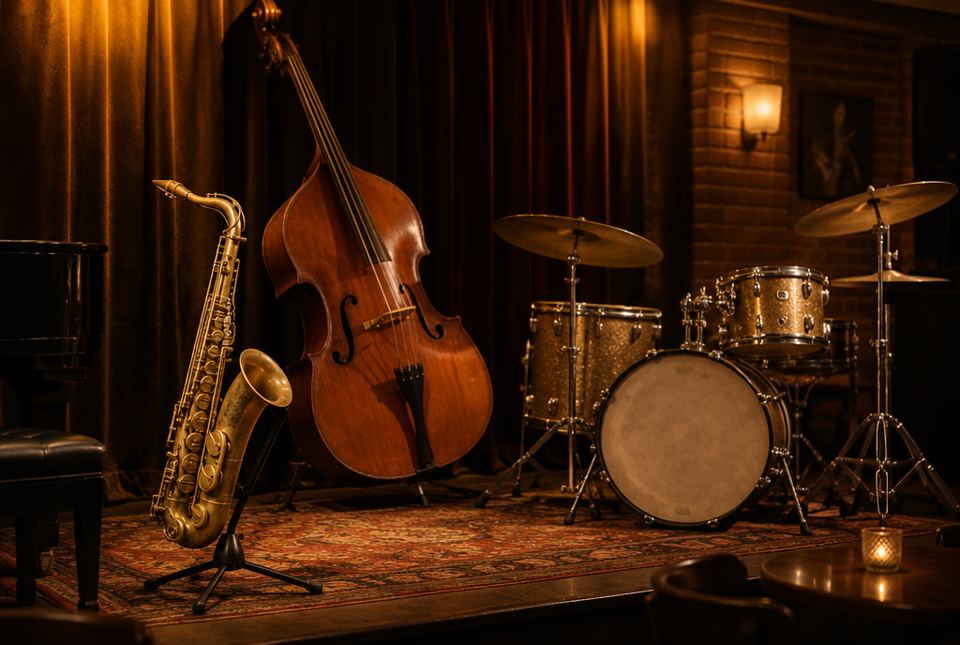 Saxophone, bass and drums are a classic blues and jazz combo. Players take turns improvising solos over the 12-bar blues. AI-generated imageA two-bar riff in 4/4 using the C blues scale. Bar 1: C, E flat, F and F sharp as two eighth notes, G. Bar 2: B flat and G as two eighth notes, F, then C as a half note. Each bar adds up to 4 beats.
How to improvise
Improvising means making up music on the spot, but not randomly: you work inside a structure. Over the 12-bar blues in C, almost any note of the C blues scale will fit.
- Start small: use just 2 or 3 notes (try C, E♭ and G).
- Use rests. Space makes your ideas easier to hear.
- Repeat a riff, then change it a little each time (sound familiar? theme and variations!).
- Call and response: play a short idea (the call), then answer it.
- Land on home: ending a phrase on C sounds finished.
Blues lyrics: AAB form
Many blues verses follow an AAB pattern over 12 bars: line A (4 bars), line A repeated (4 bars), then an answering line B (4 bars).
Where the blues came from
The blues developed in African American communities in the southern United States in the late 1800s and early 1900s, growing from work songs, field hollers and spirituals. It became the foundation for jazz, rhythm and blues, rock and roll and much of today's popular music.
Worked exampleExample: Let's build a blues scale on a new note
Build the D blues scale using the pattern 3, 2, 1, 1, 3, 2.
- Start on D.
- Up 3 half steps: D♯, E, F.
- Up 2: F♯, G. Up 1: G♯. Up 1: A.
- Up 3: A♯, B, C. Up 2: C♯, D. We're back to D, so it works.
- Check: six different notes, then the octave.
D blues scale: D F G G♯ A C D.
Worked exampleExample: Let's write a blues verse and plan a solo
Write an AAB blues verse about a Canadian winter, and plan how to fill the gaps between sung lines.
- A: Woke up this morning, snow piled up to my door.
- A (repeat): Woke up this morning, snow piled up to my door.
- B (answer, rhymes with A): Grabbed my shovel and mitts, can't see the street no more.
- Each line takes about 2 bars to sing and leaves 2 bars of space. Fill that space with an improvised response on the C blues scale, like the riff in the picture.
- Over the last 4 bars, the chords go V IV I I (G F C C), so end your last response on C.
An AAB verse with sung calls and instrumental responses fits perfectly into the 12-bar blues.
Just for funHow many blues musicians does it take to change a light bulb?
Two. One changes it, and the other sings, “Woke up this morning, my light bulb was burnt out...” twice, because it’s AAB form. 💡
Hands-on activityKitchen blues jam
You need: a keyboard, keyboard app, xylophone or other instrument if you have one (or your voice), a pot and spoon for the beat, and a family member.
- Your partner keeps a steady swing beat on the pot while counting the 12 bars: C C C C | F F C C | G F C C. If you have a keyboard, they can play the chord roots instead.
- Play or sing the C blues scale up and down until it feels easy.
- Take turns improvising: one plays a 2-bar call, the other answers with a 2-bar response.
- Write your own AAB verse about something in your life (a snow day, a lost mitten, a long bus ride). Sing it over the 12 bars, filling the gaps with improvised riffs.
- Record your jam if you can, and listen back: which phrase sounded best? Why?
Your turn
2What is the half-step pattern of the blues scale?
3Name the blue notes in C blues.
4What does it mean to improvise?
To make up music on the spot, usually within a structure.
5Write the chords of the 12-bar blues in C.
C C C C | F F C C | G F C C.
6What is AAB form in blues lyrics?
Line A, line A repeated, then an answering line B.
7Clap two pairs of swung eighth notes.
Look for a long-short, long-short feel (doo-ba doo-ba), not even notes.
More practice: warm-up
1How many different notes are in a blues scale (not counting the top octave)?
A short, catchy pattern that repeats.
3In swing, which eighth note of a pair is longer?
4Which note sounds most finished at the end of a C blues phrase?
5Name one style the blues influenced.
Any one: jazz, rhythm and blues, rock and roll, pop.
More practice: on your own
1Build the G blues scale. Show the half steps.
G →3→ B♭ →2→ C →1→ C♯ →1→ D →3→ F →2→ G. G B♭ C C♯ D F G.
2Check that this bar fits 4/4: eighth, eighth, quarter, quarter, quarter.
½ + ½ + 1 + 1 + 1 = 4 beats. Yes.
3Why are rests helpful when improvising?
They create space, so ideas are easier to hear, give you time to think, and make room for a response.
4Write the B line for this AAB verse: My dog ran off this morning, chasing every squirrel in sight (repeated).
Example: He came home muddy at supper, now he's sleeping on my bed tonight. Any line that answers and roughly rhymes is correct.
5Where did the blues develop, and from which kinds of music?
In African American communities in the southern United States, from work songs, field hollers and spirituals.
Challenge
E →3→ G →2→ A →1→ A♯ →1→ B →3→ D →2→ E. E G A A♯ B D E.
2Write a 2-bar riff in 4/4 using the C blues scale, with at least one pair of eighth notes, and show that each bar adds up.
Example: bar 1: C (quarter), E♭ (quarter), F F♯ (two eighths), G (quarter) = 1 + 1 + ½ + ½ + 1 = 4. Bar 2: B♭ (half), G (quarter), C (quarter) = 2 + 1 + 1 = 4. Any riff using only blues-scale notes with correct bar totals is correct.
3Explain how the blues is an example of a cultural influence on later music.
The blues came from African American musical traditions (work songs, spirituals, call and response). Its 12-bar form, blue notes and call and response were taken up in jazz, R&B and rock and roll, so one community's music shaped styles heard around the world.
Quiz
1. The C blues scale is ___.
2. The blues scale's half-step pattern is ___.
3. Making up music on the spot is called ___.
4. In swing rhythm, pairs of eighth notes are played ___.
5. In an AAB blues verse, the B line ___.
6. The blues developed in ___.
Big idea: Grade 7 pitch and form include the blues scale and the 12-bar blues. Students notate and perform scales, including the blues scale (C1.5), create compositions and improvisations (C1.3), apply the elements for effect (C1.2), perform (C1.1), and look at cultural influences on style and genre (C3.2).
How to help at home:
- Be the rhythm section: tap a steady beat and count the 12 bars while your child improvises.
- Praise risk-taking. In improvising there are few wrong notes, only choices.
- Listen to some blues and early jazz together and clap along to the swing.
Common difficulties:
- Playing too many notes at once. Suggest starting with three notes and lots of rests.
- Losing their place in the 12 bars. Count out loud or point to a written chart.
- Swinging unevenly or not at all. Say doo-ba doo-ba while playing.